Remember Passover (Deuteronomy 16:1-8)

Exodus, by Yoram Raanan

Observe the month of Aviv and celebrate the Passover of the Lord your God, because in the month of Aviv he brought you out of Egypt by night. Sacrifice as the Passover to the Lord your God an animal from your flock or herd at the place the Lord will choose as a dwelling for his Name. Do not eat it with bread made with yeast, but for seven days eat unleavened bread, the bread of affliction, because you left Egypt in haste—so that all the days of your life you may remember the time of your departure from Egypt. Let no yeast be found in your possession in all your land for seven days. Do not let any of the meat you sacrifice on the evening of the first day remain until morning.

You must not sacrifice the Passover in any town the Lord your God gives you except in the place he will choose as a dwelling for his Name. There you must sacrifice the Passover in the evening, when the sun goes down, on the anniversary of your departure from Egypt. Roast it and eat it at the place the Lord your God will choose. Then in the morning return to your tents. For six days eat unleavened bread and on the seventh day hold an assembly to the Lord your God and do no work. (New International Version)

The first five books of the Old Testament are known by Christians as the Pentateuch. These same books are the Torah in Judaism. Deuteronomy is the fifth and final book; it is a restatement of God’s Law for the Israelites about to enter the Promised Land.

Several prominent theological themes are highlighted in the book of Deuteronomy. It vigorously advocates for exclusive loyalty to the monotheistic God, Yahweh. Yahweh is characterized as a transcendent Being, full of steadfast love and transformative justice.

Deuteronomy places significant emphasis upon the covenant relationship between God and Israel. The covenant was established with the patriarchs – Abraham, Isaac, and Jacob – and affirmed at Mount Sinai after the exodus from Egypt, at the giving of the Law. This Law was graciously provided by God for the people; it is encapsulated in the Ten Commandments, and is to be reaffirmed as soon as Israel enters the land.
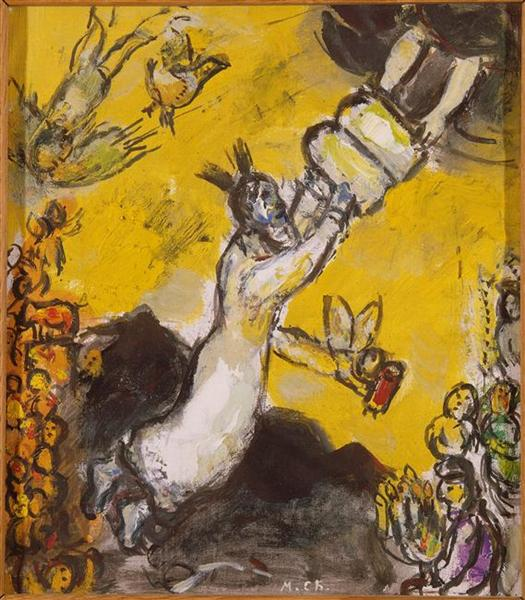
Moses receiving the Tablets of Law, by Marc Chagall, 1963

Therefore, the entire book of Deuteronomy looks forward toward a new existence in the Promised Land. This new society is to pursue justice and be devoted to righteousness. All Israel is to live in harmony with God and one another, enjoying the land and the covenant relationship.

The welfare of Israel depends upon upholding and maintaining the social and religious laws given by Yahweh. God’s commands are a divine gift, and if closely followed, will be the best humanitarian way of caring for the poor and disadvantaged, as well as bringing the people close to Yahweh.

The sacrificial system will revolve around a singular sanctuary in the religious capital. By locating sacrifices in a particular place, this has the effect of Jewish faith not becoming dependent on offerings, but instead on mercy, love, learning the law, and rituals that uphold reverence for God.

Perhaps the greatest of all the rituals is Passover. Israel’s experience of deliverance at the Red Sea and the centralization of worship in Jerusalem is remembered and celebrated at the festival of Passover every year.

In the original Passover, at the time of the exodus, the blood of a sacrificed lamb was smeared on the doorposts of each Jewish home. In doing this, it let the angel of death know to “pass over” that house, thereby only entering Egyptian homes that did not revere nor recognize God. This act was also the final miraculous act of ten plagues leveled on Egypt.

And There Was a Great Cry in Egypt, by Arthur Hacker, 1897

As the households of Egypt were grieving their dead, Israel was urged by the Egyptians to get out. Egypt feared what would happen if the Israelites remained. Therefore, Israel left post haste. They didn’t have any time for their bread to rise. The people ate unleavened bread so they could immediately leave Egypt.

So, from then on, every year in early Spring, Israel commemorates and remembers God’s deliverance of the people from slavery. God, through Moses, instructed the Israelites to mark Aviv as the first month; it is then that the Passover festival is to occur.

I believe that what we can takeaway from this Scripture, is that perhaps, we ought to stop trying to always have takeaways for everything – as if the Bible can be boiled down to some neat personal application for my life.

Aside from admitting I’ve had a bit of a cynical streak lately, we really must contend with seasons like Passover and Lent, and matters such as social justice and religious worship. These religious seasons are important enough to warrant what the late Eugene Peterson called “a long obedience in the same direction.”

By that phrase, Peterson meant that there are some spiritual practices that we must commit ourselves to year after year, even day after day, for the rest of our lives. Generations before did, and generations after us will need to, as well.

Spiritual growth and maturity take time; and we must patiently and consistently cultivate a sense of justice and a practice of righteousness over and over again.

Passover Seder, by Melita Kraus

One must fight for what they believe, each and every day. Spiritual growth takes a lot of time, grit, tenacity, and resilience. It requires patience and grace, perseverance and a good nature. And it is very much a skill which demands daily practice.

Contemporary society is obsessed with quick fixes and easy solutions. But the time-tested practices of Lent, rooted in the remembrances of Passover, are a Christian discipleship that is long on obedience in the same well-worn ancient directions.

We need to keep moving in the directions of deepening a life of prayer, learning the joy of service, growing in the worship of God, and discovering the virtues of humility and a concern for the welfare of everyone in the community.

In other words, to truly observe something, we need to do it, over and over, year after year. In observing the significant events and dates and seasons of the Christian Year, we can find the sort of spiritual support that will fortify our soul, and bless others.

Almighty and everlasting God, you hate nothing you have made and forgive the sins of all who are penitent: Create and make within us new and contrite hearts, so that we may acknowledge our guilt and lament our shame. Let us obtain from you, O merciful God, reconciliation through the Cross, and empowerment through the Spirit, to do justice, love mercy, and walk humbly with you. Amen.

Trust vs. Anxiety (Isaiah 30:15-18)

The holy Lord God of Israel
    had told all of you,
“I will keep you safe
if you turn back to me
    and calm down.
I will make you strong
    if you quietly trust me.”

Then you stubbornly said,
“No! We will safely escape
    on speedy horses.”

But those who chase you
    will be even faster.
As few as five of them,
or even one, will be enough
    to chase a thousand of you.
Finally, all that will be left
    will be a few survivors
as lonely as a flag pole
    on a barren hill.

The Lord God is waiting
to show how kind he is
    and to have pity on you.
The Lord always does right;
he blesses those who trust him. (Contemporary English Version)

God’s plan for our lives calls for times of retreat and renewal, of quiet patience and perseverance, for restraint and waiting.

Ancient Judah was experiencing one of their many periods of rebellion toward God’s commands. One of the things that happens – whether in ancient times or today – is that whenever we go off the road of God’s ways, our lives become characterized by a grand self-help program.

Those in the Judean royal court could not wait on God. They had to do something about Assyria. The Assyrian Empire was waning, and Judah wanted to take advantage of it, seeing an opportunity for some relative autonomy.

So, many of the activists in the royal court rushed to Egypt for help – not at all considering to turn toward God and wait on the Lord. God blesses those who trust and wait on divine promises and initiative. But, in their anxiety, the people of Judah would not exercise faith and patience.

As a result, the enemy would overtake them. The people’s refusal to take the quiet course would not end well for them.

On many days, as I attend to the hospitals for which I work, I visit many hurting people, including patients, their families, and teammates. In my time there, I deal with a vast array of emotional problems, spiritual struggles, and mental disorders. One of things I have discovered through this work is that people’s internal issues absolutely need to be expressed, out loud, to someone who cares and knows what to do with those expressions.

And this is not only a modern problem; the need to deal with our internal stuff has been there throughout all of human history. Every culture and society who does not attend well to personal and communal spiritual health is literally killing their bodies – because body and soul are inextricably connected in a union as one.

It continually amazes me that people who think nothing of going to a medical doctor, an emergency room, or having a surgery, would never think of getting help when their minds are mixed up, emotions are frayed, and spirits are downcast.

Stubbornly holding onto self-help to handle a spiritual crisis, refusing help from others, and ignoring God, is just as sure to kill you as believing that chest pains, shortness of breath, and inability to walk across the room will simply get better on its own.

Conversely, isolating oneself and calling it “waiting on God” and remaining passive – when the Lord has clearly told us to be active – will accomplish the same ends as the committed self-help person. Faith and action are not mutually exclusive terms. It takes some wisdom to know when to retreat, pray, and be patient; and when to take initiatives of faith, and trust God to work through action.

Rebellion gets us nowhere. It’s what puts us in the awkwardness of making bad decisions and discernments. The Lord had told the people of Judah to stay put and not rely on Egypt to help them. There were clear instructions through the prophets about what to do. But the people were too anxious, too impatient, wondering too much about whether God would show up or not.

The Spirit God gave us does not make us afraid. His Spirit is a source of power and love and self-control.

2 Timothy 1:7, ERV

No matter where we have been or what we have done, the Lord is continually waiting on us – and will consistently respond with grace and mercy to our petitions and overtures to live for God. It’s never too late to flee to God in quiet trust.

Running to God is not escaping our problems. Rather, the Lord enables us to face both our outward situations, as well as our inward thinking and feeling. It’s easy to engage in busywork and keep active when we are anxious; yet it is very difficult to sit still before God and be alone. Silence and solitude put us face to face with ourselves. And doing that is what many people would rather avoid.

“I’ll do it myself!” is the cry of many a person who is mentally, emotionally, and spiritually overwhelmed. That approach, however, is a highway to the grave. And, in fact, it is a stubborn rebellion that puts a stiff arm to God.

I’m not saying that opening-up is easy; I am stating that it is necessary to our spiritual and emotional health. It might be helpful to begin communicating with some vulnerability and authenticity to God. The following are some appropriate ways that might help:

  1. Be congruent between the outer self and inner self. Make sure your outside affect and behavior is congruent with your inside feelings and thoughts. If you are discouraged on the inside, but wear a smile and pretend to be spiritually with it, you’re not fooling God. You cannot receive grace apart from humble authenticity.
  2. Focus on feelings. You won’t get struck by lightning if you express your anger, or other emotions, to God. Be aware of how you are feeling. In fact, ask the Lord to help you understand your feelings. Share them openly as much as you can.
  3. Change questions into statements. Sometimes, when we have an attitude or a feeling, we’re afraid to say it and be open. So instead, we ask a question. Try changing questions such as “Do you love me?” into “I love you.” And, “Do you want me to do this?” to “I want to do your will.”
  4. Speak in the first person. Begin sentences with “I” instead of “you,” For example, ” I am happy that you are with me,” instead of asking, “Are you there?”
  5. Say out loud what you really want and need. It’s okay to do that. This is when it is appropriate to ask questions. The Lord’s ear is ready to listen.

Patient and confident trust in God is always a better option than anxious and nervous striving by yourself.

O God, the source of all health: So fill my heart with faith in your love, that with calm expectancy I may make room for your power to possess me, and gracefully accept your healing; through Jesus Christ our Lord. Amen.

Impatient (Genesis 16:1-6)

Sarai and Hagar, by Cody F. Miller

Now Sarai, Abram’s wife, had borne him no children. But she had an Egyptian slave named Hagar; so she said to Abram, “The Lord has kept me from having children. Go, sleep with my slave; perhaps I can build a family through her.”

Abram agreed to what Sarai said. So after Abram had been living in Canaan ten years, Sarai his wife took her Egyptian slave Hagar and gave her to her husband to be his wife. He slept with Hagar, and she conceived.

When she knew she was pregnant, she began to despise her mistress. Then Sarai said to Abram, “You are responsible for the wrong I am suffering. I put my slave in your arms, and now that she knows she is pregnant, she despises me. May the Lord judge between you and me.”

“Your slave is in your hands,” Abram said. “Do with her whatever you think best.” Then Sarai mistreated Hagar; so she fled from her. (New International Version)

In a convoluted series of decisions, mostly outside of her control, Hagar became pregnant with Abraham’s son. Although it may seem strange to us today, the practice of building a family line through a surrogate – in this case the slave of the household’s mistress Sarai – was not an unusual way of handling infertility in the ancient world.

Yet, things went awry with that approach. God had promised that a son of Abram’s own flesh and blood would inherit the divine covenant. But it wasn’t happening quickly enough for his wife Sarai. And this impatience led to the worldly approach of trying to gain an heir.

Impatience

Throughout Holy Scripture, patience is a virtue, as well as a spiritual practice to be cultivated. Impatience is the ants-in-your-pants response of wanting something now, without all the fuss and effort of planting and cultivating. The inability to wait is the desire for an instant harvest of righteousness.

The spiritual life of patience, however, like every other virtue, requires progressive growth over a long period of time. That is the only way of attaining any sort of spiritual maturity in this life. To go with shortcuts, or ingenious plans for quickness and efficiency, will not end well.

And it only short circuits the spiritual growth and formation of the believer. Like a farm-factory-raised animal who has been given growth hormones to speed things along, the fallout is the mistreatment of creatures – both animal and human – in shortened lifespans and poor quality of life.

Perhaps the original ancestor of Sarai, Eve, also had a bit of impatience in wanting to gain wisdom, now, from the tree of the knowledge of good and evil. And maybe the original ancestor of Abram, Adam, was okay with letting Eve follow through with an impatient plan.

It could be that both Adam and Abram just wanted to keep their spouses happy; and so, they let them do whatever the heck they wanted in order to keep the peace. It certainly wouldn’t be the only time this ever happened in history.

A commitment to submitting to the process of developing patience is a must – otherwise, the believer will give up and retreat into half-baked ideas for getting what they want, without all the hard work. We also need to realize that patience itself is a great reward, and worth all the energy it takes to possess it.

Be patient, then, brothers and sisters, until the Lord’s coming. See how the farmer waits for the land to yield its valuable crop, patiently waiting for the autumn and spring rains. You too, be patient and stand firm, because the Lord’s coming is near.

James 5:7-8, NIV

What’s more, the effects of impatience are murmuring and complaining to God and others, leading to depression and anxiety. That’s what happened to the ancient Israelites in the desert when it was taking too long to get to the Promised Land:

They traveled from Mount Hor along the route to the Red Sea, to go around Edom. But the people grew impatient on the way; they spoke against God and against Moses, and said, “Why have you brought us up out of Egypt to die in the wilderness? There is no bread! There is no water! And we detest this miserable food!” (Numbers 21:4-5, NIV)

Worldliness

If we give the attainment of patience it’s due attention, then a lot of ungodly worldliness can be avoided. In Holy Scripture, “the world” is many times used not as a reference to the people of the earth, but as an inordinate interest in, concern with, or devotion to the systems, organizations, and institutions of this world that operate by unjust means.

Do not love the world or anything in the world. If anyone loves the world, love for the Father is not in them. For everything in the world—the lust of the flesh, the lust of the eyes, and the pride of life—comes not from the Father but from the world. The world and its desires pass away, but whoever does the will of God lives forever. (1 John 2:15-17, NIV)

Worldliness, then, is an obstacle to that which is good, right, and just; it is in opposition to and independence from God. In short, worldliness isn’t some sort of sophisticated intelligence, but is a way to get what we want apart from virtue and godliness. But God’s grace can be our teacher to a better way of life:

For the grace of God has appeared that offers salvation to all people. It teaches us to say “No” to ungodliness and worldly passions, and to live self-controlled, upright and godly lives in this present age, while we wait for the blessed hope—the appearing of the glory of our great God and Savior, Jesus Christ.

Titus 2:11-13, NIV

Conclusion

Patience is one of the hardest lessons in life to learn. Yet, a devotion to becoming skilled in the art of patience, and of forsaking the practice of impatience, can reap both existential and eternal rewards. And it will keep us from going down the path of worldly temptation; and delivered from the machinations of the evil one.

Perhaps with patience, Sarai could have avoided mistreating her servant; and maybe Abram could have stood up and held her accountable. Together, they would eventually embrace faith in it’s fullness and enjoy the blessing of a son from Sarai’s own womb. Yet, today’s Old Testament lesson would always serve as part of their history to learn from. And, thankfully, we can learn from it, as well.

Almighty God, support your people and grant us patience in all our circumstances and miseries.
Lord, when in the midst of trials and temptations, suffering and injustice, give us patience.
When wracked with pain, illness, and lack of sleep, give us patience.
When burdened with afflictions, wonderings, and loneliness, give us patience.
When overcome by fear, and all our spiritual energy is dried up, give us patience.
When distractions grab our attention, bring us back, and grant us patience, O Lord. Amen.

A View of Suffering (Job 36:1-23)

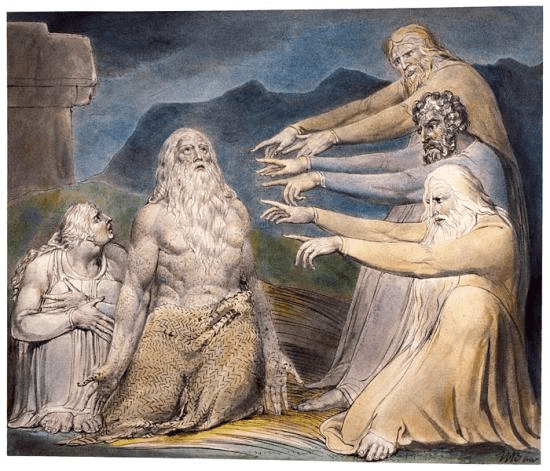
The Wrath of Elihu,” by William Blake (1757-1827)

Elihu continued:

“Bear with me a little longer and I will show you
    that there is more to be said in God’s behalf.
I get my knowledge from afar;
    I will ascribe justice to my Maker.
Be assured that my words are not false;
    one who has perfect knowledge is with you.

“God is mighty, but despises no one;
    he is mighty, and firm in his purpose.
He does not keep the wicked alive
    but gives the afflicted their rights.
He does not take his eyes off the righteous;
    he enthrones them with kings
    and exalts them forever.
But if people are bound in chains,
    held fast by cords of affliction,
he tells them what they have done—
    that they have sinned arrogantly.
He makes them listen to correction
    and commands them to repent of their evil.
If they obey and serve him,
    they will spend the rest of their days in prosperity
    and their years in contentment.
But if they do not listen,
    they will perish by the sword

    and die without knowledge.

“The godless in heart harbor resentment;
    even when he fetters them, they do not cry for help.
They die in their youth,
    among male prostitutes of the shrines.
But those who suffer he delivers in their suffering;
    he speaks to them in their affliction.

“He is wooing you from the jaws of distress
    to a spacious place free from restriction,
    to the comfort of your table laden with choice food.
But now you are laden with the judgment due the wicked;
    judgment and justice have taken hold of you.
Be careful that no one entices you by riches;
    do not let a large bribe turn you aside.
Would your wealth or even all your mighty efforts
    sustain you so you would not be in distress?
Do not long for the night,
    to drag people away from their homes.
Beware of turning to evil,
    which you seem to prefer to affliction.

“God is exalted in his power.
    Who is a teacher like him?
Who has prescribed his ways for him,
    or said to him, ‘You have done wrong’? (New International Version)

Job’s “friends” scorn him, painting by William Blake

I’m just going to go ahead and say it: Elihu was a jerk. His worldview wasn’t big enough to accommodate for Job’s awful suffering as anything but a chastisement from God.

Elihu embodied the proud person, full of himself, believing that he knows how the world works. But, in reality, he knows jack squat. The best thing Elihu did in the book of Job was to keep his mouth shut. The silence was actually helpful.

After Job lost everything and everyone dear to him (except his wife) he was understandably in tremendous grief. His lament needed to be heard – not responded to with the rebuttal of an ignoramus. Unfortunately, Elihu didn’t keep his mouth closed. He seems like a mere windbag, speaking a lot of words and saying nothing.

To be fair, Elihu gets a lot of information right; it’s just that his reasoning is narrow and misguided. He rightly affirms that God has incomparable power, and is the One who is able to punish the wicked and grant justice to the oppressed.

Yet, Elihu assumes – in his apparent black-and-white world – that anyone afflicted with such terrible events as Job is under the correction of God. The Lord is disciplining the person and teaching them a lesson about the error of their ways, he reasons.

That sort of logic betrays a very contractual sort of relationship with God – as if the Lord is only the high and transcendent plantation boss who singularly serves to maintain discipline and fealty amongst the ranks of inferiors. Elihu ignored the immanence of God in coming close to the brokenhearted and providing release for those in captivity.

In such a bifurcated world of a high God and low humanity, there are really only two choices whenever someone is in a situation like Job: either turn from your erroneous ways and serve God; or don’t, and die under the punishment of God.

But the book of Job challenges us on that kind of thinking and belief. The hard circumstances of people cannot neatly be categorized into the need for repentance – nor can a life of ease and wealth be considered a mark of divine favor.

Elihu was leaning toward viewing Job as a rebellious man who needed to admit his sin and submit to God. Yet, Job (and God!) knew better than this. And that is perhaps one of the most difficult aspects of horrible human suffering – that the sufferer must contend with persons who look at them askance as if they have done some egregious sin which offended God.

We know, as readers of the biblical book, that there was no wickedness or sin involved in Job’s suffering. Instead, there were unseen forces behind the scenes causing that suffering. In fact, just the opposite was at work: Job was suffering because of his incredible righteousness, and not by any wrongdoing on his part.

Most situations are complex and defy simple explanations or solutions. It is foolish to make assumptions based upon circumstantial evidence. Wanting quick and easy answers to the problems we face as humans is the path of simpletons.

In contrast to nice and neat mental categories, there are loving believers who are devoted to faith and patience, knowing that there can be more going on than what it seems on the surface. Listening and understanding is the path to wisdom, whereas entrenched opinions – offered as certainty of belief – is a way of dying in ignorance.

“Life’s but a walking shadow; a poor player, that struts and frets his hour upon the stage, and then is heard no more: it is a tale told by an idiot, full of sound and fury, signifying nothing.”

William Shakespeare, Macbeth

If we keep a focus on being helpful to the other, then we are less likely to offer unhelpful, even harmful, words. Knowing that life is much bigger than we can realize, is one good step toward that end.

O Lord our heavenly Father, whose blessed Son came not to be served, but to serve: We ask you to bless all who, following in his steps, give themselves to the service of others; endue them with wisdom, patience, and courage, that they may strengthen the weak and raise up those who fall, and, being inspired by your love, may worthily minister to the suffering, the friendless, and the needy, for the sake of him who laid down his life for us, your Son our Savior Jesus Christ. Amen.