
A Sad Family Situation (2 Samuel 14:25-33)

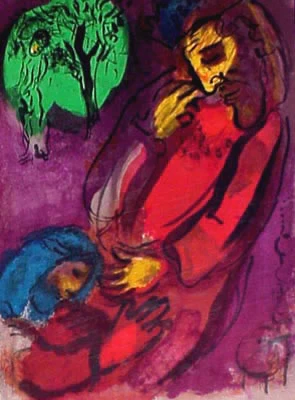
David and Absalom, by Marc Chagall, 1956

In all Israel there was not a man so highly praised for his handsome appearance as Absalom. From the top of his head to the sole of his foot there was no blemish in him. Whenever he cut the hair of his head—he used to cut his hair once a year because it became too heavy for him—he would weigh it, and its weight was two hundred shekels by the royal standard.

Three sons and a daughter were born to Absalom. His daughter’s name was Tamar, and she became a beautiful woman.

Absalom lived two years in Jerusalem without seeing the king’s face. Then Absalom sent for Joab in order to send him to the king, but Joab refused to come to him. So he sent a second time, but he refused to come. Then he said to his servants, “Look, Joab’s field is next to mine, and he has barley there. Go and set it on fire.” So Absalom’s servants set the field on fire.

Then Joab did go to Absalom’s house, and he said to him, “Why have your servants set my field on fire?”

Absalom said to Joab, “Look, I sent word to you and said, ‘Come here so I can send you to the king to ask, “Why have I come from Geshur? It would be better for me if I were still there!”’ Now then, I want to see the king’s face, and if I am guilty of anything, let him put me to death.”

So Joab went to the king and told him this. Then the king summoned Absalom, and he came in and bowed down with his face to the ground before the king. And the king kissed Absalom. (New International Version)

Parents are people, and so, they don’t always make sense. David was both a king and a parent. And those two roles often got mixed and complicated for him.

David’s son Abasalom had killed another son, Amnon, who had sexually assaulted a daughter, Tamar, Abasalom’s sister. Yes, it sounds a lot like a Bible soap opera.

Joab, David’s military general (and cousin) convinces the king to bring Absalom back to Jerusalem, having fled Jerusalem after killing Amnon. And David did so. Yet, he gave an order that Absalom was not to come into his presence, even though David longed for his son.

It was a case of the nonsensical – the parental approach of yearning for an adult child, while at the same time, shunning and shaming them. Indeed, these were incongruent actions on the part of David.

When Tamar was assaulted, David found out and was very angry; yet he neither dealt with Tamar by giving her support and compassion, nor dealt with Amnon in meting out justice.

As for Absalom, David’s feelings for him did not translate into action. It appears the story wants us to see the wide gap between King David’s emotions and actions.

Perhaps the emphasis on Absalom’s sheer beauty is designed to emphasize the incongruence of David – this handsome man is put at arm’s length by his father. Furthermore, this behavior would eventually put David’s royal position in jeopardy.

When guilt and shame are not confronted, it leads to a downward spiral into continued levels of degradation.

The assault of Tamar led to the murder of Amnon, which led to the inactions of David. Everyone ended up responding to someone else’s guilt by adding their own guilt to it. In this scenario, everyone loses something, and there is a lot of unnecessary grief.

Abasalom returned to his hometown of Jerusalem. But everything had changed. He was simply existing. Honestly, Absalom needed something, anything, instead of living day after day in a house without any love or acceptance. Absalom was in that awkward place of wanting either mercy or judgment, acceptance or punishment, because to live in limbo was shrinking him to nothing.

For those who know the story of David and Absalom, you understand where all of this family dysfunction is leading; and it will not end well.

It could be that Jesus had this story in the back of his head when he told the parable of the prodigal son (Luke 15). Perhaps Christ wanted us to see what could happen when a father chooses to respond with actions of grace, acceptance, and undeserved kindness. Even though the son had done something awful and was full of guilt, when he finally made his way home, the father ran to him, embraced him, and accepted him with a blowout party.

We can only wonder what would have happened had David stepped into the situations of his children’s lives when they were going awry. Methinks that had David done so, with his characteristic wisdom and mercy, there would have been a very different outcome in his family.

One way of viewing this story is that the incongruence of King David toward Absalom, with his combination of longing and rejection, was a stubborn passive-aggressive refusal to give his son the grace and love which God had given to him. In light of the story’s eventual end, this view makes a lot of sense.

Yet, this doesn’t have to be the same for you or me in our family relationships today. We can choose to love, instead of inflexibly holding on to a denial of love. One can do all the mental gymnastics of justifying that denial by believing you’re teaching the kid a lesson, or giving them what they deserve, but it’s really, at it’s core, choosing not to love with the love provided by God.

Réconciliation d’Absalom et de David, by Gabriel de Saint-Aubin, 1752

Absalom eventually entered David’s throne room and received a kiss. But it was simply too little, too late. And that’s why, at some point after this, Absalom decided to replace his emotionally and actively distant father as king.

If guilt, shame, evil, and sin go unchecked for too long, it makes for a terrible mess of people’s lives; and usually results in either verbal violence, physical violence, or both.

But it doesn’t have to be that way….

For being quick to see the sins of others, and slow to repent of our own, forgive us, Lord.

For clinging to remembered hurts, and brushing off gestures of kindness, forgive us, Lord.

For the divisions among us that damage our mission to the world, forgive us, Lord.

For the work we have not done because we refused to do it together, forgive us, Lord.

For these and all our sins, O God, we weep in sorrow and ask for your forgiveness, through Jesus Christ our Lord. Amen.

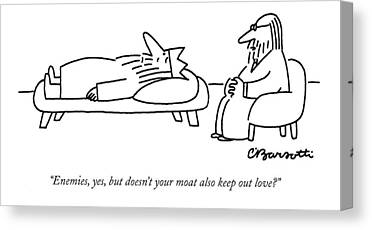
Luke 6:27-31 – Love Your Enemies

“But to you who are listening I say: Love your enemies, do good to those who hate you, bless those who curse you, pray for those who mistreat you. If someone slaps you on one cheek, turn to them the other also. If someone takes your coat, do not withhold your shirt from them. Give to everyone who asks you, and if anyone takes what belongs to you, do not demand it back. Do to others as you would have them do to you.” NIV)

“Maturity is looking at every person we meet and saying to yourself, ‘I will never, God helping me, do anything to harm you: not by angrily lashing out at you, lusting over you, faithlessly slipping away from you, verbally hitting back at you, or even justifiably disliking you.’”

–Frederick Dale Bruner

Here are a few rhetorical questions, considering the astounding words from Jesus to love enemies: Have you ever had someone not like you?  Offend you? Purposely say or do things that upset you? I once had a next-door neighbor who was plain mean. Once, when my dog accidentally strayed into her yard and left a package, she picked it up and placed the package directly in front of my backdoor. 

When such things happen, it is tempting to respond in kind with the same behavior as the obnoxious person.  Many of us have sly passive aggressive tendencies of getting back at others when they do or say offensive things, and we consider them an enemy.

The situation with my neighbor was frustrating, yet quite benign. It is an entirely different matter trying to love someone who has deeply hurt us. Their words of malice or actions of abuse are evil, and we naturally seek to defend and respond by hurting them back. This is no trite saying of Jesus to proclaim that we are to love the enemy. It will be hard to love a villain apart from the grace of God, and Jesus knew what he was asking of us.  He does not ask of us anything that he himself has not already done.

We are often pleased with ourselves if we love our family and friends, because even that is a struggle for us, at times. We need to treat all people with respect and kindness, even active love, because that is what God does.

Jesus did not say anything new in calling for neighbor love. The Old Testament clearly says to do so: 

You must not take revenge nor hold a grudge against any of your people; instead, you must love your neighbor as yourself; I am the Lord. (Leviticus 19:18, CEB)

Nowhere in the Old Testament does it say to hate your enemy. However, over time, the idea became popular that if we are told to love our neighbor, then we must hate our enemy (who is not our neighbor). Jesus was once asked, “Who is my neighbor?” He responded by telling the parable of the Good Samaritan. The conclusion to that parable is that everyone I encounter is my neighbor, and so must be shown mercy when they are in need. (Luke 10:25-37)

Jesus let us know that when we walk in the way of love, we will sometimes be treated harshly by the world (Matthew 5:10-12).  When that happens, Christ says we must not exact revenge or retaliate. Even more, we are to respond with overt gestures of love, rather than simply ignoring them.

We are to pray for our enemies. It is hard to hate someone or a group of people when we are devoted to praying for them. Pray the Spirit would open their eyes so they can see the error of their way. Make sure to leave the judgment to God, for that is divine business, not ours.

We are to love because God loves. To love those who offend us emulates God’s benevolence. When we love our enemies, without expecting anything in return, we imitate God’s character as children of God:

Watch what God does, and then you do it, like children who learn proper behavior from their parents. Mostly what God does is love you. Keep company with him and learn a life of love. Observe how Christ loved us. His love was not cautious but extravagant. He did not love to get something from us but to give everything of himself to us. Love like that. (Ephesians 5:1-2, MSG)

If we have no love for our enemies, then we are no different from them. Christians are to be distinctive because of the way they treat others, especially outside the faith. We are to model our lives after God’s love, not by the standard of niceness to those who are nice to us. God does not expect us to live as followers of Jesus by only showing reciprocity, that is, just giving back to those who already have given something to us. Instead, we give even when we are persecuted. We do this because God shows no distinction in the distribution of sunshine and rain. Showing basic respect and goodness to all people, no matter who they are, can be God’s rain and sun toward others.

“To return evil for good is devilish. To return good for good is human. To return good for evil is divine. To love as God loves is moral perfection.” Alfred Plummer

Grace, undeserved kindness, is not something we can just conjure up, as if we might will ourselves to love our enemies. It is not natural – it is supernatural, and so must come from a supernatural Being. 

During World War II, a Lutheran pastor, imprisoned in a German concentration camp, was tortured by an S.S. officer who wanted to force him to a confession.  The pastor did not respond to the torture.  His silence only enraged the officer to such a degree that he hit the pastor harder and harder until he finally exploded and shouted at him, “don’t you know that I can kill you!?”  The pastor looked him the eye and said, “Yes, I know – do what you want – but I have already died.”  At that point, the officer lost power over the pastor.  All of the officer’s cruelty had been based on the idea that the pastor would hold onto his life as his most valuable property and would be willing to give a confession in exchange for his life.  But with the grounds for his violence gone, torture had become a ridiculous and futile activity.

Our human relationships may easily become subject to verbal violence, bitterness, and destruction, when we make enemies of each other and treat people as properties to be defended or conquered instead of precious gifts to be received. If we have nothing to defend, then we have no enemies who can harm us.

Jesus, Prince of Peace,
you have asked us to love our enemies 
and pray for those who persecute us.
We pray for our enemies and those who oppose us.

With the help of the Holy Spirit, 
may all people learn to work together 
for the justice which brings true and lasting peace.
Holy Spirit of God, we ask you for the strength and the grace to love those who harm us, that we may shine as beacons of Christian light in a world of revenge, retaliation, and darkness.

We pray for those who have hurt us.
Bless them always and in every way, Lord.

We pray for those who hate us.
Bless them always and in every way, Lord.

We pray for those who insult us.
Bless them always and in every way, Lord.

We pray for those who have stolen from us.
Bless them always and in every way, Lord.

We pray for those who will not hear us.
Bless them always and in every way, Lord.

We pray for those who have hurt our church.
Bless them always and in every way, Lord.  Amen.