Be Ready (Mark 13:9-23)

Art by Mark Keathley

“As for yourselves, beware, for they will hand you over to councils, and you will be beaten in synagogues, and you will stand before governors and kings because of me, as a testimony to them. And the good news must first be proclaimed to all nations. 

“When they bring you to trial and hand you over, do not worry beforehand about what you are to say, but say whatever is given you at that time, for it is not you who speak but the Holy Spirit. 

“Sibling will betray sibling to death and a father his child, and children will rise against parents and have them put to death, and you will be hated by all because of my name. But the one who endures to the end will be saved.

“But when you see the desolating sacrilege set up where it ought not to be (let the reader understand), then those in Judea must flee to the mountains; the one on the housetop must not go down or enter to take anything from the house; the one in the field must not turn back to get a coat. Woe to those who are pregnant and to those who are nursing infants in those days! Pray that it may not be in winter. 

“For in those days there will be suffering, such as has not been from the beginning of the creation that God created until now and never will be. And if the Lord had not cut short those days, no one would be saved, but for the sake of the elect, whom he chose, he has cut short those days. 

“And if anyone says to you at that time, ‘Look! Here is the Messiah!’ or ‘Look! There he is!’—do not believe it. False messiahs and false prophets will appear and produce signs and wonders, to lead astray, if possible, the elect. But be alert; I have already told you everything. (New Revised Standard Version)

The genuineness and strength of one’s faith is demonstrated through the testing of it. A believer’s faith must and will be tried. How will that faith hold up when the world is angry and pours out its hate against them?
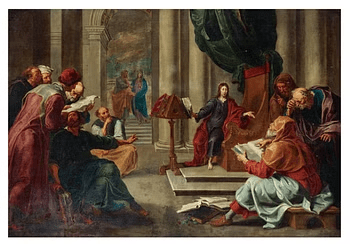
Jesus teaching in the Temple, by Willem van Herp (1614-1677)

The follower of Jesus will undergo afflictions and be oppressed by others. They will suffer.

Since that is true, the Christian must ensure that whatever suffering they endure is not because they have been obnoxious and unhelpful to people in this world; but that they are suffering because of their commitment to the words and ways of Jesus, because of their humility, gentleness, righteousness, purity, mercy, and peace.

Christians are meant to bear the cross, so that they may be conformed to the image of their Lord Jesus. There will be times when believers are the brunt of ungodly rage and fury, gossip and slander, opposition and injustice.

Jesus was warning his disciples that they needed to be prepared for endurance, to persevere over the long haul for their faith in him. Otherwise, they might be overwhelmed by temptation.

Christ followers are to remain steady in their purpose of living into the words of Jesus, and living out his ways in a world that prizes the opposite of Christian values.

The godly person values humility. The ungodly persons values pride.

The godly grieve and mourn over injustice in the world. The ungodly celebrate getting ahead by any means possible in this world.

The godly are meek. The ungodly are mean.

The godly seek right relationships with God and others. The ungodly leverage relationships to get what they want.

The godly prize mercy. The ungodly champion being merciless.

The godly are pure in heart. The ungodly have spiders in their heart, and garlic in their soul.

The godly engage in peacemaking. The ungodly engage in warmongering.

The godly end are persecuted for embracing the virtues of Jesus. The ungodly are the persecutors of good people.

The godly will be comforted, inherit the earth, receive mercy, see God, and belong to the kingdom of heaven. The ungodly will be judged, inherit the wind, receive condemnation, see nothing, and belong to the kingdom of darkness.

Sermon on the Mount, by Jorge Cocco Santángelo

The Lord wants us relieved of anxiety, and cheerfully living life with our burdens laid upon Jesus, for he gently and ably carries them. We can cast all our cares on him, because he cares for us. (Matthew 11:28-30; 1 Peter 5:7)

Whenever we are in the position of being afflicted by others, wisdom shall be granted to the godly who follow in the way of Christ.

The grace of God exists for those who seek to do justice, love mercy, and walk humbly. But there is nothing for the proud and arrogant, who believe they themselves are sufficient – because they refuse to receive any gift of God being offered to them.

All sorts of false prophets come along to try and deceive the godly into listening and following them. They make empty promises and blame others for unwanted situations. Know that whatever they say about others, is actually true of themselves.

So, when they accuse another of lying, cheating, stealing, murdering, etc. you can be sure that this is precisely what they themselves do to get ahead and get what they want in this life. Therefore, don’t be tempted by any rhetoric which demeans others.

Love of God and humanity is to be kindled hot, and not cooled through ingratitude and treachery. For whenever courage is weakened, a flood of violent speech and behavior follows.

We must strive against anything which harms the whole of humanity, and puts God at a distance. Instead, good news needs to be proclaimed.

The end will eventually come. Yet, we need not wander around in darkness, as if we don’t know what to do or where to go. We will indeed go through testing and many trials to our faith.

The desolating sacrilege, the abomination of desolation, will appear – which will be the sign that the time is short. An abomination, or desolation, means to profane something, to make it unclean or impure, to treat a holy thing as if it were simply not significant nor important.

In other words, whenever and wherever corruption is rife, and people (and God) are treated as disposable, then you know destruction is at hand. Thus, you must flee, because there is danger.

In such a situation, the rule of law will not help you. Services which were once helpful will be abolished and thrown away like garbage. And it could all happen rather quickly. So, don’t run back and try to save pieces of that previous life and existence; it isn’t worth it. You life is on the line.

Malicious motives and meanness of heart have no intention for the common good of all persons on this earth. A few people want what they want, and they don’t care who gets hurt in the process.

None of this awful behavior will go on forever. God’s judgment can and will deal with it. Yet, no one knows the time or date when that judgment will be rendered. For the sake of the godly, those days will be shortened.

Jesus was not attempting scare his disciples, but to exhort and arouse them to beware of the ungodly; and to keep watch, so that they would not fall into temptation and have their faith weakened.

As believers, we may experience troubles, but we need not be troubled.

The Good Shepherd of the sheep, Jesus Christ, is watching over us so that we don’t need to become distressed and discouraged.

My sheep hear my voice. I know them, and they follow me. I give them eternal life, and they will never perish. No one will snatch them out of my hand. My Father, in regard to what he has given me, is greater than all, and no one can snatch them out of the Father’s hand.  (John 10:27-29, NRSV)

The permanence of our deliverance from guilt, shame, sin, death, and hell does not depend on any of us. It is relies firmly upon the grace of God in Christ. And none who have been given to God shall perish. (John 17:12)

Be encouraged. But also be ready.

Keep watch, dear Lord, with those who work, or watch, or weep this night, and give your angels charge over those who sleep. Tend the sick, Lord Christ; give rest to the weary, bless the dying, soothe the suffering, pity the afflicted, shield the joyous; and all for your love’s sake. Amen.

Beware of Your Fear (Mark 13:1-8)

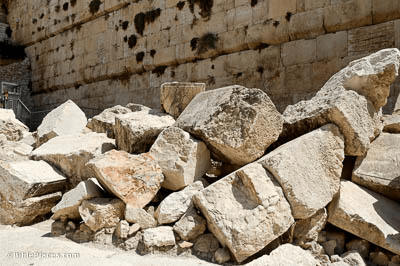
As he came out of the temple, one of his disciples said to him, “Look, Teacher, what large stones and what large buildings!” Then Jesus asked him, “Do you see these great buildings? Not one stone will be left here upon another; all will be thrown down.”

When he was sitting on the Mount of Olives opposite the temple, Peter, James, John, and Andrew asked him privately, “Tell us, when will this be, and what will be the sign that all these things are about to be accomplished?” 

Then Jesus began to say to them, “Beware that no one leads you astray. Many will come in my name and say, ‘I am he!’ and they will lead many astray. When you hear of wars and rumors of wars, do not be alarmed; this must take place, but the end is still to come. For nation will rise against nation and kingdom against kingdom; there will be earthquakes in various places; there will be famines. This is but the beginning of the birth pangs. (New Revised Standard Version)

In my undergraduate college days, decades ago, springtime brought a regular staple of sidewalk preachers calling for people to repent, because the end of the world is imminent.

That was in the days of the Cold War; the specter of a nuclear holocaust was a real fear among many. The outdoor preachers got a serious hearing with some.

Although religious end times preaching gets little attention anymore, the idea of a cataclysmic apocalypse is still very much a part of the culture. Dystopian novels are widely read; and stockpiling for a zombie apocalypse is a real thing.

End of the world stuff is, at the least, interesting and/or fascinating to many; and, at the most, there are folks fully prepared for an apocalypse of the world to happen in their lifetime.

Christ’s disciples asked him a question. And Jesus went directly to talking apocalypse.

In the Gospel of Mark, Jesus takes on demons and all sorts of other-worldly opposition. Christ is certainly presented by Mark as one who discerns there is much more going on – and will go on – in this world than what it may seem on the surface of things.

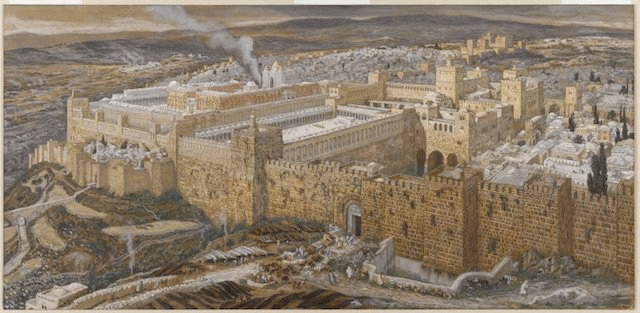
Jerusalem and Herod’s Temple, by James Tissot, c.1890

The disciples saw large and wonderful stones which were part of the temple. They marveled at what their physical eyes perceived. But Jesus saw further, into the future, and was not at all impressed; he saw a time of apocalypse. All of those stones in a heap. No one marveling over the temple.

Christ’s disciples wanted to know when such a time would happen. As was often the case with Jesus, he didn’t answer their question, at least not directly. He used it as an opportunity to teach about things to come.

The gist of Christ’s words to his disciples was to communicate that things are going to get worse than what they already are. The Roman occupation they were experiencing is nothing compared to what’s coming.

The apocalyptic language had been around in ancient Judea for a long time. There had been centuries of people talking about the world’s end.

Apocalyptic stuff is nothing new to contemporary folk, as well. Just mention the Book of Revelation and heads pop up, eyebrows raise, and imagination goes to seed.

We as biblical readers, however, need to observe that Jesus didn’t answer the question of his disciples. Which is perhaps something we must become more alert to.

Nobody knows when the end of the world will come. Not even Jesus. But that doesn’t seem to stop folks from asking anyway. Perhaps we need to ask a different question. Instead of asking “When will these things happen?” maybe we ought to ask, “What must I watch out for?”

The change of question orients us in a different way. Rather than end times speculation, we begin watching for things which are dangerous to humanity, things that bring upheaval to our world.

We start valuing awareness and observance, listening and contemplating. We learn to place our energies wisely into the things we believe truly matter in this life for the common good of all.

God is up to all sorts of kingdom business that is beyond our purview, and frankly, even beyond our ability to perceive or understand.

When we accept the exhortation of Jesus to “beware,” then we watch and look for things that are already here among us, and not get lost in a future we cannot predict. That type of future orientation only produces the kind of worry and anxiety that leads to fear.

And when fear takes root, it spawns the evils of hate and injustice. We become vulnerable to selfish incompetent leaders who make promises to take our fears away. We end up doing terrible acts against others, like imprisoning political opponents, denaturalizing and deporting citizens we don’t like, and creating fascist states that oppress others.

Fallen stones from the destruction of the Temple

But if we will wake up, hear the call of Jesus to beware, and awaken to our true commitment to the kingdom of God, we will then forsake fear-based tactics, and courageously help others in both body and soul.

It also means that, at times, we are off somewhere in centering and contemplative prayer, just like our Lord in the Garden of Gethsemane, knowing that the real source of power and authority is outside of us.

A true biblical view of the end times is about God working out divine purpose on behalf of all humanity. It isn’t about us and all of our fears and anxieties getting worked out in harmful ways.

The realization of a coming apocalypse must lead us toward faith and trust in the God who holds justice, righteousness, and mercy in good divine hands.

God has no limitations because of our questions. God will be God. God is who God is. Our task is to watch, remain faithful, and persevere until Christ returns to judge the living and the dead.

May it be so, to the glory of God.

How Much Is Too Much? (1 Kings 4:20-28)

King Solomon’s court, by Claude Vignon (1593-1670)

The people of Judah and Israel were as numerous as the sand on the seashore; they ate, they drank and they were happy. And Solomon ruled over all the kingdoms from the Euphrates River to the land of the Philistines, as far as the border of Egypt. These countries brought tribute and were Solomon’s subjects all his life.

Solomon’s daily provisions were thirty cors of the finest flour and sixty cors of meal, ten head of stall-fed cattle, twenty of pasture-fed cattle and a hundred sheep and goats, as well as deer, gazelles, roebucks and choice fowl. For he ruled over all the kingdoms west of the Euphrates River, from Tiphsah to Gaza, and had peace on all sides. During Solomon’s lifetime Judah and Israel, from Dan to Beersheba, lived in safety, everyone under their own vine and under their own fig tree.

Solomon had four thousand stalls for chariot horses, and twelve thousand horses.

The district governors, each in his month, supplied provisions for King Solomon and all who came to the king’s table. They saw to it that nothing was lacking. They also brought to the proper place their quotas of barley and straw for the chariot horses and the other horses. (New International Version)

Wealth, in and of itself, is neither good nor bad – it just is. The real issue is why any particular person wants to be wealthy, how we view wealth, and what we do with it when we have it.

In ancient Israel, under King Solomon, the Israelites enjoyed a time of prosperity, safety, and abundance. To flourish and thrive in life is good. The ability to meet basic needs, and to enjoy life is good.

King Solomon on his throne, by Frans Francken the Younger (1581-1642)

But what about beyond that? Is there such a thing as too much? And what about others who may not be able to make ends meet?

Solomon certainly had a lot. Yet, we do have warnings in Holy Scripture about exorbitant wealth. Here is what the Deuteronomic law says concerning any future king:

The king, moreover, must not acquire great numbers of horses for himself or make the people return to Egypt to get more of them, for the Lord has told you, “You are not to go back that way again.” He must not take many wives, or his heart will be led astray. He must not accumulate large amounts of silver and gold. (Deuteronomy 17:16-17, NIV)

Whatever standard one may use, I would say 12,000 horses falls into the great-numbers-of-horses category. And likewise, having 1,000 wives is most likely 999 too many for just about every man on the planet.

Indeed, Solomon’s heart was eventually led astray. It’s quite sad. Even the wisest and wealthiest person who ever lived was not able to sustain complete faithfulness to God. The remainder of Deuteronomy’s instruction about a future king is this:

When he takes the throne of his kingdom, he is to write for himself on a scroll a copy of this law, taken from that of the Levitical priests. It is to be with him, and he is to read it all the days of his life so that he may learn to revere the Lord his God and follow carefully all the words of this law and these decrees and not consider himself better than his fellow Israelites and turn from the law to the right or to the left. Then he and his descendants will reign a long time over his kingdom in Israel. (Deuteronomy 17:18-20, NIV)

In all fairness, King Solomon started out paying attention to God’s law. In his wisdom, he sought to learn and obey – but it ended up being only a partial obedience.

A dimension of any rule or government is to realize that – with any sort of success, security, and wealth – there is always a dark underbelly to it. That is, there are people within that government who are not enjoying its largess and wealth.

Under the new expanded governmental system, Solomon had his kingdom, and its subject peoples, divided into districts in order to give provisions, as well as laborers for his ambitious building projects. Not everyone was enjoying leisure time under a fig tree.

King Solomon set up an economic system that transferred wealth from nations subservient to Israel, and from subsistence farmers within Israel, to support the massive needs of Jerusalem.

The city, under Solomon, was living off the surplus grain to feed all of the horses, as well as the tribute exacted from surrounding nations. In other words, the wealth was being centralized by Solomon for his many projects and interests.

All of the opulence was meant to impress people with wealth, exhibiting Israel’s and Solomon’s great power and wisdom. Yet, if we are to follow the old adage, “follow the money,” we would discover a governmental system that extracted money from others; and produces a lot of oppression, grievances, and exploitation – hence, the dark underbelly of it all.

This sort of situation is precisely why we have prophetic literature in the Old Testament. The prophets are especially attuned to the cries of injustice amongst the people. Every society needs such persons who are within the system, yet are able to be a voice for those who are voiceless.

Had King Solomon moved beyond his partial obedience to complete and total obedience, I surmise that he likely would have considered the needs of everyone within his empire, before establishing a system of government that depended upon economic exploitation.

Specifically, perhaps Solomon ought to have engaged more vigorously and robustly with the covenant code between God and Israel that he was supposed to know so well.

And perhaps, Christianity and the Church have been too lax on the subject of handling Holy Scripture. Because, for all of our talk of being faithful to scripture, that talk has not translated into a solid social and economic understanding of human need and justice.

It simply will not do to label anything we don’t like as communist or socialist. And it will not do to say King Solomon was wealthy and successful, as if that, in and of itself, is the evidence of God’s favor. In reality, it means little, apart from a complete fidelity to God’s law.

In my judgment, Jesus did better than all of this. He pointed us to an alternative system which considers the common good of all persons, and not just some people. The ethics and morality of his Sermon on the Mount lays out the foundational means upon which any sort of governmental system ought to build upon. (Matthew 5-7)

But seek first his kingdom and his righteousness, and all these things will be given to you as well.

Jesus (Matthew 6:33, NIV)

If we are looking for the same sort of wealth and success as Solomon, that means we’ll need to ignore Jesus. Yet, if faithfulness, obedience, humility, righteousness, mercy, purity, and peacemaking matter more than our economic bottom line, then I believe we will discover that the pursuit of these virtues leads to having all of our needs met, as well.

Lord of our lives, teach us how to use our money and our possessions. Deliver us from stinginess and wasteful extravagance; inspire our giving with the spirit of true generosity. Help us always to remember your generous love for us, that we may be wise and faithful stewards of the good gifts you have given us. Amen.

Don’t Get Too Comfortable (Amos 9:7-15)

“Are not you Israelites
    the same to me as the Cushites?”
declares the Lord.
“Did I not bring Israel up from Egypt,
    the Philistines from Caphtor
    and the Arameans from Kir?

“Surely the eyes of the Sovereign Lord
    are on the sinful kingdom.
I will destroy it
    from the face of the earth.
Yet I will not totally destroy
    the descendants of Jacob,”
declares the Lord.
“For I will give the command,
    and I will shake the people of Israel
    among all the nations
as grain is shaken in a sieve,
    and not a pebble will reach the ground.
All the sinners among my people
    will die by the sword,
all those who say,
    ‘Disaster will not overtake or meet us.’

“In that day

“I will restore David’s fallen shelter—
    I will repair its broken walls
    and restore its ruins—
    and will rebuild it as it used to be,
so that they may possess the remnant of Edom
    and all the nations that bear my name,”
declares the Lord, who will do these things.

“The days are coming,” declares the Lord,

“when the reaper will be overtaken by the plowman
    and the planter by the one treading grapes.
New wine will drip from the mountains
    and flow from all the hills,
    and I will bring my people Israel back from exile.

“They will rebuild the ruined cities and live in them.
    They will plant vineyards and drink their wine;
    they will make gardens and eat their fruit.
I will plant Israel in their own land,
    never again to be uprooted
    from the land I have given them,”

says the Lord your God. (New International Version)

No one is immune from judgment, nor from the watchful eye of the God who knows both the actions of humanity and what is truly within their hearts.

Every one of us has the capacity and the potential for evil – even, and perhaps especially, those who claim to believe and follow God. To be arrogant and cocky is to set up oneself for a fall. To think that you could never fall or do evil is to operate in the realm of pride and hubris – which are the very traits of the Evil One.

Don’t get too comfortable with your life. Don’t simply believe you’re okay and anyone who disagrees with you is not okay.

Evil is not always (and usually isn’t) an in-your-face sort of thing. The sinister and unjust amongst us is much more like someone putting the text of the United States Constitution, the Bill of Rights, the Declaration of Independence, and the Pledge of Allegiance inside of a Bible, making it a convenient collection for those who are tired of having to separate their church from their state.

The Lord, however, will do some separating – the wheat from the chaff, and the sheep from the goats. (Matthew 3:12; 25:31-33)

God does not punish simply for the sake of punishment; rather, judgment is a means to restore and renew. Curses will give way to blessings. What has been lost shall be found.

“They will rebuild the ruined cities and live in them...”

Doom and hope, judgment and grace, suffering and glory. These are the movements and rhythms of the Old Testament prophets. The great sin of Israel which warranted divine wrath was not only that they trampled on the poor and needy. On top of it all, they saw nothing wrong with their way of life. 

This profound lack of awareness, rooted in the spiritual blindness of greed, is what led to judgment. It would take the form of having the Assyrian Empire come, seize the land, and take the people away to a place where they would have no chance to oppress others. Sadly, death would come to many.

The sin of oppressing others and believing there’s nothing wrong with it comes with severe consequences. The people relied too much on their ethnicity and spiritual pedigree. The ancient Israelites wrongly assumed that because they were the people of the covenant, this somehow inoculated them from disaster. Their belief in Jewish exceptionalism was their downfall.

Yet, all would not be endless gloom. The Lord will not destroy completely. God’s anger lasts for a moment. However, God’s grace lasts forever. Restoration, renewal, and fruitful times will come because of God’s mercy. 

Yes, God pronounces judgment when it is warranted. But God also makes and keeps promises to people. In our lesson for today, the Lord promises to restore the fortunes of the people through rebuilding ruined cities and letting them inhabit them once again.

God steps in and graciously acts on behalf of all people because that is what God does. We might get the notion in our heads that God executes judgment to teach people a lesson or to make a point. In my line of work, it is common to hear people express the idea they are under divine punishment because of personal illness or hard circumstances. 

God, however, acts independently out of a vast storehouse of righteousness and mercy. The Lord maintains holy decrees while showing grace to the undeserving. The nation of Israel, in the days of the prophet Amos, deserved only judgment, not grace. 

It seems to me God would have been completely justified to never restore or renew a recalcitrant people. Yet, God’s grace overwhelms and swallows human sin. Try as you might to understand grace, you will end up befuddled. That’s because grace is wildly illogical, nonsensical, and unconditionally free. Grace shows radical acceptance where there ought to be only the punishing fire of hell.

The height of grace and the pinnacle of restoring the fortunes of Israel (from a Christian perspective) came through a baby and a humble birth in the small village of Bethlehem. Jesus came to save the people from their sins. God acted by entering humanity with divine love so that there could be new life and fresh hope. 

So, let grace wash you clean. Allow mercy to renew your life. Receive the gift of gracious forgiveness, merciful love, and divine peace. Look ahead and see there is hope on the horizon.

For the afflicted, there is comfort. But for the comfortable, affliction is coming.

Merciful God, although you are careful to uphold your great holiness, your mercy extends from everlasting to everlasting. May the gospel of grace form all my words and actions so that true righteousness reigns in my life through Jesus, my Lord, in the power of the Holy Spirit. Amen.