
Beginnings and Endings

Forest Sunset, by James Naughton

I’ve always thought it strange that we have New Year’s celebrations on January 1 at midnight when the year begins. The year hasn’t even happened yet, and we’re celebrating it. I understand celebrating a live birth and all the possibilities of a new baby in a family; but having worldwide blowouts about an upcoming New Year just strikes me as weird.

For some reason, we don’t celebrate the year we’ve just lived. We “take a look back” at the significant events and happenings. But there’s certainly no party around it. I suppose it’s because a lot of terrible things happen in a year. Yet, a lot of good things happen, too, that we could center some joy around.

What I’m getting at, in a round about way, is that we humans don’t do well with endings. And then we quickly become discouraged with our new beginnings – likely because we put little to no thought and preparation into how important and necessary our endings really are.

This is yet another roundabout way of saying that I (and we together) are experiencing something of an ending. For the past 1,750 days, I have provided a daily reflection upon a text from Holy Scripture. And those reflections haven’t been just a few sentences of devotional drivel, nor a measly daily crumb. I’ve written thousand-word-posts which I believe have been thoughtful and truly reflective on the text and our human condition.

However, all things must end. And this is my last post – at least for a while. I won’t be posting every day, as I’ve done for nearly 5 years! Yet, in order for me to have a proper new beginning of my own (one that I neither wanted nor asked for) I must let go of my daily blog posts.

Although I have been blogging for the past 15 years, I started doing the daily reflections at the beginning of COVID, as a way of remaining connected with my then church congregation, and with others. My thought was to give up doing it every day, once things got back to some sort of normalcy – whatever the heck that is.

Yet, when the masks initially came off and we all began seeing one another again, I found that the daily routine of writing biblical reflections had gotten into my spiritual bones. I was no longer simply writing for others; I was writing for myself. It buoyed my own faith to rise early in the morning and put some intentional focus upon crafting some scriptural thoughts on the Bible.

But that is no longer possible. My life can no longer sustain the practice. I intend to keep up the occasional post of maybe once a week. I might not even be able to do that. It might be once or twice a month. I don’t yet know.

Yet, what I do know is that I want to take the opportunity to celebrate the reality that I spent 1,750 straight days writing and posting impactful blog posts! Many of you were gracious to send me private notes of appreciation and encouragement. I especially treasure the ways some of you explained your story of how your own relationship with God has been helped.

When you boil down life to its essence, all any of us really have is our stories. Behind every event, each encounter, and all of the numbers which get crunched and the stuff that gets done and achieved, there is a story.

Stories bring just as much healing to us as modern medicine and surgeries. And they encourage, inspire, and change us in ways we cannot imagine.

The Bible, at its core, is a collection of stories. It seems God has created us as story-driven people, and so, in order to reveal something of God’s personhood and nature, we were given a grand and unfolding story of redemption.

I love reading and meditating on Holy Scripture, mainly because I love the Holy God of whom I belong and gladly serve.

I’ll continue writing the occasional post, but I will miss the daily meetings I’ve had with the Lord and with you in these past few years. Thank you for your faith, and for listening to God’s Word. What’s more, you can always avail yourselves of the nearly 2,700 blog posts on the website.

I pray that we all may learn to end things well, so that we might begin new things with some needed wisdom, humility, and grace.

May you live this day compassionate of heart, gentle in word, gracious in awareness, courageous in thought, and generous in the love of God through Jesus Christ our Lord and in the strength of the Holy Spirit. Amen.

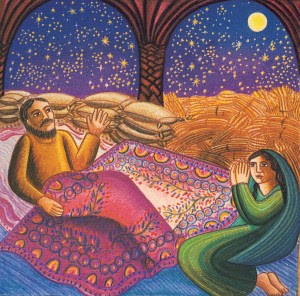
Redeem One Another (Ruth 3:1-7)

Boaz and Ruth, by John August Swanson (1938-2021)

Naomi her mother-in-law said to her, “My daughter, I need to seek some security for you, so that it may be well with you. Now here is our kinsman Boaz, with whose young women you have been working. See, he is winnowing barley tonight at the threshing floor. Now wash and anoint yourself, and put on your best clothes and go down to the threshing floor, but do not make yourself known to the man until he has finished eating and drinking. When he lies down, observe the place where he lies; then go and uncover his feet and lie down, and he will tell you what to do.” She said to her, “All that you say I will do.”

So she went down to the threshing floor and did just as her mother-in-law had instructed her. When Boaz had eaten and drank and was in a contented mood, he went to lie down at the end of the heap of grain. Then she came stealthily and uncovered his feet and lay down. (New Revised Standard Version)

Naomi and Ruth were two widows – a mother-in-law and daughter-in-law – living in an ancient time when women were dependent upon men for survival.

Ruth had been out in the barley fields during harvest, gleaning as much as she could by walking behind the harvesters. It was what people in need did back then.

The owner of the land, Boaz, had heard of Ruth and took notice of her. He was kind and made sure she had enough for herself and Naomi.

So, Naomi, although too old to be out in the fields gleaning barley, could still use her wisdom. She decided to help Ruth have some security for the future. Naomi wanted to help her daughter-in-law,  so she instructed Ruth to make herself available to Boaz.

Boaz was a kinsman, connected to Naomi’s extended family. Naomi intended on using this connection to bring Ruth and Boaz together in marriage, thus settling her daughter-in-law in a good and secure life.

The approach of Naomi underscores her thoughtfulness, creativity, and limited resources. Most of all, however, Naomi’s plan rests entirely on the goodwill and generosity of Boaz. Naomi was observing Boaz, and assessed him as a person she could put her faith into.

Would Boaz be willing to act in Ruth’s favor, as a near kinsman to Naomi? Would he take up the mantle of kinsman-redeemer and enter a levirate marriage with Ruth?

A “levirate” is reference to an ancient marital system which involved in-laws. If a man died without children, the dead man’s name could be perpetuated through the widow’s marriage with a man related to the dead person.

Israel and Judah had a strong sense of community and family solidarity which is evidenced in God’s law. Members of the family and the community had a duty to watch out for each other and care for one another. For example:

“If anyone of your kin falls into difficulty and sells a piece of property, then the next of kin shall come and redeem what the relative has sold. If the person has no one to redeem it but then prospers and finds sufficient means to do so, the years since its sale shall be computed and the difference refunded to the person to whom it was sold, and the property shall be returned. But if there are not sufficient means to recover it, what was sold shall remain with the purchaser until the year of Jubilee; in the Jubilee it shall be released, and the property shall be returned. (Leviticus 25:25-28, NRSV)

Naomi did her best to try and prepare for a marriage to happen. And her best chance was with Boaz on the threshing floor after the barley harvest. Considering that arranged marriages were the norm, none of this was weird at the time.

She wanted to stir up this sense of duty in Boaz, and help him take responsibility for the family, so that Ruth could be properly cared for.

Israelites had a strong theological sense that their God had redeemed them out of Egypt, and therefore, they themselves were to act as redeemers, whenever needed, within their families and communities.

Another way of putting the matter, is that Israel’s covenant with Yahweh their God was to have the wider implication of covenanting to help and care for each other as Israelites. And this was especially true for one’s family.

Boaz was related to Naomi through her late husband Elimelech; and related to Ruth through Elimelech’s son Mahlon, who was Ruth’s late husband.

As you can imagine, not every scenario in Judah which involved redeeming one’s in-law’s actually happened. The question was whether Boaz would do anything. And Naomi was betting on the farm that he would care and help. Hence, Naomi’s advice to Ruth concerning Boaz.

Naomi instructed Ruth to make clear to Boaz that she wanted him to marry her. All of the preparation for the nighttime visit was designed to spark within Boaz that Ruth is asking for a levirate marriage.

Ruth did exactly what her mother-in-law told her. I believe that not only was Naomi looking out for her daughter-in-law, but Ruth was also looking out for her mother-in-law.

Neither one of them had to do what they did. Naomi didn’t have to make arrangements for Ruth to be cared for. But she did. And Ruth, as a foreigner from Moab, didn’t have to succumb to any Jewish covenantal understandings of things. And yet, she did.

Individualistic Western societies reflexively think of personal interest first, and often only think of the personal implications to just about everything – even concerning family. Many persons abandon their families and take up a sort of surrogate family.

They may feel no duty or responsibility to biological family connections. Even more persons move from place to place without much thought to the communities they leave, nor to how they might contribute to the wellbeing of their new community.

A careful reading of the Book of Ruth ought to challenge those types of approaches to family and community. Although none of us are living in the covenant society of Ruth, Naomi, and Boaz, there is an inherent universal ethic of caring for those closest to us, especially family.

Each day is an opportunity to act in redemptive ways which lift up and help others in whatever their need may be. I pray we all to have the sensibilities of persons like Boaz, Ruth, and Naomi.

Gracious God, enable us to understand and care about the needs of others. May your way of love open up for all those who suffer or are in any kind of trouble. Thank you for your steadfast love and abundant mercy. Help us to both accept your love and mercy, and to give it. Amen.

Accomplishing the Mission, No Matter What (Acts 25:1-12)

Saint Paul before Festus and Agrippa, by Philip Galle (1537-1612)

Three days after arriving in the province, Festus went up from Caesarea to Jerusalem, where the chief priests and the Jewish leaders appeared before him and presented the charges against Paul. They requested Festus, as a favor to them, to have Paul transferred to Jerusalem, for they were preparing an ambush to kill him along the way. Festus answered, “Paul is being held at Caesarea, and I myself am going there soon. Let some of your leaders come with me, and if the man has done anything wrong, they can press charges against him there.”

After spending eight or ten days with them, Festus went down to Caesarea. The next day he convened the court and ordered that Paul be brought before him. When Paul came in, the Jews who had come down from Jerusalem stood around him. They brought many serious charges against him, but they could not prove them.

Then Paul made his defense: “I have done nothing wrong against the Jewish law or against the temple or against Caesar.”

Festus, wishing to do the Jews a favor, said to Paul, “Are you willing to go up to Jerusalem and stand trial before me there on these charges?”

Paul answered: “I am now standing before Caesar’s court, where I ought to be tried. I have not done any wrong to the Jews, as you yourself know very well. If, however, I am guilty of doing anything deserving death, I do not refuse to die. But if the charges brought against me by these Jews are not true, no one has the right to hand me over to them. I appeal to Caesar!”

After Festus had conferred with his council, he declared: “You have appealed to Caesar. To Caesar you will go!” (New International Version)

The Story Up to Now

Paul was in a pickle. Earlier in his life, as an up and coming star amongst the Jewish Pharisees, he had a life-changing encounter with the risen Christ. Paul did a complete 180 degree turn from opposing and persecuting Christians to becoming a Christian himself.

As you might imagine, this did not go over well with the Jewish establishment, and especially the Pharisees. From the event of Paul’s conversion and onward, he was a marked man. And he knew it.

But Paul didn’t care. He embraced his new life and calling with as much or more zeal than his old life. Paul dedicated himself to missionary journeys, proving that Jesus is the Christ, and establishing churches. Some of the Jews (by no means all) hated him for it. As a result, the Apostle Paul was whipped, stoned, and left for dead more than once. Finally, the upset Jews were able to get Paul arrested and jailed.

And that is where we pick up Paul’s story. And it’s also likely why he appealed to Ceasar instead of staying in Palestine; he knew he wouldn’t survive for too long surrounded by the same sort of people whom he used to run with in trying to stamp out the Christians.

The Present Story

Paul originally dealt with Felix (Acts 24) but then with a change in administration, he faced Festus. The Jews who opposed Paul wanted him transferred to Jerusalem from Caesarea. But Festus was no dummy; he knew this was an age old trick to try and ambush the Roman guards on the way and assassinate Paul. So, Festus went and saw Paul in Caesarea.

Things went as one might expect: Unsubstantiated charges are leveled against Paul in court; Paul maintains his innocence; Festus asks Paul if he wishes to go to Jerusalem for trial, or not; and Paul refuses. But the thing that no one expected is that Paul took the further step of appealing directly to the emperor himself.

We aren’t told why Paul made this appeal – although it certainly appeared as if he may not get a fair trial in Palestine. Yet, we do know that Paul had a desire to fulfill his calling of bearing witness to the gospel of Christ in the West, and to Rome.

It seems to me that, at this point, Festus saw an opportunity to rid himself of all this Jewish weirdness (as he saw it) and send Paul off and out of his own jurisdiction. One less difficult Jewish problem to have to deal with in this far off Roman outpost in the Middle East.

The Story to Come

As Bible readers, we know what is upcoming for Paul – all of the dramatic events and twist and turns of his life getting to Rome and under house arrest in the city. Yet, even though none of us really know what another day will bring, the Apostle Paul was driven by his purpose of gospel proclamation and bringing the message of Christ to the farthest western reaches of the Roman Empire. And to that end, he was not going to be dissuaded or deterred, even when he had little to no control over his life as a prisoner.

A person with meaning and purpose is a person with faith and hope. And when love is the thing animating the purpose, then it doesn’t much matter what the outward circumstances are. Perseverance and resiliency always find a way where there seems to be none.

Half of life is spent discovering, learning, and developing our skills, gifts, and abilities. The other half is applying and honing those skills in new and different contexts. As long as we know what we’re about, and we keep putting in the hard work and practice it takes for continued and sustained excellence, then each situation we encounter becomes an opportunity to extend my purpose in a new experience.

And that is what the Apostle Paul did. It wasn’t about changing or manipulating situations or people; rather, it was about finding pathways to accomplishing his mission on this earth with the calling he received from God. I would say that Paul did a pretty dang good job at that.

I also believe that you and I can do it, too.

Holy God, you search us out and know us better than we know ourselves. Help us to discern your voice and your calling. We seek to listen and learn from the wisdom of Christ. Raise up faithful people who will speak words of life with clarity and grace, with justice and true compassion; in the strength of the Holy Spirit. Amen.