Hebrews 5:1-10 – Our Great High Priest

Mosaic of Jesus Christ in the Hagia Sophia, Istanbul, Turkey

Every high priest is selected from among the people and is appointed to represent the people in matters related to God, to offer gifts and sacrifices for sins. He is able to deal gently with those who are ignorant and are going astray, since he himself is subject to weakness. This is why he has to offer sacrifices for his own sins, as well as for the sins of the people. And no one takes this honor on himself, but he receives it when called by God, just as Aaron was.

In the same way, Christ did not take on himself the glory of becoming a high priest. But God said to him,

“You are my Son;
    today I have become your Father.”

And he says in another place,

“You are a priest forever,
    in the order of Melchizedek.”

During the days of Jesus’ life on earth, he offered up prayers and petitions with fervent cries and tears to the one who could save him from death, and he was heard because of his reverent submission. Son though he was, he learned obedience from what he suffered and once made perfect, he became the source of eternal salvation for all who obey him and was designated by God to be high priest in the order of Melchizedek. (New International Version)

The New Testament letter of Hebrews is perhaps the most Christ-centered book in all the Bible. If you like Jesus, or are at all intrigued by him, this is the best place to go, outside the four Gospels.

Hebrews deliberately points out and exalts the supremacy of Jesus Christ over the Old Testament prophets, the angelic realm, and even Moses and the Law. And, as today’s New Testament lesson insists, Jesus is superior to the old Levitical priesthood because Christ is our salvation. His priesthood is from a different and better order.

With all this talk in Hebrews about Christ’s superiority over everything, some might expect a focus on his deity. Yet, it is the humanity of Jesus which gets the most attention. The actual lived experience of Jesus on this earth is the highest qualification there is to intercede between God and us.

Jesus, as a true bona fide human person, had to learn obedience just like the rest of us. He went through all the hardships and sufferings of life, too. Jesus was dependent on prayer, just as we are. And he was heard by God the Father because of his reverent submission.

One of the great deceptions which can befall Christians is that Christianity is all about strength, victory, and glory. That, however, is only part of the story. If Jesus needed to learn and grow by means of suffering, then how much more do we need to be spiritually formed through the adversities, challenges, and heartaches of life?

Jesus Christ proved himself through his obedience to God. Even though he himself was God, he submitted himself to being human with all of it’s limitations, weaknesses, and pains. Through it all, Christ maintained perfect submission and obedience to the will of God.

All of this means that Jesus, the pioneer and perfecter of our faith, is eminently qualified to be our great high priest. Jesus can relate to us. Jesus knows us. Jesus understands what it’s like for us. And Jesus has dealt with the endemic issue of guilt and shame once for all through the cross.

So, what does this mean for you and me? Without a realization of who Jesus is, what he did for us, and continues to do for us, we easily take Christ for granted and slip into spiritual lethargy – and perhaps even spiritual self-loathing – and needlessly suffer in loneliness and despair.

The truth is: Jesus Christ loves us. He has become our high priest, the one who is able to intercede for us – constantly taking our prayers and advocating for us to God the Father.

Let Christians everywhere be reminded that we serve a Trinitarian God – Father, Son, and Spirit – who conspires to do what is best for us, at all times. There is a divine community of three persons, the Holy Trinity, who work seamlessly and with perfect unity to provide deliverance from sin, death, and hell. The God whom we serve is both willing and capable to meet our most pressing needs.

Here are 17 ways we can live into being mature Christian believers who are spiritually growing in the grace of God:

  1. Realize God has called you to be holy and righteous and has given you everything you need to do so. (2 Peter 1:3-4)
  2. Be an integral part of a Christian faith community so that you can be encouraged and encourage others. (Hebrews 10:24-25)
  3. Listen to the counsel of others and discern what is good and what is not. (Philippians 1:9-11)
  4. Stick to a consistent regimen of Bible reading and Scripture study. (Hebrews 4:12-13)
  5. Find good books to read and go through them carefully. (2 Timothy 2:15)
  6. Seek to obey Holy Scripture with all your heart. (Psalm 119:89-96)
  7. Persevere and keep growing spiritually. (Hebrews 10:35-36)
  8. Pray continually, realizing your utter dependence on Christ. (1 Thessalonians 5:16-18)
  9. Always look for ways to praise God and serve Christ. (2 Corinthians 1:1-7)
  10. Consider the consequences of your words and actions before you say and do them. (Galatians 6:7-10)
  11. Enjoy God and God’s people. (Philippians 4:4-9)
  12. Understand that the Christian life is not always easy. (Philippians 1:27-30)
  13. Be patient: Spiritual growth and maturity take time. (Hebrews 6:1-3)
  14. Use the spiritual gifts given to you for the benefit of others. (Romans 12:3-8)
  15. Make plans with other like-minded persons to become spiritually self-disciplined. (Proverbs 27:17)
  16. Pursue genuine and intimate spiritual friendships. (2 Corinthians 7:1-4)
  17. Engage in spiritual conversation and prayer around the Bible’s contents and message. (Colossians 4:2-6)

Gracious Father, we pray for Christ’s Church. Fill it with all truth and peace. Where it is corrupt, purify it; where it is in error, direct it; where in anything it is amiss, reform it. Where it is right, strengthen it; where it is in want, provide for it; where it is divided, reunite it; for the sake of Jesus Christ, your Son, our Savior. Amen.

Psalm 128 – Obey and Enjoy Happiness

Around Your Table by Melani Pyke

Happy are those who respect the Lord and obey him.
You will enjoy what you work for,
    and you will be blessed with good things.
Your wife will give you many children,
    like a vine that produces much fruit.
Your children will bring you much good,
    like olive branches that produce many olives.
This is how the one who respects the Lord
    will be blessed.
May the Lord bless you from Mount Zion;
    may you enjoy the good things of Jerusalem all your life.
May you see your grandchildren.

Let there be peace in Israel. (New Century Version)

Obedience and blessing go together like a hand in a glove. Holy Scripture consistently connects the call to obey the Lord with blessing from G-d. Indeed, in carefully observing wise and biblical instruction, one will typically enjoy divine favor and approval.

Keep in mind, however, this is not a math equation. Like 2+2=4 there are folks who expect a neat linear connection between their obedience and their blessing. In math theology, when a woman is unable to have children, or a child goes astray from their heritage, the parent concludes that they themselves must have been unfaithful to G-d’s law or are being punished. Conversely, with children who grow to be good citizens and respectful persons, the parents might conclude it was because of their superior observance to the spiritual life.

In both cases, parents take too much credit, either for a child’s wandering or success. As for kids going astray, even G-d had prodigal children, so cut ourselves some slack. As for children who maintain faithfulness, a lot of factors went into who they are. I suppose it is only natural to quickly assume we have far more control of than we really do.

This all cuts to the heart of biblical interpretation. If all Scripture is read literally, then we will likely see the Bible as a math equation where doing and saying the right things gets a predictable result of blessing. Yet, this mistakenly views promise and proverb as the same thing, and divine work with one person or group will be precisely the same for another. The wisdom literature of Scripture, which includes the psalms, were never designed as prescriptive decree but rather as the sage approach for work, worship, and family.

“Faith is only real when there is obedience, never without it, and faith only becomes faith in the act of obedience.”

Dietrich Bonhoeffer

Today’s psalm communicates the path of happiness coming through love and respect for G-d. It neither promises lots of kids, ensures money, nor guarantees smooth sailing. Rather, when one lives each day being cognizant and observant to center everything around the divine, then blessing and happiness will tend to follow.

Blessings and benedictions are given to sustain us in hope and confidence. The best things in life usually come through faith and family. So, when we choose to walk with G-d and travel down the ethical road, then life becomes full of peace and prosperity – perhaps not always in the manner we expect, yet blessing, nonetheless.

Humanity is hard-wired for blessing, for a steady diet of encouragement, acceptance, and approval from G-d and others. When this is withheld from us, unhappiness, even despair begins to settle. Giving and receiving blessing is at the heart of being fully human and alive. Our work and family life will likely be miserable if blessing is absent. Yet, with blessing, we have a sustainable form of happiness and enjoyment.

Most every good thing in life is obtained through a great deal of blood, sweat, and tears. Obedience is no easy task. It typically requires courage and is complicated in its application to life situations. Here are a few ways to maintain an obedient life to G-d:

  • Devote yourself to the daily reading of Scripture. One cannot obey that which is neither known nor remembered. A steady regimen of good old fashioned Bible reading is the best way to refresh the mind and incline the heart toward biblical commands. (Psalm 119:57-64)
  • Pray to listen and pay attention. There is more to prayer than petitions and praise. We must also practice silence and solitude so that we can give focused attention to hearing G-d, thus, obeying the Spirit. (Jeremiah 7:21-26)
  • Practice repentance. Being aware of our guilt and shame, acknowledging it, and naming it before G-d is the path of change – keeping us on the narrow road of obedience. (1 John 1:5-10)
  • Take the long view. Not all obedience is rewarded in this life but in the life to come. Perseverance and patience is needed to sustain obedience over the long haul of life. And, in the end, there are heavenly blessings awaiting us. (Hebrews 11:36-12:3)

Eternal God, by whose power we are created and by whose love we are redeemed, guide, strengthen, and bless us through your Spirit so that we may give ourselves to your service and live today in love to one another and to you, through Jesus Christ our Lord. Amen.

Matthew 17:23-32 – Parable of the Two Sons

The Parable of the Two Sons by Jorge Cocco

Jesus entered the temple courts, and, while he was teaching, the chief priests and the elders of the people came to him. “By what authority are you doing these things?” they asked. “And who gave you this authority?”

Jesus replied, “I will also ask you one question. If you answer me, I will tell you by what authority I am doing these things. John’s baptism—where did it come from? Was it from heaven, or of human origin?”

They discussed it among themselves and said, “If we say, ‘From heaven,’ he will ask, ‘Then why didn’t you believe him?’ But if we say, ‘Of human origin’—we are afraid of the people, for they all hold that John was a prophet.”

So, they answered Jesus, “We don’t know.”

Then he said, “Neither will I tell you by what authority I am doing these things.

“What do you think? There was a man who had two sons. He went to the first and said, ‘Son, go and work today in the vineyard.’

“‘I will not,’ he answered, but later he changed his mind and went.

“Then the father went to the other son and said the same thing. He answered, ‘I will, sir,’ but he did not go.

“Which of the two did what his father wanted?”

“The first,” they answered.

Jesus said to them, “Truly I tell you – the tax collectors and the prostitutes are entering the kingdom of God ahead of you. For John came to you to show you the way of righteousness, and you did not believe him, but the tax collectors and the prostitutes did. And even after you saw this, you did not repent and believe him. (New International Version)

The people entering God’s kingdom may not be the ones we expect. 

That’s because God’s kingdom is an upside-down kingdom. The spiritual insiders are really on the outside, while the spiritual outsiders are the ones inheriting the kingdom.

Today’s Gospel parable is a warning to all the spiritually serious to beware, lest their energies be spent entirely in correctness, believing the right things, and making obedience to Christ of secondary importance. 

This parable also encourages moral failures with the wonderful possibilities of a changed life. 

That’s because talk is cheap. Only what one believes, one will do.

Lip service to God, without loving service, is hollow and means nothing.

The Warning: Don’t Assume

Christ’s parable warns those who arrogantly assume they have an inside track by their belief, when in reality they aren’t obeying God, at all.  It’s a bit hard for us to imagine how offensive this story was to the religious authorities of the day, so here is a restatement of the parable in a more contemporary form:

What do you think? There was once a man well-respected in the community. He had two sons. The one son grew up and also became a respectable member of the community. This son was a successful businessman, and willingly gave a lot of money to causes in his community, including new lights for the football field – which was no small cost. He only asked that appropriate and prominent recognition be given him with a plaque on each of the light poles with his name on it. 

The other son was not so successful.  He was the one in school of whom the teachers said, “Why can’t you be more like your brother?”  There was nothing spectacular about this son. In fact, he lived an alternative lifestyle and seemed to always be the talk of people behind his back. 

One day the father said to him, “Son, go and work at my place of business today. I am going away and need you to do some of the tedious paperwork I have gotten behind on so that I can get away.” “I will not,” he answered, but later felt heartsick about the way he had spoken to his father and decided to go to his place of business and do all the grunt work his father needed done.

The father also went to the other son, the well-respected one, and said the same thing about needing him to do all the thankless paperwork that was piled up. That son answered, “Yes, sir, I will. Anything you need I will do.”  However, that son did not follow through and go do the tedious work. Instead, he chose to go golfing with some people whom he was trying to coy favor with.

After telling the story, Jesus asked all the upstanding church leaders and people listening, “Which of the two sons did what his father wanted?” “The first,” they all answered.

Then, Jesus said to them, “I tell you the truth, the gay, lesbian, bisexual, transgender, and queer people are entering the kingdom of God ahead of you. For you have had heard hundreds if not thousands of sermons about grace and the true way of righteousness, and you did not believe by putting the Word of God into practice; but they did. And even after you saw how grace can transform a life from the inside-out, you yourselves did not repent and believe.

For Jesus to tell such a story was so incredibly scandalous that it could get him killed – and it did. Simply believing the right things and living as an upstanding citizen is not the way of salvation. Tax collectors and prostitutes were the most despised people in Christ’s time. It was assumed they were on the outside and could never come to God, much like some might believe it unthinkable that a Muslim terrorist could be saved by Jesus. 

The proof of genuine belief is not in talking a good line; it is in actively obeying God when no one is looking to see what a good person you are.

Those who say, “I love God” and hate their brothers or sisters are liars. After all, those who don’t love their brothers or sisters whom they have seen can hardly love God whom they have not seen! This commandment we have from him: Those who claim to love God ought to love their brother and sister also.

1 John 4:20-21, CEB

The Christian life hinges on obedience to the words and ways of Jesus. It is to be a blessing to a lost world in need of the grace and love of God.

There was once a Pastor in the 1890’s, Pastor Wright, who pronounced from his pulpit and wrote an article for his denomination’s newsletter on how people flying was both impossible and contrary to the will of God.  Pastor Wright had two sons named Orville and Wilbur. The Pastor was so sure of himself, but he was surely wrong.

The Invitation: Walk Through the Open Door

This parable is more than a warning; it is also a story that opens a door of grace and mercy for unlikely people, far from God, who have said “no” to God. It is a wonderful invitation for all us screw-ups and people with little to no faith to come to Jesus, and he will give rest.

One of my favorite Old Testament references is from the life of David. It is rather obscure and tucked away where no one notices it in Scripture. David was on the outside looking in. King Saul was trying to capture him, even though he had done nothing wrong:

David got away and escaped to the Cave of Adullam. When his brothers and others associated with his family heard where he was, they came down and joined him. Not only that, but all who were down on their luck came around—losers and vagrants and misfits of all sorts. David became their leader. There were about four hundred in all. (1 Samuel 22:1-2, MSG)

This rag-tag group of outsiders in Israel became Israel’s insiders as David eventually became king. These were the men, referred to later, as David’s mighty men, people on the cutting edge of bringing Israel into prominence. 

Jesus, Son of God, Son of Humanity, came and clearly identified himself as the Savior to the outsider when he quoted the prophet Isaiah: 

“The Spirit of the Lord is on me.
    He has chosen me to tell good news to the poor.
He sent me to tell prisoners that they are free
    and to tell the blind that they can see again.
He sent me to free those who have been treated badly
    and to announce that the time has come for the Lord to show his kindness.” (Luke 4:18-19, ERV)

In Christ, there is no lost cause and no person too far to be rescued and redeemed. And if we believe that, we will participate with God’s desire to reach the outsider.

Conclusion

Practicing the words and ways of Jesus happens when we locate ourselves within this parable. For the true outsider, this is the most wonderful news possible – that Jesus is reaching out and bringing you to himself – that changing a “no” to saying “yes,” entry to life is possible. 

Yet, maybe some of us need to locate ourselves as the insider who needs to get a clue before we miss out on the grace of God in Christ.

Take heart, for Jesus came to seek and to save that which is lost. It is time to act on what we believe – to affirm truth and right doctrine, and to embody it with obedience to God’s call on our life.

Hebrews 11:17-22 – Faith Forward

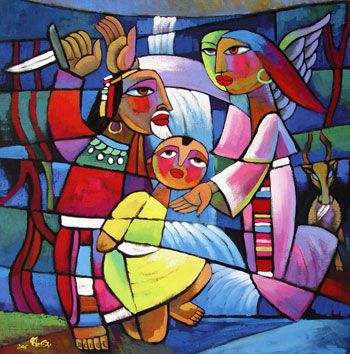
Sacrifice of Abraham by He Qi

By faith Abraham, when God tested him, offered Isaac as a sacrifice. He who had embraced the promises was about to sacrifice his one and only son, even though God had said to him, “It is through Isaac that your offspring will be reckoned.” Abraham reasoned that God could even raise the dead, and so in a manner of speaking he did receive Isaac back from death.

By faith Isaac blessed Jacob and Esau in regard to their future.

By faith Jacob, when he was dying, blessed each of Joseph’s sons, and worshiped as he leaned on the top of his staff.

By faith Joseph, when his end was near, spoke about the exodus of the Israelites from Egypt and gave instructions concerning the burial of his bones. (New International Version)

Life requires faith.

To keep going, to endure and persevere, demands sustained faith over the course of a lifetime.

Faith is confidence in what we hope for and assurance about what we do not see. (Hebrews 11:1)

The biblical character, Abraham, let faith shape his actions. He obeyed God’s call on his life and left his home country to go somewhere he knew nothing about. And he did it with no GPS and no AAA tour books.

Even thought Abraham had a good life in his home city of Ur, he left, believing there was something better ahead.

After reaching the land which God led them to, Abraham, age 100 and his wife, Sarah, age 90, became parents. It happened because of faith. The two of them believed God’s promise of a child, even though it was biologically impossible.

Abraham kept his faith over the long haul of his life. He did it by looking ahead to the eternal city. Because Abraham had looked ahead on this earth and stepped out in faith, he was able to clearly discern that all his faith eggs were not in the earthly basket.

Against all odds, Abraham was convinced God was good for his promises and knew what he was doing.

Trust in the Lord with all your heart,
And lean not on your own understanding;
In all your ways acknowledge Him,
And He shall direct your paths.

Proverbs 3:5-6, NKJV

Isaac was the miracle child, the promised son born to Abraham and Sarah in their old age. One day, God came along and gave Abraham a very strange command: Take your son, the child of the promise, and go to the mountain and sacrifice him there. (Genesis 22:1-19)

“Huh? What the @#$&*!!” we might say. But it only seems perplexing and weird to us. Abraham listened and obeyed. He simply went about the business of saddling up the donkey, chopping some wood for the sacrifice, and took his only son with him on the journey to the mountain – with no questions or talk back to God.

While you and I might try and figure out if we really heard God or not, Abraham had a history of faith with God. He knew God’s voice as well as he knew his own. Abraham was well down the road of relationship with the God he served.

Today’s New Testament lesson gives us an insight into Abraham’s thought process, a line of thinking consistent with a person who has a regular habit of talking with God. Abraham was willing to follow through with sacrificing his beloved son because he was sure that God could raise people to life. Abraham believed death would not have the last word.

Abraham did not try and figure out God’s mind. He didn’t get into a debate with God about the contradiction of ethics he was being asked to do. He just obeyed. Abraham reasoned that it didn’t matter if Isaac were killed because God could raise him from death. This, of course, is not what happened. It was all a test of faith. Abraham knew beyond a shadow of a doubt that God is the Lord who provides.

You and I rarely know why we are facing the unwanted circumstances we are enduring. We don’t always know what in the world God is thinking. Yet, like Abraham, if we have a spiritual history of walking with God and hearing the Lord’s voice, we don’t hesitate to respond. We are convinced God will provide.

Obedience for the follower of Christ is not a burden but a privilege, even when we are being tested beyond our seeming emotional ability to do it.

Grant, O God, that we may never lose our way through self-will, and so end up in the far countries of the soul. May we never abandon the struggle, but endure to the end, and so be saved. May we never drop out of the race but press forward to the goal of our high calling. May we never choose the cheap and temporary path but let go of all but you. May we never take the easy way and never forget that sweat is the price of all things, and that without the cross, there cannot be the crown.

So, keep us and strengthen us by your grace so that no disobedience, weakness, or failure may stop us from entering into the blessedness which awaits those who are faithful in all the changes and chances of life, through Jesus Christ our Lord. Amen