Why? (Job 18:1-21)

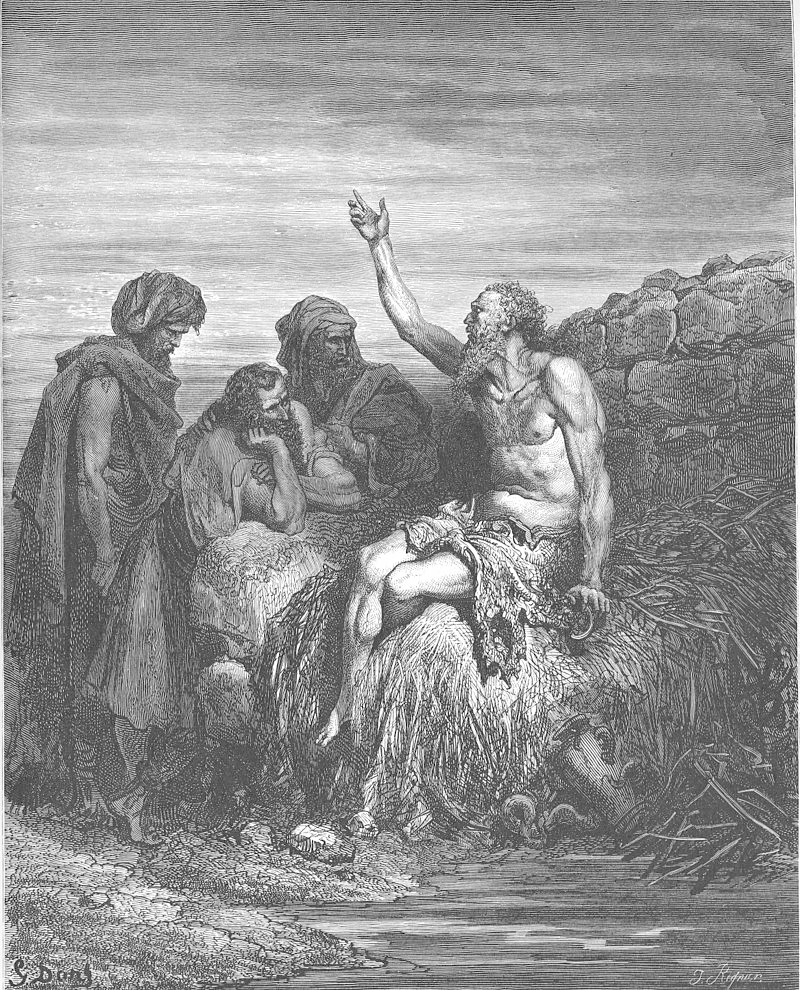
Job speaks with his friends, by Gustave Doré, 1866

Then Bildad the Shuhite replied:

“When will you end these speeches?
    Be sensible, and then we can talk.
Why are we regarded as cattle
    and considered stupid in your sight?
You who tear yourself to pieces in your anger,
    is the earth to be abandoned for your sake?
    Or must the rocks be moved from their place?

“The lamp of a wicked man is snuffed out;
    the flame of his fire stops burning.
The light in his tent becomes dark;
    the lamp beside him goes out.
The vigor of his step is weakened;
    his own schemes throw him down.
His feet thrust him into a net;
    he wanders into its mesh.
A trap seizes him by the heel;
    a snare holds him fast.
A noose is hidden for him on the ground;
    a trap lies in his path.
Terrors startle him on every side
    and dog his every step.
Calamity is hungry for him;
    disaster is ready for him when he falls.
It eats away parts of his skin;
    death’s firstborn devours his limbs.
He is torn from the security of his tent
    and marched off to the king of terrors.
Fire resides in his tent;
    burning sulfur is scattered over his dwelling.
His roots dry up below
    and his branches wither above.
The memory of him perishes from the earth;
    he has no name in the land.
He is driven from light into the realm of darkness
    and is banished from the world.
He has no offspring or descendants among his people,
    no survivor where once he lived.
People of the west are appalled at his fate;
    those of the east are seized with horror.
Surely such is the dwelling of an evil man;
    such is the place of one who does not know God.” (New International Version)

It only makes sense that Bildad was expecting a sensible discussion with Job.

But it was not going to happen.

Why?

Because grief doesn’t make sense; it’s nonsensical, whimsical, and fractal.

If you’ve ever been in a discussion with someone in which the person speaks illogically, it’s likely that you tried to talk sensibly and logically, pointing out the thought process.

And if you have ever done that, it’s also likely that the person did not change one iota of what they said.

Why?

Because people are not primarily thinking creatures who happen to have emotions. Instead, people are emotional creatures who happen to think.

Why do people ask, “Why?”

Because they’re angry. It’s not a cerebral question; it’s an emotional question.

Bildad, a “friend” of Job, was exasperated with his carrying on about being innocent, contending with God, and expressing anger – which is rather funny, because Bildad himself was angry.

Why?

Because supposedly logical and controlled people have illogical and emotional issues, too.

Welcome to the human race, all of you who pride yourselves on your flawless logic and neatly formed theology.

There is a chunk of people in this world who think that everything either works, or ought to work, according to Cartesian coordinates.

A Cartesian coordinate system describes the position of points in space using perpendicular axis lines that meet at a point called the origin. Any given point’s position can be described based on its distance from the origin along each axis. In other words, Cartesian coordinates allow one to specify the location of a point.

So, why am I talking about Cartesian coordinates?

Because that is what Bildad the Shuhite was trying to do with Job, to fix him on a plane that he could understand.

Because in Bildad’s theological world, the wicked are punished by God with bad circumstances and suffering. In the Cartesian world, as the wickedness increases, so does the pain and suffering.

Hence, one is being punished by God… But does the world really operate according to Bildad’s conception of it?

Hell no! (apparently wicked people say that sort of thing when not in the Cartesian world; they should probably get right with God; and, by the way, sarcastic people are wicked, too)

Bildad went so far as to suggest that perhaps Job doesn’t know God at all.

After all, that’s where one goes in a conversation with someone who doesn’t conform to clear and tidy Cartesian-style theology.

They can preach hellfire and damnation to others, yet when another even uses the word “hell” in a phrase, that is where they’re going to go.

It seems that Bildad isn’t really making sense.

Why?

Because he’s stuck. He cannot imagine life outside of his theological bubble.

The difference between Bildad and Job is that Job will admit that he is stuck, confused, messed-up, angry, and has no decent answer to what is going on in his life.

Whereas Bildad would never admit such a thing, even though he is so far stuck in the mud that it would take a divine miracle to get him out.

In fact, it appears we all need a divine miracle.

But God is silent.

Why?

I don’t know. But I do know that it won’t be for long.

Everyone might want to brace themselves for what’s coming.

Why?

Because we will receive precisely what we’re looking for: A word from God. But it’s probably not going to be what we expect.

After all, we aren’t living in a world of Cartesian coordinates.

O Lord God almighty, Creator of heaven and earth: I admit that these people you created drive me nuts! And I’m one of them! I can barely live with myself, let alone others.

In my wondering and confusion and pain, it’s hard to focus on anything. I don’t know why everything is upside-down and topsy-turvy. Yet, somehow I know, and am convinced, that you are present with me, and that you love me.

How in the world could I accept good from you, and not bad? If you love me, and are present with me, then I believe that whatever happens from this point forward, I shall not be forsaken by you.

Contend with those who contend against me. Help me with today, for tomorrow has enough worries of its own. Amen.


Nonsensical Theology (Job 17:1-16)

The Nonsense #1, by Jacqueline Withers

My spirit is broken,
    my days are cut short,
    the grave awaits me.
Surely mockers surround me;
    my eyes must dwell on their hostility.

“Give me, O God, the pledge you demand.
    Who else will put up security for me?
You have closed their minds to understanding;
    therefore you will not let them triumph.
If anyone denounces their friends for reward,
    the eyes of their children will fail.

“God has made me a byword to everyone,
    a man in whose face people spit.
My eyes have grown dim with grief;
    my whole frame is but a shadow.
The upright are appalled at this;
    the innocent are aroused against the ungodly.
Nevertheless, the righteous will hold to their ways,
    and those with clean hands will grow stronger.

“But come on, all of you, try again!
    I will not find a wise man among you.
My days have passed, my plans are shattered.
    Yet the desires of my heart
turn night into day;
    in the face of the darkness light is near.
If the only home I hope for is the grave,
    if I spread out my bed in the realm of darkness,
if I say to corruption, ‘You are my father,’
    and to the worm, ‘My mother’ or ‘My sister,’
where then is my hope—
    who can see any hope for me?
Will it go down to the gates of death?
    Will we descend together into the dust?” (New International Version)

The biblical Book of Job is a troublesome story in more than one way. It not only reveals the grinding trouble of Job in losing nearly everything and everyone he had, but the story also presents some theological trouble for us.

Just when we may believe we have some understanding about how God operates in the world, the life of Job throws a theological monkey wrench into the whole thing.

Job was a righteous person, who did good in the world. He was happy and wealthy. And most people would attribute his earthly success to his spiritual piety. Yet, Job’s awful loss and suffering seem anything but a good, just, and right response from God.

Although Satan was behind all of Job’s trouble, the story makes it plain that it was God who let it all happen.

However, the Book of Job is not much concerned about God’s justice; rather, it is a story about a change in worldview. Job went from health, wealth, and happiness to sickness, poverty, and grief. It all happened quickly, one tragic event after another.

The beginning premise of the story is to question whether a privileged person in prosperity is devoted to God simply because of material and familial blessing. How would such a person look, act, and think, after having it all taken from him? Would he continue to be pious and faithful toward God, or not?

Job and his friends had the same worldview, theology, and outlook on things. But after what Job went through, a clear division opened in which the friends never budged from their views.

Yet, Job had an awakening. He saw and felt anarchy in the world. He experienced the putrid spiritual and emotional abscess of unimagined circumstances so bad that it made him wish he were never born.

Through it all, Job never lost his attachment and faithfulness to God. But he did lose his old view of the world.

Job saw firsthand that tidy theological systems of thought and belief are only that. If those systems cannot withstand the smack of worldly horror, then one needs a different system (and not a different God).

In the teeth of such misfortune, one cannot explain things in a nice neat linear fashion. In other words, bad things that happen to us don’t necessarily require repentance, condemnation, or punishment. That’s what Job’s friends believed needed to happen. But Job knew better.

A truism in life is that it’s hard to appreciate something you’ve never experienced.

You may have thoughts, opinions, and beliefs about marriage and child-rearing as an unmarried person without kids. But your world turns upside-down when those relationships become your daily reality and life. Old views become antiquated in the face of these real flesh-and-blood people.

And it’s also difficult for the privileged, the prosperous, and the well-positioned to appreciate the life of the underprivileged, the poor, and those without any power and authority in this world.

They, of course, have plenty of beliefs and opinions about how things ought to be, and what the disadvantaged among us need to do. But one cannot put themselves in their shoes, simply because the poor don’t even have shoes that the wealthy could put on.

In today’s society, it can also be difficult for the reasonably happy and optimistic among us to imagine what life is like for those whose daily reality is debilitating depression and chronic anxiety. What would happen if everything that made optimistic persons happy were completely taken away from them?

Whatever would happen, such a person’s world would never be the same again. Something would change within them. Their thoughts would be altered. There would be no going back to the status quo of things before.

Could Job, in his health and wealth, have appreciated the anguish of victims from senseless calamity? Could he have ever considered God as an enemy against him?

Maybe if one of Job’s friends had experienced terrible suffering, he himself would have responded with the established tidy worldview of telling him he needed to repent of his sin. After all, they were his friends for a reason – sharing their creed and convictions on life.

But horrible suffering opened a chasm between Job and his friends. Only Job alone knew that his disaster was undeserved – that he had done nothing against God.

Sometimes, all you and I can do in the midst of senseless and seemingly needless suffering, is to, like Job:

  • affirm our innocence and our integrity, even though no one understands
  • reaffirm our faith and commitment to God, even though what we are going through is confusing and makes no sense
  • awaken to the plight of others who go through hard things and need a friend who will truly listen and have compassion on us

Keep watch, dear Lord, with those who work, or watch, or weep this night, and give your angels charge over those who sleep. Tend the sick, Lord Christ; give rest to the weary, bless the dying, soothe the suffering, pity the afflicted, shield the joyous; and all for your love’s sake. Amen.

Making Sense of Faith and Trouble? (Job 15:1-35)

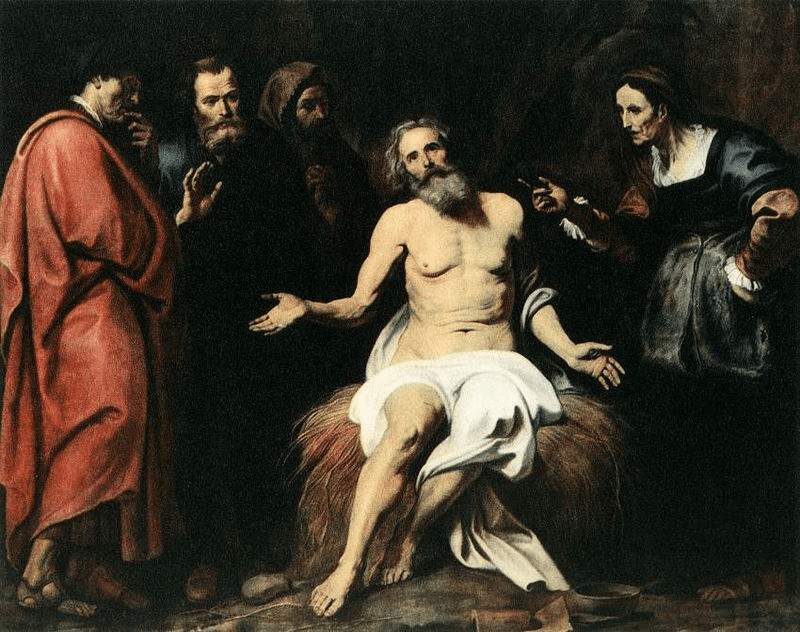
Job with his friends, by Gerard Seghers (1591-1651)

Then Eliphaz the Temanite replied:

“Would a wise person answer with empty notions
    or fill their belly with the hot east wind?
Would they argue with useless words,
    with speeches that have no value?
But you even undermine piety
    and hinder devotion to God.
Your sin prompts your mouth;
    you adopt the tongue of the crafty.
Your own mouth condemns you, not mine;
    your own lips testify against you.

“Are you the first man ever born?
    Were you brought forth before the hills?
Do you listen in on God’s council?
    Do you have a monopoly on wisdom?
What do you know that we do not know?
    What insights do you have that we do not have?
The gray-haired and the aged are on our side,
    men even older than your father.
Are God’s consolations not enough for you,
    words spoken gently to you?
Why has your heart carried you away,
    and why do your eyes flash,
so that you vent your rage against God
    and pour out such words from your mouth?

“What are mortals, that they could be pure,
    or those born of woman, that they could be righteous?
If God places no trust in his holy ones,
    if even the heavens are not pure in his eyes,
how much less mortals, who are vile and corrupt,
    who drink up evil like water!

“Listen to me and I will explain to you;
    let me tell you what I have seen,
what the wise have declared,
    hiding nothing received from their ancestors
(to whom alone the land was given
    when no foreigners moved among them):
All his days the wicked man suffers torment,
    the ruthless man through all the years stored up for him.
Terrifying sounds fill his ears;
    when all seems well, marauders attack him.
He despairs of escaping the realm of darkness;
    he is marked for the sword.
He wanders about for food like a vulture;
    he knows the day of darkness is at hand.
Distress and anguish fill him with terror;
    troubles overwhelm him, like a king poised to attack,
because he shakes his fist at God
    and vaunts himself against the Almighty,
defiantly charging against him
    with a thick, strong shield.

“Though his face is covered with fat
    and his waist bulges with flesh,
he will inhabit ruined towns
    and houses where no one lives,
    houses crumbling to rubble.
He will no longer be rich and his wealth will not endure,
    nor will his possessions spread over the land.
He will not escape the darkness;
    a flame will wither his shoots,
    and the breath of God’s mouth will carry him away.
Let him not deceive himself by trusting what is worthless,
    for he will get nothing in return.
Before his time he will wither,
    and his branches will not flourish.
He will be like a vine stripped of its unripe grapes,
    like an olive tree shedding its blossoms.
For the company of the godless will be barren,
    and fire will consume the tents of those who love bribes.
They conceive trouble and give birth to evil;
    their womb fashions deceit.” (New International Version)

The biblical character of Job had asked the friends to hear him out on his case against God. But they did not stay quiet and listen. Instead, they got irritated with Job and accused him of sin.

One of the three friends, Eliphaz, went from exhortation to an outright rebuke of Job. He took him to task on what he was saying, and gave Job a hellfire sermon designed to get him right with God.

Eliphaz had a problem with Job’s approach to God. Yet, we as readers know that none of this suffering was Job’s fault. In reality, it was Eliphaz who had the problem: He was stuck in a particular way of thinking to the point of not being able to entertain another’s point of view.

Each of the three friends did not distinguish between their assumptions and the truth. They had such engrained habits of thinking and living, that their minds were not open to the experience of Job being anything but sinful.

The major presupposition that Eliphaz held is that anyone who experiences such extreme hardship and suffering as Job is being punished by God. And that was a false presupposition.

There is a tragic irony with the story of Job and his friends. Eliphaz assessed Job’s situation and words as wicked. What’s more, Eliphaz believed that Job added to that sin by contending with God and insisting on his own personal innocence.

Yet, what Eliphaz said about Job was actually true about himself. Eliphaz was the one speaking out of ignorance and pride, as if he knew how the universe really works. In truth, Eliphaz was talking about himself, without knowing it.

Eliphaz presupposed, assumed, and believed that wicked persons are the ones who experience a life of pain, terror, illness, and deprivation. Thus, Job is wicked. And therefore, believed Eliphaz, Job’s future destiny was in jeopardy.

Is crying out in pain and giving a vulnerable yell toward God sin? Is it a sign of wickedness? Will it lead one to hell?

In the view of Eliphaz, yes. Because to challenge God is to rebel against God. To experience extreme suffering is a sign of personal wickedness against God.

By taking a good hard look at the entirety of the Book of Job, I can say with confidence that Eliphaz was, at best, ignorant; and, at worst, hurtful. He had no idea how off target he really was. The sinner in the room was not Job; it was Eliphaz.

The friends had too simple and easy of a theology of suffering. They equated Job’s suffering with God’s punishment. Reading the story of Job, however, challenges that simplistic theology.

Job insisted that his supposed punishment was undeserved. And he was right. Terrible misfortune is not necessarily a result of personal sin or wickedness.

The piety of Job was strong enough to accept the misfortune that fell upon him, without rebelling against God (Job 1:10). Yet, Job’s faithfulness to God could not make sense between his agonizing suffering, the loss of property and family, and God’s silence and purpose in it all.

And maybe that is, in part, the point of the Book of Job – that there are people all over the world who undergo hard circumstances and grinding loss, without knowing why they are going through it.

Hopefully, this awakening to the suffering of others will kindle within us a more compassionate spirit and empathetic presence with those feeling the nonsensical situations of their lives.

Almighty God, I bring to you all those who suffer in body, mind, spirit or with grief. May your loving kindness and divine presence sustain them in the midst of their pain. May those who are stretched beyond their capacity to cope and remain hopeful gain a sense of coherence, comfort and strength in the Lord. Amen.

Suffering That Is Beyond Understanding (Job 2:11-3:26)

When Job’s three friends, Eliphaz the Temanite, Bildad the Shuhite and Zophar the Naamathite, heard about all the troubles that had come upon him, they set out from their homes and met together by agreement to go and sympathize with him and comfort him. 

When they saw him from a distance, they could hardly recognize him; they began to weep aloud, and they tore their robes and sprinkled dust on their heads. Then they sat on the ground with him for seven days and seven nights. No one said a word to him, because they saw how great his suffering was.

After this, Job opened his mouth and cursed the day of his birth. He said:

“May the day of my birth perish,
    and the night that said, ‘A boy is conceived!’
That day—may it turn to darkness;
    may God above not care about it;
    may no light shine on it.
May gloom and utter darkness claim it once more;
    may a cloud settle over it;
    may blackness overwhelm it.
That night—may thick darkness seize it;
    may it not be included among the days of the year
    nor be entered in any of the months.
May that night be barren;
    may no shout of joy be heard in it.
May those who curse days curse that day,
    those who are ready to rouse Leviathan.
May its morning stars become dark;
    may it wait for daylight in vain
    and not see the first rays of dawn,
for it did not shut the doors of the womb on me
    to hide trouble from my eyes.

“Why did I not perish at birth,
    and die as I came from the womb?
Why were there knees to receive me
    and breasts that I might be nursed?
For now I would be lying down in peace;
    I would be asleep and at rest
with kings and rulers of the earth,
    who built for themselves places now lying in ruins,
with princes who had gold,
    who filled their houses with silver.
Or why was I not hidden away in the ground like a stillborn child,
    like an infant who never saw the light of day?
There the wicked cease from turmoil,
    and there the weary are at rest.
Captives also enjoy their ease;
    they no longer hear the slave driver’s shout.
The small and the great are there,
    and the slaves are freed from their owners.

“Why is light given to those in misery,
    and life to the bitter of soul,
to those who long for death that does not come,
    who search for it more than for hidden treasure,
who are filled with gladness
    and rejoice when they reach the grave?
Why is life given to a man
    whose way is hidden,
    whom God has hedged in?
For sighing has become my daily food;
    my groans pour out like water.
What I feared has come upon me;
    what I dreaded has happened to me.
I have no peace, no quietness;
    I have no rest, but only turmoil.” (New International Version)

Job and His Friends, by Ilya Repin, 1869

By anyone’s definition of trouble, the biblical character of Job was in a world of it. Through a series of terrible calamities in which he lost all his children and his earthly possessions, Job was sitting in misery with painful sores on his body from head to toe.

We as readers of Job’s story, have been informed of the behind the scenes discussion between God and Satan. Out of that conversation, Satan was allowed to do anything to Job except outright kill him. (Job 1:1-12)

Job and his “friends,” however, were not privy to any of that insider information. All they knew was the bald reality concerning Job’s loss of family, property, and health. When the friends heard of the tragedies, they came to visit him. And upon seeing Job, they barely recognized him, devastated from the harsh circumstances of his experiences.

What would you do if you were Job? I’ve seen people give up on life altogether, having gone through a lot less than Job. What would you do if you were the friends? I’ve known people that didn’t even have their friends show up, at all, when they went through extreme difficulties.

Sometimes I feel as if I’m in the business of being a chaplain to the Job’s of this world. I consider myself a creative guy, but the experiences and stories from some of the patients I’ve seen, I don’t think I could ever have imagined. There are hardships some folks have lived through that have no words. “Trauma” is an understatement for them.

That was the spiritual and emotional territory for Job. Yet, he held fast to his commitment toward God. But that didn’t mean Job was going to keep quiet and be passive before God or anyone else.

Job was in such a holistic state of misery that he wished he were never born. Both body and soul were hurting beyond hurt.

It is laughable to me to consider that Job would have ever said anything like, “Well, there are others who have it worse than me!” “I could be more thankful for what I have!” “My wife is alive. I need to be strong for her.” And yet, people in awful situations tell themselves things like this every day.

Then, there are the friends. Within the biblical Book of Job, they are actually at their best in the beginning of the story. That is, they are quiet and don’t say a thing. Later, when they open their mouths, we get them saying shortsighted and ignorant things.

In our quest to make sense of unwanted and unasked for situations, we try to understand what is going on. But not everything is going to make sense. There is a chunk of life that will forever be nonsense to us. And it isn’t our task in this life to figure everything out – namely because there are some things that are well beyond our ever figuring out.

In saying that, it doesn’t mean that I am a nihilist. If you perhaps think that, then maybe you have an inordinate need to know all things and how they work.

Instead, I am pointing out something that may seem simple, in the midst of people’s lives that are incredibly complex with all sorts of strange permutations to them:

  1. If you have been through something life-changing, you need to tell your story to someone. To connect with another person who cares about what you are going through is vital. You cannot live without it.
  2. If your friend has been through something life-changing, you need to listen to their story, without immediate comment or thinking about how to respond. Your caring affect and demeanor is what just may save their life.

This is actually difficult work. Stories can be hard, because life can be hard. Listening is hard, because it hurts to hear another’s pain.

But it is more necessary than you could ever imagine.

As Jesus cried out on the cross, I cry out to you in pain, O God my Creator. Do not forsake me. Grant me relief from this suffering and preserve me in peace; through Jesus Christ my Savior, in the power of the Holy Spirit. Amen.