Christ’s Parable of the Weeds (Matthew 13:24-30, 36-43)

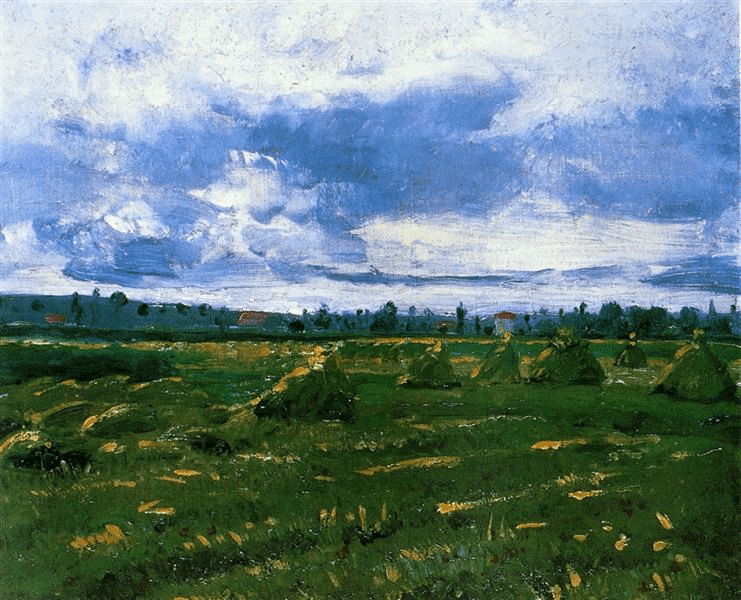
Wheat Fields with Stacks, by Vincent Van Gogh, 1888

Here is another story Jesus told: “The Kingdom of Heaven is like a farmer who planted good seed in his field. But that night as the workers slept, his enemy came and planted weeds among the wheat, then slipped away. When the crop began to grow and produce grain, the weeds also grew.

“The farmer’s workers went to him and said, ‘Sir, the field where you planted that good seed is full of weeds! Where did they come from?’

“‘An enemy has done this!’ the farmer exclaimed.

“‘Should we pull out the weeds?’ they asked.

“‘No,’ he replied, ‘you’ll uproot the wheat if you do. Let both grow together until the harvest. Then I will tell the harvesters to sort out the weeds, tie them into bundles, and burn them, and to put the wheat in the barn….’”

Then, leaving the crowds outside, Jesus went into the house. His disciples said, “Please explain to us the story of the weeds in the field.”

Jesus replied, “The Son of Man is the farmer who plants the good seed. The field is the world, and the good seed represents the people of the Kingdom. The weeds are the people who belong to the evil one. The enemy who planted the weeds among the wheat is the devil. The harvest is the end of the world, and the harvesters are the angels.

“Just as the weeds are sorted out and burned in the fire, so it will be at the end of the world. The Son of Man will send his angels, and they will remove from his Kingdom everything that causes sin and all who do evil. And the angels will throw them into the fiery furnace, where there will be weeping and gnashing of teeth. Then the righteous will shine like the sun in their Father’s Kingdom. Anyone with ears to hear should listen and understand! (New Living Translation)

As you have likely noticed, not everyone in this world is supportive of you and what you’re doing.

The good work we do – no matter how competently and expertly done – will be undermined by others. There will be people with selfish and sinister agendas who put roadblocks in our way to frustrate our ongoing work. They don’t like what we are doing and what we’re trying to accomplish.

Unfortunately, that’s just the way it is. So then, one of the big questions for all of us is this: How do we live with others trying to subvert the good work we are doing for the Kingdom of Heaven?

One of the most popular responses is to strike the enemy on their cheek just as hard or harder in the way they slapped you. It is responding to evil in kind.

But if we will ponder for a moment, we shall realize that is makes no sense to repay evil with evil. Why? Because then the Kingdom of Hell has just snagged this one with doing evil in order to defend good work – which ends-up ruining the whole enterprise.

No, instead let’s heed the words of Christ to turn the other cheek and not retaliate; and live the words of the Apostle Paul who reminded us to overcome evil by doing good. (Matthew 5:38-42; Romans 12:14-21)

Yes, all judgment belongs to the Lord, and not us. In today’s Gospel lesson the reasoning Jesus provides for non-retaliation and non-violence is both reasonable and practical.
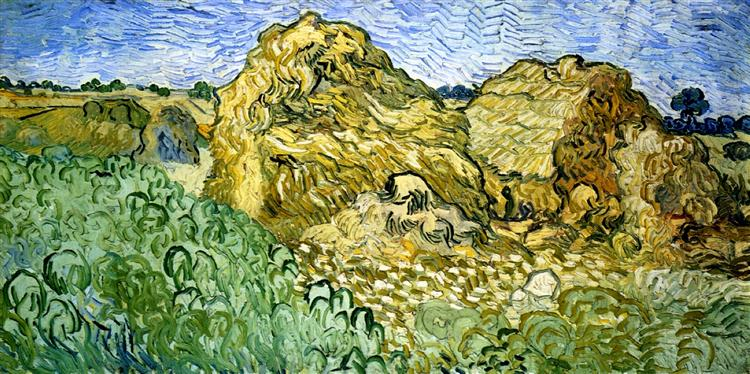
Field with Stacks of Wheat, by Vincent Van Gogh, 1890

Christ told his disciples that the enemy’s efforts at thwarting our good works are sinister enough to bring about a situation where evil is so close to the good that to eradicate the evil is to therefore also do away with the good.

If you have weeds in your field or your garden, you know that some of those nasty weeds cannot be pulled out of the ground without yanking-up the good plant along with it. Instead, you’ll have to wait until you can harvest the plant, and then you can safely get rid of the offending weed.

Let’s think, then, about our own situations right now in this world. For myself, it seems that every single day I am upset and angered over decisions made by those in political power, because they almost always involve oppressing and/or harming powerless people.

Yet, to immediately stop the offending persons and organizations would involve some wicked methods. Instead, if I want to maintain doing good, I will have my time to unseat them through the vote, or writing my Senators, or directly contacting the offices of the institutions, etc.

Some of our responses may seem tepid in comparison to the evil being perpetrated, yet we can be sure that there is a time coming in which the reality of divine judgment will handle the wicked once and for all. At the proper time, heaven’s angels will do their own good work of removing evil and eradicating it forever.

We need to put our efforts into doing the very best at living in harmony with one another, promoting peace, and being peacemakers – using our greatest and most effective tools of humility, gentleness, grace, and love. These are the proper fertilizers which will keep the plants of righteousness and justice growing and thriving, even though they are surrounded by a bunch of close weeds.

As maddening as it is to see those weeds grow up alongside the plants, nowhere in Holy Scripture are we called or encouraged to become judge, jury, and executioner to the wicked.

Furthermore, Christians are nowhere called to force onto others Jesus as King through a theocratic nation, using authoritarian means. We are called, rather, to put our faith where our fear is and exercise a faith that does good work through love. (Galatians 5:6)

Equipped by the Spirit, we urge oppressors, tyrants, and egotists to turn from their selfishness and amend their evil ways. And we are not called to force the Kingdom of Heaven on others by trying to ensconce a form of Christian nationalism. For Americans, many of our ancestors came to the New World in order to flee their home Christian nationalist countries who persecuted them and did evil to them.

“To identify any particular form of government with Christianity is a dangerous error, for it confounds the permanent with the transitory, the absolute with the contingent.” T.S. Eliot

It takes very little prodding for Christians with political power to move into glorifying violence and ignoring biblical injunctions to love enemies, seek peace, and grant grace.

God puts a high premium of looking after the poor and needy, and rescuing them from oppression and violence. The last thing we ought to be doing is becoming the violent oppressors ourselves!

Giving ourselves as ambassadors of reconciliation, speaking truth to power, and doing the work of peacemaking is a narrow and hard road to hoe. The easy way is typically the road of destruction. (Matthew 7:13-14)

As citizens of the Kingdom of Heaven, we are to labor toward the things Jesus himself did: Challenge the arrogant religious types; offer mercy to the lowly and forgotten ones; warn of judgment; encourage faith; forgive generously; and speak words of truth in all places, including the halls of political power.

It is perfectly legitimate to disagree with others, but only if we ourselves are willing to defend their equally legitimate right to be disagreeable.

So, instead of always trying to snuff-out and vanquish our opponents with overt tools of evil, let us do the good work of winning their respect, living in peace with them, and affirming our shared humanity together.

We all have the right to be different; we don’t have the right to do evil and reprise evil with evil. The organizations, institutions, faith communities, corporations, and governments of this world are only as good as the people guarding that goodness through their good work, utilizing good means toward good ends.

Anyone with ears ought to listen and understand.

God of steadfast love and grace: Teach us your way and your truth. Root us in you alone, and help us to grow in grace and love, so that we may fulfill our role and our work in the reign of Jesus Christ our Lord. Amen.


Matthew 5:5 – Blessed Are the Meek

Blessed are the meek,
    for they will inherit the earth. (NIV)

To give us a flavor of Christ’s counter-cultural Beatitudes, when was the last time, or has anyone ever, described themselves to you as meek?

Whenever I have interviewed people for positions, both paid and voluntary, and asked them to tell me their strengths, I have never had anyone say to me, “I’m a meek person.”

Why would I want to be meek?

Far too often, we equate meek with weak. If someone is meek, we may wrongly reason they must be a washrag, or overly introverted, and maybe not taking proper initiative in life. Of all the character qualities we might aspire to, I doubt that meekness is on anyone’s top ten list of desired qualities.

Yet, of the few words in the Gospels which Jesus uses to describe himself, one of those words is meek. And even then, many English translations steer clear of the word. For example, the New International Version of the Bible says in translating the words of Jesus, “Come to me all you who are weary and burdened, and I will give you rest. Take my yoke upon you and learn from me, for I am gentle and humble in heart, and you will find rest for your souls. For my yoke is easy and my burden is light.” (Only the King James Version translates the word as “meek,” instead of “gentle.”)

What does it mean to be meek?

Meek and gentle are the same words. The original Greek word is πραεῖς (pronounced “prah-ace”). “Meek” is the word used in other ancient Greek literature for breaking a horse. It is to be changed from being a wild stallion who wants to go his own way, to a broken horse who is gentle before the Master and allows others on his back without bucking.

Consider, for example, the scene around Christ’s crucifixion. Jesus was naked, exposed, and vulnerable to the idle curiosity of the crowd and the vulgar frivolity of the soldiers who were having a party around his suffering. “If you are the king of the Jews,” they taunted, “save yourself.”

And yet the extraordinary thing is there was no spirit of revenge with our Lord. Jesus did not curse his tormentors. Instead, he prayed, “Father forgive them, for they don’t know what they’re doing.” (Luke 23:24)

It is important to notice the meekness that Jesus is speaking about in this Beatitude is not being a pushover. Meekness is not to be confused with being nice and easy-going. Meek and lowly as he was, Jesus could also take a whip to greedy money-changers in the Temple. We must not confuse meekness with weakness.

What characterizes a meek person?

Whereas poverty of spirit is more a humility before God, meekness is a humility toward other people. It is to be flat on our backs with only one way to look: up to God; and because we are in that position, there is no opportunity to look down on others. 

Meekness is a foundational Beatitude. Jesus considers it a necessary part of righteousness. I believe the word “meek” needs a renaissance. Even if we use the word “gentle” this will be a great advancement in how people interact with one another. So, what characterizes a meek person?

  • The meek have a desire to put other’s interests ahead of their own, because they know it is not all about them. They practice healthy rhythms of giving and receiving with others, without prejudice or favoritism.
  • The meek are more concerned with edifying and building up their brothers and sisters than justifying themselves. They don’t care who gets the credit. And they receive criticism well.
  • The meek are truly egalitarian and do all things with equity and inclusion. They make no distinctions between rich and poor, beautiful and ugly, intelligent and cognitive deficits, black and white, gay and straight, Democrat and Republican, or insider and outsider. In the meek person’s mind, every person is created in the image of God and therefore deserves respect, attention, and justice.

It is the meek who will inherit the earth – not aggressive people who believe in survival of the fittest, stepping on people to get where they want to go, or badgering others in order to get their way. 

Someone might protest, “But if I live this way, I’ll be pushed around.”  Meekness is not living without boundaries but is power under control. Maybe you will get stepped on – but you will inherit the earth.

How do I live as a meek person?

The three Beatitudes of being poor in spirit, mourning over sin, and meekness toward others are foundational to all that Jesus says and does. They are central to being Christ’s follower. Without them, there is only a contrived legalistic righteousness of our own without any real need of God. That is the way of pride, which is the straight and broad road to hell. 

Perhaps repentance is in order. It could be that too many people have made much more of themselves than what they truly are. Maybe we have adopted a soft attitude toward shame and shaming others, believing that some people need a bit of guilt from us to change their obnoxious ways. Perhaps we have paid scant attention to those who are in physical or spiritual poverty. And just maybe we have ignored and gossiped about others simply because we believe we are better than them.

A genuine follower of Christ lives a repentant lifestyle. The Apostle James said, “Confess your sins to one another, and pray for one another so that you may be healed” (James 5:16).  The way of Christ is the way of community. We are not to live ingenuine lives, hiding behind a mask of outward conformity. Now is the time for authenticity, living life as God intended it to be lived, as a disciple of Jesus in the way of spiritual poverty, mourning, and meekness – the narrow path that leads to salvation.

Non-retaliation happens when we realize our poverty of spirit and practice grief and lament. When we are flat on our backs before God, there is no place to look but up. And it means there is no ability to look down on others. It is to be broken and moldable before God. 

If you and I were part of the original crowd that listened to Jesus, there is hope. I have no ability to practice retaliation, even if I wanted to, because I have no earthly power. But that’s okay because, in this spirit of meekness, I take personal responsibility for my attitudes and my actions. I am neither worse nor better than any other person. I do not need to retaliate, even when egregiously wronged, because I can fully entrust myself to God alone who judges the living and the dead. 

Conclusion

It turns out that brokenness is the path to genuine righteousness. Jesus promised that the meek will inherit the earth. Christ didn’t just make that up. He was quoting Holy Scripture:

Do not fret because of those who are evil
    or be envious of those who do wrong;
for like the grass they will soon wither,
    like green plants they will soon die away.

Trust in the Lord and do good;
    dwell in the land and enjoy safe pasture.
Take delight in the Lord,
    and he will give you the desires of your heart.

Commit your way to the Lord;
    trust in him and he will do this:
He will make your righteous reward shine like the dawn,
    your vindication like the noonday sun.

Be still before the Lord
    and wait patiently for him;
do not fret when people succeed in their ways,
    when they carry out their wicked schemes.

Refrain from anger and turn from wrath;
    do not fret—it leads only to evil.
For those who are evil will be destroyed,
    but those who hope in the Lord will inherit the land.

A little while, and the wicked will be no more;
    though you look for them, they will not be found.
But the meek will inherit the land
    and enjoy peace and prosperity. (Psalm 37:1-11, NIV)

Jesus was saying that only the truly meek will learn contentment, joy, and satisfaction. Their ego is not so inflated that they insist they deserve more. Indeed, because as God’s people they are learning from him, the meek understand they are co-heirs with Christ in an inheritance of God’s kingdom.

May your meekness and gentleness be known to all.

*Above painting by Hyatt Moore