Born from Above (John 3:1-17)

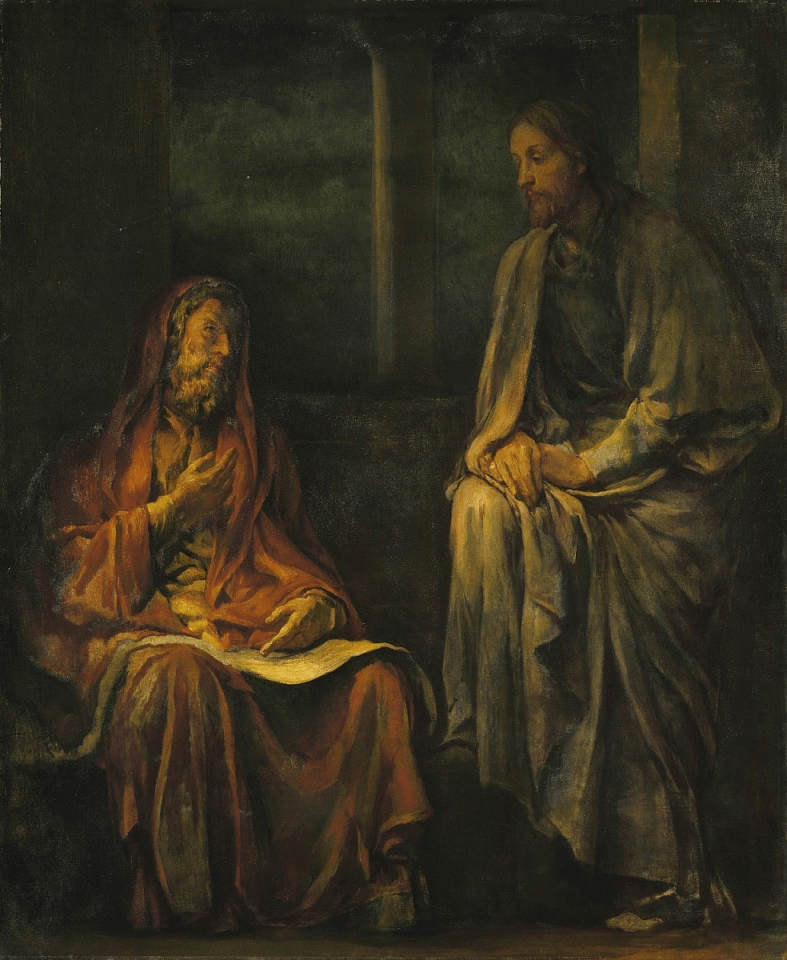
Visit of Nicodemus to Christ, by John LaFarge, 1880

Now there was a Pharisee named Nicodemus, a leader of the Jews. He came to Jesus by night and said to him, “Rabbi, we know that you are a teacher who has come from God, for no one can do these signs that you do unless God is with that person.” 

Jesus answered him, “Very truly, I tell you, no one can see the kingdom of God without being born from above.”

Nicodemus said to him, “How can anyone be born after having grown old? Can one enter a second time into the mother’s womb and be born?” 

Jesus answered, “Very truly, I tell you, no one can enter the kingdom of God without being born of water and Spirit. What is born of the flesh is flesh, and what is born of the Spirit is spirit. Do not be astonished that I said to you, ‘You must be born from above.’The wind blows where it chooses, and you hear the sound of it, but you do not know where it comes from or where it goes. So it is with everyone who is born of the Spirit.” 

Nicodemus said to him, “How can these things be?” 

Jesus answered him, “Are you the teacher of Israel, and yet you do not understand these things?

“Very truly, I tell you, we speak of what we know and testify to what we have seen, yet you do not receive our testimony. If I have told you about earthly things and you do not believe, how can you believe if I tell you about heavenly things? No one has ascended into heaven except the one who descended from heaven, the Son of Man. And just as Moses lifted up the serpent in the wilderness, so must the Son of Man be lifted up, that whoever believes in him may have eternal life.

“For God so loved the world that he gave his only Son, so that everyone who believes in him may not perish but may have eternal life.

“Indeed, God did not send the Son into the world to condemn the world but in order that the world might be saved through him. (New Revised Standard Version)

Christians serve a triune God – Father, Son, and Spirit. This Holy Trinity of three persons, yet one God, conspires to plan and orchestrate the deliverance of people from sin, death, and hell. The Lord makes it possible for people to be born again.

Maybe you’re ready to tune out with the phrase “born again” or “born from above” because either this is old hat to you; or you want to distance yourself from the obnoxious evangelist who is the pester pup toward others’ salvation.

However, today’s Gospel lesson is for me and you. So instead of tuning out, consider the person of Nicodemus in the story:

  • Served God
  • Good guy
  • Upstanding Jewish citizen
  • Devout and pious man
  • Faithful temple worship attendance
  • Member of a prestigious religious group 

And yet, it was to Nicodemus that Jesus said, “You must be born again.” But why? Because although Nicodemus was a really good egg, he was an adoring fan of Jesus, but not a committed follower of Jesus.

Nicodemus Visiting Christ, by Henry Ossawa Tanner, 1899

Admiration and kudos isn’t the same as taking up your cross and following Christ. Nicodemus didn’t need to adjust his life and make some tweaks here and there; it was time for a new life in walking the path of discipleship with Jesus.

The further away we are from birth, the easier it is to take God for granted; and to have a spiritually settled way of life in which the mystery, wonder, and awe of life is slowly drained from us. That’s why I think two year olds probably know more about God than anyone around – since they can articulate the wonder of life being only a few short years from their birth. 

One night I came home and walked into the kitchen to find my then four-year old grandson unashamedly crawling on all fours with his face barely off the floor. I said, “What in the world are you doing?” He looked up at me with a twinkle in his eye and a serious tone in his voice and said, “I’m sniffing for clues.” 

I honestly do not expect you to sniff for clues on your kitchen floor. But would any of us be found sniffing for clues of God? Would we seek hard and doggedly pursue the Lord? 

Because Nicodemus was such a good guy, he did not see himself in need of new life. Meeting Jesus at night is deeply symbolic of the fact that Nicodemus was literally in the dark about his spiritual condition. He was actually clueless to many of God’s ways, and how the world works in God’s kingdom. Nicodemus maintained a respectable distance as a fan of Jesus.

How do we move from being a fan to a follower of Jesus? 

Believe. To believe in Jesus means to move from only an intellectual faith of acknowledging doctrinal beliefs about Christ and God. There is to be movement from observing the works of God to a life of complete trust as a dedicated follower of Jesus.

Christian discipleship is more than asking Christ to help out in a jam or bad situation. And it is certainly more than praying a particular prayer. Rather, it’s letting Jesus decide what to do with us and remove any shortcomings, character defects, guilt, shame, and general crud from us.

We are to be made pure, to be cleansed – as if we were a new person or born again, from above. There is the willingness to depend on something other than myself, my resources, and my connections.

In Christianity, Jesus is much more than a wise teacher and a miracle worker; Christ is Savior for whom the follower gives complete allegiance to. In other words, we let Jesus use us for divine purposes, instead of us using Jesus for our own puny human purposes.

Let us intentionally and deliberately relinquish control of our lives, and of everything, to Jesus and become his faithful followers. Information is not transformation; and, seeing transformation in another person’s life is not a substitute for transformation in my own life.

Interview Between Jesus and Nicodemus, by James Tissot (1839-1902)

Nicodemus had to grab ahold of the reality that Jesus did not only come to save others, but to save him, as well.  We must be born from above, to have a new life, to be “born of water and spirit.” Nicodemus would have immediately been reminded of John the Baptist’s ministry of a baptizing for the repentance and forgiveness of sins. 

Jesus was letting Nicodemus know that he, too, needed repentance from trusting in those good deeds, and of simply acknowledging Christ. The practices of fasting, praying, and giving; and the dedication to thrift and morality is quite admirable. Yet, these are not the things which move a person from darkness to light. And they don’t give us a leg up to heaven.

Jesus is the One who has worked hard for us. God conceives us as Christians, and then nurtures us in the womb of faith. At some point, we come to full term, and God births us spiritually into new life. 

Maybe it’s time to move from darkness to light; from staying warm and cozy inside the womb to the bright outside world; from being a fan of Jesus to a follower of Jesus; from being in the dark audience to the bright lights of the stage for all to see. 

The issue is not in saving yourself, but to let God be God; and let God do the work in you that God wants to do. 

If there is no gestation from Jesus as Teacher to Jesus as Savior, there is no birth. If there is no gestation from Jesus as Miracle-Worker to Jesus as Savior, there is no birth. 

The Apostle John was making the point here in describing the conversation that if Nicodemus, who is the upstanding religious citizen, needed to be born again by Jesus, then how much more do we need to have a new life, to move from the comfortable confines of being a fan to the playing field of being a follower of Jesus?

Jesus does not need a bunch of groupies admiring him at night. But conversely, we need Jesus.

Fans sometimes confuse their admiration for devotion; people mistake their knowledge of Jesus for an actual relationship with Jesus. Fans assume that their good works and good intentions are sufficient. Yet, new life requires giving up an old life. And that, my friends, is what’s at stake in Christian discipleship.

May God the Holy Trinity make us strong in faith and love, and birth us into new life through Christ our Lord. Guide us in truth and peace; and may the blessing of God Almighty – Father, Son, and Holy Spirit – be among us, and remain with us always. Amen.

Speak To the Dry Bones (Ezekiel 37:1-14)

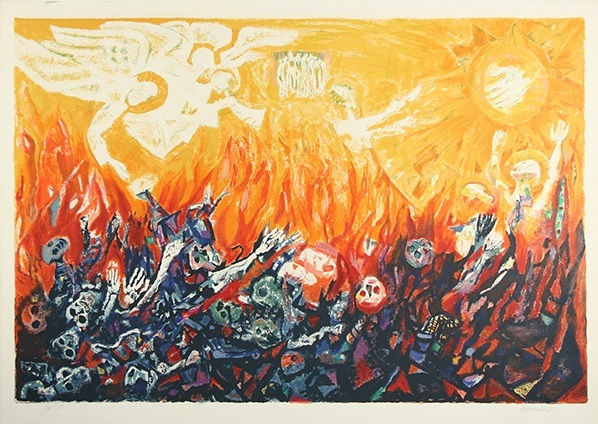
Valley of the Dried Bones, by Abraham Rattner (1895–1978)

The power of the Lord came over me. The Lord brought me out by his Spirit and put me down in the middle of a valley. The valley was filled with bones. He led me all around them. I saw that there were very many bones at the bottom of the valley, and they were very dry.

Then he asked me, “Son of man, can these bones live?”

I answered, “Only you know, Almighty Lord.”

Then he said to me, “Prophesy to these bones. Tell them, ‘Dry bones, listen to the Lord’s word. This is what the Almighty Lord says to these bones: I will cause breath to enter you, and you will live. I will put ligaments on you, place muscles on you, and cover you with skin. I will put breath in you, and you will live. Then you will know that I am the Lord.’ ”

So I prophesied as I was commanded. While I was prophesying, suddenly there was a rattling noise, and the bones came together, one bone attaching itself to another. As I looked, I saw that ligaments were on them, muscles were on them, and skin covered them. Yet, there was no breath in them.

Then the Lord said to me, “Prophesy to the breath! Prophesy, son of man. Tell the breath, ‘This is what the Almighty Lord says: Come from the four winds, Breath, and breathe on these people who were killed so that they will live.’ ”

So I prophesied as he commanded me, and the breath entered them. Then they came to life and stood on their feet. There were enough of them to form a very large army.

The Lord also said to me, “Son of man, all the people of Israel are like these bones. The people say, ‘Our bones are dry, and our hope has vanished. We are completely destroyed.’ So prophesy. Tell them, ‘This is what the Almighty Lord says: My people, I will open your graves and take you out of them. I will bring you to Israel. Then, my people, you will know that I am the Lord, because I will open your graves and bring you out of your graves. I will put my Spirit in you, and you will live. I will place you in your own land. Then you will know that I, the Lord, have spoken, and I have done it, declares the Lord.’ ” (God’s Word Translation)

Dry. It might be good for humor or a martini. Dry, however, doesn’t feel good when it’s a time of spiritual dryness.

Perhaps you are dry. It seems the entire world is dry. Wars, conflict, death, violence, uncertainty, unrest, and upset people everywhere is evidence that there is dryness across the earth. Many institutions, organizations, companies, and faith communities have become so withered and dry, that they have folded and died.

The hard circumstances of our world, stress in our families, and challenging personal lives may easily create anxiety, and, so, parch our souls and leave our spirits bone dry. There is, however, a God who can breathe new life into us and move us from old-worn ruts in our thinking, feeling, and behaving, to renewed ways of being in the world. 

The prophet Ezekiel’s vision is a promise and a hope of resurrection, revival, and new life. Regardless of who we are and the situations in front of us, we are all displaced people – cast out of Eden and in need of restoration. 

We, along with the ancient Israelites, are in exile and long to return to our true home with God. Along with St. Augustine we declare that our “hearts are forever restless until they find their rest in God.”

Maybe you are presently experiencing the dry bones of hopelessness and despondency. Perhaps you are in a dark night of the soul where all of life seems like one huge rut. It could be you are wondering if God is really listening, or is even there at all, because of the dry bones surrounding you.

In my work as a hospital chaplain I often encounter patients who are, ironically, bone dry from too much drinking. Their alcoholism is like a massive desert littered with thousands of dry bones. Attempting to reanimate themselves while dulling the pain of incredibly hard dry circumstances, they drink liter after liter of “spirits” to replace the dead spirit inside them. Some become so dry and dead inside their immaterial selves, that they seek to end their material lives through suicide.

But it need not be this way. We might believe we will be able to live life and pursue God better without danger or hardship – that somehow difficulty is not to be part of life. The dry bones exist, however, as an opportunity for God to give life. That’s why Alexander Solzhenitsyn’s reaction to his exile in a Soviet labor camp in Siberia was to bless it, because it was there he said:

“I discovered that the meaning of earthly existence lies not, as we have grown used to thinking, in prospering, but in the development of the soul.”

Alexander Solzhenitsyn

God not only gives life; God restores life. And this is an important truth to know and remember in the inevitable dry times of our lives. God is not only a helper; the Lord reanimates us from spiritual rigor mortis to lively resurrection through breathing on us. And this is done for a reason. Jesus came to his disciples after his resurrection and said:

God resuscitates us for a purpose, so that we might be a blessing to the world. Faith is not only a possession to keep, but a gift to give. We glorify God in loving one another and loving the world as Jesus did.  God could have resurrected the bones without Ezekiel. Instead, the Lord used Ezekiel and had him participate in the revival by speaking to the bones. 

Such a challenge to speak to the dry bones can seem overwhelming to us. What do you do when your life is upended, even shattered – when such a profound change comes to you that it is impossible for your life to be as it was? 

The questions and commands of God seemed totally absurd to Ezekiel, speaking to dead dry bones. Yet methinks we ought to operate more in the realm of the absurd than in the realm of the safe routine.

Perhaps we ought to expect our faith to be exercised and look for God to breathe new life into the dead and decaying. To believe that something, someone, or even myself can change is to have internalized this amazing story of dry bones living again. 

Our self-imposed graves cannot hold us because God is among us.

We need a genuine heaven-sent, Spirit-breathed, glorious reanimation in which God sends reviving grace and raises the dead. 

Lord of Resurrection, please be attentive to our prayers; and make what is impossible possible:

For those without hope – feeling dried up and cut off from you – open their graves and bring them back to the land of the living.

For those spiritually oppressed – held captive by sin – release them from their chains and let them go! For those who weep – lost and lifeless in a tomb of fear and shame – give them the peace of your presence, and show them what your love can do.

For those complacent – withering on the vine, and living a dull dry existence without any spiritual vigor – awaken them, O Lord! Breathe into them new life!

Pour out your Spirit, gracious God, and awaken all kinds of people to a revival of obedience, love, and courage.

May your people be so full of your Spirit that life comes rolling off our tongues and the strength of life empowers our hands for service. Amen.

Magic vs. Miracle (Acts 8:9-25)

Peter’s Conflict with Simon the Sorcerer, by Avanzino Nucci, 1620. Simon is on the right, wearing black.

Now for some time a man named Simon had practiced sorcery in the city and amazed all the people of Samaria. He boasted that he was someone great, and all the people, both high and low, gave him their attention and exclaimed, “This man is rightly called the Great Power of God.” They followed him because he had amazed them for a long time with his sorcery. 

But when they believed Philip as he proclaimed the good news of the kingdom of God and the name of Jesus Christ, they were baptized, both men and women. Simon himself believed and was baptized. And he followed Philip everywhere, astonished by the great signs and miracles he saw.

When the apostles in Jerusalem heard that Samaria had accepted the word of God, they sent Peter and John to Samaria. When they arrived, they prayed for the new believers there that they might receive the Holy Spirit, because the Holy Spirit had not yet come on any of them; they had simply been baptized in the name of the Lord Jesus. Then Peter and John placed their hands on them, and they received the Holy Spirit.

When Simon saw that the Spirit was given at the laying on of the apostles’ hands, he offered them money and said, “Give me also this ability so that everyone on whom I lay my hands may receive the Holy Spirit.”

Peter answered: “May your money perish with you, because you thought you could buy the gift of God with money! You have no part or share in this ministry, because your heart is not right before God. Repent of this wickedness and pray to the Lord in the hope that he may forgive you for having such a thought in your heart. For I see that you are full of bitterness and captive to sin.”

Then Simon answered, “Pray to the Lord for me so that nothing you have said may happen to me.”

After they had further proclaimed the word of the Lord and testified about Jesus, Peter and John returned to Jerusalem, preaching the gospel in many Samaritan villages. (New International Version)

Simon the Sorcerer was quite a character. For that matter, so was Simon Peter. The contrast between them, however, shows that there were really no similarities between the two – even though the Sorcerer tried to make it so.

The Sorcerer reminds me of the church elder who is a continual suck-up to the pastor. Those sorts of parishioners always drive me nuts in the ministry. I have known plenty of them over the years, who put on a façade of politeness and speak with flattery; but their real agenda is to have power, by any means possible.

People like Simon the Sorcerer have always existed, ever since the fall of humanity into sin. They aren’t committed to anything but themselves. Their actions are motivated by the accumulation of information so that they can use that knowledge to leverage for more power and control.

What is so sad about the Simon the Sorcerer sort of people is that they actually believe that everyone else is motivated by the very same things they are; and that the world operates on acquiring more and more control and power over it.

They need money because they believe everyone has a price. They compulsively follow influential individuals because they believe anyone can be manipulated. They continually boast (and even lie) about their importance and all the great things they have done in the past.

Perhaps most of all, the Simon the Sorcerer type person obsessively seeks attention because they believe their sense of security and self-worth are determined by how many other people like them.

The Apostles of Christ, Philip and John and Peter, saw right through the false discipleship of the Sorcerer. They didn’t need to know all the events of Simon’s past to clearly see that he was a bitter man who was a prisoner to the guilt and shame he carried around in his heart.

simony: The buying or selling of advantages for positions in the Church, or for religious pardons

The difference between Simon the Sorcerer and Simon Peter the Apostle is the difference between manipulative magic and divine miracles. Like the Egyptian magicians of Pharaoh, and the divinely inspired Moses, the ability to perform a great wonder of power, or spiritual sign of power, seem rather similar – that is, at first.

But the similarities of the supernatural powers are merely superficial. There are always limits to what the Sorcerer can do versus the unlimited abilities of the true believer possessing spiritual power – or even between supposed Christian faith healers and the godly believer who is gifted with being a healer.

The bottom line of it all is that the deeds of Simon the Sorcerer pointed to himself in selfish acts of self-glorification. The signs and wonders of Simon Peter – and all the other Christian Apostles – consistently pointed to the kingdom of God and validated the message of repentance and new life, faith and forgiveness, in Jesus Christ.

In other words, the Apostles did not really do any of the miracles of bringing a changed life to people; Christ himself did that, through the ministry and power of the Holy Spirit. It was a message about release and freedom from the dark forces of Satan, and the ability to live a good, just, and right life without having to pay for it in any way.

Today, although few people practice an overt form of magic as the ancients once did, we still must be wary of those who promise magical results for whatever we need or what ails us.

One could argue that much of contemporary marketing and consumerism are a modern form of buying into the magical thinking that my life can be mystically and unexplainedly improved through using a particular product (or a certain church consultant!).

The easy way is most typically the approach of the Sorcerer and charlatan; it doesn’t really change anything, or require anything of us, especially when it comes to the human heart. It never truly brings about a better world.

The way of the cross, however, is a hard road – the narrow way – and few end up finding it. The old life must go in order to make way for the new life. There must be a crucifixion before there can ever be a resurrection.

God, you sent your Son into the world that we might live through him. May we abide in his risen life so that we may bear the fruit of love for one another and know the fullness of joy. Amen.

Persecuted (Acts 8:1b-8)

A scene from the movie, “Paul, Apostle of Christ,” in which Saul sought to wipe out Christians beginning with the stoning of Stephen

On that day a great persecution broke out against the church in Jerusalem, and all except the apostles were scattered throughout Judea and Samaria. Godly men buried Stephen and mourned deeply for him. But Saul began to destroy the church. Going from house to house, he dragged off both men and women and put them in prison.

Those who had been scattered preached the word wherever they went. Philip went down to a city in Samaria and proclaimed the Messiah there. When the crowds heard Philip and saw the signs he performed, they all paid close attention to what he said. For with shrieks, impure spirits came out of many, and many who were paralyzed or lame were healed. So there was great joy in that city. (New International Version)

Just because Christians experience the blessing of God through new life in Christ, does not mean that the rest of this earthly life will be bunnies and unicorns without any hardship.

Sometimes we forget that rabbits and horses produce manure, and we’ll have to muck out the barn. And even more than that, blessings from God are not limited to an abundance of earthly resources; blessing also comes through suffering. Jesus said:

“Great blessings belong to those who suffer persecution for doing what is right. God’s kingdom belongs to them.

“People will insult you and hurt you. They will lie and say all kinds of evil things about you because you follow me. But when they do that, know that great blessings belong to you. 

“Be happy about it. Be very glad because you have a great reward waiting for you in heaven. People did these same bad things to the prophets who lived before you.” (Matthew 5:10-12, ERV)

Saul was an up and coming Jewish Pharisee. He was intelligent, driven, and pious. Saul had the pedigree, passion, and position to go a long way and make a big splash in Judaism. And he was more than ready to do whatever it took to stamp out a heretical and dangerous sect of Jesus followers – even to the point of giving approval to the stoning of the Christian Stephen; and leading a persecution against believers like him.

Jesus not only promised abundant and eternal life to his followers, but he also promised that the cost of Christian discipleship would be persecution. Believers in Jesus Christ can expect to suffer in this life for their faithful commitment. Yet, because Christ overcame the world, we too, can accept, cope, and transcend any persecution and trouble we face in our embrace of faith. Jesus said:

“The world will make you suffer. But be brave! I have defeated the world!” (John 16:33b, GNT)

Even though the unity the believers enjoyed together in Jerusalem was disrupted and destroyed by the leadership of Saul, God bent the adverse situation toward blessing. Christians were flung all over the known world. In their going, they obeyed the words of their Lord Jesus to proclaim the message they so wholeheartedly embraced.

When Jesus came near, he spoke to them. He said, “All authority in heaven and on earth has been given to me. So wherever you go, make disciples of all nations: Baptize them in the name of the Father, and of the Son, and of the Holy Spirit. Teach them to do everything I have commanded you.

“And remember that I am always with you until the end of time.” (Matthew 28:18-20, GW)

The ancient prophesies were becoming realized. Grace, mercy, and peace were overcoming bitterness, judgment, and enmity toward one another. Even though persecution was happening, there was now a very different response to it, which will lead to a new outcome. In the last days…

The Lord will mediate between nations
    and will settle international disputes.
They will hammer their swords into plowshares
    and their spears into pruning hooks.
Nation will no longer fight against nation,
    nor train for war anymore. (Isaiah 2:4, NLT)

Suffering can be tolerated, even embraced, whenever we are aware that it can lead us to peace and joy – both personally and communally. Instead of evil taking root amongst a people, good seeds can be planted in the heart of humanity. And when those seeds are watered and nurtured, they grow to become a blessing for the world.

Finally, Jesus said, “What is God’s kingdom like? What story can I use to explain it? It is like what happens when a mustard seed is planted in the ground. It is the smallest seed in all the world. But once it is planted, it grows larger than any garden plant. It even puts out branches that are big enough for birds to nest in its shade.” (Mark 4:30-32, CEV)

Spiritual growth is built into Christianity. The faith formation and development of both individual believers and churches is important. Without it, Christians devolve into cliques of special interest groups.

But with it, Christianity becomes a blessing to the world, that is, if believers focus on producing and harvesting the spiritual fruit of love, joy, peace, patience, kindness, generosity, faithfulness, gentleness, and self-control. (Galatians 5:22-23)

Whenever and wherever believers and followers of Jesus are spiritually growing in their faith, they become like exorcists who organically purge unhealthy institutional systems of their moral corruption, selfishness, idolatry, hate, in-fighting, obsessions, bitterness, rage, competitive oppositions, conflict, and polarizing group rivalries. (Galatians 5:19-21)

Christianity is meant to bring joy and healing of both body and soul. If it doesn’t do this, then it has become just another unjust and unhealthy organization that is in need of purging its impurities; and embracing its mandate to uphold the common good of all persons through proclamation of good news and committed to a lifestyle of loving one another as Christ has loved us.

For people pay attention to that which is right, just, and good – because righteousness, justice, and goodness are in everyone’s spiritual DNA.

Almighty and gracious God of all:
Remember Christ, your Son, who is peace itself,
and who has washed away our hatred with his blood.
Because you love all men and women everywhere,
look with mercy on all who are engaged in battles of the flesh and the spirit.
Banish the violence and evil within all combatants of both body and soul
so that one day, we may all deserve to be called your sons and your daughters.
Grant this through Christ our Lord, in the enablement of the Spirit. Amen.