Revelation 21:1-6 – Making All Things New

Make All Things New by James Janknegt, 2005

Then I saw a new heaven and a new earth; for the first heaven and the first earth had passed away, and the sea was no more. And I saw the holy city, the new Jerusalem, coming down out of heaven from God, prepared as a bride adorned for her husband. And I heard a loud voice from the throne saying,

“See, the home of God is among mortals.
He will dwell with them;
they will be his peoples,
and God himself will be with them;
he will wipe every tear from their eyes.
Death will be no more;
mourning and crying and pain will be no more,
for the first things have passed away.”

And the one who was seated on the throne said, “See, I am making all things new.” Also, he said, “Write this, for these words are trustworthy and true.” Then he said to me, “It is done! I am the Alpha and the Omega, the beginning, and the end. To the thirsty I will give water as a gift from the spring of the water of life. (NRSV)

The world as we now know it will someday disappear. We have a future hope – it will literally be heaven on earth. The entire planet will be a renewed and God will descend to dwell with us. The Lord will bring us to the original design of the garden with Adam and Eve – an unhindered relationship between divinity and humanity. We shall no longer be dogged by our personal shame, institutional and systemic evil, and the temptations and oppression of Satan. Tears, death, sorrow, and pain will be a thing of the past. Eventually, our struggle with the fallen nature of everything will be completely over.

The message from the Apostle John to the early church was extremely encouraging. The people had faced all kinds of trouble and persecution due to their Christian commitment. To know that suffering only lasts for the night, but joy comes in the morning because of Jesus, changes everything. To the ancient church, as well as us today, this is a comfort and help in our present adversities.

Yet, we are such an impatient people! We want good things to happen, and now! All God’s people throughout history have been looking ahead for the ultimate fulfillment of God’s promises. The Apostle John did not  give a brand-new revelation to the church but upheld and anticipated what had been known and true for centuries. God said to the prophet Isaiah:

“See, I will create
    new heavens and a new earth.
The former things will not be remembered,
    nor will they come to mind.
But be glad and rejoice forever
    in what I will create,
for I will create Jerusalem to be a delight
    and its people a joy.
I will rejoice over Jerusalem
    and take delight in my people;
the sound of weeping and of crying
    will be heard in it no more. (Isaiah 65:17-19, NIV)

Making All Things New by Beth Lighthouse, 2018

In the first Advent of Christ, many of God’s people thought for certain all these promises would finally be realized. Yet, like a young couple in their engagement period, the promises of God had been initiated and promised, but not yet realized or consummated. The Apostle Peter addressed a common question asked throughout the ages:

“What happened to the promise that Jesus is coming again? From before the times of our ancestors, everything has remained the same since the world was first created.” (2 Peter 3:4, NLT)

Peter responded, in part, by reminding Christians:

Do not let it escape your notice, dear friends, that with the Lord a single day is like a thousand years and a thousand years are like a single day. The Lord is not slow to keep his promise, as some think of slowness, but he is patient toward you, not wanting anyone to perish but all to change their hearts and lives. (2 Peter 3:8-9, CEB)

“I am making everything new,” said Jesus. And he wanted John to get that down in writing so not to forget. God is still in the process of moving history to its final stage. Will we be patient in letting God do this work until the final day comes, or will we be impatient? 

Although we are awaiting the end of all things, this is no time to be idly sitting by, twiddling our thumbs with nervous anxiety. Nor are we to go all apoplectic with furious activity creating prophecy charts, trying to figure out exactly the day and hour of Christ’s Second Advent. No, rather, we properly anticipate the Second Coming when we let God change our hearts and lives, our neighborhoods and workplaces, our families, and churches, to be just like Christ.

God is presently preparing for Christ’s return by doing away with the old order to make room for the new. The Apostle Paul put it this way to the Corinthian Church:

When anyone is in Christ, it is a whole new world. The old things are gone; suddenly, everything is new! (2 Corinthians 5:17, ERV)

With each transformed life, we are reminded God is not slow in keeping promises but is now vigorously active preparing for the last day.

The Revelation of John helps us to break our fixation with the past and the ways we have always done things.  God’s capacity and ability to renew is astounding. Even now, we can walk now in newness of life.

We were buried with him through baptism into death, that just as Christ was raised from the dead by the glory of the Father, even so we also should walk in newness of life. (Romans 6:4, NKJV)

To avoid impatience and to keep persevering, it is helpful to have a big picture view of what God has done, is doing, and will do.

In the Fall of 1991, a car driven by a drunk driver jumped its lane and smashed headfirst into a minivan driven by a man named Jerry Sittser. He and three of his children survived, but Jerry’s wife, four-year-old child, and mother died in the crash. In his book A Grace Revealed Sittser shares the following interaction with one of his surviving children, David, months after the accident:

“Do you think Mom sees us right now?” he suddenly asked.

I paused to ponder. “I don’t know, David. I think maybe she does see us. Why do you ask?”

“I don’t see how she could, Dad. I thought Heaven was full of happiness. How could she bear to see us so sad?”

Could Lynda, my wife, witness our pain in Heaven? How could that be possible? How could she bear it?

“I think she does see us,” I finally said. “But she sees the whole story, including how it all turns out, which is beautiful to her. It’s going to be a good story, David.”

God knows the whole story. When everything dies, all is stripped from our lives, and the world as we know it is done away with, what are we left with?  God and the renewal of all things. The troubles of this present evil age will be eradicated forever.

Whenever we seek to do away with the world’s grinding poverty and the starvation of children; whenever we work to end global sex-trafficking and domestic abuse; whenever we tackle epidemics, pandemics, and disease; whenever we help others face and cope with the evil of this world; whenever we come alongside others in their trouble; whenever we extend comfort to the grieving and grace to the wayward; whenever we choose mercy and kindness; then, God is using us to make everything new.

The end is coming. But it is not yet here. God is presently working to make everything new by bringing deliverance from sin, death, and hell to people throughout the world.

Almighty God, in the New Year, at this moment of transition, we understand this is the moment of your intervention. We offer to you, O Lord, everything that makes us sad and upset; everything that makes us desperate; all our unfulfilled plans, and all our unrealized dreams. They are yours. Take them and transform them into something beautiful, magnificent, and new. Let your Holy Spirit make us new creations in Jesus Christ our Lord.  Amen.

1 Samuel 2:1-10 – From Weeping to Singing

Stained glass window of Hannah offering her son Samuel to the Lord by Phil Watkins

Then Hannah prayed:

My heart rejoices in the Lord.
    My strength rises up in the Lord!
    My mouth mocks my enemies
        because I rejoice in your deliverance.
No one is holy like the Lord—
    no, no one except you!
    There is no rock like our God!

Don’t go on and on, talking so proudly,
    spouting arrogance from your mouth,
    because the Lord is the God who knows,
        and he weighs every act.

The bows of mighty warriors are shattered,
    but those who were stumbling now dress themselves in power!
Those who were filled full now sell themselves for bread,
    but the ones who were starving are now fat from food!
    The woman who was barren has birthed seven children,
        but the mother with many sons has lost them all!
The Lord!
    He brings death, gives life,
        takes down to the grave, and raises up!
The Lord!
He makes poor, gives wealth,
    brings low, but also lifts up high!
God raises the poor from the dust,
    lifts up the needy from the garbage pile.
    God sits them with officials,
    gives them the seat of honor!
The pillars of the earth belong to the Lord;
    he set the world on top of them!
God guards the feet of his faithful ones,
    but the wicked die in darkness
        because no one succeeds by strength alone.

The Lord!
His enemies are terrified!
        God thunders against them from heaven!
    The Lord!
    He judges the far corners of the earth!

May God give strength to his king
    and raise high the strength of his anointed one. (CEB)

This is the song of Hannah, a woman unable to conceive children and then offered a heartfelt petition to God for a child. Her prayer was answered. A thousand years later, Mary took this same song, reworked it, and personalized it, to voice and sing her own praise to God. (Luke 1:46-55)

Hannah dared to hope. It might seem from the perspective of one who has never struggled with being childless that offering a prayer for children is easy. However, when hope has been dashed and all seems impossible, putting oneself out there to ask, even to beg, is downright hard. In a fear of having what little hope remains be crushed, it is far easier to stay away from God and keep the prayers to oneself.

Hannah actively sought divine help and risked praying and emoting. The Lord heard. Hannah’s weeping turned to singing. And, like Mary’s Magnificat, Hannah quickly moved from her own experience to the experiences of people everywhere. In short, Hannah focused on the God of the impossible and the divine accessibility which exists when we become vulnerable and put ourselves out there in risky hope.

The great reversal of Hannah’s condition from barren to fertile gives hope for the weak to become strong, the hungry to be filled, and the lost to be found. In a world in which God is Sovereign, nothing needs to stay the same – nothing is carved in stone.

Since no part of our existence as humans is outside the purview of God, there is always the possibility of change, of a reversal of fortunes.

The underdog has a champion with God. The misfits, the exploited, and the downtrodden – those who cannot lift themselves or pull themselves up by their bootstraps – are precisely the persons whom the Lord raises up. God’s providential care shall oversee them, and justice will be dispensed with perfect equity.

It is one thing to hope; it is another thing altogether in daring to hope against all odds and while others poo-poo your dreams. Godly hope is not wishful thinking but a confident expectation that God will show up and be gracious, merciful, and kind.

The place of crying and weeping is important because it is our tears which find a better way. Anyone can offer cheap praise but the person who sits with their sadness and feels the heart-wrenching agony of a hope unfulfilled is the one who is able to give genuine praise and to sing with authenticity. Since their hope was planted and watered with tears, their joy in the harvest is abundant and plenteous.

As we move to the expectant close of Advent and realize the Christmas hope fulfilled, allow the daring hope of Mary and Hannah to conceive a fresh hope in your own life so that you will give birth to new life.

God of hope, in these times of change, helplessness, and uncertainty give us courage to overcome our fears, and help us to build a future in which all may prosper and share together, through Jesus Christ our Lord. Amen.

Acts 2:36-42 – From Sorrow to Salvation

Baptism by American artist Ivey Hayes (1948-2012)

“Therefore, let all Israel be assured of this: God has made this Jesus, whom you crucified, both Lord and Messiah.”

When the people heard this, they were cut to the heart and said to Peter and the other apostles, “Brothers, what shall we do?”

Peter replied, “Repent and be baptized, every one of you, in the name of Jesus Christ for the forgiveness of your sins. And you will receive the gift of the Holy Spirit. The promise is for you and your children and for all who are far off—for all whom the Lord our God will call.”

With many other words he warned them; and he pleaded with them, “Save yourselves from this corrupt generation.” Those who accepted his message were baptized, and about three thousand were added to their number that day.

They devoted themselves to the apostles’ teaching and to fellowship, to the breaking of bread and to prayer. (NIV)

Imagine we are all standing around in a huge modern-day lobby, ready to listen to Peter. We understand big events like this must be well-organized, so everyone is getting a name tag.  But the name tags are given to us with not only our first names; they also include our hidden guilt and shame.  People walk up to the registration table. “Name?” “Bob.”  “What are you ashamed of, Bob?”  “I stole some money from my boss once, and he never found out.” The person takes a marker and writes, Bill: Embezzler. 

Next person: “Name?” “Jill.” “Jill, what are you guilty of?” “I deliberately slandered a group of people. I said things that were not true about them because I did not like them.” So, the person writes on Jill’s nametag, Jill: Slanderer. “Name?” “George.” “What kind of guilt and shame are you carrying?” “I’ve been coveting my neighbor’s Corvette… and his wife.” George: Coveter. Person after person comes. 

Then, up to the table comes Jesus. “What is your shame, Jesus?” Well, in truth, none. So, Jesus starts walking down the line. He comes to Bob and says, “Bob, give me your name tag,” and puts it on himself. “Jill, give me your name tag.” He puts it on himself. “George, give me your name tag.” It goes on himself.

Soon Jesus is covered with name tags and a bunch of icky shame and awful guilt. Apart from Jesus, we cannot take the name tags off because we cannot shed the labels of who we really are. Christ bore the cross covered with all our guilt and shame attached to him. It was all crucified with him.

When the people of the Apostle Peter’s day understood who Jesus was and what he had done for them, they were deeply troubled in their spirits and their souls were horribly upset. They were cut to the heart with the things they had done which sent Christ to the cross. The crowd’s remorse was so deep and profound that they were beside themselves with spiritual pain and asked Peter,

“What shall we do!?”

Peter called them to “repent and be baptized.” To repent is to have a complete change of mind and heart; it is to express a courageous naming of shame, guilt, and sin. Repentance, then, leads to a 180 degree turn of direction to our lives. Repentance is realizing what we have become, and seeing it is not a good place to be.

Sometimes we lack awareness of how serious our situation really is and how at risk we really are. It may be hard to imagine our offense is bad enough to crucify Jesus. Perhaps we have self-justified our morsels of gossip or our lack of attention to the poor, only choosing to see our hard work and sincere efforts to do good.

For others, the problem with repentance runs deeper, having been raised in a legalistic environment. These folks lug around a guilt-laden backpack that would bend the knees of a mule. And most of the guilt, they realize, is neurotic—not based on any real transgression.  Every bad thought and each failure of faith is obsessed over to the point that they cannot shake the pangs of constant shame.

The good news is that the kingdom of God is near. In the name of Jesus Christ there is forgiveness, healing, and new life. If today there is a realization of being in a bad place in your life, whatever that place is, the cross of Christ addresses the deepest needs of your life. What shall we do?  Repent and be baptized.

Repentance, baptism, forgiveness of sins, and receiving the Spirit are all linked together in today’s New Testament lesson. Baptism is the sign and seal of God’s promise of forgiveness in Jesus; it visually shows us that God washes away our guilt and shame in the name of Jesus.

Baptism is a different kind of nametag, identifying that we belong to God. One who repents and embraces new life in Jesus Christ de-thrones all other competing lords and identifies as a beloved child of God.

The result of that ancient mass repentance and baptism was that three-thousand people were added to a small church of one-hundred-twenty persons! Since repentance leads to action, the new believers went to work devoting themselves to the apostles’ teaching and orienting their lives completely around Jesus through their constant fellowship together.

Allow me to be a bit more specific about what repentance looks like and does not look like. The prayers of the mildly repentant sound something like this:

“Easy-going God: We have occasionally had some minor errors of judgment, but they’re not really our fault. Due to forces beyond our control, we have sometimes failed to act in accordance with our own best interests. Under the circumstances, we did the best we could. We are glad to say that we’re doing okay, perhaps even slightly above average. Be your own sweet Self with those who know they are not perfect. Grant us that we may continue to live a harmless and happy life and keep our self-respect. And we ask all these things according to the unlimited tolerances which we have a right to expect from you. Amen.”

I like eggs.  I eat them nearly every day.  Fresh eggs are the best.  Sometimes I make an omelet, with, of course, bacon, green pepper, and cheese.  When I am making my omelet, if I crack open a rotten egg, I do not go ahead and mix it in with the others in the hope that the other good eggs will overwhelm the rotten one.

Grace can only be grace when we have a true realization of our guilt and shame. Grace is radical. It throws out the rotten omelet altogether and makes a new one so incredibly delicious that we never want to go back to the old way of making them. And it is for everyone who calls on the name of the Lord.

Godly sorrow, like the kind in today’s story, leads to repentance. In the Apostle Paul’s first letter to the Corinthian church, he called them out and insisted they turn from their old way of life.  In his second letter, he followed up with this: 

I know I distressed you greatly with my letter. Although I felt awful at the time, I don’t feel at all bad now that I see how it turned out. The letter upset you, but only for a while. Now I’m glad—not that you were upset, but that you were jarred into turning things around. You let the distress bring you to God, not drive you from him. The result was all gain, no loss.

Distress that drives us to God does that. It turns us around. It gets us back in the way of salvation. We never regret that kind of pain. But those who let distress drive them away from God are full of regrets, end up on a deathbed of regrets.

And now, isn’t it wonderful all the ways in which this distress has goaded you closer to God? You’re more alive, more concerned, more sensitive, more reverent, more human, more passionate, more responsible. Looked at from any angle, you’ve come out of this with purity of heart. And that is what I was hoping for in the first place when I wrote the letter. (2 Corinthians 7:8-11, MSG)

There are (many) times we need to feel awful before we feel wonderful – awful concerning how much we have hidden our shame and never let it see the purifying light of the gospel – but wonderful of how over-the-top good grace really is, once we have exposed the guilt and let Jesus replace it with God’s mercy.

O merciful God, we bring long-held grudges and recent grievances, and we chew them over, even at the foot of your cross. We tiptoe around chasms of misunderstanding, we pick our way anxiously among stumbling-blocks of language and culture, and blame each other for every misstep, even while singing of your Spirit. We tremble to name the troubles we see in the Church and the world, for fear of our own sins finding us out, for fear that we will become easy targets for everyone’s hostility. Have pity on us, for our hands are not strong enough and our hearts are not big enough to hold all together in love. We beg you to come to us, foolish as we are, downcast and despairing. We beg you to send us a breath of your Spirit with the perfume of resurrection and hope, through Jesus Christ, the Light of the world. Amen.

Ezekiel 36:24-28 – I Will Give You A New Heart

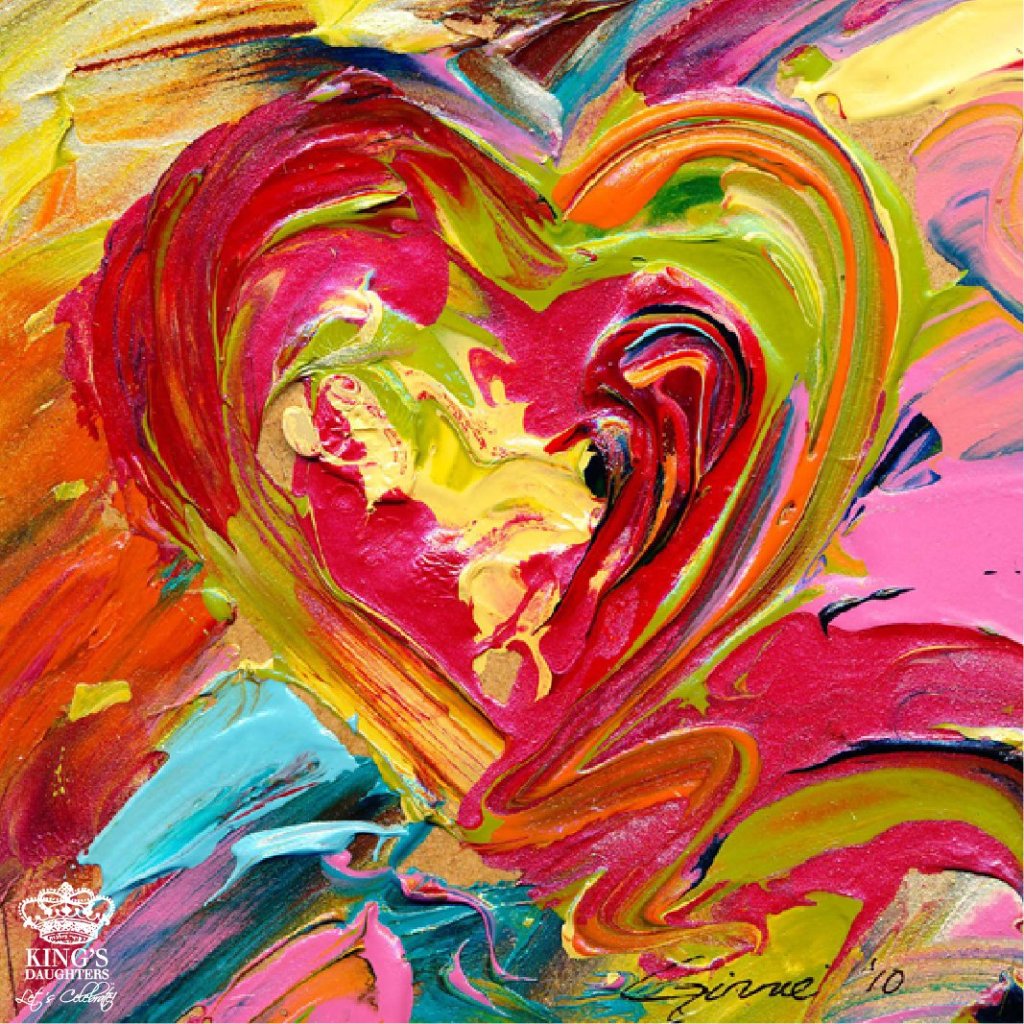
New Heart by Ginnie Johansen Johnson

I will take you from the nations, I will gather you from all the countries, and I will bring you to your own fertile land. I will sprinkle clean water on you, and you will be cleansed of all your pollution. I will cleanse you of all your idols. I will give you a new heart and put a new spirit in you. I will remove your stony heart from your body and replace it with a living one, and I will give you my spirit so that you may walk according to my regulations and carefully observe my case laws. Then you will live in the land that I gave to your ancestors, you will be my people, and I will be your God. (CEB)

Every time I read these Old Testament verses from the prophet Ezekiel I am reminded of my time as chaplain on two cardiac intensive care units. I had several occasions to follow patients through the process of a heart transplant. I sat with them as they wondered if they would ever get a new one, as their own heart could no longer sustain the rest of their life. Would they die before receiving one? What would happen to their families?

Then, finally the day came for many (unfortunately, not all) there is a heart for them. After the incredible transplant surgery, joy abounds, knowing there is a new lease on life, a fresh experience. Through weeks or months of waiting and flirting with the Grim Reaper of death, hope is realized. Their old useless heart now replaced with a vibrant one, full of life!

However, the process is not yet over. Typically, about two or three days into possessing this new heart, a new realization comes along with it: Someone else had to die so that I could live….

He personally carried our sins
    in his body on the cross
so that we can be dead to sin
    and live for what is right.
By his wounds
    you are healed. (1 Peter 2:24, NLT)

Life comes from death. Resurrection can only happen when there is a crucifixion. Gaining a new spiritual heart has been achieved at the greatest of costs. “I will” is uttered nine times by God in five verses of Ezekiel’s prophecy. In gracious acts of determination to restore fallen people, God makes promises and has the authority and power to back them up. Our new heart is waiting to be animated by God’s Spirit so that our observance of God’s law is infused with divine might. Our consent to surgery is all that is needed.

Consider just a few of the great “I will” statements of Holy Scripture:

“I will instruct you and teach you in the way you should go; I will counsel you with my loving eye on you.” (Psalm 32:8, NIV)

“If someone trusts me, I will save them.
    I will protect my followers who call to me for help.
When my followers call to me, I will answer them.
    I will be with them when they are in trouble.
    I will rescue them and honor them.
I will give my followers a long life
    and show them my power to save.” (Psalm 91:14-16, ERV)

“I will strengthen you; I will help you; I will uphold you with my victorious right hand.” (Isaiah 41:10, NRSV)

“Call to me and I will answer you and tell you great and unsearchable things you do not know.” (Jeremiah 33:3, NIV)

“I will never leave you nor forsake you.” (Hebrews 13:5, NKJV)

May Christ make his home in your heart as you trust in him.

May your spiritual roots grow down deep into God’s love and keep you strong.

May you have the power to grasp, along with all God’s people, how wide, how long, how high, and how deep is the love of God.

May you experience the love of Christ, though it is too great to understand fully.

May you be made complete with all the fullness of life and power that comes from God.

May your new heart pump with the grace of Jesus Christ, the love of God, and the encouragement of the Spirit. Amen.