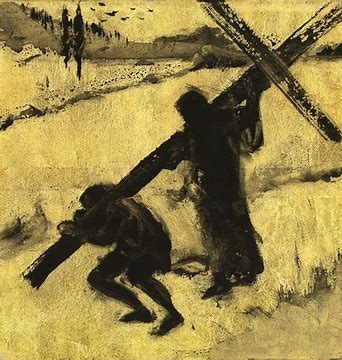
Matthew 8:18-22 – The Path of Christian Discipleship

When Jesus saw that a curious crowd was growing by the minute, he told his disciples to get him out of there to the other side of the lake. As they left, a religion scholar asked if he could go along. “I’ll go with you, wherever,” he said.

Jesus was curt: “Are you ready to rough it? We’re not staying in the best inns, you know.”

Another follower said, “Master, excuse me for a couple of days, please. I have my father’s funeral to take care of.”

Jesus refused. “First things first. Your business is life, not death. Follow me. Pursue life.” (The Message)

Count the cost. Realize what it will take. Have some understanding of the time, energy, and resources needed. Discern the kind of commitment which is before you. It’s a matter of life and death, of spiritual survival.

If you had to carry everything you needed in a backpack, what would you put into it?

First off, for me and most people, that means identifying the barest essentials. It would likely take a long time to think simplistically about what is most important for survival. A lot of things would get left behind. And many items would gain greater attention and appreciation.

We would need some small basic tools including: a multi-tool with a knife and pliers; a source of illumination, like a flashlight and extra batteries; duct tape; rope; fishing line; a way of starting fire; a pot, pan, and mug; first-aid kit; emergency poncho; and just a few extra items of clothing.

If we were to live out of a backpack, it would very much change our lifestyle. And that is the point Jesus was trying to get across to some individuals who seemed like they couldn’t do that.

Trying to fit an existing life into a brand new life won’t work. It will not fit into the backpack of Christian discipleship.

Instead, we must adjust to a new reality, a completely different way of being.

When my wife and I were raising our girls, those precocious little females brought lots of life to the dinner table each night. There was never a dull moment with them. Today, however, they are all grown with their own families – which means we are empty-nesters.

It would be weird if my wife and I continued to live as if they were home – making large meals, dirtying lots of dishes, and engaging in mock conversations. Rather, although it took a while to get used to, we eventually came to grips with the new reality that our precious girls were grown and no longer living under our roof. And that meant a complete change of lifestyle for us.

A full-orbed Christian spirituality includes both the comfort of Christ to others, and the rugged responsibility to obey the words and ways of Jesus. In other words, the love of Jesus Christ is both tender and tough, at the same time, all the time.

Hurting and healing are both necessary for the follower of Jesus. Hard teachings and uncompromising commands for discipleship from Christ become the pathways of healing.

So, then, to go all out for Christ will involve much difficulty.

Jesus said to his followers, “If any of you want to be my follower, you must stop thinking about yourself and what you want. You must be willing to carry the cross that is given to you for following me. Any of you who try to save the life you have will lose it. But you who give up your life for me will find true life.”

Matthew 16:24-25, ERV

In today’s New Testament lesson, Jesus rather rudely rejected two would-be followers. When it comes to God’s upside-down kingdom, the eager beavers are turned away, and the half-hearted are called.

Jesus wants us, all of us, and not just our dedication. That is the demand of Christian discipleship. Anyone who believes they can remain the same person and simply fit a bit of Jesus into their lives, does not understand the cost of following Christ. The person who thinks it is Christianity’s lucky day when they decide to follow Jesus has not yet grasped what it means to be a Christian.

Whereas the religious scholar’s head was too big to fit through the narrow hole of Christian discipleship, the man who wanted to bury his father was too fainthearted and timid. He wanted to dip his toe in the water, and really had no intention of taking the all out plunge into the pool.

Nobody needs to do something “first” before following Jesus. Essentially, Jesus was neither invited nor welcome to the funeral. And Christ will have nothing to do with people picking and choosing which areas of their lives he will be invited into. It’s either a wholesale welcome or no welcome, at all.

When Jesus knocks on the door, he wants to be invited into the entire house, not just the foyer.

For Jesus, following him isn’t easy. The world is full of spiritual zombies, the walking dead. This old fallen world needs Christian disciples who will follow Jesus anywhere – into the hard places and rough terrain of engaging the sinful world.

We are meant to wholeheartedly follow Jesus, neither flippantly without counting the cost, nor procrastinating the hard road of Christian discipleship. Christians are to accept and maintain orders of first importance – which means full submission and obedience to Jesus Christ. Anything less is merely a cheap form of following.

When I Survey the Wondrous Cross by Isaac Watts

When I survey the wondrous cross
On which the Prince of glory died
My richest gain I count but loss
And pour contempt on all my pride.

Where every realm of nature mine
My gift was still be far too small
Love so amazing, so divine
Demands my soul, my life, my all.

Lord, you are all-knowing and full of wisdom. Your plan is masterful. Help me as your disciple to follow you in every thought, word, and deed. Give me a heart of obedience and trust so that I do not get wrapped up in my doubt or what I think is the right choice.

Help me to recognize that your good will does not always look the way I think it should, but that doesn’t make it any less good. I desire to be your disciple and follow you all the days of my life. Please give me the strength to do that. Amen.

Ezekiel 37:1-14 – Speak to the Dry Bones

Sometime later, I felt the Lord’s power take control of me, and his Spirit carried me to a valley full of bones. The Lord showed me all around, and everywhere I looked I saw bones that were dried out. He said, “Ezekiel, son of man, can these bones come back to life?”

I replied, “Lord God, only you can answer that.”

He then told me to say:

Dry bones, listen to what the Lord is saying to you, “I, the Lord God, will put breath in you, and once again you will live. I will wrap you with muscles and skin and breathe life into you. Then you will know that I am the Lord.”

I did what the Lord said, but before I finished speaking, I heard a rattling noise. The bones were coming together! I saw muscles and skin cover the bones, but they had no life in them.

The Lord said:

Ezekiel, now say to the wind, “The Lord God commands you to blow from every direction and to breathe life into these dead bodies, so they can live again.”

As soon as I said this, the wind blew among the bodies, and they came back to life! They all stood up, and there were enough to make a large army.

The Lord said:

Ezekiel, the people of Israel are like dead bones. They complain that they are dried up and that they have no hope for the future. So, tell them, “I, the Lord God, promise to open your graves and set you free. I will bring you back to Israel, and when that happens, you will realize that I am the Lord. My Spirit will give you breath, and you will live again. I will bring you home, and you will know that I have kept my promise. I, the Lord, have spoken.” (Contemporary English Version)

Dry. It might be good for humor or a martini. Dry, however, doesn’t feel good when it is a time of spiritual dryness. In many ways, this past year has been very dry. Quarantine. Masking. Social distance. Lost jobs and businesses. Some churches already dry from withering attendance simply folded and died.

The hard circumstances of our world, stress in our families, and challenging personal lives may easily create anxiety, and, so, parch our souls and leave our spirits bone dry. There is, however, a God who can breathe new life into us and move us from old-worn ruts in our thinking, feeling, and behaving, to renewed ways of being in the world. 

The prophet Ezekiel’s vision is a promise and a hope of resurrection, revival, and new life. Regardless of who we are and the situations in front of us, we are all displaced people – cast out of Eden and in need of restoration.  We, along with the ancient Israelites, are in exile and long to return to our true home with God. Along with St. Augustine we declare:

“Our hearts are forever restless until they find their rest in God.”

St. Augustine

There are dry bones lying around – parched places in need of being reinvigorated. Maybe you are experiencing the dry bones of hopelessness and despondency. Perhaps you are in a dark night of the soul where all of life seems like one huge rut. It could be you are wondering if God is really listening, or is even there at all, because of the dry bones surrounding you.

I do a lot of work as a chaplain on a behavioral health unit with folks who are, ironically, bone dry from too much drinking. Their alcoholism is like a massive desert littered with thousands of dry bones. Attempting to reanimate themselves while dulling the pain of incredibly hard dry circumstances, they drink liter after liter of “spirits” to replace the dead spirit inside them. Many become so dry and dead, inside their immaterial selves, that they seek to end their material lives through suicide.

But it need not be this way. We might believe we will be able to live life and pursue God better without danger or hardship – that somehow difficulty is not to be part of life. The dry bones exist, however, as an opportunity for God to give life. That’s why Alexander Solzhenitsyn’s reaction to his exile in a Soviet labor camp in Siberia was to bless it, because it was there that, he said:

“I discovered that the meaning of earthly existence lies not, as we have grown used to thinking, in prospering, but in the development of the soul.”

Alexander Solzhenitsyn

God not only gives life; God restores life. And this is an important truth to know and remember in the inevitable dry times of our lives. God is not only a helper; the Lord reanimates us from spiritual rigor mortis to lively resurrection through breathing on us. And this is done for a reason. Jesus came to his disciples after his resurrection and said:

“Peace be with you!  As the Father has sent me, I am sending you.” And with that he breathed on them and said, “Receive the Holy Spirit.”

John 20:20-21, NIV

God resuscitates us for a purpose, so that we might be a blessing to the world. Faith is not only a possession to keep, but a gift to give. We glorify God in loving one another and loving the world as Jesus did.  God could have resurrected the bones without Ezekiel. Instead, the Lord used Ezekiel and had him participate in the revival by speaking to the bones. 

Such a challenge to speak to the dry bones can seem overwhelming to us. What do you do when your life is upended, even shattered – when such a profound change comes to you that it is impossible for your life to be as it was? 

The questions and commands of God seemed totally absurd to Ezekiel, speaking to dead dry bones. Maybe we ought to operate more in the realm of the absurd than in the realm of the safe routine. Perhaps we ought to expect our faith to be exercised and look for God to breathe new life into the dead and decaying. To believe that something, someone, or even myself can change is to have internalized this amazing story of dry bones living again. 

Our self-imposed graves cannot hold us because God is among us. We need a genuine heaven-sent, Spirit-breathed, glorious reanimation in which God sends reviving grace and raises the dead. 

God Almighty, Lord of Resurrection, be attentive to our prayers. For those whose hope is lost, who feel dried up and cut off from you, open their graves; bring them back to the land of the living. For those who are spiritually oppressed and held captive by the enemy of our souls, release them from their chains; unbind them and let them go! For those who weep, lost and lifeless in a tomb of fear and shame, give them the peace of your presence, and show them what your love can do.

And for those who are complacent, withering on the vine, and living a dull dry existence without any spiritual vigor – awaken them God! Breathe into them new life! Pour out your Spirit gracious God and awaken your people to a revival of obedience, love, and courage. May your people be so full of your Spirit that life comes rolling off our tongues and the strength of life empowers our hands for service. Amen.

Acts 10:34-43 – Alive with a New Vision

Then Peter began to speak: “I now realize how true it is that God does not show favoritism but accepts from every nation the one who fears him and does what is right. You know the message God sent to the people of Israel, announcing the good news of peace through Jesus Christ, who is Lord of all. You know what has happened throughout the province of Judea, beginning in Galilee after the baptism that John preached—how God anointed Jesus of Nazareth with the Holy Spirit and power, and how he went around doing good and healing all who were under the power of the devil, because God was with him.

“We are witnesses of everything he did in the country of the Jews and in Jerusalem. They killed him by hanging him on a cross, but God raised him from the dead on the third day and caused him to be seen. He was not seen by all the people, but by witnesses whom God had already chosen—by us who ate and drank with him after he rose from the dead. He commanded us to preach to the people and to testify that he is the one whom God appointed as judge of the living and the dead. All the prophets testify about him that everyone who believes in him receives forgiveness of sins through his name.” (New International Version)

Peter’s Vision

The Apostle Peter, a Jew, was told by God to go to the house of Cornelius, a Gentile. God had given Peter a vision of unclean animals, saying, “Get up, Peter. Kill and eat.”  While Peter was wondering about how to make sense of this, men came to retrieve Peter and take him to the house of Cornelius the Centurion.

The death and resurrection of Christ is universal in its scope. It effects every person on planet earth. God shows no favoritism. The cross of Christ is for all kinds of people from every nation, race, and ethnic group. Peter invites us to have a perspective on the cross which delivers us from all wrongdoing and misguided living. The Apostle encourages us to interpret the resurrection of Jesus as a new lease on life to millions of people. Peter’s message is to view the life and death of Jesus and see it as our redemption.

My Vision

For the first seventeen years of my life, I grew up in a nice family, a nice church, and attending a nice school. I heard the facts of Jesus, and the story of Jesus. I heard and understood that Jesus lived on this earth; lived a holy life; was a loving and good teacher; that evil persons had him arrested, tortured, and killed on a cross; that after three days he rose from death; and, that he now lives with the Father in heaven. I simply took all these Christian facts for granted. And yet, I never looked at those facts from my own perspective.

I did not see that as a teenager I was metaphorically speeding down a gravel road about to hit a t-intersection and face spiritual death. I did not interpret those events of Jesus from the angle that it was all done for me.  After all, there are all kinds of needy and lost people in the world, and I was living in Christian America. It’s all good for me, right? 

But it wasn’t all good. My heart was dark and unable to see the good news that Jesus did it all for me. Then, not too unlike what God did for Peter in seeing the world a new way, I saw that Jesus died for me. It totally changed my life.

“For we know that since Christ was raised from the dead, he cannot die again; death no longer has mastery over him. The death he died, he died to sin once for all; but the life he lives, he lives to God. In the same way, count yourselves dead to sin but alive to God in Christ Jesus.”

Romans 6:9-11, NIV

Suddenly, I saw life around me as if it were a new world. I began seeing and experiencing God’s love. I started to see the beauty and grace of God everywhere. I began to experience peace. These are the very things the gospel does for us – changes us from the inside-out.

When Peter preached his message to the household of Cornelius, they both were changed. Peter gained a brand new perspective on Gentiles and on God’s grace. And Cornelius began to interpret Jesus in a way that brought hope and life. 

A Cosmic Vision

In forty years of proclaiming the message of God’s peace through Christ to others, I have seen that the gospel is for everyone – poor and rich, the paranoid schizophrenic and the well-adjusted, addicts and non-addicts, those without much education and the highly educated, mean people and nice people.

One of the interesting things about the book of Acts is that it ends quite abruptly. We have all these wonderful stories about the good news of Jesus changing people’s lives, and then, in the middle of one of those stories with the Apostle Paul, the book of Acts just ends with chapter 28. The wise way of interpreting the abrupt ending is to see that God is still writing a story. The Lord is still active in the world, helping people to see Jesus in new and life-giving ways.

Today the right and proper way to interpret the story of Christ is that he is alive!  Because he lives, we live, if we direct our faith squarely toward Jesus. There is forgiveness through the cross. Since Jesus is alive, we are alive. Alive to the grace of God that has taken care of the guilt and shame issue once for all through the cross. Alive to the possibilities of what God wants to do in and through us. Alive to the people around us who need Jesus. Alive to one another. Alive in Jesus. 

God Almighty, thank you that Easter is for all people, that your love and salvation are for all who confess with voices and heart that the tomb is empty because Jesus is risen so that we might know forgiveness, and be reborn through Christ, your Son, our Lord, who with you and the Holy Spirit reign as one God, now and forever. Amen.

Mark 14:26-31 – Pride Comes Before the Fall

Peter Disowns Jesus by Ethiopian artist Nebiyu Assefa

When they had sung a hymn, they went out to the Mount of Olives.

“You will all fall away,” Jesus told them, “for it is written:

“‘I will strike the shepherd,
    and the sheep will be scattered.’

But after I have risen, I will go ahead of you into Galilee.”

Peter declared, “Even if all fall away, I will not.”

“Truly I tell you,” Jesus answered, “today—yes, tonight—before the rooster crows twice you yourself will disown me three times.”

But Peter insisted emphatically, “Even if I have to die with you, I will never disown you.” And all the others said the same. (New International Version)

Learning to Trust

I have two sisters-in-law who were lifeguards when they were teenagers. One day I watched one of them handle a group of kids experiencing their first swim lesson. She went to each child and told them to put their ears in the water and their belly buttons in the air while she was holding them up. “When I count to three, you won’t feel my hands underneath you, but they’re there,” she said. Most of the kids frantically jerked their knees toward their chins and flailed their arms. Truth is, almost all people float when they assume a posture of rest. But people who think they will sink don’t keep their posture for long. 

The disciples had a hard time trusting Jesus. They just couldn’t seem to rest and relax with Jesus holding them up. After all, Jesus said and did things they were not expecting him to say and do. Jesus preached the necessity of humility and loving one’s enemies. He focused ministry on the least and the lost. 

Different Agendas

The disciples had not yet really bought into Christ’s kingdom agenda. They kept pulling their knees up, thinking Jesus was going to lead a rebellion against the Romans and put Israel back on the map. Bless their hearts, the disciples mistakenly believed Jesus was there to immediately restore the glory days of Jewish dominance in the land.

Despite Christ’s teaching and ministry, some folks believe God’s agenda ought to be restoring prayer in public schools and The Ten Commandments back in courthouses. But Jesus has a different agenda. Christ goes to the heart of the matter. New life is what he is after. Transformation leads to observance of God’s will so the least and the lost persons among us will be reached. 

Jesus turned the world upside-down by insisting not that people come to the temple but that the temple worshipers go to the people. It was not a popular teaching with the disciples, let alone everyone else. The disciples had greater (or so they thought) ideas about how things ought to go.  

Christ followers might neglect the upside-down teaching ministry of Jesus because we believe ourselves to be good people. We already assume we know what God wants. And we would never betray Jesus, right!?  O, sure, we sin occasionally, but not like murderers and child molesters. Our sins are respectable – a little resentment here, a little prejudice there, or a smidge of gossip just to make sure outsiders know and respect their place.

However, we must first hear the bad news before we can hear the good news. And once we hear the bad news and accept it, we need to receive God’s remedy for it. The disciples Peter and Judas are contrasting figures in grasping Christ’s message and responding to it.

Peter and Judas

Peter and Judas had similar ideas about how the future should look – seeing Israel restored to its previous glorious prominence. Judas was a religious and political Zealot. And Peter had no problem picking up a sword when it seemed the time was ripe for a political rebellion and takeover.

Peter insisted he would never turn on Jesus. Yet, Jesus flat-out told him that would happen. Sure enough, Peter did a big belly flop in the pool of denial by disowning Jesus three times.

Then there was Judas. He caught on quicker than Peter that Jesus wasn’t going to lead a military coup. Talking about wasting time on marginal people who couldn’t help usher-in a glorious revolution was the last straw for him.  After Judas clearly saw Jesus had no intention of fulfilling what he thought should happen, he actively sought an opportunity to betray him.

In fact, none of the disciples wanted to take a step of commitment into the world of suffering as the means of reaching others. They wanted glory, not suffering. But Jesus chose the cup of suffering.

Both Judas and Peter realized, after denying Jesus, they had made a terrible mistake. However, that is where the similarities end. Judas responded to his guilt by completing suicide.  Rather than throw himself upon the mercy of God, Judas handled the guilt himself. It was a refusal of grace.

Peter, instead, wept bitterly. He realized his poverty of spirit. He mourned over his sin. Later, Peter became a genuinely meek person with God’s righteousness taking root within him. Having received grace, Peter became a preacher of truth and grace.

Stubborn Pride

Renewal comes from spiritual transformation. It requires a brutally honest assessment of self and others. “I will never fall” comes from a heart that believes “I’m not so bad.” Our failures of faith stem ultimately from pride and a lack of trust. We keep pulling our knees up because we are too anxious to let the agenda of Jesus control our lives. 

Proud people have little need for prayer because they are self-sufficient. However, humble people pray a lot! They don’t want to fall into temptation and defame the name of the Lord. They pray because apart from Jesus Christ they know they’ll act like a cockeye little dog who thinks he is a big dog. Even Jesus himself felt the need to watch and pray so that he could face his hour of pain and suffering on behalf of humanity.

When Jesus was arrested, Peter followed him at a distance. That describes too much of our own following of Christ. We want to see how everything will shake-out before we commit. Jesus invites us to trust him, to commit, to make and keep promises before we even know what it all means. 

It could be that we need to acknowledge we’ve made a mess of our lives through being stubborn. Perhaps we have willfully held to our own ideas of how things ought to go, for far too long.

If you find yourself in a mess, whether it is of your own making or of somebody else’s, grace is the thing that can handle it. That is, coming to God with honesty and humility. Being willing to rest and relax when Jesus is telling you to. It’s okay to let your knees go down and stick the belly button out – to rest in Jesus.

Give us honest hearts, O God, and send your kindly Spirit to help us confess our sins and bring us the peace of your forgiveness, in Jesus Christ our Lord. Amen.