Acts 10:34-43 – Alive with a New Vision

Then Peter began to speak: “I now realize how true it is that God does not show favoritism but accepts from every nation the one who fears him and does what is right. You know the message God sent to the people of Israel, announcing the good news of peace through Jesus Christ, who is Lord of all. You know what has happened throughout the province of Judea, beginning in Galilee after the baptism that John preached—how God anointed Jesus of Nazareth with the Holy Spirit and power, and how he went around doing good and healing all who were under the power of the devil, because God was with him.

“We are witnesses of everything he did in the country of the Jews and in Jerusalem. They killed him by hanging him on a cross, but God raised him from the dead on the third day and caused him to be seen. He was not seen by all the people, but by witnesses whom God had already chosen—by us who ate and drank with him after he rose from the dead. He commanded us to preach to the people and to testify that he is the one whom God appointed as judge of the living and the dead. All the prophets testify about him that everyone who believes in him receives forgiveness of sins through his name.” (New International Version)

Peter’s Vision

The Apostle Peter, a Jew, was told by God to go to the house of Cornelius, a Gentile. God had given Peter a vision of unclean animals, saying, “Get up, Peter. Kill and eat.”  While Peter was wondering about how to make sense of this, men came to retrieve Peter and take him to the house of Cornelius the Centurion.

The death and resurrection of Christ is universal in its scope. It effects every person on planet earth. God shows no favoritism. The cross of Christ is for all kinds of people from every nation, race, and ethnic group. Peter invites us to have a perspective on the cross which delivers us from all wrongdoing and misguided living. The Apostle encourages us to interpret the resurrection of Jesus as a new lease on life to millions of people. Peter’s message is to view the life and death of Jesus and see it as our redemption.

My Vision

For the first seventeen years of my life, I grew up in a nice family, a nice church, and attending a nice school. I heard the facts of Jesus, and the story of Jesus. I heard and understood that Jesus lived on this earth; lived a holy life; was a loving and good teacher; that evil persons had him arrested, tortured, and killed on a cross; that after three days he rose from death; and, that he now lives with the Father in heaven. I simply took all these Christian facts for granted. And yet, I never looked at those facts from my own perspective.

I did not see that as a teenager I was metaphorically speeding down a gravel road about to hit a t-intersection and face spiritual death. I did not interpret those events of Jesus from the angle that it was all done for me.  After all, there are all kinds of needy and lost people in the world, and I was living in Christian America. It’s all good for me, right? 

But it wasn’t all good. My heart was dark and unable to see the good news that Jesus did it all for me. Then, not too unlike what God did for Peter in seeing the world a new way, I saw that Jesus died for me. It totally changed my life.

“For we know that since Christ was raised from the dead, he cannot die again; death no longer has mastery over him. The death he died, he died to sin once for all; but the life he lives, he lives to God. In the same way, count yourselves dead to sin but alive to God in Christ Jesus.”

Romans 6:9-11, NIV

Suddenly, I saw life around me as if it were a new world. I began seeing and experiencing God’s love. I started to see the beauty and grace of God everywhere. I began to experience peace. These are the very things the gospel does for us – changes us from the inside-out.

When Peter preached his message to the household of Cornelius, they both were changed. Peter gained a brand new perspective on Gentiles and on God’s grace. And Cornelius began to interpret Jesus in a way that brought hope and life. 

A Cosmic Vision

In forty years of proclaiming the message of God’s peace through Christ to others, I have seen that the gospel is for everyone – poor and rich, the paranoid schizophrenic and the well-adjusted, addicts and non-addicts, those without much education and the highly educated, mean people and nice people.

One of the interesting things about the book of Acts is that it ends quite abruptly. We have all these wonderful stories about the good news of Jesus changing people’s lives, and then, in the middle of one of those stories with the Apostle Paul, the book of Acts just ends with chapter 28. The wise way of interpreting the abrupt ending is to see that God is still writing a story. The Lord is still active in the world, helping people to see Jesus in new and life-giving ways.

Today the right and proper way to interpret the story of Christ is that he is alive!  Because he lives, we live, if we direct our faith squarely toward Jesus. There is forgiveness through the cross. Since Jesus is alive, we are alive. Alive to the grace of God that has taken care of the guilt and shame issue once for all through the cross. Alive to the possibilities of what God wants to do in and through us. Alive to the people around us who need Jesus. Alive to one another. Alive in Jesus. 

God Almighty, thank you that Easter is for all people, that your love and salvation are for all who confess with voices and heart that the tomb is empty because Jesus is risen so that we might know forgiveness, and be reborn through Christ, your Son, our Lord, who with you and the Holy Spirit reign as one God, now and forever. Amen.

Mark 14:26-31 – Pride Comes Before the Fall

Peter Disowns Jesus by Ethiopian artist Nebiyu Assefa

When they had sung a hymn, they went out to the Mount of Olives.

“You will all fall away,” Jesus told them, “for it is written:

“‘I will strike the shepherd,
    and the sheep will be scattered.’

But after I have risen, I will go ahead of you into Galilee.”

Peter declared, “Even if all fall away, I will not.”

“Truly I tell you,” Jesus answered, “today—yes, tonight—before the rooster crows twice you yourself will disown me three times.”

But Peter insisted emphatically, “Even if I have to die with you, I will never disown you.” And all the others said the same. (New International Version)

Learning to Trust

I have two sisters-in-law who were lifeguards when they were teenagers. One day I watched one of them handle a group of kids experiencing their first swim lesson. She went to each child and told them to put their ears in the water and their belly buttons in the air while she was holding them up. “When I count to three, you won’t feel my hands underneath you, but they’re there,” she said. Most of the kids frantically jerked their knees toward their chins and flailed their arms. Truth is, almost all people float when they assume a posture of rest. But people who think they will sink don’t keep their posture for long. 

The disciples had a hard time trusting Jesus. They just couldn’t seem to rest and relax with Jesus holding them up. After all, Jesus said and did things they were not expecting him to say and do. Jesus preached the necessity of humility and loving one’s enemies. He focused ministry on the least and the lost. 

Different Agendas

The disciples had not yet really bought into Christ’s kingdom agenda. They kept pulling their knees up, thinking Jesus was going to lead a rebellion against the Romans and put Israel back on the map. Bless their hearts, the disciples mistakenly believed Jesus was there to immediately restore the glory days of Jewish dominance in the land.

Despite Christ’s teaching and ministry, some folks believe God’s agenda ought to be restoring prayer in public schools and The Ten Commandments back in courthouses. But Jesus has a different agenda. Christ goes to the heart of the matter. New life is what he is after. Transformation leads to observance of God’s will so the least and the lost persons among us will be reached. 

Jesus turned the world upside-down by insisting not that people come to the temple but that the temple worshipers go to the people. It was not a popular teaching with the disciples, let alone everyone else. The disciples had greater (or so they thought) ideas about how things ought to go.  

Christ followers might neglect the upside-down teaching ministry of Jesus because we believe ourselves to be good people. We already assume we know what God wants. And we would never betray Jesus, right!?  O, sure, we sin occasionally, but not like murderers and child molesters. Our sins are respectable – a little resentment here, a little prejudice there, or a smidge of gossip just to make sure outsiders know and respect their place.

However, we must first hear the bad news before we can hear the good news. And once we hear the bad news and accept it, we need to receive God’s remedy for it. The disciples Peter and Judas are contrasting figures in grasping Christ’s message and responding to it.

Peter and Judas

Peter and Judas had similar ideas about how the future should look – seeing Israel restored to its previous glorious prominence. Judas was a religious and political Zealot. And Peter had no problem picking up a sword when it seemed the time was ripe for a political rebellion and takeover.

Peter insisted he would never turn on Jesus. Yet, Jesus flat-out told him that would happen. Sure enough, Peter did a big belly flop in the pool of denial by disowning Jesus three times.

Then there was Judas. He caught on quicker than Peter that Jesus wasn’t going to lead a military coup. Talking about wasting time on marginal people who couldn’t help usher-in a glorious revolution was the last straw for him.  After Judas clearly saw Jesus had no intention of fulfilling what he thought should happen, he actively sought an opportunity to betray him.

In fact, none of the disciples wanted to take a step of commitment into the world of suffering as the means of reaching others. They wanted glory, not suffering. But Jesus chose the cup of suffering.

Both Judas and Peter realized, after denying Jesus, they had made a terrible mistake. However, that is where the similarities end. Judas responded to his guilt by completing suicide.  Rather than throw himself upon the mercy of God, Judas handled the guilt himself. It was a refusal of grace.

Peter, instead, wept bitterly. He realized his poverty of spirit. He mourned over his sin. Later, Peter became a genuinely meek person with God’s righteousness taking root within him. Having received grace, Peter became a preacher of truth and grace.

Stubborn Pride

Renewal comes from spiritual transformation. It requires a brutally honest assessment of self and others. “I will never fall” comes from a heart that believes “I’m not so bad.” Our failures of faith stem ultimately from pride and a lack of trust. We keep pulling our knees up because we are too anxious to let the agenda of Jesus control our lives. 

Proud people have little need for prayer because they are self-sufficient. However, humble people pray a lot! They don’t want to fall into temptation and defame the name of the Lord. They pray because apart from Jesus Christ they know they’ll act like a cockeye little dog who thinks he is a big dog. Even Jesus himself felt the need to watch and pray so that he could face his hour of pain and suffering on behalf of humanity.

When Jesus was arrested, Peter followed him at a distance. That describes too much of our own following of Christ. We want to see how everything will shake-out before we commit. Jesus invites us to trust him, to commit, to make and keep promises before we even know what it all means. 

It could be that we need to acknowledge we’ve made a mess of our lives through being stubborn. Perhaps we have willfully held to our own ideas of how things ought to go, for far too long.

If you find yourself in a mess, whether it is of your own making or of somebody else’s, grace is the thing that can handle it. That is, coming to God with honesty and humility. Being willing to rest and relax when Jesus is telling you to. It’s okay to let your knees go down and stick the belly button out – to rest in Jesus.

Give us honest hearts, O God, and send your kindly Spirit to help us confess our sins and bring us the peace of your forgiveness, in Jesus Christ our Lord. Amen.

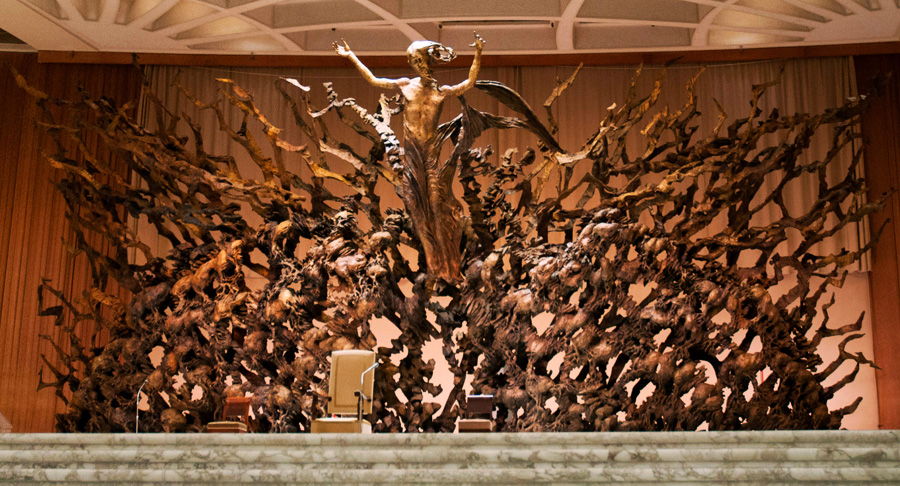
Acts 4:1-4 – The Message of Resurrection

La Resurrezione by Italian sculptor Pericle Fazzini (1913-1987)

The priests and the captain of the temple guard and the Sadducees came up to Peter and John while they were speaking to the people.They were greatly disturbed because the apostles were teaching the people, proclaiming in Jesus the resurrection of the dead. They seized Peter and John and, because it was evening, they put them in jail until the next day. But many who heard the message believed; so, the number of men who believed grew to about five thousand. (NIV)

There’s nothing quite like upsetting the status quo. And that’s exactly what the apostles Peter and John were doing. Creating trouble, causing a stink, disturbing the peace, and making waves. At least, that’s how the ruling authorities saw the upstart Christians’ activity.

At the heart of the disturbance was the authorities’ deep concern of potential social disorder. After all, the Roman Empire with all its great strength was firmly ensconced in Judea. It was already hard enough trying to maintain Jewish customs and religious practices. Now, these rabblerousers come along with their unorthodox teaching and threaten the very social fabric of Jewish life. No! Get them out of here!

So, off to jail Peter and John went. That’s how the politics of fear typically works. Being afraid of change leads to removing the object of fear. Stuff the apostles in the gulag. Shut and lock the door. Maybe if they are out of sight they will be out of mind to the people.

The rulers were too late. So many people heard the message of Christ’s resurrection that the number of believers in Jesus swelled into the thousands. Well, now, everyone’s really in a pickle! Except the church. Each time the Christians get squelched and silenced, more of them show up. Oh, my, goodness. They’re multiplying like roaches!

It doesn’t help the ruling authorities that these religious bugs continue to interpret their own whippings and jailtime as a positive thing – enjoying the solidarity of suffering with their Lord. Ugh. What’s a decent Sadducee to do?

Turns out nothing can stop resurrection. It cannot be chained, bound, or imprisoned. Once life gets into the hearts of people, there’s no getting it out. The message just takes over and consumes the whole person. Then it spreads to another, like some infectious disease.

Before you know it, the entire social order is off kilter. What a bunch of weirdos. Following a dead guy who they say isn’t dead. Walked right out of the grave, they say. Sheesh. Pull yourselves together. So many unhinged delusional people believing in resurrection!

“Here’s to the crazy ones. The misfits. The rebels. The troublemakers. The round pegs in the square holes. The ones who see things differently. They’re not fond of rules. And they have no respect for the status quo. You can quote them, disagree with them, glorify or vilify them. About the only thing you can’t do is ignore them. Because they change things. They push the human race forward. And while some may see them as the crazy ones, we see genius. Because the people who are crazy enough to think they can change the world, are the ones who do.”

Rob Siltanen

It’s easy for some Christians to be hard on non-Christians, just as it was easy for the ancient Jewish rulers to be hard on others leaving their fold. Sometimes we followers of Jesus forget whence we have come. We can get so upset and worked up in fear. Could be our underwear is too tight. More likely, we take the prideful stance of believing our status quo is best for everyone. So, there’s no listening, paying attention, or teachable spirits.

Peter, John, and the other apostles just went about proclaiming good news with joy. And the gospel spread. Jesus became known first to thousands, then tens of thousands, hundreds of thousands, and millions. Today, according to the Pew Research Center, there are 2.5 billion Christians in the world. That’s a lot of people. Christianity has had two thousand years to create their own status quo, some of it good, some of it not so much.

Yet, at the heart of it all, is the resurrection of Jesus Christ from death. It’s a message that still speaks to billions. And it’s a message Christians need to come back to whenever they are fearful of others challenging their hegemony.

All the hopes and expectations of Christians everywhere are realized not in maintaining some Constantinian sort of Christendom but in the resurrection of Jesus Christ the dead. The former does a lot of handwringing over social and cultural issues. The latter has a lot of joy, celebration, and renewal which works itself out in both personal and systemic redemption.

Because the good news of Easter can hardly be contained in a single day’s celebration, it’s message of new life in Christ is like a bright sun of inexhaustible grace to people everywhere – still warming the earth all these centuries later.

The Apostle Peter went on to pen a letter to struggling Christians facing hard circumstances in a world not yet dominated by Christianity, reminding them of the heart of Christian faith:

Praise be to the God and Father of our Lord Jesus Christ! In his great mercy he has given us new birth into a living hope through the resurrection of Jesus Christ from the dead, and into an inheritance that can never perish, spoil or fade. This inheritance is kept in heaven for you, who through faith are shielded by God’s power until the coming of the salvation that is ready to be revealed in the last time. In all this you greatly rejoice, though now for a little while you may have had to suffer grief in all kinds of trials. These have come so that the proven genuineness of your faith—of greater worth than gold, which perishes even though refined by fire—may result in praise, glory and honor when Jesus Christ is revealed. Though you have not seen him, you love him; and even though you do not see him now, you believe in him and are filled with an inexpressible and glorious joy, for you are receiving the result of your faith, the salvation of your souls.

1 Peter 1:3-9, NIV

May we come back repeatedly to Christianity’s message so that our faith is strengthened, the church is edified, and the world is blessed. Amen.

Children of God, Loved by God

By Unknown artist

See what great love the Father has lavished on us, that we should be called children of God! And that is what we are! The reason the world does not know us is that it did not know him. Dear friends, now we are children of God, and what we will be has not yet been made known. But we know that when Christ appears, we shall be like him, for we shall see him as he is. All who have this hope in him purify themselves, just as he is pure.

Everyone who sins breaks the law; in fact, sin is lawlessness. But you know that he appeared so that he might take away our sins. And in him is no sin. No one who lives in him keeps on sinning. No one who continues to sin has either seen him or known him.

Dear children, do not let anyone lead you astray. The one who does what is right is righteous, just as he is righteous. (1 John 3:1-7, NIV)

True children of God, Christians, are loved by God – that is their status and identity. This cannot be changed any more than a tiger can change his stripes.

True children of God live, remain, abide, and continue in their identity as Christians. They know who they are and how they are to live.

Who We Are

When Jesus was on this earth, he was misunderstood by a lot of people. Christians must learn to expect the same. True children loved by God will neither fit in with the world nor seek the world’s affirmation and accolades. The practical difference between Christianity and the world is that Christians locate their primary identity, allegiance, and purpose in Christ, whereas the world finds their identity elsewhere.

Being loved by God brings assurance, peace, security, and hope. These qualities cannot be manufactured by us because they are results of being loved. The world cannot give us these characteristics. This does not mean that Christians always have it all together. We are continually in a process of discovering our identity and growing more and more into that uniqueness. The reason Jesus lived his life without needing the world’s recognition is that he was firmly and securely assured of the Father’s love and care for him. 

Christians continue to learn what it means to be loved by God in Christ. This love helps fortify our faith so that we will not find our identities in worldly roles, however intrinsically good those roles might be. For example, a parent with the primary identity as mother or father will view salvation as coming through the family. Or a person with the primary identity as teacher will see deliverance coming through education. 

When Christians have their primary identity as children of God, loved by God, then they see deliverance from guilt, shame, darkness, and oppression as coming through Jesus. When the church, living and serving together, secure in their identity as children of God, loved by God, then she can withstand any adulterous flirtations from the world to woo them away from Jesus.

We are children of God. We are not children of the world’s institutions, systems, organizations, ethos, mores, and values. Everyone who has hope in Christ is pure and holy. When we locate our primary identity in being loved by God, we avoid defiling ourselves with the world’s grime. We take regular spiritual baths which cleanse us from the world’s crud. We keep reminding ourselves and each other of our true status as God’s children. We do not allow any other identity to topple or replace our wonderful reality of being loved by God.

How we view ourselves will determine how we live our lives.

How We Are to Live

True children of God abide by the law because they abide in Christ. Jesus said all the law could be summed up in two commands: Love God. Love neighbor. Breaking the law means:

  • Hating instead of loving.
  • Working to undermine someone instead of seeking their best interests.
  • Excluding others instead of including others.
  • Dividing and opposing instead of unifying and cooperating. 

No one abiding in Christ continues the same trajectory they had before knowing Christ. Jesus came to take care of the sin issue once for all through the cross. Therefore, Christians, loved by God, cannot be lawbreakers if they are abiding; the two cannot co-exist with each other.

So, our primary task as Christians is to abide in Jesus and remain firmly in our identity as children of God, loved by God. We are to love by remaining in God’s love and allowing love to shape all our thoughts, words, and actions. We will continue to be steadfast in that love. We will not be led astray. We will abide in Christ.

Identity and life work together. For example, I am currently a citizen of the state of Wisconsin. I not only geographically live in Wisconsin, but I am to abide in the state as a responsible person. Being a Wisconsinite is different from the rest of the world. Wisconsinites are readily identifiable by their sports and their food.

Lambeau Field, home of the Green Bay Packers

Diehard Green Bay Packer fans forsake any identification as Lions, Bears, or the god-forsaken pagan Vikings. They like their prep and collegiate sports, flock to curling clubs, get married in bowling alleys, and observe time through the various hunting seasons. Citizens of Wisconsin like their food and drink. Nothing compares to the Friday night fish fry, cheese curds, venison, mustard – all washed down with either a Spotted Cow, Leinenkugel’s, or a trip to the bubbler.

We are to become more and more like Christ. Our identity as loved by God means we will seek to live in Christ by living a life of love. The people of Wisconsin have a general reputation of being polite and helpful, not rude and unhelpful. All their citizens should live into this identity and behavior. And as Christians whose primary identity is in being children of God, loved by God, we should abide in Christ through love and obedience. 

“I am the true vine, and my Father is the gardener. He cuts off every branch in me that bears no fruit, while every branch that does bear fruit, he prunes so that it will be even more fruitful. You are already clean because of the word I have spoken to you. Remain in me, as I also remain in you. No branch can bear fruit by itself; it must remain in the vine. Neither can you bear fruit unless you remain in me.

I am the vine; you are the branches. If you remain in me and I in you, you will bear much fruit; apart from me you can do nothing. If you do not remain in me, you are like a branch that is thrown away and withers; such branches are picked up, thrown into the fire and burned. If you remain in me and my words remain in you, ask whatever you wish, and it will be done for you. This is to my Father’s glory, that you bear much fruit, showing yourselves to be my disciples.

As the Father has loved me, so have I loved you. Now remain in my love. If you keep my commands, you will remain in my love, just as I have kept my Father’s commands and remain in his love. I have told you this so that my joy may be in you and that your joy may be complete. My command is this: Love each other as I have loved you. Greater love has no one than this: to lay down one’s life for one’s friends. You are my friends if you do what I command. I no longer call you servants because a servant does not know his master’s business. Instead, I have called you friends, for everything that I learned from my Father I have made known to you. You did not choose me, but I chose you and appointed you so that you might go and bear fruit—fruit that will last—and so that whatever you ask in my name the Father will give you. This is my command: Love each other.” (John 15:1-17, NIV)

Conclusion

A true Christian is a child of God, not the world. Our behavior flows from who we are. If our primary identity is securely in being a loved child of God, then what comes out of us will be loving words and actions, even to those in the world who might not believe or understand.

When we think about our world, it can be a sad place, devoid of love. People from different cultures and backgrounds often do not get along with each other. Political parties have difficulty finding common ground. Some Christians cannot seem to get along with other Christians. In the world, differences often divide us. Can people different from each other get along? 

The early church did. And they did it without all the stuff we have – sanctuaries, church buildings, programs. Those early believers did it through the message of the cross using the basic tool of love. Not every Christian will serve on the foreign mission field or serve in a professional ministry position. However, every Christian can be loving.

True children of God are loved by God. They are characterized by the Christian practices of hospitably loving the immigrant and stranger, loving their enemies, forgiving those who have sinned against them, and obeying God’s commands. These practices stem the tide of evil and hate in the world and usher in the love of God in Christ.