Resolving a Problem (Acts 6:1-7)

In those days when the number of disciples was increasing, the Hellenistic Jews among them complained against the Hebraic Jews because their widows were being overlooked in the daily distribution of food. 

So the Twelve gathered all the disciples together and said, “It would not be right for us to neglect the ministry of the word of God in order to wait on tables. Brothers and sisters, choose seven men from among you who are known to be full of the Spirit and wisdom. We will turn this responsibility over to them and will give our attention to prayer and the ministry of the word.”

This proposal pleased the whole group. They chose Stephen, a man full of faith and of the Holy Spirit; also Philip, Procorus, Nicanor, Timon, Parmenas, and Nicolas from Antioch, a convert to Judaism. They presented these men to the apostles, who prayed and laid their hands on them.

So the word of God spread. The number of disciples in Jerusalem increased rapidly, and a large number of priests became obedient to the faith. (New International Version)

Growing Pains

The burgeoning new church grew both spiritually and numerically. The apostolic ministry proclaimed the good news of Jesus Christ every day in the Jerusalem temple, and from house to house.

Anytime a group gets larger, there are growing pains. Problems arise which need to be addressed. In the earliest church, a conflict developed because the Greek-speaking widows were being neglected and overlooked in the distribution of food, whereas the Hebrew-speaking widows were not.

You can easily see how all sorts of feelings and judgments could pop up from that situation. Just because the church ministry was growing and thriving, did not mean that there would never be problems. Quite the contrary.

A Bad Approach

We can observe what the apostles did, and did not, do when the conflict came to their attention. The apostles did not:

Work harder

They didn’t simply add more work to what they were already doing with the old philosophy that “if you want something done right, do it yourself.” The apostles were clearly not control freaks. They appear to understand that God has ultimate control of all things, and that they themselves were practice self-control.

Operate in their weakness

The apostles weren’t experts on food distribution. Some of them, like Peter and John, knew how to get food to a market; but they likely knew nothing of keeping hundreds of widows daily fed. After all, there were no government food programs for needy people to rely upon. Everyone relied on family. And if there was no family to help, then the church stepped in to fill the gap.

Do everything themselves

Not every problem or situation has to be handled by an apostle (or a church clergyperson). God has gifted every believer with spiritual gifts of various kinds. Having skills, abilities, and talents wasted because the top leadership does everything, not only makes no sense, but it is also bad spiritual theology.

Attack the complainers

It’s one thing to grumble out of a sense of selfishness and ingratitude; it’s another thing altogether to complain because of grief, of being neglected and overlooked as a legitimate person to receive something you need. This is what we call “justice,” that everyone has what they need to thrive and flourish in this life. The apostles listened; they didn’t belittle the complaints or simply tell the people to stop complaining.

Take a vote

Leaders lead. Apostles engage in apostolic ministry. They don’t vote. Oftentimes, voting is a cop out for leaders to not make a decision that they ought to be making. In their insecurity, they’ll do anything but be decisive. They’ll ask for more information, and promise to take care of it sooner than later. But they won’t make a decision. Putting that on the congregation or the group as a whole is unnecessary.

Form committees and subcommittees

The apostles did not research the problem to death. They didn’t commission a group of people to study the issue and come up with at least three options to choose from. The issue of widows not getting food was serious. A matter of health, and life, and death. The problem needed to be handled quickly and efficiently. Leaders are given authority to make decisions and get things done – not to keep vital issues in a committee for months on end.

Start a new church

It was never a thought in any of the apostle’s heads to have two churches: one Greek, and the other Hebrew. No, they were determined to maintain the unity of the church through the bond of peace. The apostles didn’t ask anyone to leave and start a new ministry on the other side of Jerusalem.

A Good Approach

Instead of doing any of that goofy stuff, here is what the original apostles of Christ did do:

Came up with a practical solution

Instead of commissioning committees, the apostles commissioned faithful people to ensure that the work of distributing food would be carried out with integrity and competence.

Had people with skin in the game do the work

The men the apostles commissioned for the work were Greek Christians. These guys were likely familiar with the widows and knew their situations. And they were the best people for the job of making sure the ladies got needed food. Ministry is always personal, not impersonal.

Kept doing their important work

The apostles decided that their ministry of the word and prayer was too important to neglect for even a moment. They kept up the teaching, praying, mentoring, and encouraging ministry to which they were called. It is possible to affirm the good work of others and let them do it, while also affirming one’s own good work and sticking to it.

Focused on people and relationships

The presenting problem was food distribution. Yet, the real issue was widows in need. They were hungry. The apostles implemented a system based upon people and relationships, and not just on solving a problem.

Impacted the community

The way in which the conflict of food distribution was handled made a big difference – both in the church community, and also in the city of Jerusalem. As a result of the apostles and their decision in this matter, their ministry became even more effective, and people were added to the church – including a number of priests, who likely understood better than anyone how an internal issue can get out of control. They wanted in, as they heard the good news, and saw it demonstrated in the life of the church.

Conclusion

Dealing with church problems and internal issues within a group of people is not about being right and winning arguments. It’s about meeting the needs of people, and glorifying God. It matters how we treat one another within the church. Christians are meant to be the light of the world, and not the dark underbelly of detached systems, policies, and doctrinal statements.

The choices we make, how we go about making those decisions, and the way in which we implement them, reflects whether the life of Christ is within us, or not.

Blessed God, may the humility, wisdom, and compassion of Jesus Christ flow powerfully within me, so that what comes out of me is thoroughly loving, in my words, affect, tone of voice, gestures, and actions. Amen.

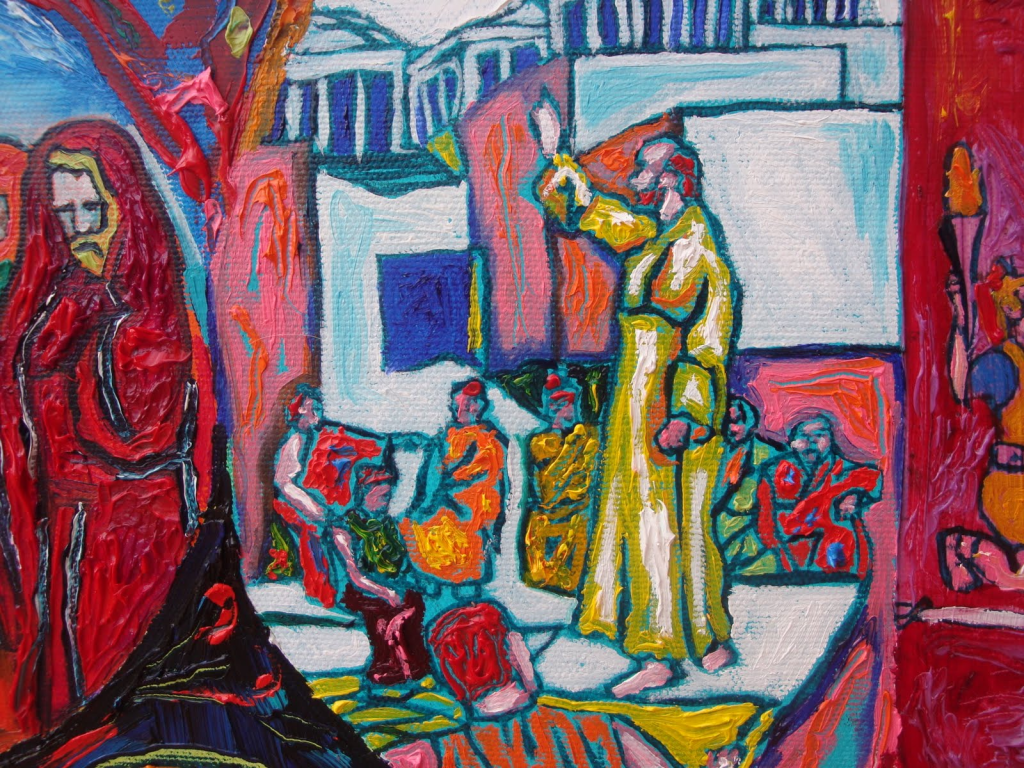
Effective Communication (Acts 17:16-31)

St. Paul preaching at the Areopagus in Athens, by Kennedy A. Paizs

While Paul was waiting for them in Athens, he was deeply troubled by all the idols he saw everywhere in the city. He went to the synagogue to reason with the Jews and the God-fearing Gentiles, and he spoke daily in the public square to all who happened to be there.

He also had a debate with some of the Epicurean and Stoic philosophers. When he told them about Jesus and his resurrection, they said, “What’s this babbler trying to say with these strange ideas he’s picked up?” Others said, “He seems to be preaching about some foreign gods.”

Then they took him to the high council of the city. “Come and tell us about this new teaching,” they said. “You are saying some rather strange things, and we want to know what it’s all about.” (It should be explained that all the Athenians as well as the foreigners in Athens seemed to spend all their time discussing the latest ideas.)

So Paul, standing before the council, addressed them as follows: “Men of Athens, I notice that you are very religious in every way, for as I was walking along I saw your many shrines. And one of your altars had this inscription on it: ‘To an Unknown God.’ This God, whom you worship without knowing, is the one I’m telling you about.

“He is the God who made the world and everything in it. Since he is Lord of heaven and earth, he doesn’t live in man-made temples, and human hands can’t serve his needs—for he has no needs. He himself gives life and breath to everything, and he satisfies every need. From one man he created all the nations throughout the whole earth. He decided beforehand when they should rise and fall, and he determined their boundaries.

“His purpose was for the nations to seek after God and perhaps feel their way toward him and find him—though he is not far from any one of us. For in him we live and move and exist. As some of your own poets have said, ‘We are his offspring.’ And since this is true, we shouldn’t think of God as an idol designed by craftsmen from gold or silver or stone.

“God overlooked people’s ignorance about these things in earlier times, but now he commands everyone everywhere to repent of their sins and turn to him. For he has set a day for judging the world with justice by the man he has appointed, and he proved to everyone who this is by raising him from the dead.” (New Living Translation)

Ancient ruins of Athens, Greece

The city of Athens was a major intellectual center in the ancient world. Ideas, philosophy, reason, rhetoric, and debate were standard fare amongst the citizens. At the time of the Apostle Paul’s arrival in the city, Greece knew next to nothing about Christianity.

Paul’s response to what he saw and felt in the city dictated what he did and said. And those words were wise and impactful for the people of Athens. The Apostle’s interaction with the philosophers was like a seminar in how to communicate with folks who believe and live very differently than ourselves.

Observation

Paul entered the city and made a simple observation: Athens is full of idols. Out of all the observations Paul could have made, this one would not likely be made by most people visiting the city. Athens was a glorious place with its unparalleled architecture. The Acropolis and the Agora were resplendent with the arts and democracy.

For all its physical beauty and brilliance, the one thing Paul homed-in on was the idols. This would have struck many folks as odd – something like focusing on the dog collar instead of the dog. Yet, Paul was using more than his physical eyes – his spiritual sight was making a big observation – that Athens was very much a religious place.

Feeling

The Apostle felt troubled and distressed. Paul was disturbed down deep in his gut with the spiritual state of this renowned city-state. The sheer volume of idols and the practice of idolatry did not sit well with him. He experienced feelings of pity mixed with anger.

Paul handled his emotions well. By freely acknowledging them, he was then able to choose his response. Had he not done so, it’s likely Paul might have gone on some frustrating tirade, thereby never truly connecting relationally with the people. There’s nothing wrong with being irritated or exasperated; it’s what we do with those feelings that’s important.

Need

Emotions, not thoughts, move us to act. Paul knew why he was feeling disturbed, and decided not to stuff those feelings. Instead, he stepped out and addressed the great need he was observing.

Paul decided to meet the Athenians on their turf and on their level by reasoning with them every day in the great buildings and open spaces of the city.

While in Athens, it seems that Paul, understandably, utilized the Socratic method of dialogue – involving questions and answers. It’s impressive that throughout the Acts of the Apostles, Paul demonstrated a deft ability to communicate and connect with a broad range of people.

Appeal

Paul wasn’t interacting and dialoging just for the fun of it; he wanted to make an appeal, a request for people to seriously consider the Christian good news of Jesus Christ’s resurrection as a viable philosophy of life. He made a widespread appeal to Jews, Greeks, and passers-by, as well as philosophers.

Since the massive intellect of Paul could handle any reasoned debate, he was invited to the Areopagus, which was the place where the best-of-the-best carried-on their discussions.

Paul’s address to them was incredibly cogent and well-reasoned – finding common ground from which to debate. While doing so, he maintained outward grace amidst his inward disturbance.

Conclusion

The late British exegete, John R.W. Stott, reflected on today’s New Testament lesson and gave us words which are still relevant for us in these contemporary times:

“Why is it that, in spite of the great needs and opportunities of our day, the church slumbers peacefully on, and that so many Christians are deaf to Christ’s commission, and dumb with tongues-tied in testimony? The major reason is this: We do not speak as Paul spoke because we do not feel as Paul felt. We have never had his indignation. Divine jealousy has not stirred within us. We constantly pray, ‘Hallowed be Thy Name,’ yet we do not seem to mean it… Paul saw people created in the image and likeness of God giving to idols the homage which was due to God alone… and he was deeply pained by it.”

May the good news of Jesus Christ be so pressed into our minds, hearts, and guts that what comes out of us is deep compassion, wise dialogue, and an effective ministry of communication with others. Amen.

For the Love of God, Not Money (2 Corinthians 8:1-7)

And now, brothers and sisters, we want you to know about the grace that God has given the Macedonian churches. In the midst of a very severe trial, their overflowing joy and their extreme poverty welled up in rich generosity. 

For I testify that they gave as much as they were able, and even beyond their ability. Entirely on their own, they urgently pleaded with us for the privilege of sharing in this service to the Lord’s people. 

And they exceeded our expectations: They gave themselves first of all to the Lord, and then by the will of God also to us. So we urged Titus, just as he had earlier made a beginning, to bring also to completion this act of grace on your part. 

But since you excel in everything—in faith, in speech, in knowledge, in complete earnestness and in the love we have kindled in you—see that you also excel in this grace of giving. (New International Version)

I’ll be honest: As a preacher and pastor, I don’t much like talking about money. Yet, money is always an issue, especially in churches.

Although there are contemporary pastors and churches who deal with millions of dollars, the vast majority of believers and faith communities struggle from Sunday to Sunday. Money is a topic that has to be addressed and talked about.

So, even though there are plenty of abuses out there when it comes to money, it’s good to gain a more biblical, reasonable, and compassionate view of financial resources.

Holy Scripture does not condemn economic wealth; but it does warn us against the love of money, and centering our lives around it. Perhaps Jesus said it best:

“No one can serve two masters. Either you will hate the one and love the other, or you will be loyal to the one and have contempt for the other. You cannot serve God and wealth.”

Jesus (Matthew 6:24, CEB)

Jesus clarified the issue of money as a matter of our values and commitments. To possess money in and of itself is neither good nor bad; it’s whether money is the master you serve, or God is, with money being a tool to serve the Lord.

In writing to Timothy about how to instruct the Ephesian Church concerning money, the Apostle Paul framed the issue this way:

But people who are trying to get rich fall into temptation. They are trapped by many stupid and harmful passions that plunge people into ruin and destruction. The love of money is the root of all kinds of evil. Some have wandered away from the faith and have impaled themselves with a lot of pain because they made money their goal. (1 Timothy 6:9-10, CEB)

Financial resources are tools to be used, not only in providing for oneself and one’s family, but also to do good and to think of the common good of all people.

And that is exactly what the Apostle Paul was intent on doing. He was gathering a collection for the believers in Jerusalem. So, he took some space (2 Corinthians 8-9) in writing to the Corinthian Church for addressing this issue, as well as money and wealth in general.

Paul unabashedly called upon the Corinthian Christians to give, and considered it their obligation to do so.

The Apostle broached the subject by challenging the Corinthians to follow the example of the Macedonian churches. Paul fully embraced his training in rhetoric in using the technique of comparison to evoke competition between Corinth and Macedonia.

He did so by alluding to the generosity of the Macedonians. Even though the Macedonian believers were themselves experiencing a severe ordeal of affliction and even poverty, they voluntarily gave quite generously.

What’s more, the Macedonians gave well beyond their means. Paul didn’t ask them to do that; and nobody expected it of them. If anything, the churches in Macedonia could have probably received a collection of money and resources themselves. Yet, instead, they stretched themselves financially and gave.

The motivation to give from such meager resources, and in such a difficult situation, was an overflow of the believers’ hearts. In other words, they really wanted to give, so they did. The Macedonian Christians discerned that their true calling was to give of themselves to the Lord, and therefore, to also give of themselves to the Apostle Paul.

So then, Paul encouraged the Corinthian Christians to demonstrate their own commitment and loyalty to both God and to the Apostle. Titus would show up in Corinth to receive the collection, and Paul expected them to be generous – mainly because he knew they could do so, and therefore, ought to do so.

Paul established the church in Corinth. He spent a good deal of time there amongst the people and the city. He knew them well. And Paul was often frustrated with them, even sometimes using sarcasm to get his point across.

I wonder if he was a bit sarcastic, appealing to the Corinthians’ sense of pride in their city and their wealth. After all, the Corinthians excelled in everything else – such gifted people! (or so they always thought). Surely, they would also take full advantage of this opportunity to excel in giving, and be as generous as they possibly could!

Throughout my years of pastoral ministry, I have found in every place I’ve been, ironically, that those with little give much; and those with much give little.

Indeed, the wealthy are able to give much more than the poor. But I have never seen a rich person give everything they have for a cause, whereas many times, I have seen a person in poverty give everything they have for another. That’s also the observation Jesus made when folks were giving their offerings at the Temple:

Jesus sat across from the collection box for the temple treasury and observed how the crowd gave their money. Many rich people were throwing in lots of money. One poor widow came forward and put in two small copper coins worth a penny.

Jesus called his disciples to him and said, “I assure you that this poor widow has put in more than everyone who’s been putting money in the treasury. All of them are giving out of their spare change. But she from her hopeless poverty has given everything she had, even what she needed to live on.” (Mark 12:41-44, CEB)

Indeed, money is very much needed in this life. And money isn’t everything. Economic wealth, financial resources, and money are temporary. God and relationships are permanent. Life is eternal, at least for those who haven’t centered their lives around money as their god.

Money is to be used for good in this world. It is a tool. So, let’s use it with wisdom and a generous heart, putting it in it’s proper place in our lives.

Lord of our lives, teach us how to use our money and our possessions. Deliver us from stinginess and wasteful extravagance; inspire our giving with the spirit of true generosity. Help us always to remember your generous love for us, that we may be wise and faithful stewards of the good gifts you have given us. Amen.

Giving Freely for a Worthy Project (Exodus 25:1-22)

Gathering To Build the Tabernacle, by Yoram Raanan

The Lord said to Moses, “Tell the Israelites to bring me an offering. You are to receive the offering for me from everyone whose heart prompts them to give. These are the offerings you are to receive from them: gold, silver and bronze; blue, purple and scarlet yarn and fine linen; goat hair;ram skins dyed red and another type of durable leather; acacia wood; olive oil for the light; spices for the anointing oil and for the fragrant incense; and onyx stones and other gems to be mounted on the ephod and breast-piece.

“Then have them make a sanctuary for me, and I will dwell among them. Make this tabernacle and all its furnishings exactly like the pattern I will show you.

“Have them make an Ark of acacia wood—two and a half cubits long, a cubit and a half wide, and a cubit and a half high. Overlay it with pure gold, both inside and out, and make a gold molding around it. Cast four gold rings for it and fasten them to its four feet, with two rings on one side and two rings on the other. Then make poles of acacia wood and overlay them with gold. Insert the poles into the rings on the sides of the ark to carry it. The poles are to remain in the rings of this ark; they are not to be removed. Then put in the ark the tablets of the covenant law, which I will give you.

“Make an atonement cover of pure gold—two and a half cubits long and a cubit and a half wide. And make two cherubim out of hammered gold at the ends of the cover. Make one cherub on one end and the second cherub on the other; make the cherubim of one piece with the cover, at the two ends. The cherubim are to have their wings spread upward, overshadowing the cover with them. The cherubim are to face each other, looking toward the cover. Place the cover on top of the ark and put in the ark the tablets of the covenant law that I will give you. There, above the cover between the two cherubim that are over the ark of the covenant law, I will meet with you and give you all my commands for the Israelites. (New International Version)

Israel gathers to bring gifts for the construction of the Tabernacle

Details matter. Typically, when something is important to someone, they go into great detail about it. It won’t do for them to ignore the nuances of what they care about. So when God goes into intricate detail about the construction of the portable sanctuary, the Tabernacle, the people can take notice that this has great significance.

The Israelities were delivered from Egyptian slavery. Now, in the desert of the Sinai peninsula, they are to worship in a particular way with certain sacred objects for its use. The sacred tent, the Tabernacle, was the center of Israel’s religious life while wandering in the years between Egypt and the Promised Land. It became God’s dwelling place amongst the people – the place where sacrifices were offered and Moses their leader communicated with the Lord.

The instruction manual given to Moses from God for the holy implements of worship was very specific and involved a lot of people. It was such an important and technical project that it required the participation of all the people. In a national-level sort of fundraiser, God asked Moses to ask the Israelites to bring their contributions and donations as freewill offerings for the work to be done.

Moses went up Mount Sinai to meet with God. The expressed purpose was to provide divine instructions concerning the law, worship, and how to live in the Promised Land once they get there. Since the Tabernacle was a central part of the nation’s covenant with God, the Lord sought to communicate how everything was to be built.

But before it could all happen, there needed to be a collection of the materials for construction. And it was not something to be taxed or required; it was an ask. The true heart of righteousness is that giving is an opportunity to help and do the right thing; it’s a privilege.

Righteousness is a healthy dynamic of freely giving, and thus, freely receiving. It benefits everyone – both giver and receiver. The wise and righteous person understands that it is the giver who benefits most.

When everyone has an opportunity to give, all persons are of equal status; there is no charity because the whole community acts as one person together in ensuring needs are satisfied.

If everyone gives, then we benefit from living in a society where everyone’s needs are met, and none are in want. The truly righteous society that is full of justice and goodness is the one in which everyone is privileged, and everyone receives the benefits of giving.

In the New Testament, the Apostle Paul picked up on this form of right living and described it to the Corinthian Church:

“And now, brothers and sisters, we want you to know about the grace that God has given the Macedonian churches. In the midst of a very severe trial, their overflowing joy and their extreme poverty welled up in rich generosity. For I testify that they gave as much as they were able, and even beyond their ability.

Entirely on their own, they urgently pleaded with us for the privilege of sharing in this service to the Lord’s people. And they exceeded our expectations: They gave themselves first of all to the Lord, and then by the will of God also to us… For if the willingness is there, the gift is acceptable according to what one has, not according to what one does not have.” (2 Corinthians 8:1-5, 12, NIV)

Paul went on to encourage the believers that each individual should give what they have decided in their heart to give, not reluctantly or under compulsion. Why? Because God loves a cheerful giver, and not a reluctant miser. (2 Corinthians 9:7)

If something is important enough to warrant a full detailed and technical plan, then it’s worthy enough to allow others to freely give for that project as they so desire.

Everyone is blessed when we know what has to be done, and are willing to freely give what we possess to make that important thing happen.

Lord of our lives, teach us how to use our money and our possessions. Deliver us from stinginess and wasteful extravagance; inspire our giving with the spirit of true generosity. Help us always to remember your generous love for us, that we may be wise and faithful stewards of the good gifts you have given us. Amen.