Lessons From a Genealogy (Ruth 4:18-22)

Now these are the descendants of Perez: Perez became the father of Hezron, Hezron of Ram, Ram of Amminadab, Amminadab of Nahshon, Nahshon of Salmon, Salmon of Boaz, Boaz of Obed, Obed of Jesse, and Jesse of David. (New Revised Standard Version)

No, I didn’t make a mistake about what the verses are for today from the Revised Common Lectionary. Yes, the Old Testament lesson is a brief genealogy. And yes, there is something to learn from this.

The Bible contains a lot of genealogies. Although they may be boring, with names we have difficulty pronouncing, every genealogy serves the same purpose that it does for your own family history.

Genealogies remind us of our connection with past generations. And this interconnectedness has influenced us in profound ways. You and I are the result of what history has produced. We are who we are, to a significant degree, because of the people who came before us.

By listing someone’s descendants in writing, it indicates an ongoing developing story which has happened, and continues to develop up to the present time, and even into the future.

One aspect about biblical genealogies that must be noted: Ancient compilers of genealogical lists did not often include every single person in the genealogy. They typically listed the more significant persons, and left out persons who barely dented history.

That’s because the biblical writer’s purpose in giving a genealogy was not necessarily to be exact and precise about each individual past actor. Rather, the writer usually has a moral and/or theological reason for providing the list.

For the writer of the Book of Ruth, the reason for this genealogy was to establish the bloodline and pedigree of King David. Perez was a son of the patriarch Judah (and Tamar). Boaz was a descendant of Judah. Boaz married Ruth, and they had a son, Obed, who was the grandfather of David.

I hope that you see the grace in every biblical genealogy. Including in our genealogy for today, we have two women, Tamar and Ruth. Both of them were unlikely candidates for producing a king. And even more unlikely to be included in greatest Christian genealogy of them all, the lineage of Jesus (Matthew 1:1-17)

The Gospel writer Matthew included in his genealogical list a note about Boaz. He was the son of Rahab. Yes, the same Rahab who was the prostitute in Jericho, and became a faithful woman included in God’s covenant community. (Matthew 1:5-6)

Ruth was a “heathen” woman from Moab, a nation which historically was hostile to Judah. Yet, through her own pious actions, Ruth became a worthy member of Judah, and listed as a great mother of the Jewish people.

The brief genealogy we have here is a part of an historical continuity in God’s covenant community. From Abraham to Judah to David to Jesus, and to the Christian Church, this both literal and spiritual heritage is brought about through a daughter-in-law of Naomi the Jew, Ruth.

None of us are truly alone. We are all connected as people. And Christians are spiritually linked to the covenant as God’s people, by faith.

Just as Abraham “believed God, and it was reckoned to him as righteousness,” so, you see, those who believe are the descendants of Abraham. And the scripture, foreseeing that God would reckon as righteous the gentiles by faith, declared the gospel beforehand to Abraham, saying, “All the gentiles shall be blessed in you.” For this reason, those who believe are blessed with Abraham who believed. (Galatians 3:6-9, NRSV)

This connection to the past, prevents us from having an over-individualistic faith in God and relationship to the Lord. We belong to the historical and worldwide communion of saints. We, both personally and communally, belong to God.

For the writer of the Book of Ruth, history is important. Genealogy is significant. God’s covenant matters. The Church’s life is bound up in the person of Christ, in King Jesus, Son of David, Son of Boaz and Ruth, Son of Abraham.

Not only do we belong to God, but we also belong to one another. We belong to ordinary people who showed extraordinary faith.

And it is through ordinary people that God works out divine purposes on this earth for the common good of all people.

We have many grandparents in the faith. We are linked to them by faith. There is a mystical spiritual connection that we enjoy with them. And that connection is shared with others of the faith, as well.

For by the grace given to me I say to everyone among you not to think of yourself more highly than you ought to think but to think with sober judgment, each according to the measure of faith that God has assigned. For as in one body we have many members and not all the members have the same function, so we, who are many, are one body in Christ, and individually we are members one of another. (Romans 12:3-5, NRSV)

Blessed Christ, you do not call us servants, but friends—companions on this mission to see love, peace, and hope made known. You do not leave us to fend for ourselves, but invite us into community with you and others. Draw us closer to you and one another, and help us to become companions and confidants in our collective journey of faith and perseverance. Amen.

Show Some Basic Human Kindness and Love (Ruth 3:8-18)

Art by Chanelle Nibbelink

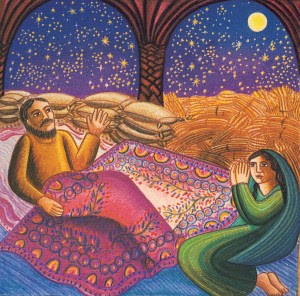
At midnight the man was startled and turned over, and there, lying at his feet, was a woman! He said, “Who are you?” And she answered, “I am Ruth, your servant; spread your cloak over your servant, for you are next-of-kin.”

He said, “May you be blessed by the Lord, my daughter; this last instance of your loyalty is better than the first; you have not gone after young men, whether poor or rich. And now, my daughter, do not be afraid, I will do for you all that you ask, for all the assembly of my people know that you are a worthy woman. But now, though it is true that I am a near kinsman, there is another kinsman more closely related than I. Remain this night, and in the morning, if he will act as next-of-kin for you, good; let him do it. But if he is not willing to act as next-of-kin for you, then, as the Lord lives, I will act as next-of-kin for you. Lie down until the morning.”

So she lay at his feet until morning but got up before one person could recognize another, for he said, “It must not be known that the woman came to the threshing floor.” Then he said, “Bring the cloak you are wearing and hold it out.” So she held it, and he measured out six measures of barley and put it on her back; then he went into the town. 

She came to her mother-in-law, who said, “How did things go with you, my daughter?” Then she told her all that the man had done for her, saying, “He gave me these six measures of barley, for he said, ‘Do not go back to your mother-in-law empty-handed.’” She replied, “Wait, my daughter, until you learn how the matter turns out, for the man will not rest but will settle the matter today.” (New Revised Standard Version)

Boaz was an unmarried wealthy landowner. He was pious and conscientious. Ruth was a widow, a foreigner from Moab. Naomi was Ruth’s mother-in-law, and also a widow. Naomi and Ruth only had each other.

As one in poverty did in those times, Ruth walked behind the harvesters in the fields during the barley harvest, gleaning whatever was left behind. She was gleaning in the field of Boaz. He noticed.

Boaz was kind enough to make sure that Ruth was able to glean for two people. It turns out that Boaz was an in-law to Naomi, through her late husband Elimelech. Naomi sought to play matchmaker, so that Ruth would be well cared for. So, she instructed Ruth in what to do….

A woodcut of Ruth and Boaz on the threshing floor, by Unknown Artist

Harvest time in Judah was also a time of celebration and feasting. Late one night, on the barley wheat threshing floor, Boaz lay down to sleep after a day of bringing in the grain, and an evening of eating and drinking.

Doing exactly as her mother-in-law Naomi instructed, Ruth went to threshing floor, and then quietly laid down at the feet of Boaz. At midnight, Boaz was startled and woke up. There, at his feet, was a woman!

“Who are you? What do you want?” asked Boaz. And Ruth made herself known with the humble response, “I am Ruth, your maidservant.”

Ruth continued to follow Naomi’s guidance, and asked that Boaz spread his cloak over her, because he is the next of kin, the relative who could be responsible for engaging a levirate marriage with her (that is, a legal marriage involving in-law’s).

Although sleepy, and maybe even a bit tipsy, Boaz knew immediately that Ruth was asking him to marry her. Pious man that he was, Boaz would likely have realized the imagery of his situation, as likened to the prophet Ezekiel’s description concerning God’s love toward Jerusalem:

I spread the edge of my cloak over you and covered your nakedness: I pledged myself to you and entered into a covenant with you, says the Lord God, and you became mine. (Ezekiel 16:8, NRSV)

In following Naomi’s advice, Ruth put herself in a very vulnerable situation. Yet, Naomi’s observation of Boaz was spot on. Ruth’s faith in, and love for, her mother-in-law was well-placed.

The man Boaz responded favorably to the asking and overture of Ruth. He praised Ruth for her steadfast love and faithfulness; and her willingness to be with him, instead of a younger man.

Arising organically and sincerely from within Boaz was a prayer for God’s blessing upon Ruth. Not only would Boaz act to marry Ruth, but he also assured her that she belongs to God and God’s people.

The cloak of Boaz being spread over Ruth not only symbolized their upcoming levirate marriage, but it also communicated her marriage to God. Ruth was coming into God’s covenant as one of the people, as well as entering the marriage covenant.

I like that Boaz did not regard the actions and words of Ruth as something impertinent, immoral, or inappropriate. He fully recognized that she was operating consistent with the law of God in honoring a family obligation. And Boaz reciprocated by being honored to have been asked, and honored to comply with Ruth’s wishes.

It seems to me that this is love, as it is intended to be with us. We respect one another’s character, and seek to do whatever we can to meet this person’s need. When I love, I want to go out of my way to act on behalf of this person I admire and adore.

Boaz was not under a legal obligation to marry Ruth. He could have done nothing. But love compelled him – a love for Ruth which was grounded in an abiding love for God.

It wasn’t that Boaz should have, or could have, done something to help meet the needs of Ruth and Naomi. Boaz wanted to do something. He wanted to help Ruth. Boaz wanted to show kindness and steadfast love to Ruth. He wanted to fulfill her asking.

Naomi came up with a plan, because she trusted in the mercy, kindness, and generosity of Boaz. And also because she loved her daughter-in-law Ruth, and wanted her to be loved and cared for.

To show his goodwill and intention to fulfill Ruth’s request, he gave her a significant gift of barley. That is, he loaded her up with groceries to take home. This was a sign that Boaz would indeed make sure that the needs of Ruth and Naomi would be met this day, and into the future.

I am struck with how simple this story really is, at it’s core. It’s just three people, who each care. Caring is something that all of us can do, no matter who we are, where we are, or what situation we find ourselves in.

We really can show basic human kindness to another. We can be merciful, just, and generous. We can ask for what we want and need. We can help one another.

Perhaps, then, the real question for each of us is not whether we can speak and act with love, grace, and kindness; the real question is: Will I speak and act with love and mercy?

If we want to live in a world where there is justice, mercy, and love, then we must demonstrate those very things in our own lives, today and every day.

Live the way that you yourself want to be treated. And if you want mercy, generosity, and love from others, then ask for it.

God of steadfast love, help us each day in the midst of things we don’t understand, To those of us who are afraid, give courage To those who are exhausted, give strength To those in despair, give hope.

Comfort us in our struggles, O Loving God, and meet every need. Grant us safety, security and stability, and help us learn the lessons you are giving us, so that we may all work together to make this world a better place. Amen.

Redeem One Another (Ruth 3:1-7)

Boaz and Ruth, by John August Swanson (1938-2021)

Naomi her mother-in-law said to her, “My daughter, I need to seek some security for you, so that it may be well with you. Now here is our kinsman Boaz, with whose young women you have been working. See, he is winnowing barley tonight at the threshing floor. Now wash and anoint yourself, and put on your best clothes and go down to the threshing floor, but do not make yourself known to the man until he has finished eating and drinking. When he lies down, observe the place where he lies; then go and uncover his feet and lie down, and he will tell you what to do.” She said to her, “All that you say I will do.”

So she went down to the threshing floor and did just as her mother-in-law had instructed her. When Boaz had eaten and drank and was in a contented mood, he went to lie down at the end of the heap of grain. Then she came stealthily and uncovered his feet and lay down. (New Revised Standard Version)

Naomi and Ruth were two widows – a mother-in-law and daughter-in-law – living in an ancient time when women were dependent upon men for survival.

Ruth had been out in the barley fields during harvest, gleaning as much as she could by walking behind the harvesters. It was what people in need did back then.

The owner of the land, Boaz, had heard of Ruth and took notice of her. He was kind and made sure she had enough for herself and Naomi.

So, Naomi, although too old to be out in the fields gleaning barley, could still use her wisdom. She decided to help Ruth have some security for the future. Naomi wanted to help her daughter-in-law,  so she instructed Ruth to make herself available to Boaz.

Boaz was a kinsman, connected to Naomi’s extended family. Naomi intended on using this connection to bring Ruth and Boaz together in marriage, thus settling her daughter-in-law in a good and secure life.

The approach of Naomi underscores her thoughtfulness, creativity, and limited resources. Most of all, however, Naomi’s plan rests entirely on the goodwill and generosity of Boaz. Naomi was observing Boaz, and assessed him as a person she could put her faith into.

Would Boaz be willing to act in Ruth’s favor, as a near kinsman to Naomi? Would he take up the mantle of kinsman-redeemer and enter a levirate marriage with Ruth?

A “levirate” is reference to an ancient marital system which involved in-laws. If a man died without children, the dead man’s name could be perpetuated through the widow’s marriage with a man related to the dead person.

Israel and Judah had a strong sense of community and family solidarity which is evidenced in God’s law. Members of the family and the community had a duty to watch out for each other and care for one another. For example:

“If anyone of your kin falls into difficulty and sells a piece of property, then the next of kin shall come and redeem what the relative has sold. If the person has no one to redeem it but then prospers and finds sufficient means to do so, the years since its sale shall be computed and the difference refunded to the person to whom it was sold, and the property shall be returned. But if there are not sufficient means to recover it, what was sold shall remain with the purchaser until the year of Jubilee; in the Jubilee it shall be released, and the property shall be returned. (Leviticus 25:25-28, NRSV)

Naomi did her best to try and prepare for a marriage to happen. And her best chance was with Boaz on the threshing floor after the barley harvest. Considering that arranged marriages were the norm, none of this was weird at the time.

She wanted to stir up this sense of duty in Boaz, and help him take responsibility for the family, so that Ruth could be properly cared for.

Israelites had a strong theological sense that their God had redeemed them out of Egypt, and therefore, they themselves were to act as redeemers, whenever needed, within their families and communities.

Another way of putting the matter, is that Israel’s covenant with Yahweh their God was to have the wider implication of covenanting to help and care for each other as Israelites. And this was especially true for one’s family.

Boaz was related to Naomi through her late husband Elimelech; and related to Ruth through Elimelech’s son Mahlon, who was Ruth’s late husband.

As you can imagine, not every scenario in Judah which involved redeeming one’s in-law’s actually happened. The question was whether Boaz would do anything. And Naomi was betting on the farm that he would care and help. Hence, Naomi’s advice to Ruth concerning Boaz.

Naomi instructed Ruth to make clear to Boaz that she wanted him to marry her. All of the preparation for the nighttime visit was designed to spark within Boaz that Ruth is asking for a levirate marriage.

Ruth did exactly what her mother-in-law told her. I believe that not only was Naomi looking out for her daughter-in-law, but Ruth was also looking out for her mother-in-law.

Neither one of them had to do what they did. Naomi didn’t have to make arrangements for Ruth to be cared for. But she did. And Ruth, as a foreigner from Moab, didn’t have to succumb to any Jewish covenantal understandings of things. And yet, she did.

Individualistic Western societies reflexively think of personal interest first, and often only think of the personal implications to just about everything – even concerning family. Many persons abandon their families and take up a sort of surrogate family.

They may feel no duty or responsibility to biological family connections. Even more persons move from place to place without much thought to the communities they leave, nor to how they might contribute to the wellbeing of their new community.

A careful reading of the Book of Ruth ought to challenge those types of approaches to family and community. Although none of us are living in the covenant society of Ruth, Naomi, and Boaz, there is an inherent universal ethic of caring for those closest to us, especially family.

Each day is an opportunity to act in redemptive ways which lift up and help others in whatever their need may be. I pray we all to have the sensibilities of persons like Boaz, Ruth, and Naomi.

Gracious God, enable us to understand and care about the needs of others. May your way of love open up for all those who suffer or are in any kind of trouble. Thank you for your steadfast love and abundant mercy. Help us to both accept your love and mercy, and to give it. Amen.

A Reason To Hope (Ruth 2:15-23)

When she got up to glean, Boaz instructed his young men, “Let her glean even among the standing sheaves, and do not reproach her. You must also pull out some handfuls for her from the bundles and leave them for her to glean, and do not rebuke her.”

So she gleaned in the field until evening. Then she beat out what she had gleaned, and it was about an ephah of barley. She picked it up and came into the town, and her mother-in-law saw how much she had gleaned. Then she took out and gave her what was left over after she herself had been satisfied. 

Her mother-in-law said to her, “Where did you glean today? And where have you worked? Blessed be the man who took notice of you.”

So she told her mother-in-law with whom she had worked, saying, “The name of the man with whom I worked today is Boaz.” 

Then Naomi said to her daughter-in-law, “Blessed be he by the Lord, whose kindness has not forsaken the living or the dead!” Naomi also said to her, “The man is a relative of ours, one of our nearest kin.”

Then Ruth the Moabite said, “He even said to me, ‘Stay close by my young men until they have finished all my harvest.’ ” 

Naomi said to Ruth, her daughter-in-law, “It is better, my daughter, that you go out with his young women, otherwise someone might bother you in another field.” 

So she stayed close to the young women of Boaz, gleaning until the end of the barley and wheat harvests, and she lived with her mother-in-law. (New Revised Standard Version)

Ruth was both a widow and a foreigner from Moab. She and her mother-in-law Naomi had no land. Widowed foreign women were likely to be poor. They were vulnerable to abuse by being out in the fields during harvest time, trying to glean whatever leftovers they could find after the harvesters came through.

The covenant code of Israel prescribed laws concerning how to treat the poor. There was even instruction on what to do in just such a situation of the landowning harvester Boaz and the poor gleaner Ruth:

“When you reap your harvest in your field and forget a sheaf in the field, you shall not go back to get it; it shall be left for the alien, the orphan, and the widow, so that the Lord your God may bless you in all your undertakings. When you beat your olive trees, do not strip what is left; it shall be for the alien, the orphan, and the widow.

“When you gather the grapes of your vineyard, do not glean what is left; it shall be for the alien, the orphan, and the widow. Remember that you were a slave in the land of Egypt; therefore I am commanding you to do this. (Deuteronomy 24:19-22, NRSV)

The law stipulated a spirit of generosity toward the poor in the land. The reason for the law is that the Israelites had been slaves in Egypt, and experienced the cruelty of abusive slavedrivers. Israel was to remember this, and ensure that no foreigners would experience what they themselves had to go through for 400 hundred years in Egypt.

Ruth gleaning, by James Tissot, c.1898

Fortunately for Ruth, Boaz was an observant Jew, concerned for the intent and spirit of God’s law. He held to the covenant law both legally and spiritually.

Boaz remembered God’s grace to Israel. He blessed Ruth, and commended her for placing herself in God’s hands.

If not for the covenant code’s opportunity for the poor to glean, Boaz would have faced a dilemma. Once he became aware Ruth and Naomi’s poverty, he surely would not have let them starve. Yet, neither would he likely have made them dependent upon himself.

It is important to preserve the dignity of people, which is why the Old Testament is filled with social and economic laws concerning the poor in Israel.

Ruth was given the chance to glean and work for the harvest. This allowed her to use the grain for making bread. Furthermore, her own labor freed herself and her mother-in-law from being dependent as beggars. All of this helped make the two of them less vulnerable to exploitation by those with little concern for God’s covenant code.

Rather than being smothered either by sheer dependency, or through being used and exploited, God’s law operated as intended, thanks to the pious concern of Boaz.

This did not go unnoticed by Naomi. She clearly saw the gracious hand of God acting through Boaz.

Regardless of who we are, whether rich or poor, old or young, we can be gracious. We can commit ourselves to working hard for one another. We can be concerned for the common good of everyone.

God’s grace turns our hearts and minds, our heads and hands, toward ensuring that all persons have what they need to grow, thrive, and flourish in this life. This is exactly what biblical justice is all about. It’s what Boaz was about.

This will include concerns about equity. A just society will involve some sort of distribution of resources. It will mean making sure that our collective values, communal priorities, and social structures uphold the inherent dignity of human life. We will protect the most vulnerable among us.

A culture attuned to grace will champion the underprivileged and not use them as political pawns to achieve personal goals. A people focused on grace will place faith in God’s presence and provision for us all.

Those with much will care for the disadvantaged, and will uphold laws that do so. Those with little will take advantage of opportunities to both receive and give, and will make their voices heard on behalf of the needy.

Since God is just toward all, so we who are created in God’s image are to also be just.

Since God is good in all that God does, we too, are to be good.

Since God is gracious, merciful, and kind to the poor, so we are to be full of grace, mercy, and kindness.

Since God is love, so we are to love, not hate.

Faith and hope are born within the heart, because there is a reason to do so. Let us all be the people who give others a reason to trust God, hope for a better tomorrow, and love, despite any unloving situations.

Soli Deo Gloria