How Much Is Too Much? (1 Kings 4:20-28)

King Solomon’s court, by Claude Vignon (1593-1670)

The people of Judah and Israel were as numerous as the sand on the seashore; they ate, they drank and they were happy. And Solomon ruled over all the kingdoms from the Euphrates River to the land of the Philistines, as far as the border of Egypt. These countries brought tribute and were Solomon’s subjects all his life.

Solomon’s daily provisions were thirty cors of the finest flour and sixty cors of meal, ten head of stall-fed cattle, twenty of pasture-fed cattle and a hundred sheep and goats, as well as deer, gazelles, roebucks and choice fowl. For he ruled over all the kingdoms west of the Euphrates River, from Tiphsah to Gaza, and had peace on all sides. During Solomon’s lifetime Judah and Israel, from Dan to Beersheba, lived in safety, everyone under their own vine and under their own fig tree.

Solomon had four thousand stalls for chariot horses, and twelve thousand horses.

The district governors, each in his month, supplied provisions for King Solomon and all who came to the king’s table. They saw to it that nothing was lacking. They also brought to the proper place their quotas of barley and straw for the chariot horses and the other horses. (New International Version)

Wealth, in and of itself, is neither good nor bad – it just is. The real issue is why any particular person wants to be wealthy, how we view wealth, and what we do with it when we have it.

In ancient Israel, under King Solomon, the Israelites enjoyed a time of prosperity, safety, and abundance. To flourish and thrive in life is good. The ability to meet basic needs, and to enjoy life is good.

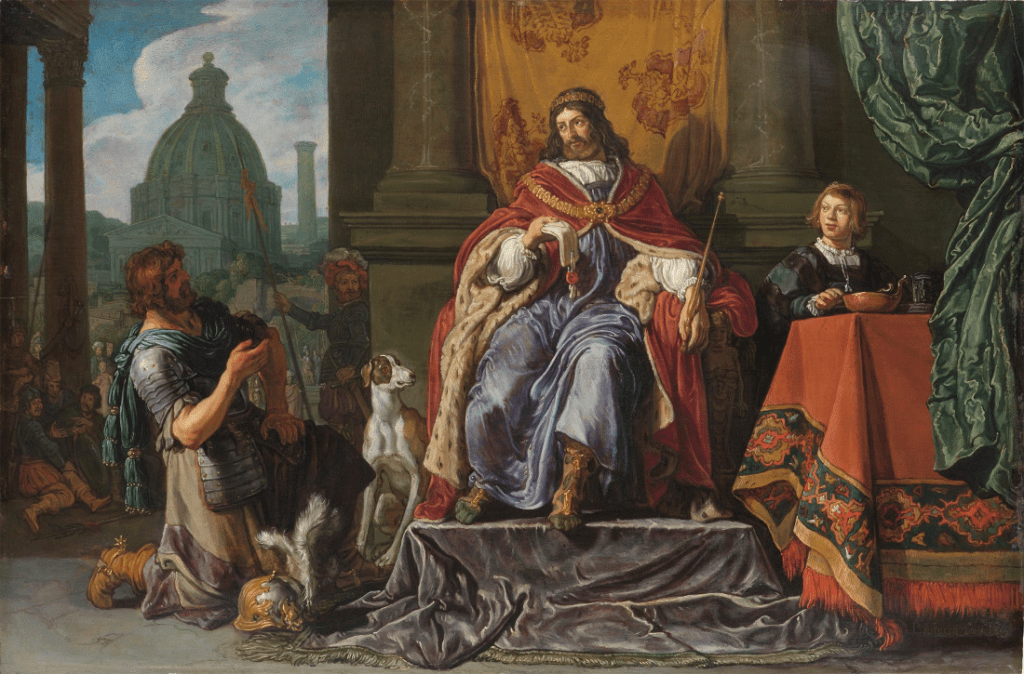
King Solomon on his throne, by Frans Francken the Younger (1581-1642)

But what about beyond that? Is there such a thing as too much? And what about others who may not be able to make ends meet?

Solomon certainly had a lot. Yet, we do have warnings in Holy Scripture about exorbitant wealth. Here is what the Deuteronomic law says concerning any future king:

The king, moreover, must not acquire great numbers of horses for himself or make the people return to Egypt to get more of them, for the Lord has told you, “You are not to go back that way again.” He must not take many wives, or his heart will be led astray. He must not accumulate large amounts of silver and gold. (Deuteronomy 17:16-17, NIV)

Whatever standard one may use, I would say 12,000 horses falls into the great-numbers-of-horses category. And likewise, having 1,000 wives is most likely 999 too many for just about every man on the planet.

Indeed, Solomon’s heart was eventually led astray. It’s quite sad. Even the wisest and wealthiest person who ever lived was not able to sustain complete faithfulness to God. The remainder of Deuteronomy’s instruction about a future king is this:

When he takes the throne of his kingdom, he is to write for himself on a scroll a copy of this law, taken from that of the Levitical priests. It is to be with him, and he is to read it all the days of his life so that he may learn to revere the Lord his God and follow carefully all the words of this law and these decrees and not consider himself better than his fellow Israelites and turn from the law to the right or to the left. Then he and his descendants will reign a long time over his kingdom in Israel. (Deuteronomy 17:18-20, NIV)

In all fairness, King Solomon started out paying attention to God’s law. In his wisdom, he sought to learn and obey – but it ended up being only a partial obedience.

A dimension of any rule or government is to realize that – with any sort of success, security, and wealth – there is always a dark underbelly to it. That is, there are people within that government who are not enjoying its largess and wealth.

Under the new expanded governmental system, Solomon had his kingdom, and its subject peoples, divided into districts in order to give provisions, as well as laborers for his ambitious building projects. Not everyone was enjoying leisure time under a fig tree.

King Solomon set up an economic system that transferred wealth from nations subservient to Israel, and from subsistence farmers within Israel, to support the massive needs of Jerusalem.

The city, under Solomon, was living off the surplus grain to feed all of the horses, as well as the tribute exacted from surrounding nations. In other words, the wealth was being centralized by Solomon for his many projects and interests.

All of the opulence was meant to impress people with wealth, exhibiting Israel’s and Solomon’s great power and wisdom. Yet, if we are to follow the old adage, “follow the money,” we would discover a governmental system that extracted money from others; and produces a lot of oppression, grievances, and exploitation – hence, the dark underbelly of it all.

This sort of situation is precisely why we have prophetic literature in the Old Testament. The prophets are especially attuned to the cries of injustice amongst the people. Every society needs such persons who are within the system, yet are able to be a voice for those who are voiceless.

Had King Solomon moved beyond his partial obedience to complete and total obedience, I surmise that he likely would have considered the needs of everyone within his empire, before establishing a system of government that depended upon economic exploitation.

Specifically, perhaps Solomon ought to have engaged more vigorously and robustly with the covenant code between God and Israel that he was supposed to know so well.

And perhaps, Christianity and the Church have been too lax on the subject of handling Holy Scripture. Because, for all of our talk of being faithful to scripture, that talk has not translated into a solid social and economic understanding of human need and justice.

It simply will not do to label anything we don’t like as communist or socialist. And it will not do to say King Solomon was wealthy and successful, as if that, in and of itself, is the evidence of God’s favor. In reality, it means little, apart from a complete fidelity to God’s law.

In my judgment, Jesus did better than all of this. He pointed us to an alternative system which considers the common good of all persons, and not just some people. The ethics and morality of his Sermon on the Mount lays out the foundational means upon which any sort of governmental system ought to build upon. (Matthew 5-7)

But seek first his kingdom and his righteousness, and all these things will be given to you as well.

Jesus (Matthew 6:33, NIV)

If we are looking for the same sort of wealth and success as Solomon, that means we’ll need to ignore Jesus. Yet, if faithfulness, obedience, humility, righteousness, mercy, purity, and peacemaking matter more than our economic bottom line, then I believe we will discover that the pursuit of these virtues leads to having all of our needs met, as well.

Lord of our lives, teach us how to use our money and our possessions. Deliver us from stinginess and wasteful extravagance; inspire our giving with the spirit of true generosity. Help us always to remember your generous love for us, that we may be wise and faithful stewards of the good gifts you have given us. Amen.

Be Careful about Your Decisions (2 Samuel 11:14-21)

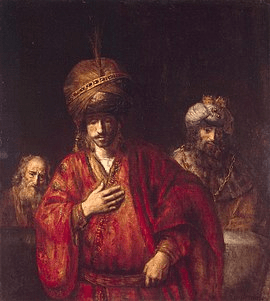
David and Uriah, by Rembrandt, c.1665

In the morning David wrote a letter to Joab and sent it with Uriah. In it he wrote, “Put Uriah out in front where the fighting is fiercest. Then withdraw from him so he will be struck down and die.”

So while Joab had the city under siege, he put Uriah at a place where he knew the strongest defenders were. When the men of the city came out and fought against Joab, some of the men in David’s army fell; moreover, Uriah the Hittite died.

Joab sent David a full account of the battle. He instructed the messenger: “When you have finished giving the king this account of the battle, the king’s anger may flare up, and he may ask you, ‘Why did you get so close to the city to fight? Didn’t you know they would shoot arrows from the wall? Who killed Abimelek son of Jerub-Besheth? Didn’t a woman drop an upper millstone on him from the wall, so that he died in Thebez? Why did you get so close to the wall?’ If he asks you this, then say to him, ‘Moreover, your servant Uriah the Hittite is dead.’” (New International Version)

Today we have a lesson in the middle of a story about King David’s greatest error in judgment and cover up of that decision. Indeed, bad decisions can often beget even more bad decisions.

It would be an understatement to say that David blew it. Our Old Testament books of 1 and 2 Samuel are arranged by the original editor in such a way that the chapter of 2 Samuel 11 is a hinge upon which the life of David moves.

All of the material before 2 Samuel 11 is generally positive, describing a man devoted to God in every way. But everything after this chapter is mostly tragic. The editor wanted readers and listeners to understand that God cares about morality and ethics by showing the consequences of both a life well-lived, as well as a life that is self-centered.

Before our verses for today, the story begins with David choosing adultery and taking another man’s wife. King David should have been doing the work of a king – protecting and serving Israel. But instead, he hung out in Jerusalem and avoided all the needed military stuff. (2 Samuel 11:1)

The editor wants us to see that King David was shirking his responsibility, which then brought a set up for moral failure. It appears David was resting on his laurels, content with his victories and successes. For the most part, at the time, the nation was happy and prosperous.

The king was walking around on the roof of his palace, instead of being in the trenches with his men, leading them in the defense of Israel.

Rather than giving proper orders as a king ought to do, David was sending people to do his personal bidding in satisfying his earthly wants. This is a significant reversal of what we see from earlier chapters in the story of David.

Up to this point we have observed David as a merciful king, seeking to use power for benevolent purposes in the common good of the nation. But in today’s chapter, David turns into the typical earthly king, ordering others around and using his authority to get what he wants.

The editor wants us to learn some lessons from David’s life. One of those lessons is that if the right and just King David can fall, then none of us are immune from falling into bad decisions which alter people’s lives forever.

The moment we think we are above falling, look out, because an arrogant nose dive into depravity is probably not far behind.

The stories of people who fall into immorality are mostly the same. Having some power or authority to wield, they use it to assert control over another person or group in order to get what they want – without being concerned for the needs and wants of others, and usually unconcerned for the negative consequences it brings upon other people.

It’s important that we call such behavior what it is: Evil. Awful. Selfish. Ungodly. A violation of ethics and morality. An offense against God.

David committed adultery, then lied, manipulated others, and covered up his actions. He murdered an innocent man, and was okay with an entire regiment of soldiers getting killed to ensure that an innocent man would be dead.

None of that icky nasty stuff was a mistake, or a lapse in judgment. It was pre-meditated sin.

And the way to deal with such sin is not to say something like “I did it, but it wasn’t really me; I’m not really like that!” Well, apparently, you are. Maybe David thought he was above it all, and believed it wasn’t really something he could ever do. But he did.

David gives Uriah a letter for Joab, by Pieter Lastman, 1619

Once we make an immoral and ungodly decision, it often causes us to start selling-out our principles and convictions. Sin only begets more sin, until we deal with it squarely.

Truth is a celebration of openness and honesty. Shame keeps to the shadows and prizes secrecy and remaining quiet. If one chooses not to go down the path of truth, then they will be continually encrusting their lives with lies so that no one ever knows.

In fact, much of religious legalism is nothing more than a person piling on the rules in order for others to not see the guilt and shame that hides deep within. Only through confession, repentance, and faith, will forgiveness, wholeness, and happiness ever occur.

Yet another lesson we can learn from this story of David is that the results which may satisfy our wants may not necessarily satisfy our needs, or God.

David accomplished what he wanted. He was successful in covering up his sin, and he got the woman he wanted. But God saw the whole thing, and was not okay with any of it. 

We must not assume that because we do something, and there was no immediate lightning strike, that it was okay. 

To only selfishly satisfy ourselves is to be a spiritual cannibal who eats other people alive.

So, how might we avoid falling into the same sorts of bad decisions which befell David?

  • Make prayers of confession a regular staple of your daily spiritual regimen. Had David engaged in prayer on the roof instead of being bored, we would likely have a very different story.
  • Maintain an active and engaged mind. An idle mind is the devil’s workshop. David was wandering around the palace instead of actively engaged in the government of his kingdom.
  • Keep the Sabbath. A day of rest helps the body to be in healthy rhythms of care, as well as enabling the spirit to connect meaningfully with God. Without adequate rest, we are like the little kid in a grocery store at 9pm throwing a fit and having a meltdown. David got out of a healthy rhythm as king, and it led to a fall.
  • Strengthen your family relationships. If you are married, live from the place of your marriage. Marriage is more than living with someone and having occasional fun; it is a one-flesh relationship that is meant to be a priority. Only from this relational place can a spouse effectively take on the world with all its needs and brokenness. 
  • Submit to accountable relationships. There are far too many lonely people with few friends in this world, even among people who are constantly around others. Everyone needs a small coterie of confidants with whom to share anything and everything with.  David’s close friends were all out with the army, and he was alone. Not a good thing.
  • Avoid stuffing all desire down as selfish and bad. Jettisoning desire only sets us up for a fall. But identifying godly desire enables us to make better decisions which engage the whole person.

Almighty God, you are the fountain of all wisdom and grace. You know our needs before we even ask, and our ignorance in not asking for the things we really need. Have compassion on our weakness, and mercifully give us those things that in our blindness we don’t know to ask for. 

Gracious Lord, we acknowledge and confess our sinful nature, prone to evil and slow to good.  You know our secret sins, and how often we have offended you and damaged others through wandering from your ways, wasting your gifts, and forgetting your love. Cleanse us from our hidden sins and forgive our faults for the sake of your Son, our Savior, Jesus Christ who loved us and gave himself for us. Amen.

Learn a Lesson from Conflict (2 Samuel 10:13-19)

David Attacks the Ammonites, by Gustave Doré, 1866

Then Joab and the troops with him advanced to fight the Arameans, and they fled before him. When the Ammonites realized that the Arameans were fleeing, they fled before Abishai and went inside the city. So Joab returned from fighting the Ammonites and came to Jerusalem.

After the Arameans saw that they had been routed by Israel, they regrouped. Hadadezer had Arameans brought from beyond the Euphrates River; they went to Helam, with Shobak the commander of Hadadezer’s army leading them.

When David was told of this, he gathered all Israel, crossed the Jordan and went to Helam. The Arameans formed their battle lines to meet David and fought against him. But they fled before Israel, and David killed seven hundred of their charioteers and forty thousand of their foot soldiers. He also struck down Shobak the commander of their army, and he died there. When all the kings who were vassals of Hadadezer saw that they had been routed by Israel, they made peace with the Israelites and became subject to them.

So the Arameans were afraid to help the Ammonites anymore. (New International Version)

Outward Conflict with Ammon

You would think that showing basic human kindness to another would always end well… Yet, not always. And King David found that out, the hard way.

David, having become king of Judah and Israel, demonstrated that his reign would be characterized by extending the sort of mercy and kindness that is characteristic of God.

Whereas David’s kindness was most often accepted, when it came to King Hanun and the Ammonites, it was misunderstood and rejected. The Ammonites humiliated King David’s sent ambassadors.

The delegation wanted to express David’s condolences to Hanun in the event of his father’s death. Then, after the Ammonites saw that King David was upset about how his ambassadors were treated, they mobilized a mercenary force of Arameans with Hadadezer leading the charge.

Both the Ammonites and the Arameans underestimated the experience and skill of the Israelite army under their commander Joab. Even though Joab was outnumbered, he conceived of a strategy that evened the odds.

All of this conflict, with preparations for battle and an escalating war, came about because a king wanted to show kindness to another. Indeed, this can be a very messed-up world that we inhabit!

The result of it all is that the Ammonites and the Arameans were soundly defeated by a smaller, yet much stronger, army with King David at the head. The Arameans became subject to Israel, and the Ammonites were left slack-jawed, not knowing what hit them.

Inner Conflict with Oneself

So, here we have David, who like all of us, is a bundle of contradictions. On the one hand, King David had his heart set on showing kindness and reflecting the heart of God in his rule and reign. And on the other hand, David is a soldier and a man of blood, who does an awful lot of killing people in his lifetime.

King David is both a paragon of moral behavior, and an example of immoral living.

He did not lift a finger against his former king who was trying to kill him; and evidenced a tender spirit through musical skill and an ability to write the psalms and songs of Israel.

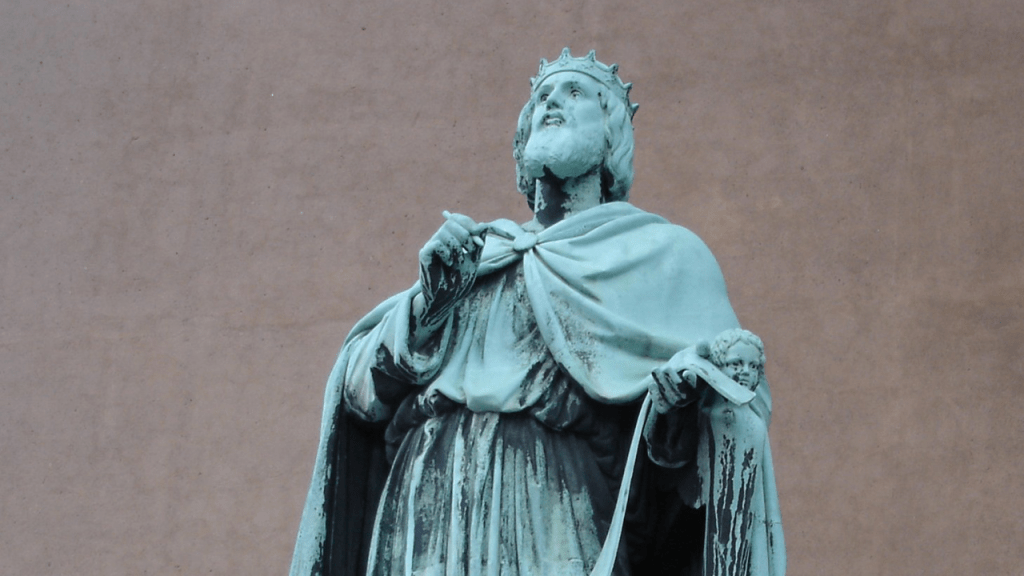
Statue of King David, Copenhagen, Denmark

Yet also, King David demonstrated for us some of the worst immorality, of which is clearly seen in the next few chapters of his story in the book of 2 Samuel. Throughout David’s adult life, he took thousands of human lives in battle.

He came to fame by beheading Goliath; made his mark in Israel by killing Philistines for King Saul; survived in the wilderness while Saul was trying to kill him by killing Amalekites; and secured Israel’s borders through an enormous amount of killing.

I won’t do to simply say that the people David killed had it coming to them, or that he did all the things he did for the sake of the nation. That sort of reductionism smacks of mental laziness and purposeful ignorance.

Coming to Grips with Conflict

At the least, it seems to me that we must accept the biblical narratives as they are, and not as we want them to be, whenever there is difficulty in understanding a story.

We have the human condition in front of us every time we read a scriptural story. Either making it all good, or all bad, just won’t do – because all of us, like David, are a bundle of contradictions and paradoxes that often don’t make sense.

It turns out that, throughout Holy Scripture, we find stories of people who are no better and no worse than we ourselves. The ancient persons, like David, are those for whom a gracious God chose to use and work through – despite either their sinning or their saintliness.

We get a glimpse of how things were and how the Lord operated through the people of the time in their own political, social, economic, and religious contexts.

God comes to us, not merely from the outside by simply mandating commands and imposing control, but enters our lives on the inside, taking us as we are and graciously working with and within us to accomplish good and just purposes on this earth.

And, as it turns out, God uses whomever God wants to use, without doing some sort of divine screening interviews to find out who the most moral candidate is available for the job.

If you are looking for a bottom line in all of this mayhem, then I believe it is this: God loves us. God is with us. And God holds us – all of us, with our maddening combinations of kindness and kookiness – to establish a truly right and benevolent world characterized by humility, gentleness, mercy, purity, and peace.

It’s a rather long and messy process of bringing in such a way of life, but God is patient and will take the centuries and even the millennia needed to accomplish it.

It’s Not All About Human Conflict

Although we are a flawed and fallible people, we are nevertheless God’s people. At the end of it all, we discover that none of this was really a story about Ammonites or Israelites or David or Joab or anyone else; it is actually a story about God – because God is both the object and subject of every biblical narrative.

And what we discover about God is that there are divine initiatives happening all the time which are meant to help us and save us from ourselves. The Lord is sovereign over all creation, and brings salvation despite what we do or don’t do.

God’s kindness – shown and expressed through our own human kindness – will eventually and always win the day.

Almighty and everlasting God, whose will it is to restore all things in your well beloved Son, the King of kings and Lord of lords: Mercifully grant that the peoples of the earth, divided and enslaved by sin, may be freed and brought together under his most gracious rule; who lives and reigns with you and the Holy Spirit, one God, now and forever. Amen.

The Issue of Holy War (Deuteronomy 7:1-11)

Joshua’s military campaign against the five Amorite kings, by Gilliam van der Gouwen, 1728

When the Lord your God brings you into the land you are entering to possess and drives out before you many nations—the Hittites, Girgashites, Amorites, Canaanites, Perizzites, Hivites and Jebusites, seven nations larger and stronger than you—and when the Lord your God has delivered them over to you and you have defeated them, then you must destroy them totally. 

Make no treaty with them, and show them no mercy. Do not intermarry with them. Do not give your daughters to their sons or take their daughters for your sons, for they will turn your children away from following me to serve other gods, and the Lord’s anger will burn against you and will quickly destroy you. 

This is what you are to do to them: Break down their altars, smash their sacred stones, cut down their Asherah poles and burn their idols in the fire. For you are a people holy to the Lord your God. The Lord your God has chosen you out of all the peoples on the face of the earth to be his people, his treasured possession.

The Lord did not set his affection on you and choose you because you were more numerous than other peoples, for you were the fewest of all peoples. But it was because the Lord loved you and kept the oath he swore to your ancestors that he brought you out with a mighty hand and redeemed you from the land of slavery, from the power of Pharaoh king of Egypt. 

Know therefore that the Lord your God is God; he is the faithful God, keeping his covenant of love to a thousand generations of those who love him and keep his commandments. But

those who hate him he will repay to their face by destruction;
    he will not be slow to repay to their face those who hate him.

Therefore, take care to follow the commands, decrees and laws I give you today. (New International  Version)

You may likely identify today’s Scripture as a difficult passage in the Bible. And rightly so. It doesn’t quite square with many people’s concept of a gracious and loving God. Yet, here it is. So, what do we do with this supposed loving God, commanding the new nation of Israel to completely wipe out the Canaanites?

Here are a couple of approaches I believe are completely unhelpful as we consider the text in front of us: 1) Ignore this text and relegate it as some antiquated piece of ancient literature which has nothing to do with us today; or 2) Reinterpret the text so that the killing doesn’t seem so bad, e.g. it’s not murder but a just war that was necessary to do.

However we choose to approach this text of Scripture, there’s no getting around the reality that it is talking about God commanding the Israelites to engage in a holy war of killing Canaanites – even though it was God who commanded, “Thou shalt not kill.” (Exodus 20:13, KJV)

Indeed, let’s face the reality that this is a moral and ethical conundrum for us. Let’s neither ignore it, nor do some interpretive gymnastics to make it say something it isn’t saying. In practical and objective terms, this is about God giving the Promised Land to the Israelites, of occupying and settling the land without any sort of residual contamination from the Canaanite way of life.

The taking of the land involved the exclusive worship of Yahweh. In order for that to effectively happen, the elimination of Canaanite gods needed to occur, according to God. And it was taken to the extreme limit of also eliminating those who worship the other gods.

An explanation is given for the method of holy war: To leave anything Canaanite in the land would end up being a snare to the Israelites because they would be led astray to serve those other gods.

For Israel to make it as a nation, they were to be holy and set apart exclusively for the worship of Yahweh. To have the Canaanites alongside them would be something like leaving a box of donuts on the desk next to you when you’re trying to work and attempting to lose weight.

Gathering, by Yoram Raanan, 2015

Covenant loyalty was highly important to both God and the Israelites. If the people would faithfully follow God’s will, as revealed in God’s Law, they could confidently go into battle against their enemies. Then, the Israelites will know that the Lord is going before them to give them success and victory.

However we try to understand holy war in the Old Testament, this was not really an issue for ancient cultures. Such an approach to taking land and occupying it was almost taken for granted. And in light of the Israelites having just lost an entire generation of people because of disobedience and complaining, they wanted nothing to do with that again – or with being under the slavery of an empire like Egypt.

Yet, here we are, trying to still make sense of the text of Scripture for today. And, it seems to me, every generation of Bible readers will continually grapple with this. There is something, however, that is important to consider: The nature of the ancient pagan worship.

There was a huge difference between the worship of Yahweh and the worship of the seven distinct gods in Canaan such as Molech and Chemosh. The abuse of both women and men in cult prostitution, as well as the practice of child sacrifice, were characteristics of that pagan worship.

Canaanite worship was so offensive to the Lord, that God as the rightful and just Judge, made the judgment to do away with them – not because Israel was so holy, but because Canaan was that immoral. In those circumstances of immoral and unethical ways of worship and life, the danger of Israel becoming morally and religiously corrupt was particularly acute.

So, this is why the Lord demanded that the Canaanite implements of worship be completely destroyed. And this situation was deemed of such high risk, that God commanded everything of the Canaanites – including the Canaanites themselves – be done away with. It was a war not just against people, but against their gods.

None of this necessarily makes a holy war justifiable from a contemporary perspective; but it does bring a needed context and understanding as to the extreme nature of ensuring the Canaanites were snuffed out altogether.

All of us are influenced by others. Bad relationships corrupt good character. No individual, group of people, or even an entire nation, can keep itself on a right, just, and good path if they are continually around others who harm people either verbally and/or physically.

It behooves us to be vigilant as to our relationships and to who we choose to listen to. One of the most significant issues for people today, in my opinion, is how we hear, and who we listen to. The poor choices that so many persons make as to the sort of people and ideas they hear every day significantly impacts our culture and society.

It is my ardent desire to be an agent of healthy religion, sound ethics, personal morality, cultural good, and societal justice. I neither need to be an obnoxious jerk in doing so, nor need to go on a holy war – namely because only God can call for such a thing. And if any person (especially a politician or a pastor) tries to tell you or me that it’s okay to destroy others and harm them, then that person is not speaking from a place of understanding or rationality.

In the end, we can choose to listen or not listen to whomever; yet we will eventually have to listen to the greatest force which exists in the universe.

Almighty God, the Sovereign of the universe who dispenses both judgment and grace: Deliver us from any sort of coldness and hardness of heart, or any kind of unhealthy and deluded thinking, so that we may have thoughts of steadfast love and affections of that which is just and true. Amen.