Mark 8:22-26 – A Ministry of Touch

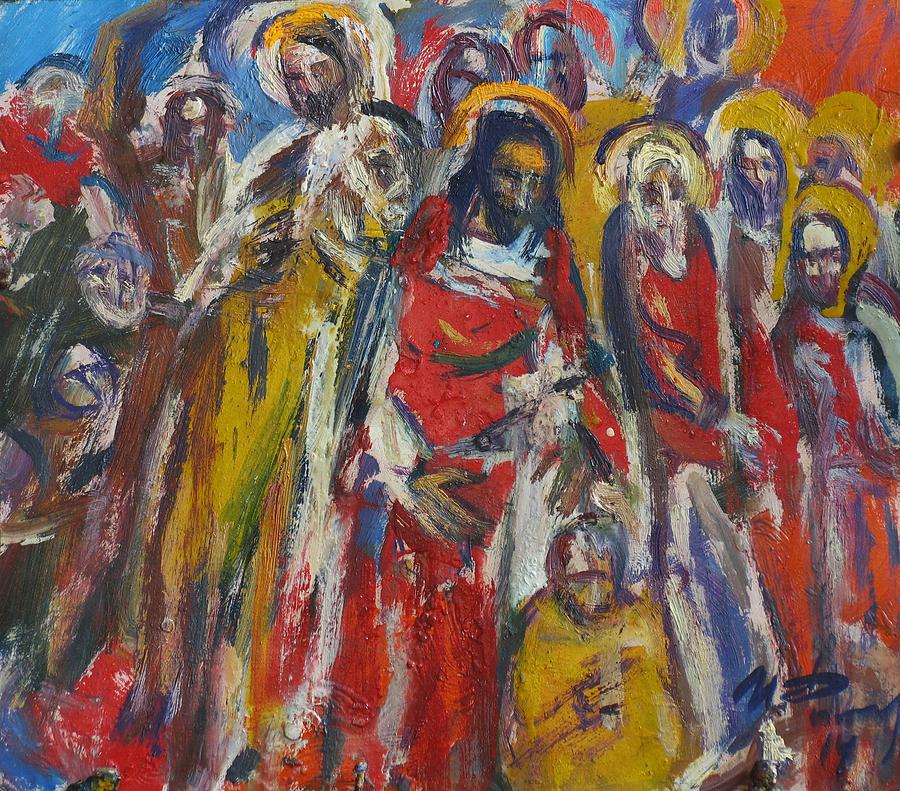
“Healing” by Ivan Filichev

They [Jesus and his disciples] came to Bethsaida, and some people brought a blind man and begged Jesus to touch him. He took the blind man by the hand and led him outside the village. When he had spit on the man’s eyes and put his hands on him, Jesus asked, “Do you see anything?”

He looked up and said, “I see people; they look like trees walking around.”

Once more Jesus put his hands on the man’s eyes. Then his eyes were opened, his sight was restored, and he saw everything clearly. Jesus sent him home, saying, “Don’t even go into the village.” (New International Version)

Spirituality is, of course, a matter of the spirit. It is also a matter of the body. It may be lost on us that the way our spirituality is expressed is through our very real physical selves. A disembodied spirituality is really no spirituality, at all.

Christianity is profoundly physical. A core doctrine of the Church is the incarnation of Christ, God becoming man. Jesus has a real flesh and blood body. His physical body was the vehicle by which he did the will of God. Christ’s earthly ministry directed attention to people’s holistic needs – including the physical body.

So, perhaps it ought not surprise us when Jesus intentionally and literally touches people. From one person to another, Jesus was attentive to the power of compassionate and healing physical touch. For healing does not happen from afar; it is close enough to be personal, touching the spirit, the emotions, the mind, and the body.

In today’s Gospel lesson, some folks came to Jesus with a blind man in tow. They were evidently concerned and close enough to the man to beg Jesus to touch him. Yes, touch him. The small group of people were looking for a tangible reach from Jesus.

Just the other day, I visited a dear lady in the hospital for which I’m a Chaplain. As I began to speak with her, she reached out her hand, and I took it. I then realized that she was blind. This patient, in the dark because of her eyes, and in a strange unfamiliar place, needed more than a verbalized healing prayer from me. She needed a very real physical connection. The ability to compassionately touch another person has tremendous power.

“To touch is to give life.”

Michelangelo

Skin-to-skin contact is vital for our mental, emotional, spiritual, and physical health. Sensory deprivation is a real thing, and it’s a pervasive problem, especially during a pandemic.

We now know that whenever we feel unusual stress and pressure in our lives that the body releases the stress hormone cortisol. One of the biggest things actual physical touch can do is reduce the abnormal stress, allowing the immune system to work the way it should. What’s more, touch helps calm our heart rate and blood pressure, enabling us to have a more regulated way of life.

Jesus took the blind man by the hand and walked him outside the village. Let’s pause on that factoid for a moment. There was a man who literally walked with Jesus, hand-in-hand, for perhaps a few miles. I wonder what he experienced, just in that walk. What seems clear to me is that this event of walking was part of the man’s healing. He quite simply needed this bodily experience with Jesus.

I find it a bit humorous that some commentators struggle with the process of Christ’s healing the blind man, as if Jesus himself was struggling with trying to heal the guy. However, by taking the approach of an embodied spirituality, we can discern that this man required a great deal of touch from Jesus. The spitting, the putting the hands on the eyes, and then doing it again, was all deliberately tactile and just what the man needed for his healing of both body and soul.

Christ’s physical body was an instrument of grace. And our own bodies are meant to bless others with appropriate and compassionate touch. I realize this gets complicated with social distancing practices and concerns with health during a pandemic, yet we can still be agents of healing through simple acts of touch, including the following:

  1. Hug others. Hugs are healthy. I completely understand that some people aren’t huggers, and we ought to be guarded hugging others we don’t know very well. I usually ask before I hug someone outside of my family or church. Unfortunately, many people have had bad experiences being touched, and my heart goes out to them. Yet, the need for meaningful and positive touch still remains both for us and for others.
  2. Pet the dog. My wife’s little dog is a prima donna. He drives me nuts sometimes (maybe most of the time). Yet, because of his disposition, he is the perfect little gentleman when in a care facility or in public. He likes the attention. If you have a pet, let other folks pet them. I’m a busy guy, but when it comes to taking time for neighborhood kids to pet the dog while I’m walking him, I’m all in. It is a simple ministry that anyone can do.
  3. Hold hands or offer light touch. This can and perhaps should be a liberal activity within most families. It can also be done with others. It’s not weird to do this, even in some contexts with strangers. For example, when leading someone in the hospital to their appointed place, depending on the circumstance, I place a light hand on the back or shoulder. Hospitals aren’t exactly destination vacation spots, so folks can be nervous when in them. Simple ways of appropriate touch help calm the anxiety.
  4. Fist pumps and elbow bumps have replaced handshakes, and that’s a good thing. Fist and elbows just aren’t the same thing as a good old fashioned tight handshake, yet it is still an opportunity to touch. Some touch is better than no touch. Don’t give up on practicing ways to physically connect, even if those ways aren’t ideal.
  5. Use your eyes. There are just going to be some circumstances and places where you cannot offer an actual physical ministry of touch. So, use your eyes. Imagine in your mind offering a hug or a handshake to the person and intentionally focus that picture to your eyes. Since our physical eyes communicate a lot, the other person will pick it up.

Every day is an opportunity, for the believer, to walk with Jesus along our life’s journey. As we allow Christ to touch our lives, we, in turn, are able to touch others both spiritually and sometimes even physically through compassionate ministry.

May you know the grace of being touched by Jesus, and the blessing of touching others with the love of God.


Matthew 15:21-31 – Sense the Urgency

Woman of Canaan by Sadao Watanabe, 1965

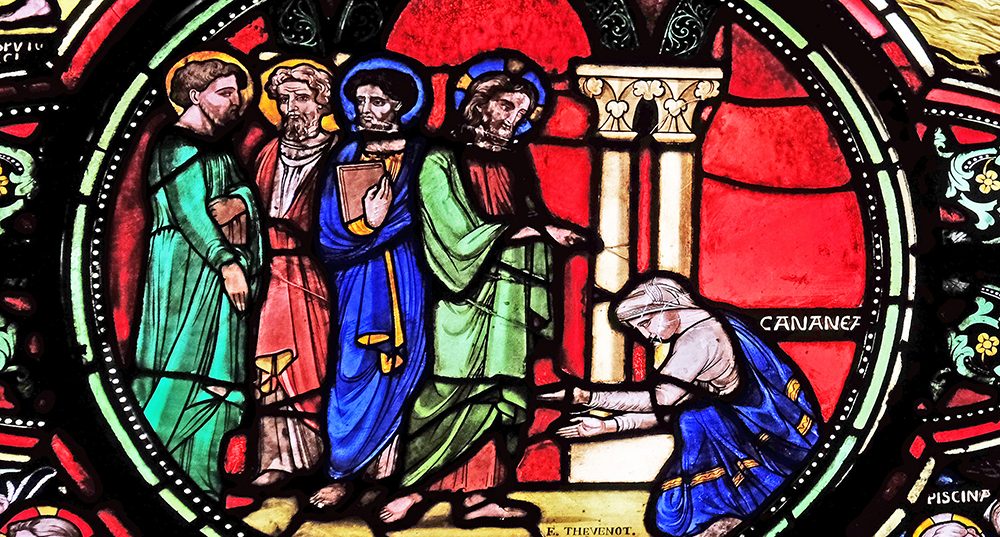
Leaving that place, Jesus withdrew to the region of Tyre and Sidon. A Canaanite woman from that vicinity came to him, crying out, “Lord, Son of David, have mercy on me! My daughter is demon-possessed and suffering terribly.”

Jesus did not answer a word. So, his disciples came to him and urged him, “Send her away, for she keeps crying out after us.”

He answered, “I was sent only to the lost sheep of Israel.”

The woman came and knelt before him. “Lord, help me!” she said.

He replied, “It is not right to take the children’s bread and toss it to the dogs.”

“Yes it is, Lord,” she said. “Even the dogs eat the crumbs that fall from their master’s table.”

Then Jesus said to her, “Woman, you have great faith! Your request is granted.” And her daughter was healed at that moment.

Jesus left there and went along the Sea of Galilee. Then he went up on a mountainside and sat down. Great crowds came to him, bringing the lame, the blind, the crippled, the mute and many others, and laid them at his feet; and he healed them. The people were amazed when they saw the mute speaking, the crippled made well, the lame walking and the blind seeing. And they praised the God of Israel. (New International Version)

Not much happens until something becomes urgent.

A doctor, a financial planner, or a preacher can tell us something until they are blue in the face, but it usually doesn’t mean much without a sense of urgency that a change must occur – that the way things are isn’t going to cut it any longer. 

We can say eating healthy is of value, yet unless there is a sense of urgency to it, it is difficult to do. Someone can proclaim that retirement savings is important, yet unless there is a sense of desperate action, it likely won’t happen. 

Christians say prayer is important, lost people matter to God, and ministry to youth is the hope of the world. Yet without a sense of urgency, there is procrastination and talking, resulting in zero change.

It’s the difference between law and gospel, or between duty and grace. The law and duty are important elements of the Christian life. The law shows us our sin and gives us direction how to live. However, law and duty can only take us so far – it cannot effect real and lasting change. Only the gospel of grace can do that. 

Law and duty alone won’t do it. And when we figure out it doesn’t work, we try and hide our struggle by keeping up the appearance of being a good Christian. Then, we boil down the rules of the Christian life to merely being nice and attending church (law). Our deep hurts and damaged emotions are handled by burying them in layers of law in order to protect ourselves from any more disappointment.

Nothing could be further from today’s Gospel lesson. We have a Gentile Canaanite woman, who is as far from God as one can get in the ancient world. She is neither concerned about appearances nor hiding to mask her pain. The woman cares about her daughter’s terrible suffering from demonization. She recognizes Jesus as the Promised One and seeks him out.

Only grace, not law-keeping, will save, deliver, or heal anyone.

Grace is bestowed to the humble who recognize the great urgency of needing Jesus – in God’s good timing, not ours. Faith is exemplified by a willingness to beg. It’s demonstrated with dogged persistence in the face of the slimmest of odds.

The Canaanite woman screams for help.

Her daughter is suffering. The region of Tyre and Sidon is demon territory – the home region of the Old Testament character, Jezebel – a place far from the covenant people of Israel’s ways. 

The woman has no leverage, no ground of appeal, and no spiritual pedigree. There is no way to approach Jesus by any other means than crying out to him with her deeply felt need. In her sense of urgency, noise and humility is all she has.

Jesus is silent.

Have you ever felt like God is silent, as though your prayers were doing nothing but bouncing off the ceiling? 

God is often silent. Yet, let’s not misinterpret this lack of response as thinking God didn’t hear, or doesn’t care, or something is wrong with me. Silence from God is just that – agonizing divine silence….

A superficial reading of the story may lead us to believe Jesus is aloof, or elitist, that maybe he isn’t interested in certain people. It seems to me, a better way of interpreting the silence is through the lens of our patience and perseverance, a sort of faith testing.

There is some mystery to this story we may never fully grasp. However, the story lets us know Jesus is not a coin machine where we can slip in a dollar and get immediate change. Jesus is a person, not a mechanism to figure out, to get what we want from him. This is not the way of grace.

The disciples want Jesus speaking to get rid of the screaming obnoxious woman.

“Holy cow, Jesus, just give her what she wants so she’ll go away!”  They wanted a healing, but it wasn’t out of a sense of compassion or grace. “After all, we’ve got important Jesus-work to do here, and we don’t need this woman upsetting the peace, rocking the boat, challenging the status quo, making waves, and ruining our sanctified party.” 

The disciples labeled the woman as loud and undeserving. Frankly, they may have been right. But they were operating out of law, not grace.

Jesus and the Canaanite woman, from Saint Germain-l’Auxerrois church in Paris, France

Sometimes the most compassionate thing we can do is not give everybody what they want, right away. 

Jesus did not come to this earth to ensure everybody gets their way and stays happy so that no one is upset. In fact, Christ did quite the opposite. Jesus sought to do his father’s will by establishing the kingdom of God on this earth – teaching values that weren’t part of the religious culture, telling the most “godly” people of the time they were a brood of vipers, and generally offending a lot of people who claimed to know God.

Jesus cared enough about the woman to not immediately give her what she wanted. She had to go hard after Jesus, to keep going after him, to exercise her faith muscle. 

Jesus doesn’t give the disciples what they want, either.

Two different petitions were given to Jesus, and his response doesn’t really address either one of those asking’s.  He just says he was sent to the lost sheep of Israel. Yet the woman responds as if she doesn’t even hear what Jesus just said.

The chosen nation of Israel was meant by God to be a missionary people. All nations on earth are blessed through Abraham, through the Jewish people. It has always been God’s design to have the Gentiles come to faith, and the way that was to happen was through Israel being a great missionary people proclaiming God and being a light to the nations. 

I tell you that Christ became a servant of the Jews to show that God has done what he promised their great ancestors. Christ also did this so that the non-Jewish people could praise God for the mercy he gives to them. The Scriptures say,

“So, I will give thanks to you among the people of other nations;
    I will sing praise to your name.” (Romans 15:8-9, ERV)

And that is exactly what happened. I am a Gentile Christian today because a small group of Jewish persons took the gospel of grace given them by Jesus and fulfilled their role as a missionary people.

The woman worships and tries Jesus again.

Jesus never said “no” to the woman. This was the basis for her asking again. She reasons much like an infatuated teenager who asks the girl of his affections, “so, what kind of chance do I have going out with you?”  The girl responds to the teenage boy, “a million to one.”  And the boy responds to her, “so, what you’re saying to me is that there’s a chance!”

Slim as the woman’s chances seem, she saw an opening where others might not. This is precisely the nature of true faith – it sees possibilities where none seem to exist.

This is raw, real, and persistent faith. If we don’t resonate with this kind of faith and persistence, there is not a sufficient level of urgency in our lives. The bald fact is: If we don’t pray, it’s because there is no desperation. We are still more fixed on law than gospel. Duty only goes so far.

Jesus still doesn’t answer the woman’s request, but gives her a metaphor about dogs, instead.

Jesus is restating what he said about the Jews: Salvation is through the Jews, not around them. We cannot ignore or get rid of the Old Testament because the gospel comes through it.

The woman still doesn’t give up but works with the metaphor.

She doesn’t argue with Jesus about being a dog; doesn’t insist she ought to be an exception; doesn’t say she has a right to be like the Jews; and doesn’t claim Jesus is being unfair or uncaring.

The woman simply accepts Christ’s words. Then, replies that even as a dog she would be allowed to receive a few crumbs from the table of the children. She might be a dog, but she’s still in the house, even if it’s under the highchair. The woman is looking for mercy as expectantly as my own dog looks at me with those sad brown eyes while I’m eating.

Jesus honors her faith.

Why? Because she humbly looked for grace. We need not write an essay to God about why our requests should be answered, as if Jesus needs convincing. We just need to seek the mercy of God.

Faith, coupled with urgency, doggedly persists. It believes Jesus will deliver. Great faith overcomes discouragement, despite the odds. It doesn’t listen to naysayers who want us to shut up and quit bothering them.  Urgent prayers are an unabashed begging before Jesus because only he can help. Begging isn’t sexy. It isn’t comfortable. But it’s needed.

So, pray. Pray like it’s the only thing that will make a difference. Pray with a sense of urgency. 

Luke 18:35-43 – Lord, Have Mercy

Coptic Church icon of Christ healing the blind man

As Jesus was coming near Jericho, there was a blind man sitting by the road, begging. When he heard the crowd passing by, he asked, “What is this?”

“Jesus of Nazareth is passing by,” they told him.

He cried out, “Jesus! Son of David! Have mercy on me!”

The people in front scolded him and told him to be quiet. But he shouted even more loudly, “Son of David! Have mercy on me!”

So, Jesus stopped and ordered the blind man to be brought to him. When he came near, Jesus asked him, “What do you want me to do for you?”

“Sir,” he answered, “I want to see again.”

Jesus said to him, “Then see! Your faith has made you well.”

At once he was able to see, and he followed Jesus, giving thanks to God. When the crowd saw it, they all praised God. (Good News Translation)

This is one of my very favorite stories in the entirety of Holy Scripture. And I will tell you why….

Because Jesus listens with ears of mercy.

Jesus was headed to Jerusalem and had a lot on his mind and his heart. He knew what was coming, that his passion and death awaited him. No one would fault Jesus for not hearing a blind man shouting. But Jesus was listening so that he might hear someone just like the needy blind man. Rather than being distracted and lost in his head, Jesus was just the opposite – being attentive and aware of the humble folk right in front of him.

Because Jesus speaks with words of mercy.

Once Jesus listened, he responded by asking a question. I am impressed with Jesus throughout the Gospels. Christ gave people the gift of choice. He acknowledged people and respected them by not simply and indiscriminately healing, as if he were some fix-it guy. Jesus Christ bestowed on the lowliest of people the human dignity of choice by empowering them to answer a question.

Because Jesus pays attention with divine appointments of mercy.

Our Lord took the time to heal the blind man. Jesus could have simply healed him without even stopping his journey. He could have just waved his hand and the man would be healed. What’s more, Jesus could have even started a healing factory where everyone with a need got healed: bring ‘em in, move ‘em out, and keep the line moving. Jesus was doing more than giving sight; he was giving a man the blessing of time and personal attention. The Gospel is never impersonal, which is why we ought to resist being non-relational in ministry to others.  It isn’t simply about meeting a need but about blessing other people with the gift of relationship.

Ethiopian Orthodox Church depiction of Jesus healing the blind man

Because Jesus reaches out with the touch of mercy.

Jesus touched the man’s eyes (Matthew 20:29-34; Mark 10:46-54). He didn’t have to do that. The Lord of all most certainly could have healed without touching. In fact, it most likely may have been downright gross. A lot of people had eye diseases with runny pussy eyes in the ancient world.

Because the blind man didn’t listen to the crowd.

I really love that! Maybe it’s the rebel in me. I just believe it is such a beautiful thing whenever someone refuses to be shamed by another and embraces their need. That is exactly what the blind man did. He not only refused to give-in to peer pressure, but he also responded to them by shouting all the louder. May his tribe increase!

Because the blind man could actually see.

The man already had sight – not physical sight but spiritual eyes which could see better than anyone else in the crowd. One of the great ironies throughout the Gospels is that the sighted crowd seems to never see who Jesus really is, while blind folk see Christ clearly for who he is: the Son of David, the rightful king, the Savior of all. It matters not how much faith one possesses but in whom that faith is placed. A thimble-full of faith is enough to move mountains, while a water tower full of faith misplaced in someone else cannot even provide a single glass of refreshment.

Because the blind man followed Jesus.

Once healed by Jesus, there were plenty of persons who simply walked away and went about their lives. Yet, this man, who was given the gift of physical sight, started following Jesus and giving thanks to him. It feels a lot like my own testimony of experiencing the love of God in Christ and not ever wanting to leave it, so I’ve been following Jesus for over forty years, still having gratitude in my heart.

Because one lowly non-descript blind man made a difference.

I don’t think the man ever set out to change the world. Yet, he did. Here we are reading his testimony all these millennia later. At the time, please take note that one man becoming a disciple of Jesus and living a life of gratitude changed the entire crowd from being a group of shushing church ladies to a robust throng of worshipers. One individual makes a difference. Don’t let anyone tell you otherwise.

Lord Jesus Christ, Son of God, have mercy on me, a sinner.

Lord Jesus Christ, Son of David, heal me, a broken person.

Lord Jesus Christ, Son of Man, help me, a lost and lonely individual.

Lord have mercy, Christ have mercy, Lord have mercy on my love-starved soul. Amen.

Mark 6:45-52 – Facing Fear

Immediately Jesus made his disciples get into the boat and go on ahead of him to Bethsaida, while he dismissed the crowd. After leaving them, he went up on a mountainside to pray.

Later that night, the boat was in the middle of the lake, and he was alone on land. He saw the disciples straining at the oars because the wind was against them. Shortly before dawn he went out to them, walking on the lake. He was about to pass by them, but when they saw him walking on the lake, they thought he was a ghost. They cried out because they all saw him and were terrified.

Immediately he spoke to them and said, “Take courage! It is I. Don’t be afraid.” Then he climbed into the boat with them, and the wind died down. They were completely amazed, for they had not understood about the loaves; their hearts were hardened. (New International Version)

Sometimes, we are afraid – even terrified. And Christians aren’t immune to the feeling of fear and terror.

The truth of the Christian life is that it is a herky-jerky process of three-steps-forward, two-steps-backward, not always knowing with certainty everything we encounter.  

The expectation that we will have a consistent upward trajectory of spiritual development with no scary experiences is wrongheaded and misguided. Throw into the mix that our self-awareness is often skewed, and that we have difficulty assessing ourselves with any accuracy, and voila! we have a recipe for the true human condition.

Doubt, fear, failure, and stubbornness aren’t just endemic to other people – it also characterizes many Christians, as well. We will face severe storms in life. They will be harsh. We will wonder if we’ll even make it out alive, or not. And it may very well seem like Jesus is nowhere to be found. Then, when he does show up, we don’t recognize him, and it scares the bejabbers out of us.

This was the experience of Christ’s disciples, who too often reflect our own stories of faith and fear all rolled up in one person. Today’s Gospel lesson is this: Our fears and foibles do not need to define us because Jesus is Lord over the water, the weather, the wondering, the waiting, the wildness, and our own whimsical natures of seeing miracles accomplished in others, then not believing it can happen in our own lives.

So, what are we really afraid of? Failure? Fear itself? Death? Irrelevance? Loss? Change? Perhaps, everything? Yes, all of life is a risky scary business. There are no guarantees, except one: Christ is present with us, whether we are aware of it, or not.

If the worst scenario you worry about in your head would actually come to pass, it will still never change the reality that God loves you and is with you.  And it will not stop Jesus from assuring us of his presence and climbing into the boat to be with us.

We don’t have any accounts of Jesus freaking out in fear, or when other people flip out in their own fear. Jesus was a person of prayer, completely grounded in his relationship with the Father.   

Jesus made his disciples get into a boat and go out on the lake – all the while knowing what they were about to face with the weather. Even though the disciples were doing God’s will by going out on the lake, they were not spared from adversity. In fact, Jesus wanted them to experience the storm because it is through the storm that we really learn faith and to face down our fears. 

There is no shame in being afraid. We all experience it. And there is no shame in admitting we’re scared. Where shame exists, our instinct is to run away like our ancestors Adam and Eve and hide, thus hiding ourselves from the grace that could be ours.

Being out on the middle of a lake during a storm did not prevent Jesus from being present with the disciples – he just walked on the water to be with them. Even though the disciples had just seen and participated in the miracle of Jesus feeding the five thousand, they were not looking for another miracle – which is why they did not recognize Jesus and were afraid when they saw him.

Jesus never chided his disciples for their fear, or their hard hearts. He simply invited them, with the tone of grace and mercy, to not be afraid. And the Scripture is replete with continual encouragements to not be afraid because of God’s presence. Along with psalmist, we can say:

But when I am afraid,
    I will put my trust in you.
I praise God for what he has promised.
    I trust in God, so why should I be afraid?
    What can mere mortals do to me? (Psalm 56:3-4, NLT)

I sleep and wake up refreshed
    because you, Lord,
    protect me.
Ten thousand enemies attack
from every side,
    but I am not afraid. (Psalm 3:5-6, CEV)

When I called, you answered me.
You made me bold by strengthening my soul. (Psalm 138:3, GW)

Ultimately, fear has to do with disconnection. It is to feel powerless, separated from any resources, unable to do anything about what is presently staring us in the face and scaring us.

Yet, when we have an awareness and a sense of connection with Jesus, there are unlimited resources of grace to accept, cope, and transcend any and every storm we find ourselves in the middle of.

May the risen and ascended Christ, mightier than the hordes of hell, more glorious than the heavenly hosts,
be with you in all your ways. 

May the cross of the Son of God protect you by day and by night, at morning and at evening, at all times and in all places.

May Christ Jesus guard and deliver you from the snares of the devil, from the assaults of evil spirits, from the wrath of the wicked, from all base passions, and from the fear of the known and unknown. 

And may the blessing of God almighty – Father, Son, and Spirit – be upon you and remain with you always. Amen.

*Above painting of Jesus walking on water by Brian Whelan

**Above Orthodox icon of Christ walking on water

***Above painting: Christ walking on the sea, by French artist Amédée Varint (1818-1883)