Luke 15:1-7 – Lost and Found

Tax collectors and sinners were all crowding around to listen to Jesus. So, the Pharisees and the teachers of the Law of Moses started grumbling, “This man is friendly with sinners. He even eats with them.”

Then Jesus told them this story:

If any of you has a hundred sheep, and one of them gets lost, what will you do? Won’t you leave the ninety-nine in the field and go look for the lost sheep until you find it? And when you find it, you will be so glad that you will put it on your shoulder and carry it home. Then you will call in your friends and neighbors and say, “Let’s celebrate! I’ve found my lost sheep.”

Jesus said, “In the same way there is more happiness in heaven because of one sinner who turns to God than over ninety-nine good people who don’t need to.” (Contemporary English Version)

Lost people matter to God… a lot!

From God’s perspective, it really doesn’t matter why a sheep has strayed from the flock. That stuff only matters to us. It seems many folks only believe a person is worth going out and looking for after we have properly deemed them worthy of pursuing.

“They made their bed; now they need to sleep in it,” “You reap what you sow,” and “They don’t want to be found,” are all human contrived justifications for letting a strayed sheep remain in the wilderness, vulnerable to the wolves.

The mercy of God makes no distinctions between a person who purposely leaves and squanders their resources, and one who accidentally wanders off because of hardship which wasn’t their fault. Lost is lost. Mercy is mercy, period.

Lost people matter so much to God that one lost soul is worth sending out the hounds of heaven to find them. And, once found, becomes the ground for a big celestial party! 

Please note this simple observation of today’s Gospel reading: If there is rejoicing in the presence of angels in heaven over one sinner who repents, then who is doing the rejoicing?  God!  God is crazy giddy with joy over one lost person being found. 

Celebration is a spiritual discipline.

Yes, indeed, it is. Celebration is an important activity for the Church and for believers everywhere. Just as pursuing lost people is a spiritual practice and a skill to be developed, so celebration is a spiritual discipline which needs time, attention, and resources.

But the religious insider might doth protest, why care about this, especially the celebration? Aren’t we being faithful already, and properly focusing on Scripture, sacrament, worship, and prayer? Isn’t this just all a waste of our limited time, energy, and assets?

Short answer: We celebrate because God celebrates.

God throws the best parties, filled with plenty of joy and recognition of persons restored to fellowship.

As people created in the image and likeness of God, we are hardwired for celebration. If God can go uncorked with joy and celebration, I’m going to say with confidence that open unabashed blowouts rejoicing over people’s transformation and new life is welcome and expected.

Folks baptized in pickle juice can join the grumbling of all the high mucky-muck dudes who smugly look down on the marginal persons among us. Hopefully, the party-poopers won’t be heard because of all the noise at God’s party.

This parable of Jesus is meant to give us a glimpse of God’s own heart. 

God would do anything to find a lost person, to restore and reconcile a person to relational connection. God would go dumpster diving and wade through the stinky nasty garbage to find that one lost valuable person.

Why should reaching out to marginal people with the grace and love of Jesus Christ be a high priority? 

Because restoring lost people is a high priority for God. 

God has placed the highest of priorities on recovering those who are spiritually lost and wandering around life without a purpose or a place to call home. Such people matter so much that God sent the Son, Jesus, to this earth. 

Christ went to the greatest lengths possible through enduring a cruel death on a cross in order to reconcile a broken lost relationship between people and God.

I still remember what it felt like to be separated from God and estranged from the church – it was lonely and sad, like being in a deep black hole with no way of getting out and no one around to help. 

But God, with immense mercy, sent spiritual commandos to extract me from my captivity of the soul. So, my greatest desire is to live my life basking in the grace shown to me, grateful for new mercies which come every day, and giving that same grace to others – especially those considered as the lost, the least, and the lonely in society.

In leaving the ninety-nine and going after the one sheep, God gave preferential attention to the lost. So, because of this, I ask a sincere and probing question which I believe needs to be asked: Can you live with that? 

My own answer is: “I sure can, because I was once that lone lost sheep!”

Jesus, you are the Good Shepherd. Thank you for going after me when I was lost. Help me remember that you will often leave my pasture to go after others. I’ll be willing and happy to go with you when you do. Let’s also take the Spirit with us.  Amen.

Blessed are the Merciful

Welcome, friends! The world cannot stand up under judgment, criticism, and unkindness. Instead, the earth spins on the axis of mercy. Everyone needs basic human kindness, compassion, and grace. Click the videos below, and let’s explore the blessing of mercy….

Matthew 5:7, Pastor Tim Ehrhardt

We do not presume to come to you, O merciful Lord,
trusting in our own righteousness,
but in your abundant and great mercies.
We are not worthy so much as to gather up
the crumbs under your table;
but you are the same Lord
whose character is always to have mercy.
Grant us, therefore, gracious Lord,
so to receive your dear Son Jesus Christ,
that our sinful bodies may be made clean by his body,
and our souls washed through his most precious blood,
and that we may evermore dwell in him, and he in us.  Amen.

Matthew 5:7 – Blessed are the Merciful

“Blessed are the merciful,
    for they will be shown mercy.” (NIV)

“Mercy” is one of the most rich and important words in all of the Holy Bible. Randomly turn to any page of Scripture and you will most likely find the word “mercy.” Mercy is highly significant because God is merciful.

King David was known as a man after God’s own heart (1 Samuel 13:14). This is first and foremost about mercy. In the ancient world, when a new king came to power who was from a different lineage than the previous ruler, it was a common practice to kill all the male heirs from the former king because they posed a grave threat to the throne. David, however, did not do that; he did just the opposite. David ascended the throne and said:

“Is there anyone still left of the house of Saul to whom I can show kindness?” (2 Samuel 9:1, NIV)

Indeed, there was. His name was Mephibosheth. He happened to be lame in both feet. That meant, literally, he was not able to run away when David became king. I am sure Mephibosheth believed he was being summoned by King David to his death. But when he arrived, David said to him:

“Don’t be afraid, for I will surely show you kindness…. I will restore to you all the land that belonged to your grandfather Saul, and you will always eat at my table.” (2 Samuel 9:7, NIV)

That, my friend, is the very definition of mercy. And that is precisely the character quality Jesus was talking about in his Beatitudes.

Just as David used his power to extend mercy and kindness to potential rivals instead of exterminating them to consolidate his power, so the true follower of Jesus will identify with the powerless and give them a seat at the table.

If we are wondering, at all, whether this is really what Jesus is talking about with mercy, his words in the Gospel of Luke make it crystal clear:

“If you love those who love you, what credit is that to you? Even sinners love those who love them. And if you do good to those who are good to you, what credit is that to you? Even sinners do that. And if you lend to those from whom you expect repayment, what credit is that to you? Even sinners lend to sinners, expecting to be repaid in full. But love your enemies, do good to them, and lend to them without expecting to get anything back. Then your reward will be great, and you will be children of the Most High, because he is kind to the ungrateful and wicked. Be merciful, just as your Father is merciful.” (Luke 6:32-36, NIV)

Merciful folks are gracious, kind, and accept others, especially an unworthy person, because they know that they themselves are unworthy of God’s great mercy and grace. The merciful person’s mantra is: “God has shown me mercy; therefore, I will show mercy to others.”

Those who are merciful will be shown mercy. If anyone treats another harshly and without mercy, they should not expect to receive blessing from God. This raises an important question which needs to be asked: Are we kind and merciful, or do we have a bent toward wanting to see others judged and punished? I share a hypothetical story….

My dear middle daughter was a remarkably busy girl. Whenever we were in public, it was my standing rule that she always holds my hand. The reason for this was that she always ran instead of walked. Holding her hand was the only way I could keep her safe and not literally run into harm’s way.

Here comes the hypothetical part: One day we are walking down the street holding hands. She gets away from my grip and runs… right into oncoming traffic… and is struck by a car. I run up to her, bend over her bleeding and broken body and say, “Well, that’s what you get for disobeying me. After all, you reap what you sow!”

Oh, my, no!… My daughter is now a Mom. And, lo and behold, she has a son just like her. I need to hold his hand, too! If an accident were ever to happen in reality, I can guarantee my response would be to run to him, bend over his bleeding and broken body, cry uncontrollably, and determine to do everything in my grandfatherly power to save his life and see him healed from his injuries.

So, then, my sisters and brothers, why in the world would we ever tell a broken hearted person – perhaps in the throes of depression or riddled with anxiety from hardship – emotionally and spiritually bleeding on the inside: “Get over it!” “Just stop worrying!” or “You need to be strong!”

God, forbid! No! Mercy! I insist, mercy! The world does not revolve on the axis of judgment, criticism, or giving someone what they deserve. God’s great big world spins because of mercy, grace, and basic human kindness that comes from the hand of a good benevolent Lord who cares about all humanity. Perhaps I must be even more specific…

  • The one filled with God’s righteousness will go out of their way to show kindness, love, and compassion to the LGBTQ+ community, becoming familiar with their needs, struggles, and heartaches as they listen without judgment and full of mercy.
  • The person touched by the mercy of God will intentionally seek to give people of color a seat at the table and the freedom to speak freely while listening with ears of mercy.
  • The human being who follows Jesus will see the image of God in our Native American sisters and brothers and will mercifully do everything within their power to advocate for them when it comes to things like inequities of poverty, disease, addiction, and death.
  • The person filled with the righteousness of God will respect all other religious people, regardless of their spirituality. They will be merciful to Buddhists, Muslims, Hindus, and even Wiccans, not because they see them as potential converts, but just because they need mercy, like the rest of us.

Consider what others have to say about mercy….

“God tolerates even our stammering and pardons our ignorance whenever something inadvertently escapes us – as, indeed, without this mercy there would be no freedom to pray.”

John Calvin

“Darkness cannot drive out darkness; only light can do that. Hate cannot drive out hate; only love can do that.”

Martin Luther King, Jr.

“It is mercy, not justice or courage or even heroism, that alone can defeat evil.”

Peter Kreeft

Consider what Holy Scripture has to say about mercy…

Some Pharisees asked Jesus’ disciples, “Why does your teacher eat with tax collectors and other sinners?” Jesus heard them and answered, “Healthy people don’t need a doctor, but sick people do. Go and learn what the Scriptures mean when they say, ‘Instead of offering sacrifices to me, I want you to be merciful to others.’ I didn’t come to invite good people to be my followers. I came to invite sinners.” (Matthew 9:11-13, CEV)

The Lord’s kindness never fails!
If he had not been merciful,
    we would have been destroyed.
The Lord can always be trusted
    to show mercy each morning.
Deep in my heart I say,
“The Lord is all I need;
    I can depend on him!” (Lamentations 3:22-24, CEV)

May we not succumb to thoughts of violence and revenge today, but rather to thoughts of mercy and compassion. We are to love our enemies and be merciful to all so that we might reverse the curse on humanity and restore them, by God’s grace, to their right mind, heart, and spirit.

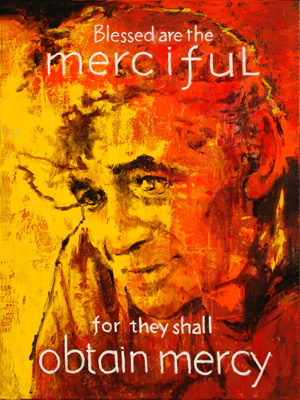
*Above painting by Hyatt Moore

Luke 18:35-43 – Lord, Have Mercy

Coptic Church icon of Christ healing the blind man

As Jesus was coming near Jericho, there was a blind man sitting by the road, begging. When he heard the crowd passing by, he asked, “What is this?”

“Jesus of Nazareth is passing by,” they told him.

He cried out, “Jesus! Son of David! Have mercy on me!”

The people in front scolded him and told him to be quiet. But he shouted even more loudly, “Son of David! Have mercy on me!”

So, Jesus stopped and ordered the blind man to be brought to him. When he came near, Jesus asked him, “What do you want me to do for you?”

“Sir,” he answered, “I want to see again.”

Jesus said to him, “Then see! Your faith has made you well.”

At once he was able to see, and he followed Jesus, giving thanks to God. When the crowd saw it, they all praised God. (Good News Translation)

This is one of my very favorite stories in the entirety of Holy Scripture. And I will tell you why….

Because Jesus listens with ears of mercy.

Jesus was headed to Jerusalem and had a lot on his mind and his heart. He knew what was coming, that his passion and death awaited him. No one would fault Jesus for not hearing a blind man shouting. But Jesus was listening so that he might hear someone just like the needy blind man. Rather than being distracted and lost in his head, Jesus was just the opposite – being attentive and aware of the humble folk right in front of him.

Because Jesus speaks with words of mercy.

Once Jesus listened, he responded by asking a question. I am impressed with Jesus throughout the Gospels. Christ gave people the gift of choice. He acknowledged people and respected them by not simply and indiscriminately healing, as if he were some fix-it guy. Jesus Christ bestowed on the lowliest of people the human dignity of choice by empowering them to answer a question.

Because Jesus pays attention with divine appointments of mercy.

Our Lord took the time to heal the blind man. Jesus could have simply healed him without even stopping his journey. He could have just waved his hand and the man would be healed. What’s more, Jesus could have even started a healing factory where everyone with a need got healed: bring ‘em in, move ‘em out, and keep the line moving. Jesus was doing more than giving sight; he was giving a man the blessing of time and personal attention. The Gospel is never impersonal, which is why we ought to resist being non-relational in ministry to others.  It isn’t simply about meeting a need but about blessing other people with the gift of relationship.

Ethiopian Orthodox Church depiction of Jesus healing the blind man

Because Jesus reaches out with the touch of mercy.

Jesus touched the man’s eyes (Matthew 20:29-34; Mark 10:46-54). He didn’t have to do that. The Lord of all most certainly could have healed without touching. In fact, it most likely may have been downright gross. A lot of people had eye diseases with runny pussy eyes in the ancient world.

Because the blind man didn’t listen to the crowd.

I really love that! Maybe it’s the rebel in me. I just believe it is such a beautiful thing whenever someone refuses to be shamed by another and embraces their need. That is exactly what the blind man did. He not only refused to give-in to peer pressure, but he also responded to them by shouting all the louder. May his tribe increase!

Because the blind man could actually see.

The man already had sight – not physical sight but spiritual eyes which could see better than anyone else in the crowd. One of the great ironies throughout the Gospels is that the sighted crowd seems to never see who Jesus really is, while blind folk see Christ clearly for who he is: the Son of David, the rightful king, the Savior of all. It matters not how much faith one possesses but in whom that faith is placed. A thimble-full of faith is enough to move mountains, while a water tower full of faith misplaced in someone else cannot even provide a single glass of refreshment.

Because the blind man followed Jesus.

Once healed by Jesus, there were plenty of persons who simply walked away and went about their lives. Yet, this man, who was given the gift of physical sight, started following Jesus and giving thanks to him. It feels a lot like my own testimony of experiencing the love of God in Christ and not ever wanting to leave it, so I’ve been following Jesus for over forty years, still having gratitude in my heart.

Because one lowly non-descript blind man made a difference.

I don’t think the man ever set out to change the world. Yet, he did. Here we are reading his testimony all these millennia later. At the time, please take note that one man becoming a disciple of Jesus and living a life of gratitude changed the entire crowd from being a group of shushing church ladies to a robust throng of worshipers. One individual makes a difference. Don’t let anyone tell you otherwise.

Lord Jesus Christ, Son of God, have mercy on me, a sinner.

Lord Jesus Christ, Son of David, heal me, a broken person.

Lord Jesus Christ, Son of Man, help me, a lost and lonely individual.

Lord have mercy, Christ have mercy, Lord have mercy on my love-starved soul. Amen.