His Resurrection Is Ours

The Resurrection, by Andrea Mantegna, c.1458 C.E.

The story of Christianity, the very heart and essence of the religion, is a tale of transformation from all the obstacles, impediments, and barriers which confine or cripple. The person and work of Jesus accomplished this. In his earthly ministry, Christ continually called people to transformative change into the reality of God’s gracious and benevolent realm.

“I have come to give the good life, a life that overflows with beauty and harmony.”

Jesus (John 10:10, First Nations Version)

Christ’s resurrection made possible our own transformative new life. This is both exciting and scary. Resurrection is frightening because it’s a call to live a life without any of the walls which have defined us and/or imprisoned us.

The massive stone covering the tomb of Jesus Christ was rolled away. He walked out of the grave by the power of resurrection. The cave of death was changed into the place of liberation.

That place is a powerful image of moving aside any and all obstacles to our own faith and freedom. The prison doors have been opened. Our self-contrived inner prisons, as well as the unjust shackles placed upon us, have dropped away.

As a result, those who have been exiled, excommunicated, and treated as expendable are visited by the luminous healing presence of God’s great liberating force: resurrection.

All of these words may either seem strange and/or compelling. If this is the case, it is a sad situation. Because it’s quite necessary that we become familiar with such language. Unfortunately, the gap between the world we are presently living in, and the world our hearts yearn to know, is quickly coming to an unsustainable place of high stress.

There is now a profound disconnect between the love deep inside us, and the way in which we are living our day-to-day lives on this earth. The issue has become so great as to warrant the need for resurrection.

And I am not simply addressing Christians. In his earthly ministry, Jesus was not only talking to his own Jewish people; he came for the whole world. Jesus is for everyone – whether we acknowledge him according to Christian dogma and doctrine, or not.

The evil gaslighting sort of person wants you to believe that you are alone, bereft of any help – that somehow you need to assert yourself aggressively into the dog-eat-dog world. Wickedness always looks to chaos and war as the path to gaining the life one wants.

But Jesus is the bridge to another kind of thinking, another sort of life. He is the guide to the greatest power which exists in the world: Love. And Love is why resurrection is a reality.

Although we suffer from systemic evil and all kinds of structural “ism’s” in this world, our shackles and chains have been largely forged by ourselves, through spiritual ignorance and misunderstandings of who we are and why we are here.

Resurrection opens us to new life. It provides identity, purpose, and passion to live the good life. Even though we live in this world below, our answers to living in the here-and-now are found in the world above.

All of us have experienced walking a dark path in life. But now it is high time to walk away from uncontrolled emotions and evil ways. There are plenty of lying spirits who intend on deceiving you and I for their own selfish purposes. Instead, we can refuse and resist such evil.

We can live in ways that represent the good, the right, and the just. We can experience living a resurrected life. Let us choose the pure path of the new person in Christ, the person you and I were created to be.

The telltale signs of the person living into resurrection are a deep feeling for the pain of others, kindness, humility of heart, a gentle spirit, and long-suffering patience with others. Such persons wear forgiveness like a well-worn pair of jeans.

This is the path of resurrection, the way of unity, peace, and harmony. And these qualities will always guide us and inform us in helpful and sacred ways.

Our current global decline comes from an accumulation of greed and sheer lovelessness. But the possibility of rebirth, of resurrection, rises from our deep universal yearning for the good and the true. It comes from our radical willingness to change and live a different counter-cultural life.

Resurrection does not occur because of lofty thoughts; it comes from a humble, and contrite heart which yearns for a better and more sacred existence.

Only until we find our present life on this world as intolerable with its injustice and persistent carelessness, will we see that we must put love where love is not.

The great lesson of resurrection is that Love makes all things right.

May resurrection move from being merely a theological concept, to a powerful reality that permeates and fills your life with meaning, power, and love. Amen.


Nonsensical Theology (Job 17:1-16)

The Nonsense #1, by Jacqueline Withers

My spirit is broken,
    my days are cut short,
    the grave awaits me.
Surely mockers surround me;
    my eyes must dwell on their hostility.

“Give me, O God, the pledge you demand.
    Who else will put up security for me?
You have closed their minds to understanding;
    therefore you will not let them triumph.
If anyone denounces their friends for reward,
    the eyes of their children will fail.

“God has made me a byword to everyone,
    a man in whose face people spit.
My eyes have grown dim with grief;
    my whole frame is but a shadow.
The upright are appalled at this;
    the innocent are aroused against the ungodly.
Nevertheless, the righteous will hold to their ways,
    and those with clean hands will grow stronger.

“But come on, all of you, try again!
    I will not find a wise man among you.
My days have passed, my plans are shattered.
    Yet the desires of my heart
turn night into day;
    in the face of the darkness light is near.
If the only home I hope for is the grave,
    if I spread out my bed in the realm of darkness,
if I say to corruption, ‘You are my father,’
    and to the worm, ‘My mother’ or ‘My sister,’
where then is my hope—
    who can see any hope for me?
Will it go down to the gates of death?
    Will we descend together into the dust?” (New International Version)

The biblical Book of Job is a troublesome story in more than one way. It not only reveals the grinding trouble of Job in losing nearly everything and everyone he had, but the story also presents some theological trouble for us.

Just when we may believe we have some understanding about how God operates in the world, the life of Job throws a theological monkey wrench into the whole thing.

Job was a righteous person, who did good in the world. He was happy and wealthy. And most people would attribute his earthly success to his spiritual piety. Yet, Job’s awful loss and suffering seem anything but a good, just, and right response from God.

Although Satan was behind all of Job’s trouble, the story makes it plain that it was God who let it all happen.

However, the Book of Job is not much concerned about God’s justice; rather, it is a story about a change in worldview. Job went from health, wealth, and happiness to sickness, poverty, and grief. It all happened quickly, one tragic event after another.

The beginning premise of the story is to question whether a privileged person in prosperity is devoted to God simply because of material and familial blessing. How would such a person look, act, and think, after having it all taken from him? Would he continue to be pious and faithful toward God, or not?

Job and his friends had the same worldview, theology, and outlook on things. But after what Job went through, a clear division opened in which the friends never budged from their views.

Yet, Job had an awakening. He saw and felt anarchy in the world. He experienced the putrid spiritual and emotional abscess of unimagined circumstances so bad that it made him wish he were never born.

Through it all, Job never lost his attachment and faithfulness to God. But he did lose his old view of the world.

Job saw firsthand that tidy theological systems of thought and belief are only that. If those systems cannot withstand the smack of worldly horror, then one needs a different system (and not a different God).

In the teeth of such misfortune, one cannot explain things in a nice neat linear fashion. In other words, bad things that happen to us don’t necessarily require repentance, condemnation, or punishment. That’s what Job’s friends believed needed to happen. But Job knew better.

A truism in life is that it’s hard to appreciate something you’ve never experienced.

You may have thoughts, opinions, and beliefs about marriage and child-rearing as an unmarried person without kids. But your world turns upside-down when those relationships become your daily reality and life. Old views become antiquated in the face of these real flesh-and-blood people.

And it’s also difficult for the privileged, the prosperous, and the well-positioned to appreciate the life of the underprivileged, the poor, and those without any power and authority in this world.

They, of course, have plenty of beliefs and opinions about how things ought to be, and what the disadvantaged among us need to do. But one cannot put themselves in their shoes, simply because the poor don’t even have shoes that the wealthy could put on.

In today’s society, it can also be difficult for the reasonably happy and optimistic among us to imagine what life is like for those whose daily reality is debilitating depression and chronic anxiety. What would happen if everything that made optimistic persons happy were completely taken away from them?

Whatever would happen, such a person’s world would never be the same again. Something would change within them. Their thoughts would be altered. There would be no going back to the status quo of things before.

Could Job, in his health and wealth, have appreciated the anguish of victims from senseless calamity? Could he have ever considered God as an enemy against him?

Maybe if one of Job’s friends had experienced terrible suffering, he himself would have responded with the established tidy worldview of telling him he needed to repent of his sin. After all, they were his friends for a reason – sharing their creed and convictions on life.

But horrible suffering opened a chasm between Job and his friends. Only Job alone knew that his disaster was undeserved – that he had done nothing against God.

Sometimes, all you and I can do in the midst of senseless and seemingly needless suffering, is to, like Job:

  • affirm our innocence and our integrity, even though no one understands
  • reaffirm our faith and commitment to God, even though what we are going through is confusing and makes no sense
  • awaken to the plight of others who go through hard things and need a friend who will truly listen and have compassion on us

Keep watch, dear Lord, with those who work, or watch, or weep this night, and give your angels charge over those who sleep. Tend the sick, Lord Christ; give rest to the weary, bless the dying, soothe the suffering, pity the afflicted, shield the joyous; and all for your love’s sake. Amen.

Making Sense of Faith and Trouble? (Job 15:1-35)

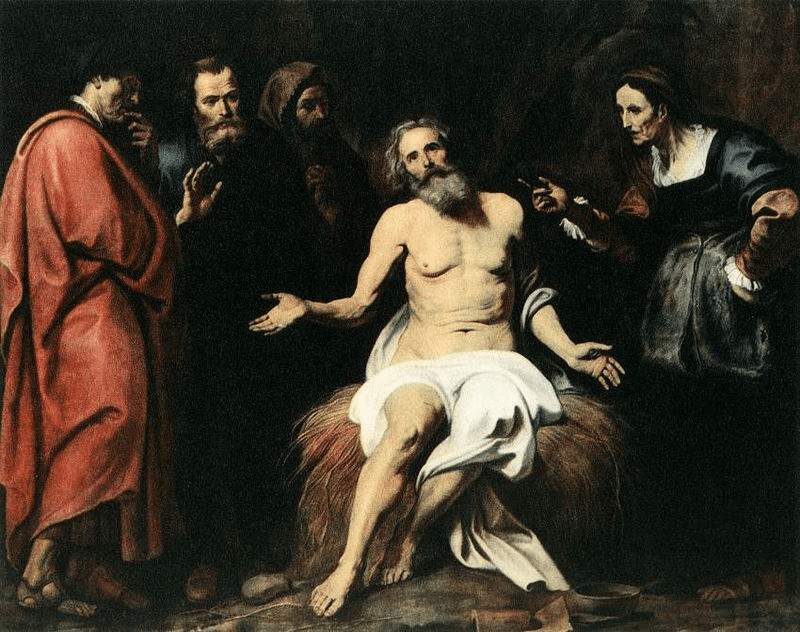
Job with his friends, by Gerard Seghers (1591-1651)

Then Eliphaz the Temanite replied:

“Would a wise person answer with empty notions
    or fill their belly with the hot east wind?
Would they argue with useless words,
    with speeches that have no value?
But you even undermine piety
    and hinder devotion to God.
Your sin prompts your mouth;
    you adopt the tongue of the crafty.
Your own mouth condemns you, not mine;
    your own lips testify against you.

“Are you the first man ever born?
    Were you brought forth before the hills?
Do you listen in on God’s council?
    Do you have a monopoly on wisdom?
What do you know that we do not know?
    What insights do you have that we do not have?
The gray-haired and the aged are on our side,
    men even older than your father.
Are God’s consolations not enough for you,
    words spoken gently to you?
Why has your heart carried you away,
    and why do your eyes flash,
so that you vent your rage against God
    and pour out such words from your mouth?

“What are mortals, that they could be pure,
    or those born of woman, that they could be righteous?
If God places no trust in his holy ones,
    if even the heavens are not pure in his eyes,
how much less mortals, who are vile and corrupt,
    who drink up evil like water!

“Listen to me and I will explain to you;
    let me tell you what I have seen,
what the wise have declared,
    hiding nothing received from their ancestors
(to whom alone the land was given
    when no foreigners moved among them):
All his days the wicked man suffers torment,
    the ruthless man through all the years stored up for him.
Terrifying sounds fill his ears;
    when all seems well, marauders attack him.
He despairs of escaping the realm of darkness;
    he is marked for the sword.
He wanders about for food like a vulture;
    he knows the day of darkness is at hand.
Distress and anguish fill him with terror;
    troubles overwhelm him, like a king poised to attack,
because he shakes his fist at God
    and vaunts himself against the Almighty,
defiantly charging against him
    with a thick, strong shield.

“Though his face is covered with fat
    and his waist bulges with flesh,
he will inhabit ruined towns
    and houses where no one lives,
    houses crumbling to rubble.
He will no longer be rich and his wealth will not endure,
    nor will his possessions spread over the land.
He will not escape the darkness;
    a flame will wither his shoots,
    and the breath of God’s mouth will carry him away.
Let him not deceive himself by trusting what is worthless,
    for he will get nothing in return.
Before his time he will wither,
    and his branches will not flourish.
He will be like a vine stripped of its unripe grapes,
    like an olive tree shedding its blossoms.
For the company of the godless will be barren,
    and fire will consume the tents of those who love bribes.
They conceive trouble and give birth to evil;
    their womb fashions deceit.” (New International Version)

The biblical character of Job had asked the friends to hear him out on his case against God. But they did not stay quiet and listen. Instead, they got irritated with Job and accused him of sin.

One of the three friends, Eliphaz, went from exhortation to an outright rebuke of Job. He took him to task on what he was saying, and gave Job a hellfire sermon designed to get him right with God.

Eliphaz had a problem with Job’s approach to God. Yet, we as readers know that none of this suffering was Job’s fault. In reality, it was Eliphaz who had the problem: He was stuck in a particular way of thinking to the point of not being able to entertain another’s point of view.

Each of the three friends did not distinguish between their assumptions and the truth. They had such engrained habits of thinking and living, that their minds were not open to the experience of Job being anything but sinful.

The major presupposition that Eliphaz held is that anyone who experiences such extreme hardship and suffering as Job is being punished by God. And that was a false presupposition.

There is a tragic irony with the story of Job and his friends. Eliphaz assessed Job’s situation and words as wicked. What’s more, Eliphaz believed that Job added to that sin by contending with God and insisting on his own personal innocence.

Yet, what Eliphaz said about Job was actually true about himself. Eliphaz was the one speaking out of ignorance and pride, as if he knew how the universe really works. In truth, Eliphaz was talking about himself, without knowing it.

Eliphaz presupposed, assumed, and believed that wicked persons are the ones who experience a life of pain, terror, illness, and deprivation. Thus, Job is wicked. And therefore, believed Eliphaz, Job’s future destiny was in jeopardy.

Is crying out in pain and giving a vulnerable yell toward God sin? Is it a sign of wickedness? Will it lead one to hell?

In the view of Eliphaz, yes. Because to challenge God is to rebel against God. To experience extreme suffering is a sign of personal wickedness against God.

By taking a good hard look at the entirety of the Book of Job, I can say with confidence that Eliphaz was, at best, ignorant; and, at worst, hurtful. He had no idea how off target he really was. The sinner in the room was not Job; it was Eliphaz.

The friends had too simple and easy of a theology of suffering. They equated Job’s suffering with God’s punishment. Reading the story of Job, however, challenges that simplistic theology.

Job insisted that his supposed punishment was undeserved. And he was right. Terrible misfortune is not necessarily a result of personal sin or wickedness.

The piety of Job was strong enough to accept the misfortune that fell upon him, without rebelling against God (Job 1:10). Yet, Job’s faithfulness to God could not make sense between his agonizing suffering, the loss of property and family, and God’s silence and purpose in it all.

And maybe that is, in part, the point of the Book of Job – that there are people all over the world who undergo hard circumstances and grinding loss, without knowing why they are going through it.

Hopefully, this awakening to the suffering of others will kindle within us a more compassionate spirit and empathetic presence with those feeling the nonsensical situations of their lives.

Almighty God, I bring to you all those who suffer in body, mind, spirit or with grief. May your loving kindness and divine presence sustain them in the midst of their pain. May those who are stretched beyond their capacity to cope and remain hopeful gain a sense of coherence, comfort and strength in the Lord. Amen.

Reverence, Humility, and Contentment (Ecclesiastes 5:1-20)

Guard your steps when you go to the house of God; to draw near to listen is better than the sacrifice offered by fools, for they do not know how to keep from doing evil. Never be rash with your mouth nor let your heart be quick to utter a word before God, for God is in heaven and you upon earth; therefore let your words be few.

For dreams come with many cares, and a fool’s voice with many words.

When you make a vow to God, do not delay fulfilling it, for he has no pleasure in fools. Fulfill what you vow.It is better that you should not vow than that you should vow and not fulfill it. Do not let your mouth lead you into sin, and do not say before the messenger that it was a mistake; why should God be angry at your words and destroy the work of your hands?

With many dreams come vanities and a multitude of words, but fear God.

If you see in a province the oppression of the poor and the violation of justice and right, do not be amazed at the matter, for the high official is watched by a higher, and there are yet higher ones over them. But all things considered, this is an advantage for a land: a king for a plowed field.

The lover of money will not be satisfied with money, nor the lover of wealth with gain. This also is vanity.

When goods increase, those who eat them increase, and what gain has their owner but to see them with his eyes?

Sweet is the sleep of laborers, whether they eat little or much, but the abundance of the rich will not let them sleep.

There is a grievous ill that I have seen under the sun: riches were kept by their owners to their hurt, and those riches were lost in a bad venture; though they are parents of children, they have nothing in their hands. As they came from their mother’s womb, so they shall go again, naked as they came; they shall take nothing for their toil that they may carry away with their hands. This also is a grievous ill: just as they came, so shall they go, and what gain do they have from toiling for the wind? Besides, all their days they eat in darkness, in much anger and sickness and resentment.

This is what I have seen to be good: it is fitting to eat and drink and find enjoyment in all the toil with which one toils under the sun the few days of the life God gives us, for this is our lot. Likewise, all to whom God gives wealth and possessions and whom he enables to enjoy them and to accept their lot and find enjoyment in their toil—this is the gift of God. For they will scarcely brood over the days of their lives because God keeps them occupied with the joy of their hearts. (New Revised Standard Version)

Life can be paradoxically both meaningful and meaningless. Yet, if we can live consistent with who we are and how we were created to be, then it is likely we shall find a semblance of meaning, purpose, and even joy in this present life.

Reverence

Too much talk leads to sin. Be sensible and keep your mouth shut. (Proverbs 10:19, NLT)

We are to be cautious in our speech, especially in addressing God. We must choose our words carefully and deliberately, in prayer, as well as with others.

God is God, and we are not. Therefore, since God is far above us, the high and holy One, it is wise to minimize our talking. There’s no need for lengthy and showy prayers. It is the mark of a fool that talks too much, just as much as it is the mark of a fool to let daydreams occupy too much of their thoughts.

Even fools who keep silent are considered wise; when they close their lips, they are deemed intelligent. (Proverbs 17:28, NRSV)

To be reverent and respectful before God involves not only the volume of words, but also the sanctity of words.

Whenever a person makes a vow or a promise to God, they need to be diligent about fulfilling that vow. The Lord takes our words seriously, and is not pleased with flippant promises that we have little intention of keeping.

On the flipside, good intentions are just that – they do not constitute a promise to do anything. We make vows so that we will be accountable to ourselves and others, and then follow through with the promise, no matter what.

Reneging on any promise, whether the vow is to another or God, is a foolish act with real consequences. Therefore, we should consider our promises well before making them, and avoid being rash.

Humility

All of us have both observed and experienced oppression and injustice of another or a group of people. In our anger, we may want to play both judge and jury. Humility teaches us that this is not our role, and to accept that a right and just God will deal with injustice.

The Lord sneers at those
    who sneer at him,
but he is kind to everyone
    who is humble. (Proverbs 3:34, CEV)

The injustice of this world does not necessarily need to create a deep theological conflict within us. We rarely, if ever, have the big picture on the circumstances and complexities of what is going on. But God does.

The Lord is watching. God neither slumbers nor sleeps. There is never a Divine nap time. So, God knows all, and will handle arrogant people according to their deeds and motives.

People who are proud will soon be disgraced. It is wiser to be modest. (Proverbs 11:2, GNT)

Contentment

It is the proud and arrogant person who never seems content. They continually want more – likely because they have the wrongheaded notion that they deserve more, even if it comes by taking resources from others.

Yet, the reality is that both kings and commoners rely upon the produce which comes from the soil. And regardless of whether a person has lots of money, or not, wealth isn’t the thing which makes for a truly happy life.

So, it is pointless and foolish to hoard food, money, stuff, resources, and even intangible things such as love and encouragement. Having a liberal outlook of sharing and giving creates joy. Misers, however, are typically curmudgeons who rarely smile and enjoy what they have.

The more stuff and wealth a person has, the less it is of benefit to humanity, whenever it is stockpiled and/or selfishly used and spent. Besides, when somebody has a lot, they have a lot to worry about. But workers living a simple life sleep just fine.

It is foolish to work so hard for something, only to end up with nothing you can take with you into eternity; or to have it taken by someone with an evil scheme to get it. On top of it, leaving this life with no humility and charity means that such a person really does leave with absolutely nothing to show for their life.

There’s no need to waste your life by filling it with nothing but aggravation and worry. Life has purpose and joy when there are liberal amounts of gratitude, encouragement, and friendship.

Let’s live today according to what is most important in life. Instead of chasing wealth, power, and control, we have the opportunity – no matter who we or our station in life – to live honestly and reverently, humbly and gently, with satisfaction and contentment.

What will you choose this day?

Almighty God of mercy, thank You for extending grace to me as I humble myself before You. Help me to be careful with my words, and to approach You with reverence and respect. Enable me to listen more and speak less, and to fulfill my vows to You. Guide me in being content with what You have given me and not to be consumed by the pursuit of wealth. I pray for wisdom and discernment in all my dealings and decision-making. Amen.