

Acts 1:1-11 – When Will We Engage in Our Ministry?

In my former book, Theophilus, I wrote about all that Jesus began to do and to teach until the day he was taken up to heaven, after giving instructions through the Holy Spirit to the apostles he had chosen. After his suffering, he presented himself to them and gave many convincing proofs that he was alive. He appeared to them over a period of forty days and spoke about the kingdom of God. On one occasion, while he was eating with them, he gave them this command: “Do not leave Jerusalem, but wait for the gift my Father promised, which you have heard me speak about. For John baptized with water, but in a few days you will be baptized with the Holy Spirit.”

Then they gathered around him and asked him, “Lord, are you at this time going to restore the kingdom to Israel?”

He said to them: “It is not for you to know the times or dates the Father has set by his own authority. But you will receive power when the Holy Spirit comes on you; and you will be my witnesses in Jerusalem, and in all Judea and Samaria, and to the ends of the earth.”

After he said this, he was taken up before their very eyes, and a cloud hid him from their sight.

They were looking intently up into the sky as he was going, when suddenly two men dressed in white stood beside them. “Men of Galilee,” they said, “why do you stand here looking into the sky? This same Jesus, who has been taken from you into heaven, will come back in the same way you have seen him go into heaven.”

When will we engage in our ministry? The short answer: Now.

The angels in this story sound a lot like my mom when I was a kid: “Why are you just standing there looking into an empty sky?  You need to quit your gawking and get to work!”

But sometimes we can be confused about what it is we are supposed to be about or when we are supposed to do it. Jesus was quite clear about what the mission of his followers is to be: witnesses.  And the angels essentially tell the disciples to quite their gawking and get to work on being witnesses.

Being a Witness Now

The mission is not simply to do some sort of evangelical job of witnessing, but to be a witness. What we do flows from who we are and what we have seen. If we have seen and experienced the risen Lord, we are witnesses. We then tell of what we have seen and heard, not necessarily because it’s our job, but because we just cannot help it.

A mom nurtures her kids because she is a mom; it isn’t just a job – it’s who she is. To be a witness involves the kind of people we are. The word “witness” is literally the term “martyr.”  A martyr, as the term has been used throughout church history, is:

  • One who chooses to suffer death rather than deny the person and work of Jesus Christ.
  • One who bears testimony to the truth of what they have seen or have experienced with God.
  • One who sacrifices all things to further God’s kingdom.
  • One who is willing to endure anything from anyone to maintain their Christian witness. 

A martyr is someone we are, not a task that gets checked off a to do list.

There is a clear mandate and mission given by Jesus, the Head of the Church: We are witnesses. We are participants in service to Christ the King, and not fans of Jesus only cheering in the bleachers. It’s a very different experience being a fan in the stands than a player on the field.

In baseball, some fans think they know what all the right calls are, then graciously let the umpire know when he is wrong. Being a spectator is significant. Yet, for us here on this earth, it is not yet our time for that. Those who have gone before us, lived in faith, and were martyrs, are testifying to us….

Some faced jeers and flogging, and even chains and imprisonment. They were put to death by stoning; they were sawed in two; they were killed by the sword. They went about in sheepskins and goatskins, destitute, persecuted and mistreated—the world was not worthy of them. They wandered in deserts and mountains, living in caves and in holes in the ground. These were all commended for their faith, yet none of them received what had been promised, since God had planned something better for us so that only together with us would they be made perfect….

Therefore, since we are surrounded by such a great cloud of witnesses [martyrs], let us throw off everything that hinders and the sin that so easily entangles. And let us run with perseverance the race marked out for us, (Hebrews 11:36-40, 12:1, NIV)

The Christian fans in the heavenly stands are witnessing that they have participated in God’s mission. And they are not unruly – spilling their beer on people and getting kicked out of the stadium. Instead, they are encouraging us who are here, right now, on this earth, seeking to fulfill Christ’s mandate.

Those who have gone before us are passing the baton of leadership and the message of good news to us – and they expect us to run with it – not to try and sit in the stands as spectators because it is not yet our time.  They are cheering us on, letting us know it’s all worth it.

Now is the time to be witnesses of what God in Christ has done and is doing. God created a perfect world. Man and woman fell into disobedience and sin. Now, God is in the business of restoring and renewing all creation. So, we are to witness to what God has done, and is doing, because our identity is thoroughly in Jesus Christ. It is our heritage and our privilege.

“Let God be the Judge. Your job today is to be a witness.”

Warren Wiersbe

In the 1990s a Christian prisoner in Cuba was asked to sign a statement containing charges against fellow Christians that would lead to their arrest. He said, “The chain keeps me from signing this.” The communist officer protested, “But you are not in chains!” “I am,” said the Christian. “I am bound by the chain of witnesses who throughout the centuries gave their lives for Jesus Christ. I am a link in this chain. I will not break it.”

Christ’s words are directed to us: “You will be my witnesses,” you and me. If we look at this as merely a task, we will likely give up and whine, saying, “This is too hard. It takes too much time. There’s too much suffering. This isn’t for me!” 

If we understand our identity as being a witness, then we will love God with all our heart, soul, mind, and strength. We willingly abandon our own personal agendas and adopt the will of God for our lives. And the will of God is that we embrace our identity as witnesses to the redemptive events of Jesus – Christ’s incarnation, holy life, compassionate ministry, suffering and death, rising from the grave, and ascending to heaven.

What do you have to witness to? Here is a teenage girl’s witness when he stood glaring at her, his weapon before her face, asking, “Do you believe in God?” She paused because it was a life or death question. “Yes, I believe in God.” “Why?” asked her executioner. But he never gave her the chance to respond. The 17-year-old girl lay dead at his feet. 

This scene could have happened in the Roman coliseum, in the Middle Ages, or in any number of countries around the world today. People are still being imprisoned, tortured, and killed every day because they refuse to deny the name of Jesus. This particular story, though, did not happen in ancient times or in another country. It happened at Columbine High School in Littleton, Colorado on April 20, 1999.

Being a Witness Everywhere to Everyone Now

The original witnesses of Jesus Christ embraced the mandate of being witnesses. Not far into the New Testament book of Acts, 3,000 people in Jerusalem were converted to Christianity through one sermon from Peter’s witness. Philip broke all kinds of taboos by going to Samaria and being a witness to the half-breed Samaritans. Peter broke all convention by going into a Gentile’s house and seeing the Spirit come on them. Saul, who became Paul, was dramatically converted and went on three separate missionary journeys so that he could take the good news of Jesus Christ to the ends of the earth.

We are to be witnesses wherever we go with whomever we encounter. We will be witnesses in Jerusalem (our families); in Judea (our community); in Samaria (other races and people different from ourselves); and, to the ends of the earth (overseas).

Being a Witness Through the Spirit’s Empowerment Now

Only after giving the mission to his followers did Jesus ascend to heaven. The ascended Lord is to be our confidence and our hope. We are not alone. We possess Christ’s authority and the Spirit’s help. The power to be a witness is not generated from within us but comes from God’s Spirit.

Jesus will return. Until then, we are to be his witnesses. It’s not the time to sit in the bleachers. We have been given power to accomplish the mission before the end of this world comes, and before Jesus comes again to judge the living and the dead.

Being a witness is not a one-time, one-size-fits-all work. Our own witness is just that: ours. We all have our own stories of faith and experiences of the risen and ascended Christ. There’s really nothing flashy or sexy about being a witness. Rather, it mostly entails a consistent and patient witness of love. It’s a lifestyle and a way of life in which our love for God pours out of our heart and soul and is expressed with all our mind and strength.

Every Christian can witness to what God is doing in their life – to tell our story of what God has done and is doing with us.

Holy God, you are making all things new through your gracious reconciling and restorative work. Grant us, your people, the vision to see you at work in our world healing our brokenness and making us new. Grant us the wisdom to hear your voice through the noise that surrounds us. And grant us the courage to bring to fruition the world you are creating, through Jesus Christ our Lord, in the power of your Holy Spirit. Amen.

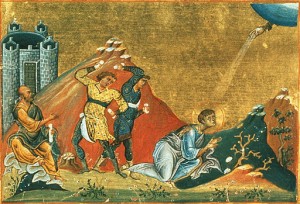
Acts 7:54-8:1 – Humility and Hubris

A 10th century depiction of Stephen’s martyrdom

When the members of the Sanhedrin heard this, they were furious and gnashed their teeth at him. But Stephen, full of the Holy Spirit, looked up to heaven and saw the glory of God, and Jesus standing at the right hand of God. “Look,” he said, “I see heaven open and the Son of Man standing at the right hand of God.”

At this they covered their ears and, yelling at the top of their voices, they all rushed at him, dragged him out of the city and began to stone him. Meanwhile, the witnesses laid their coats at the feet of a young man named Saul.

While they were stoning him, Stephen prayed, “Lord Jesus, receive my spirit.” Then he fell on his knees and cried out, “Lord, do not hold this sin against them.” When he had said this, he fell asleep.

And Saul approved of their killing him.

On that day a great persecution broke out against the church in Jerusalem, and all except the apostles were scattered throughout Judea and Samaria. (New International Version)

Although I am a trained in biblical exegesis and hermeneutics (interpreting Scripture) I believe that most insights come from making simple observations about the text. So, I want to point out: Stephen was not martyred by the Romans, a religiously pagan group, or Gentile people; he was martyred by those of his own ethnicity, by the people of God.

They weren’t simply unhappy with Stephen. The Sanhedrin (the Jewish ruling council) were incensed with him, so mad that they were grinding their teeth at him. The council truly believed Stephen was a blasphemer of God, that what he was saying was so subversive and religiously radical, they could stone him to death with a clear conscience, as if it were upholding God and God’s Law.

The result was not only the death of a humble man; it also sparked an intense persecution against the church which caused a new Christian diaspora. Many believers in Jesus now found themselves as Christian refugees trying to eke out a living and worshiping Christ in foreign places.

I wish I could say the greatest opposition I’ve ever experienced as a Christian came from non-Christians who simply misunderstood and misinterpreted me. However, my most hurtful wounds have come from the hands of church folk, believing they were acting on God’s behalf by exacting an emotional martyrdom upon me with the stones of gossip, slander, backbiting, blame-shifting, and outright lying.

Never look down on anybody unless you’re helping them up.

Whenever I encounter persons who no longer attend church and have no intention of ever returning to any local congregation, I get it. I understand. I’ve been there. Yet, although the church is sometimes like a woman of disrepute, I still love her, and will do whatever I can to edify her and not repay evil with evil.

Stoning a believer, either actually with physical rocks or virtually with metaphorical stones, is akin to persecuting Jesus himself. That’s because Christ so closely identifies with his people that it is as if he is a head, and his followers are a body – joined together in a vital union.

So, when Christ’s Body is subjected to hermeneutical hubris in which one group of people insists there is only one way to interpret Scripture, and then uses it’s authority and structures of power to force compliance on another group, the result is persecution.

And that is precisely why Christians can abuse other Christians.

Rather than discerning that all Christians belong to God, one narrow-minded and small-hearted group excludes all other groups who disagree with them as blaspheming the name of Christ.

Insisting, for example, that a literal interpretation in the only means of understanding the Bible’s authority is to ignore and abuse the actual and real authority which exists with the Bible. I am in no way encouraging an “anything goes” type of approach to Holy Scripture that lets it say whatever you want it to say. 

What I am stating is that the biblical writers themselves employed different methods of interpretation, as well as the early church fathers (which is one reason I hold to the interpretive guides of the ancient Christian creeds, i.e. The Apostles’ Creed and Nicene Creed).

Far too often churches stick to a particular interpretation because they believe they are keeping biblical fidelity. This is many times born of a fear that Christendom will be lost, and society will sink into an abyss of egregious sin. The irony is that many churches are sinking into forms of abusive and ungracious behavior by fighting battles that Scripture itself never calls them to fight.

The binary thinking of “I’m right and you’re wrong” is not an approach you’ll find in God’s Holy Word.

Even if the Sanhedrin in Stephen’s day intended on upholding the holiness of their God and the rightness of their cause, the impact it had on the church was death and diaspora.

Unfortunately, throughout Christian history, the tables have too often turned with Christians persecuting Jews. I myself would like to avoid being the persecutor. If I kill anything, may it be putting to death my own sin.

Gracious God, as your Son humbled himself on this earth, so may your church walk continually in such humility that believers everywhere work together in unity for the sake of gospel of grace as a blessing to the world in the power of your Holy Spirit. Amen.

Revelation 17:1-18 – A Vision of the End

“The Whore of Babylon” by Hans Burgkmair, 1523

One of the seven angels who had the seven bowls came and said to me, “Come, I will show you the punishment of the great prostitute, who sits by many waters.With her the kings of the earth committed adultery, and the inhabitants of the earth were intoxicated with the wine of her adulteries.”

Then the angel carried me away in the Spirit into a wilderness. There I saw a woman sitting on a scarlet beast that was covered with blasphemous names and had seven heads and ten horns. The woman was dressed in purple and scarlet, and was glittering with gold, precious stones and pearls. She held a golden cup in her hand, filled with abominable things and the filth of her adulteries. The name written on her forehead was a mystery:

BABYLON THE GREAT

THE MOTHER OF PROSTITUTES

AND OF THE ABOMINATIONS OF THE EARTH

I saw that the woman was drunk with the blood of God’s holy people, the blood of those who bore testimony to Jesus.

When I saw her, I was greatly astonished. Then the angel said to me: “Why are you astonished? I will explain to you the mystery of the woman and of the beast she rides, which has the seven heads and ten horns. The beast, which you saw, once was, now is not, and yet will come up out of the Abyss and go to its destruction. The inhabitants of the earth whose names have not been written in the book of life from the creation of the world will be astonished when they see the beast, because it once was, now is not, and yet will come.

“This calls for a mind with wisdom. The seven heads are seven hills on which the woman sits. They are also seven kings. Five have fallen, one is, the other has not yet come; but when he does come, he must remain for only a little while. The beast who once was, and now is not, is an eighth king. He belongs to the seven and is going to his destruction.

“The ten horns you saw are ten kings who have not yet received a kingdom, but who for one hour will receive authority as kings along with the beast. They have one purpose and will give their power and authority to the beast. They will wage war against the Lamb, but the Lamb will triumph over them because he is Lord of lords and King of kings—and with him will be his called, chosen and faithful followers.”

Then the angel said to me, “The waters you saw, where the prostitute sits, are peoples, multitudes, nations and languages. The beast and the ten horns you saw will hate the prostitute. They will bring her to ruin and leave her naked; they will eat her flesh and burn her with fire. For God has put it into their hearts to accomplish his purpose by agreeing to hand over to the beast their royal authority, until God’s words are fulfilled. The woman you saw is the great city that rules over the kings of the earth.” (New International Version)

Today’s New Testament lesson is the beginning of a long and elaborate vision of the Apostle John. The vision includes a woman and a scarlet beast, and the angel’s interpretation of what John saw.

An Incredible Vision

“The Whore of Babylon” from Martin Luther’s 1534 translation of the Bible.

Consistent with Old Testament’s imagery depicting the relationship between God and people, John’s vision is of a prostitute whom the kings of the earth committed adultery. This great offense will not be overlooked. It is provoking divine wrath.

The prostitute sits on a scarlet beast, an imposing and rather incredible looking creature with seven heads and ten horns. The woman and the beast signify and portray the pinnacle of opulence, extravagance, and luxury. Yet, she is also the ultimate depiction of corruption, indecency, and irreverence.

The great prostitute influences all the world. She is the evil genius behind the blood of the Christian martyrs. The woman deceives and connives so that she can wreak her violence against the saints of God.

John appears to be slack jawed with all this. The prostitute’s seductive influence has been so great that nations fall to her erotic power. She is so diabolically smooth, her presentation so marvelous, that even John is mesmerized by her.

Why Are You Astonished?

The angel’s question to John is akin to saying, “Well, what did you expect? The Wicked Witch of the West? Evil is much more sinister than an ugly old woman. Unrighteousness cloaks itself in nice garb. Snap out of it, man!”

Astonishment and awe belong to God, not some alluring vision of beauty. The enticement only traps humanity into a sticky web which the Black Widow can feed upon. The woman and the beast are doomed to destruction. Their time is imminently near.

John (and us) must see beyond the surface presentation to the darkness within. Antichrist is not only a person but the evil systems which feed upon helpless humans caught in the web of seduction.

The End Times

The leaders of the earth, deceived and smitten by the temptress, ally together to wage war on all that is right, just, and good – all the while believing they are fighting for beauty. It will eventually climax at Armageddon, the place of final victory over all the malevolence.

The Lamb shall overcome the nefarious forces of corruption. The faithful followers of God need only to persevere and see the punishment of the wicked. Please keep in mind that none of this has a timetable for us to chart. Biblical time revolves primarily around events, not precision clockwork.

It is not our task to walk around predicting dates, nor is it to point fingers at anyone we don’t like as being the antichrist. There’s plenty of shock-and-awe in the Apocalypse of John without us adding to it with our half-baked ideas of the end times.

The world, as it presently exists, is distorted by sin. And we humans tend to be ill-equipped in discerning the difference between The Great Prostitute and Lady Wisdom. What the book of Revelation does for us is show, with alarming symbolism, just how difficult it can be to navigate this old fallen world.

So, let us run to God; trust in the Lamb; and be filled with the Spirit.

Sovereign God, you are slow to anger and abound in steadfast love. Grant to national leaders the wisdom, courage and insight needed for this time of change and uncertainty. Give to all who exercise authority determination to defend the principles of freedom, love and tolerance, strength to protect and safeguard the innocent and clarity of vision to guide the world into the paths of justice and peace. This we ask through Jesus Christ our Lord. Amen.

Acts 7:30-40 – Full Acceptance, Not Partial

“After forty years had passed, an angel appeared to Moses in the flames of a burning bush in the desert near Mount Sinai. When he saw this, he was amazed at the sight. As he went over to get a closer look, he heard the Lord say: ‘I am the God of your fathers, the God of Abraham, Isaac and Jacob.’ Moses trembled with fear and did not dare to look.

“Then the Lord said to him, ‘Take off your sandals, for the place where you are standing is holy ground. I have indeed seen the oppression of my people in Egypt. I have heard their groaning and have come down to set them free. Now come, I will send you back to Egypt.’

“This is the same Moses they had rejected with the words, ‘Who made you ruler and judge?’ He was sent to be their ruler and deliverer by God himself, through the angel who appeared to him in the bush. He led them out of Egypt and performed wonders and signs in Egypt, at the Red Sea and for forty years in the wilderness.

“This is the Moses who told the Israelites, ‘God will raise up for you a prophet like me from your own people. ’He was in the assembly in the wilderness, with the angel who spoke to him on Mount Sinai, and with our ancestors; and he received living words to pass on to us.

“But our ancestors refused to obey him. Instead, they rejected him and, in their hearts, turned back to

Egypt. They told Aaron, ‘Make us gods who will go before us. As for this fellow Moses who led us out of Egypt—we don’t know what has happened to him!’ (NIV)

We humans are a confusing paradox of sinner and saint. We are majestic people, created in the image and likeness of a good God. We are also profoundly fallen, touched by sin in every area of our lives. Our hearts exist with both light and darkness, having the capacity for both incredible altruism as well as inexplicable evil.

So then, it will do no good to retreat into binary definitions of people as being either good or bad. No, we shine and shadow at the same time. What really gets us into a terrible mess is when we ignore or deny our shadow selves. We then demonize the other while claiming purity for ourselves.

This is precisely what occurred with Stephen and a group of his fellow Jews who refused to acknowledge their shadow side. And it resulted in Stephen’s stoning and death. Whereas Stephen lifted and brought to light the unseemly aspects of their collective heritage, the people wanted nothing to do with it. In our present day, the response might be something like, “Quit being so negative. We focus on the positive. Expel this recalcitrant troublemaker once and for all!”

Oy. Acceptance cuts two ways. We must accept both our blessings and our curses. And acceptance of reality will not occur apart from a solid self-acceptance of who we are and how we are feeling in any given situation. On the practical level, it works something like the following story…

Several years ago, I went on a leadership retreat in the Canadian wilderness. We were so far out in the sticks that we needed special first aid training before leaving because if someone got severely injured it would be hours before any medical attention could be received. There was no cell phone service, no towns, no anything except mile after square mile of wilderness. 

One day, it was very windy and several of us were on a lake canoeing to a destination. It was late May, which means the water was still ice cold in Canada. One of the canoes capsized and we had to act quickly and deliberately – which was no small feat in a stiff wind. More than fifteen minutes would result in hypothermia for the two people in the water.

I did not like being in that situation. In fact, I didn’t much like the Canadian wilderness. Too many black flies and giant mosquitoes for me. My shadow side was coming out. But here I was, and I had to accept the reality I was in. One of the lessons I learned in that moment was that acceptance can sit alongside other reactions and emotions.

For example, a person can be outraged by an injustice, as Stephen was, and accept that it is a reality. Acceptance does not mean complacency or giving up. We can accept something while at the same time trying to make it better.

I also needed to accept what was happening inside of me. I was cold and worried. Trying to push those feelings away would have only added to the stress of the situation. If I failed to accept what was true about myself, I would be less able to deal with the situation, and so, would compromise my ability to help two people at risk.

I needed to accept the whole circumstance, including myself. Accepting what is inside gave me more influence over the situation, not less. Self-acceptance became the key to acceptance of unwanted conditions, and more importantly, acceptance of one another as human beings.

In that moment of rescuing two people (which ultimately proved successful) I became aware of a part of myself – the part that gets afraid and irritated – and chose not to stuff it or deny its existence. I became the guy who talked to the panicked people in the water and kept them as calm as possible so that the others could get them out. I was able to do my part to help fearful people because I acknowledged and accepted my own fear.

Unlike my situation, however, Stephen’s experience ended in martyrdom. Just because we respond rightly is no guarantee that everything will work out for our benefit. Rather, we say and do the things we must say and do, while leaving the results to a sovereign Lord. It is our responsibility to work on ourselves, not others. And acceptance is the path to get there, all of it, not just part of it.

Jesus, let your mighty calmness lift me above my fears and frustrations. By your deep patience, give me tranquility and stillness of soul in you. Make me in this, and in all things, more and more like you. Amen.