Watch Out For the Millstones (Mark 9:38-50)

John said to him, “Teacher, we saw someone casting out demons in your name, and we tried to stop him because he was not following us.” But Jesus said, “Do not stop him, for no one who does a deed of power in my name will be able soon afterward to speak evil of me. Whoever is not against us is for us. For truly I tell you, whoever gives you a cup of water to drink because you bear the name of Christ will by no means lose the reward.

“If any of you cause one of these little ones who believe in me to sin, it would be better for you if a great millstone were hung around your neck and you were thrown into the sea. If your hand causes you to sin, cut it off; it is better for you to enter life maimed than to have two hands and to go to hell, to the unquenchable fire. And if your foot causes you to sin, cut it off; it is better for you to enter life lame than to have two feet and to be thrown into hell.And if your eye causes you to sin, tear it out; it is better for you to enter the kingdom of God with one eye than to have two eyes and to be thrown into hell,where their worm never dies and the fire is never quenched.

“For everyone will be salted with fire. Salt is good, but if salt has lost its saltiness, how can you season it? Have salt in yourselves, and be at peace with one another.” (New Revised Standard Version)

Weird encounters and exorcisms, hard words and sayings, and enough metaphors to creep out the visual learners among us, were all regular staples of Christ’s earthly ministry.

For me, this makes sense. Christ coming into a world of great need, filled with all sorts of disturbances and disturbing people, will create spiritual headlines. The ministry of Jesus does not involve idyllic pictures of beautiful butterflies, and bunnies without bowel movements.

The world needs real saving, which is why Jesus showed up in an incarnational invasion that nobody saw coming.

Christian discipleship is not for the faint of heart. It demands an embrace of robust moral teaching, along with a cross to carry.

Following Jesus involves lots of servitude, and only a little bit of leadership. It requires radical humility to do anything.

Furthermore, Jesus was anything but a narrow-minded exclusivist. He encouraged his disciples to have broad and open-minded attitudes and approachs toward those who do good and provide help, outside of the disciple circle.

Whether following Jesus, or not, Christ commended, and did not condemn, those who squish evil like a grape, and offer cold water to others on a hot day. Why? Doesn’t this seem antithetical to the demands of discipleship within the disciple group?

Maybe. Maybe not. Frankly, it seems paradoxical (two things that seem contradictory but nevertheless are equally true). On one hand, only the disciples bear the name of Christ; but on the other hand, everyone who does justice and mercy has Christ’s name invisibly emblazoned on their heads.

Anybody who remotely conforms to the character of Christ, upholding basic morality and human kindness, receives a divine thumbs up from Jesus.

And conversely, anyone who acts the bully and trips up a little one who believes – whether they have a label of disciple or not – are in for a world of divine retribution.

It all hinges on how scandalous we can be; or rather, what sort of scandal we stir up with our lives.

The good kind of scandal is going against the grain of injustice and doing good when no one else much cares; and the unjust ones need a big obstacle of righteousness in their way.

The bad sort of scandal is putting a stumbling block between God and those trying to come to the Lord. It’s the wicked who need to be tripped up and set straight, and not the faithful who need to run an obstacle course just to get a peek at the good life as defined by God.

Just so you know, millstones were usually the heaviest objects in a village – weighing up to a ton (2,000 lbs.) or more. We can perhaps understand Jesus talking of perpetrators getting a millstone necklace; but it’s a real tragedy whenever someone puts one on for themself.

You’re harming yourself if the choice is to be irresponsible, hateful, unloving, or unjust. I’m not talking about the inevitable mistake, white lie, or unconscious bias. I’m talking about a deliberate choice to get in another’s way of happiness; tear someone down with verbal violence; or harm a person by any means you can do it.

All of us have a responsibility to protect and promote the common good of all persons, and the social good of the community.

Nobody is helped whenever a person comes down hard with judgmental criticism on a coworker who was just trying to do their best but failed. Everyone loses whenever a relative spreads gossip throughout the family system.

And no one is built up whenever a neighborhood association leader or condo board chair creates unnecessary roadblocks to community well-being, but then railroads a pet personal project through for their own advantage.

Feet end up walking in dangerous places. Hands reach where they shouldn’t. Eyes look with a sinful gaze. There are times when it is warranted to amputate a limb in order to save the whole body; to perform a surgery in an effort to save a life; and to remove an eye before it creates serious sickness.

But I am talking metaphorically and spiritually – which is no less real than the physical and tangible. Gangrene happens not only to the flesh and blood body; it also happens to the diseased soul.

When it happens, the only the way to deal with it is by getting rid of gangrenous part. Otherwise, death is around the corner, as well as the coroner. Both body and soul suffer. And it will do no good to feign healthiness and pretend as if everything is “just fine.”

Some salt, therefore, is good. It acts as a preservative against expiration; and promotes the good taste of obedience and fidelity to God.

All your grain offerings you shall season with salt; you shall not omit from your grain offerings the salt of the covenant with your God; with all your offerings you shall offer salt. (Leviticus 2:13, NIV)

Let’s consider hard whether we want to be lame Christians who offer nothing but a tepid discipleship and spirituality to the church and world; or whether we will spiritually support one another by building bridges to provide needed supply lines, instead of walls to keep out the people we don’t like.

You already know what Jesus wants, and what Christ advocated and agitated for. So, let’s avoid a future with millstones in it.

Almighty God of redemption and mercy: Help us to be at peace with one another: not clambering for positions; not being fearful of those who we do not know in the kingdom, but honoring, loving, and serving them. Enable us to increase peace among ourselves by being aware of sin and its effects, and choosing to deal with it. May we be seasoned with salt as we live for the cause of Christ in a world of conflict. Amen.

True Greatness (Mark 9:30-37)

They went on from there and passed through Galilee. He did not want anyone to know it, for he was teaching his disciples, saying to them, “The Son of Man is to be betrayed into human hands, and they will kill him, and three days after being killed, he will rise again.” But they did not understand what he was saying and were afraid to ask him.

Then they came to Capernaum, and when he was in the house he asked them, “What were you arguing about on the way?” But they were silent, for on the way they had argued with one another who was the greatest. 

He sat down, called the twelve, and said to them, “Whoever wants to be first must be last of all and servant of all.” Then he took a little child and put it among them, and taking it in his arms he said to them, “Whoever welcomes one such child in my name welcomes me, and whoever welcomes me welcomes not me but the one who sent me.” (New Revised Standard Version)

In the Gospel of Mark, especially, there is an inexorable movement toward the Cross. It’s as if Jesus gets right down to it, and has a clarity of purpose and thought toward the future which shaped his words and actions in the present.

Today’s Gospel lesson has Jesus being forthright about what’s really important. Christ predicted his resurrection; chastised his disciples for their petty arguing; and lifted up a child as the model for what Christian discipleship truly looks like.

Even though Jesus was talking to his disciples about things that matter, things which they needed to wrap their heads and hearts around, they were afraid to ask him about it. Just so you know, that’s not healthy.

Sometimes Christ’s disciples were tight-lipped about things they ought to be asking about and openly discussing; and flapping their tongues about things they should have kept to themselves.

The motley crew of disciples were afraid to ask Jesus about his own words on his own death; and yet, they had no problem freely voicing and asking about who’s the greatest disciple amongst them. *Sigh*

The text doesn’t tell us why the disciples were afraid to ask and talk. But if they were anything like us today, it’s likely they were concerned about looking stupid or not in the know.

The disciples didn’t understand Christ’s words, but wanted to look like they understood just fine. After all, they may have reasoned, why risk getting ribbed or made fun of? Why risk the disappointment of Jesus concerning my cluelessness?

Typically, our internal fears about how we look to others is often greater than our desire to understand and know the truth.

We choose the shame of ignorance and hide-out deep within the soul’s secret lounge, where it’s dark, musty, and smells of inexpensive wine and cheap cigars. The longer we dwell in that poorly lit basement lounge, the harder it is to walk out and up the stairs to the light of grace, freedom, and understanding.

Jesus isn’t like whatever relative who hurt you with their calloused words and flippant attitude about your feelings, hopes, or desires.

Christ isn’t the teacher who ridiculed you in front of the whole class. That’s because Jesus Christ has the class to be gracious when we come out and admit what’s really going on within us.

I suspect Jesus was hard on his disciples because they should have known better than to be afraid in his presence. It demonstrated a profound lack of faith and trust.

Inevitably, whenever we opt to remain in the shame lounge of our soul, we then begin considering how to take the offensive in order to demonstrate our greatness and worthiness. And usually, there’s no better way than to do that than have a competition, and size up one another.

If Jesus could just affirm this competitive game and judge me as the best, we reason within the emptiness of our inner shame lounge, then I’ll forever be able to hide under that ratty old blanket of shame, and feel safe in this smelly place.

Prayer is really nothing more than addressing God and talking to the Lord. Oftentimes, the lack of consistent daily prayer is a telltale sign of being afraid to ask for help, clarification, or anything of substance, at all.

When we don’t pray, foolishness and bad decisions are close behind. Spiritual growth is then absent. Spiritual maturity is non-existent. And worldly tactics fill the spiritual vacuum.

Rather than being open about their questions concerning Christ’s words, the disciples’ fear led them to wonder how they stood with Jesus. In order to feel secure through one’s own efforts, we easily harbor resentment toward each other, and compete with one another to gain Christ’s approval.

Worry and anxiety, when coddled for too long, brings out an inordinate focus on one’s reputation with others; and a concern to look better in front of other people than one actually feels on the inside.

But Jesus is not one to play favorites, or to play childish games of posturing for attention. That’s because the way to greatness is not through impressing Jesus, or by being the Rabbi’s pet, but through focusing outward on something other than oneself.

It turns out that true greatness lies in humbly welcoming all – especially the ones who are the least, lost, and lonely, on the fringes of society.

We are to welcome the children, who are on the bottom rung, who need the help and assistance of others, as Christ did. We are to value them as fellow humans who are worthy of our time, attention, and effort.

Jesus did it for us. He showed us that the true measure of greatness is through humility and willingly loving others to incredibly great degrees. His disciples can and must do no less.

O God, our teacher and guide, you draw us to yourself and welcome us as beloved children. Help us to lay aside our envy and selfish ambition, so that we may walk in your ways of wisdom and understanding as servants of your peace. Amen.

The Logic of Faith and Prayer (Mark 9:14-29)

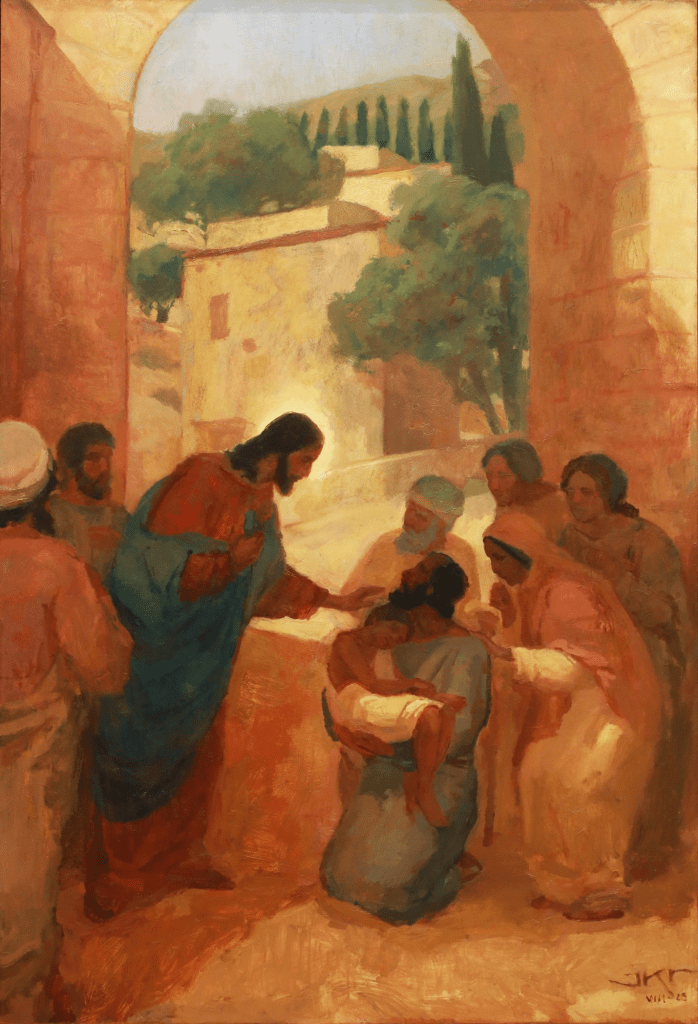
Help Thou My Unbelief, by J. Kirk Richards

When they came to the other disciples, they saw a large crowd around them and the teachers of the law arguing with them. As soon as all the people saw Jesus, they were overwhelmed with wonder and ran to greet him.

“What are you arguing with them about?” he asked.

A man in the crowd answered, “Teacher, I brought you my son, who is possessed by a spirit that has robbed him of speech. Whenever it seizes him, it throws him to the ground. He foams at the mouth, gnashes his teeth and becomes rigid. I asked your disciples to drive out the spirit, but they could not.”

“You unbelieving generation,” Jesus replied, “how long shall I stay with you? How long shall I put up with you? Bring the boy to me.”

So they brought him. When the spirit saw Jesus, it immediately threw the boy into a convulsion. He fell to the ground and rolled around, foaming at the mouth.

Jesus asked the boy’s father, “How long has he been like this?”

“From childhood,” he answered. “It has often thrown him into fire or water to kill him. But if you can do anything, take pity on us and help us.”

“‘If you can’?” said Jesus. “Everything is possible for one who believes.”

Immediately the boy’s father exclaimed, “I do believe; help me overcome my unbelief!”

When Jesus saw that a crowd was running to the scene, he rebuked the impure spirit. “You deaf and mute spirit,” he said, “I command you, come out of him and never enter him again.”

The spirit shrieked, convulsed him violently and came out. The boy looked so much like a corpse that many said, “He’s dead.” But Jesus took him by the hand and lifted him to his feet, and he stood up.

After Jesus had gone indoors, his disciples asked him privately, “Why couldn’t we drive it out?”

He replied, “This kind can come out only by prayer.” (New International Version)

Please, stick with me here, on what I see as the logic which undergirds this story:

God has authority over everything. God is powerful. Therefore, God can do the miraculous.

Humans have limited authority over some things. Humanity is sometimes strong, yet often weak. Therefore, humans must look outside themselves for a miracle.

God created people. Humans reflect the divine image and likeness of God. Therefore, God and humanity are inextricably linked.

God has miraculous power. Humans can have confidence (faith and hope) in God’s power. Therefore, miracles can happen when God’s power meets human confidence in that power.

God is personal. Humans are personal. Therefore, humans can know God.

God listens to human prayers. Humans have the ability to pray to God. Therefore, God’s power and human faith in that power are very much connected to each other.

Since God is authoritative, powerful, and personal, then God’s choice and ability to effect miracles is not an impersonal force which can be used and manipulated by humans, but rather is a gift to be prayed for and received with gratitude to God.

This then, is why Jesus seems exasperated with the experience of a botched exorcism, because:

  1. The father and the crowd have a profound lack of faith in God’s authority and power to personally effect the miraculous.
  2. The disciples have a disappointing lack of prayer in their own ministry.

The father of the son with the bad spirit was understandably desperate. And, on top it, disappointed with the disciples’ inability to do anything about the situation. The issue, however, is never about God’s ability – which is where the father went in talking to Jesus.

“If you are able” expresses little confidence in Christ.

Jesus emphatically replied that everything can be done for the one who believes. To which the father, still desperate, but then adding a healthy dose of honesty, confessed: “I believe; help my unbelief!”

That was all Jesus needed. The father’s humble and honest confession opened the soul’s door to receive the gift of faith. And the boy was rid of the bad spirit.

Furthermore, the father was also rid of his own bad spirit. The man was not demonized, like his son, nevertheless he possessed a spirit of ill confidence. The encounter with Jesus changed him, as well. It wasn’t just one person who walked away healed; both a father and a son were healed.

As often happened, the disciples left the scene with Jesus scratching their heads. They couldn’t figure out their own inability and failure to help the desperate father and his demonized son.

The bad spirit was indeed a stubborn one, and quite hard to deal with. Jesus told his disciples that one like this can only come out for those who nurture the spiritual habit of prayer.

Essentially, Jesus was saying that the vital connection between God and humans is dependent upon God. People don’t give orders to God, or act as the keepers and manipulators of divine power, like the ancient magicians did with their gods.

Rather, humans pray and ask for what they need, based upon the quality of their connection with God. This isn’t about the level of faith; it’s about whether there is any connection.

I can have lots of faith that my desk lamp will illuminate if I tell it to, but it won’t light unless I plug it in and turn it on. And if I do that, and the lamp will not turn on, then I know there is a problem with the connection – and not with my level of faith in making the lamp light up.

Everything in life must be maintained well, and taken care of. If it isn’t, it will eventually stop working, and may even fall into complete disrepair.

Faith and prayer are not simply tools which we wield with our own authority and autonomy. They must be developed and used with care for where they’ve come from.

Our prayers are opportunities for us to establish and maintain our vital connection with God via faith. Then, whenever we are in dire straits, the confidence is there, because of our connection with the Lord; nothing is hindering the power from flowing and lighting up the situation.

At its heart, Christianity is a relationship with God through Jesus Christ in the power of the Holy Spirit. And that relational connection has been brought about God, not me; and the means to maintain the relationship is from God, not me. Yet, we get to enjoy this beautiful access.

So, take advantage of it.

O Lord, our blessed Companion in life and death, your love is steadfast and never ends. Our wondering and weeping may linger in the night, but you give joy in the morning. Touch us with your healing grace so that, restored to wholeness, we may live our calling as your faithful resurrected people. Amen.

Shining the Light On Our Fears (Mark 9:2-8)

Six days later Jesus took Peter, James, and John, and brought them to the top of a very high mountain where they were alone. He was transformed in front of them, and his clothes were amazingly bright, brighter than if they had been bleached white. Elijah and Moses appeared and were talking with Jesus. 

Peter reacted to all of this by saying to Jesus, “Rabbi, it’s good that we’re here. Let’s make three shrines—one for you, one for Moses, and one for Elijah.” He said this because he didn’t know how to respond, for the three of them were terrified.

Then a cloud overshadowed them, and a voice spoke from the cloud, “This is my Son, whom I dearly love. Listen to him!” Suddenly, looking around, they no longer saw anyone with them except Jesus. (Common English Bible)

The transfiguration of Christ was a glorious experience on the mountain for those closest to Jesus. Yet, we are told that Peter, James, and John – the inner circle of Christ’s disciples – were terribly frightened.

Peter, always the extrovert of the group, and forever their mouthpiece, nervously babbled-on without making any sense because he was so nervous and afraid.

Have you ever wondered why Jesus would take three of his disciples with him to experience such an incredible vision? Why did Jesus show these men something so otherworldly that they nearly soiled themselves? 

I will tell you why I think Jesus put his close disciples in such a glorious, yet frightening, position as this:

Because the only way to see Jesus as our only hope, we must face our fears, insecurities, and anxieties, squarely, without hiding from them.

Jesus did not relieve their anxiety. He let his disciples feel the full impact of their fear. The glory of Christ shone show brightly that Peter, James, and John could not hide from what was happening to them, and could not avoid what was in their minds and hearts. 

Only through shining the light on the shadowy place of our fears and insecurities will we ever be able to accept that we need a savior. And that savior is Jesus, the light of the world, the Lord over fear, anxiety, and discouragement.

The invitation which Christ extends to us is to move further into our fears, face those fears, and sit awhile with our fears, so that we can see how desperately we need the Savior Jesus. 

No one seeks a savior when they don’t even believe they need deliverance from anything. “I’m just fine, thank you very much!” says the independently self-sufficient person among us. To seek salvation, for such a person, is an intensely personal affair; they will look within, not without. It will take quite the desperate situation for them to consult someone who knows the ways of the soul.

But the one who sees what is truly inside of them, and is aware of their fear of connection; the scary prospect of confrontation; the anxiety of what will happen; or, the discouragement of failure; this is the one who is then able to hear the voice of God, and listen to Jesus give the answer to our most pressing life issues, worries, and concerns.

Jesus Christ wants to change us from the inside-out. He helps us by showing us not to avoid the fears which cause us to be beside ourselves, but instead, to face those fears and confront the anxieties within. 

The bright light of God’s presence enables us to see very clearly all that is within us. And Christ’s intimate relationship with us assures us that change is possible. Then, the Holy Spirit comes and empowers us for transformation, so that we may shine, along with Jesus, and let the light help others, as well.

You and I are never alone; we always have the glorious presence of Christ with us as we walk through dark valleys and ascend high mountains. 

It is the wonderful existence and omnipresence of God, in Christ, through the Spirit, which makes all the difference. We were created for connection with the divine, not for separation and loneliness in our fears.

Glorious Christ, you love me with a grace and mercy which always has my best interests in mind. Help me through my most pressing fears and failures so that I might see your glory, hear your voice, and know your constant presence. Amen.