Misunderstanding Jesus (Mark 3:20-35)

By Jorge Cocco Santángelo

Then he went home, and the crowd came together again, so that they could not even eat. When his family heard it, they went out to restrain him, for people were saying, “He has gone out of his mind.” And the scribes who came down from Jerusalem said, “He has Beelzebul, and by the ruler of the demons he casts out demons.” 

And he called them to him and spoke to them in parables, “How can Satan cast out Satan? If a kingdom is divided against itself, that kingdom cannot stand. And if a house is divided against itself, that house will not be able to stand. And if Satan has risen up against himself and is divided, he cannot stand, but his end has come. But no one can enter a strong man’s house and plunder his property without first tying up the strong man; then indeed the house can be plundered.

“Truly I tell you, people will be forgiven for their sins and whatever blasphemies they utter, but whoever blasphemes against the Holy Spirit can never have forgiveness but is guilty of an eternal sin”—for they had said, “He has an unclean spirit.”

Then his mother and his brothers came, and standing outside they sent to him and called him. A crowd was sitting around him, and they said to him, “Your mother and your brothers are outside asking for you.” And he replied, “Who are my mother and my brothers?” And looking at those who sat around him, he said, “Here are my mother and my brothers! Whoever does the will of God is my brother and sister and mother.” (New Revised Standard Version)

Who exactly is Jesus? That’s a question which has been bantered around by people for the past two millennia. I suppose that is to be expected, since people contemporary to Christ misunderstood him, including his own family.

There were a couple of related charges against Jesus by the religious authorities of his day: he has a demon; and by the prince of demons he casts out demons. There was also a charge against Jesus from members of his family: he is out of his mind. All the accusations and misinterpretations were in response to the crowds Jesus was attracting.

Sometimes one’s own relatives will think one is crazy, just for doing God’s will. Yet, the good news is that the misunderstood and the misinterpreted folks can find a family within Christian community. Jesus stated that his family are not those who are related by blood, but those who share his purpose of doing the will of God.

Jesus teaching, by James Tissot (1836-1902)

When it came to the religious leaders accusations, they were essentially saying that Jesus was using dark magic and not God’s power. They thought of Jesus as having gained control of certain spirits to do his bidding, as if he were casting spells on people and making them do what he wanted.

Yet, it is illogical, as Christ pointed out, that Satan would cast out his own demons, thus undermining his own sinister work. It’s much more logical to discern Christ’s work as the power of God and the work of the Holy Spirit. To miss this completely, and accuse otherwise, is to commit an unpardonable sin.

The controversy and charges in this story are about who is truly in and who is really out. Because, in reality, the insiders are out and the outsiders are in. And it isn’t so clear cut as everyone seems to think.

Jesus was drawing in the crowd of people, while family members were becoming outsiders. Those on the inside are given insight and understanding about God’s kingdom, whereas those on the outside are scratching their heads, not knowing what Jesus is doing or talking about.

Since the family was mystified by their own relative, they misinterpreted Jesus as being off his rocker. And since the religious leaders were clueless to the parables and actions of Jesus, they misunderstood the source of his power as demonic.

To mistake the work and power of the Holy Spirit as satanic is to be guilty of an unforgivable sin, simply because the ones mistaking, misunderstanding, and misinterpreting never see a need for repentance and forgiveness. They believe they’re okay, and that Jesus is not.

You cannot be forgiven if you always think you’re right.

The bottom line for both the family and the religious leaders is that Jesus didn’t meet their expectations and act as they all think he should; so they make completely misguided conclusions about him.

But, in truth, all they’re actually doing is projecting their own stuff onto Jesus. The family is out of their mind for not recognizing who is actually in front of their face. And the religious authorities blasphemed God by saying hard things about the Lord of life, of whom they were observing.

If that’s how others are going to treat Jesus, then they’re going to be on the outside of God’s kingdom. It’s their own fault, because of their own chosen lack of awareness, and their refusal to take a good hard look at who Jesus is.

For myself, I want to investigate Jesus so closely that I’m like the crowd pressing in to see him and touch the hem of his garment – believing that my desperate desire can be fully met in him. And I want the continued assurance that I am claimed by Christ as his brother.

I am grateful that I no longer have to be an outsider looking in; but instead have become a keeper of kingdom truth because I am drawn into the mystery of God’s love in Jesus Christ through the enablement of the Holy Spirit. To which I say with flavor, “amen” and “amen.”


A Controversial Christ (Mark 2:23-3:6)

Wheatfield with Crows, by Vincent Van Gogh, 1890

One Sabbath day as Jesus was walking through some grainfields, his disciples began breaking off heads of grain to eat. But the Pharisees said to Jesus, “Look, why are they breaking the law by harvesting grain on the Sabbath?”

Jesus said to them, “Haven’t you ever read in the Scriptures what David did when he and his companions were hungry? He went into the house of God (during the days when Abiathar was high priest) and broke the law by eating the sacred loaves of bread that only the priests are allowed to eat. He also gave some to his companions.”

Then Jesus said to them, “The Sabbath was made to meet the needs of people, and not people to meet the requirements of the Sabbath. So the Son of Man is Lord, even over the Sabbath!”

Jesus went into the synagogue again and noticed a man with a deformed hand. Since it was the Sabbath, Jesus’ enemies watched him closely. If he healed the man’s hand, they planned to accuse him of working on the Sabbath.

Jesus said to the man with the deformed hand, “Come and stand in front of everyone.” Then he turned to his critics and asked, “Does the law permit good deeds on the Sabbath, or is it a day for doing evil? Is this a day to save life or to destroy it?” But they wouldn’t answer him.

He looked around at them angrily and was deeply saddened by their hard hearts. Then he said to the man, “Hold out your hand.” So the man held out his hand, and it was restored! At once the Pharisees went away and met with the supporters of Herod to plot how to kill Jesus. (New Living Translation)

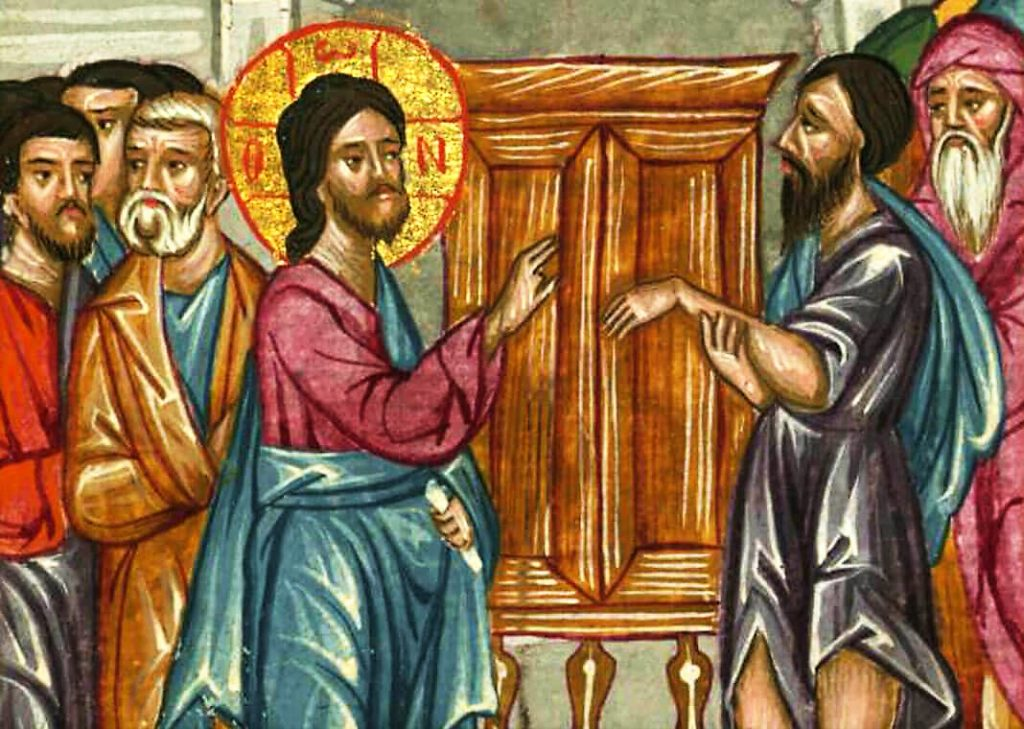
Jesus Heals the Man with the Withered Hand, by Ilyas Basim Khuri Bazzi Rahib, 1684

I am continually amazed whenever good people are surprised by being embroiled in the muck of human controversy. Since we live in a profoundly fallen world, good is often going to buck up against the bad. Besides, Jesus often found himself in a controversy of some kind; and we are not above our Lord.

There are two distinct yet similar controversies in today’s lesson; and they highlight why there were some folk who were all upset about the way Jesus went about things. Such people eventually came to the dark decision that Jesus needed to go away, permanently.

Much of the controversy between Jesus and the religious leaders came down to particular views of God’s law; and, of course, whose view was going to win out over the other. It ended up becoming what almost all controversies are about: Deciding who is really in power and calls the shots.

The Politics of Hunger

It was a Sabbath day. Jesus and his disciples were walking through the fields. And they were hungry. So the disciples took some grain, broke off the heads, and ate them. To any non-Jewish person, there’s no problem here. But the Pharisees were concerned.

First, they observed the disciples walking through grain fields. The Pharisees thought they should be staying put on the Sabbath. Second, and perhaps more significantly, the religious leaders saw Christ’s disciples gleaning – which was working on the Sabbath. To them, any respectable Jew prepared their food the day before. This is a lack of holiness, of not taking the Sabbath seriously. And this was completely unacceptable to the Pharisees.

Wheat Field and Cypress by Vincent Van Gogh, 1890

Jesus, however, viewed walking through the fields differently. He did not consider the Sabbath as trivial; Jesus instead stood back and took a big picture perspective of it all. And that view included the ancient story of David, who took the consecrated bread in the tabernacle which was reserved only for Levite priests. (1 Samuel 21:1-6; Leviticus 24:8-9)

The reason David wanted the bread was because he was a fugitive, on the run from King Saul who was trying to take his life. Jesus insisted, on that day, the priest on duty did nothing wrong in giving the special bread to David. Yes, the strict letter of the law was broken; and, no, this was not wrong – because the priest was helping to save a life, and a very important one at that.

Jesus discerned there are times when particular laws come into conflict; so it’s necessary to maintain the spirit of a law in order to maintain a high value and meet a pressing human need. In a sense, Jesus gave a covenant code legal opinion on the subject.

It’s no surprise, to any reader of the New Testament Gospels, that Christ would behave this way; and that it would drive the religious leaders bananas. After all, they, the Pharisees, upheld law and rendered legal decisions – not this upstart wannabe. Jesus took an authoritative stance on what was happening, and the leaders did not at all like their own authority questioned.

This wasn’t some maverick interpretation by Jesus. He simply pointed out that the Sabbath is a gift, given to people to promote life and health – and not a burden that folks are to carry. Any decent Sabbath-keeper knew this.

It appears the leaders didn’t like being reminded of it from Jesus. What’s more, Jesus was much too close to likening himself to David. Yet another reason to despise this uppity teacher.

The Legality of Suffering

A second controversy brought the issue of who is in charge and who gets to arbitrate community values into a greater light. There is perhaps no other place for that conflict to happen than in the synagogue, the meeting place of worshipers. The juiciest things always seem to happen in a place of worship.

In the first story, the religious leaders were caught surprised over the behavior of Jesus and his disciples. They’re determined not to make that mistake again. From this point forward, it seems the Pharisees are continually waiting for a chance to put down Jesus as a lawbreaker and rabblerouser.

Byzantine mosaic of Christ healing the man with a withered hand, Cathedral of Monreale, Palermo, Sicily

For them, the issue wasn’t about the ability to heal, but whether it’s being done on the Sabbath. Much like the grainfield incident, healing is work, and working on the Sabbath is a direct violation of God’s immutable law. The religious leaders wanted to prove that Jesus has no regard for God’s will.

Law, for many Pharisees in Christ’s day, was meant to bring order so that chaos does not rule. Obedience to the law is a pre-condition for blessing. Without a clear demonstration of holy living, the community could be under a curse, much like their ancestors before them who were exiled for disregarding God’s law.

Yet again, Jesus cut through the anxious fear and authoritative posturing and went directly to the intended spirit of the law. The Sabbath, of all days in the week, ought to be a time for doing good, not harm; and to save life, not kill it. Jesus was not doing anything that could be considered work, anymore than his disciples were actually gleaning or harvesting grain.

There is no better day than the Sabbath for restoring a man’s withered and malformed hand, for giving him back his ability to make a living and contribute to the community. Much more was restored to the man than a physical ability; he now had the ability to better his life and his family, not to mention the local economy. It ought to be all good…

Unfortunately, the Pharisees didn’t see it that way, that the man gained his dignity back, his wholeness and his joy. They could only see a threat to their own hegemony.

The Beginning of the End

So, this marks the beginning of the end. The leaders are so upset and angry, they began plotting for Christ’s destruction. Unlikely political allies came together because of a common enemy. To view Jesus as a threat to society is, at the least, messed up. But that’s what happens when people cannot see beyond the end of their nose. They make bad choices.

Even though Jesus came to give life, others want to take his. Despite the fact that Jesus did not reject the law or demean the Sabbath, people with a short-sighted agenda and hard hearts could only see someone upsetting the status quo.

Today, these same things can quickly turn to hostility. The legal implications of one’s values and commitments can get nasty fast. Opinions can harden, resulting in oppression, persecution, and even death.

The most noble of motives can go sour; and the best of intentions, the highly educated, and the most gifted persons among us can become despotic in their leadership. Indeed, absolute power corrupts absolutely.

This is why the gracious and benevolent kingdom of God will win the day. Hard-hearted people become desperately out of touch with what is most important; they are calloused to the human need in front of their faces. I believe that the words and ways of Jesus can dispel those dark forces and impulses.

I’ll take a controversial Christ any day because that is the path to life abundant and everlasting.

Whenever unjust, oppressive, harmful, and fearful systems hold on, the ministry of Jesus exposes them for what they are, and will deliver us from evil.

Thanks be to God!

Are You Looking for Healing? (Mark 3:7-12)

Jesus departed with his disciples to the sea, and a great multitude from Galilee followed him; hearing all that he was doing, they came to him in great numbers from Judea, Jerusalem, Idumea, beyond the Jordan, and the region around Tyre and Sidon. He told his disciples to have a boat ready for him because of the crowd, so that they would not crush him, for he had cured many, so that all who had diseases pressed upon him to touch him. Whenever the unclean spirits saw him, they fell down before him and shouted, “You are the Son of God!” But he sternly ordered them not to make him known. (New Revised Standard Version)

A man’s shriveled hand was restored in full view of all the public. From then on, throngs of people came to check out what was happening. Jesus was well into his earthly ministry and created quite a buzz amongst everyone in Palestine. The ancient paparazzi even started following him around.

There were more fans rushing to see Jesus than Swiftys at a sighting of Taylor Swift. Like having the limousine ready after a concert to get away from the huge crowds, so Jesus instructed his disciples to have a boat ready for him in order to avoid the great crush of people.

Christ’s reputation of curing the sick and infirmed had reached such a critical mass that thousands were determined to at least touch him and experience long-awaited healing. And, really, you can’t really blame them, can you?

Maybe you’ve never experienced debilitating chronic pain – day after day not being able to get away from it’s awful effects in both body and soul. Or perhaps you have no idea what it’s like to live with depression constantly dogging you, just waiting to take a bite out of your life and devour you like some piece of meat.

A lot of people know what it’s like to live with infirmities that they don’t want and didn’t ask for. And they’ve tried everything to either get rid of it, or cope with it, somehow.

In fact, there are so many such persons living on planet earth, that when they had a snowball’s chance at getting to Jesus, they dropped everything and took it – going after him and not caring one bit if they themselves got crushed from all the other people trying to get help.

That, my friend, is how many people there are with great physical, mental, emotional, and spiritual needs on this planet.

We could go the route of playing arm chair observer and criticize the great crowd of people for being nothing but a bunch of fans who wanted to see the latest fad in Jesus. But, if you get up close with boots-on-the-ground, you will see a different picture: thousands of people looking for hope, health, and wholeness, wanting to be “normal” like everyone else.

The problem? Normal is nothing more than a social construct. For the infirmed, it’s likely not going to happen. For those believing they’re normal, in truth, they have a profound lack of awareness to their own great need.

No, we’re all abnormal; all of us are disordered, or diseased, or distressed in some sort of way. It turns out that we all need Jesus; some of us just know it much more profoundly than others.

Jesus was not only about to be crushed from physical bodies pressing in on him; he was going to be crushed by the sheer weight of the world’s tremendous need for healing.

But he was pierced for our transgressions,
    he was crushed for our iniquities;
the punishment that brought us peace was on him,
    and by his wounds we are healed.
We all, like sheep, have gone astray,
    each of us has turned to our own way;
and the Lord has laid on him
    the iniquity of us all. (Isaiah 53:5-6, NIV)

At this point in Christ’s ministry, a significant shift began. Rather than entering a synagogue and speaking only to Jews, Jesus started addressing Gentiles, as well. In fact, the crowds wanting to see him came not only from exclusively Jewish locations, but also from other places.

This ministry of Christ raised the attention of the demonic realm. It was a major threat to the demons’ influence on people. Identifying him as the Son of God and calling Jesus out by that name was a way for the demons to reassert their power and try to get some leverage. Names are actually a big deal. Which is why, for example, Jesus once asked a demoniac in the cemetery what his name is.

That’s one way a name is powerful. Yet, when it comes to you and me, the fact that Jesus knows your name, and my name, is a mighty thing in a very different way. Rather than having demons making the Son of God known, Christ grants us the authority to make the name of Jesus known throughout the world.

Even though the redemptive events of Jesus happened two thousand years ago, great crowds of people still come to Jesus, clamoring for but a touch of his grace. And the forces of darkness are still hanging around, knowing that their time is short.

Yes, there is still healing and wholeness to be found in Jesus, even today. And even though there remain some forces of darkness in opposition to it, the victory has already been achieved.

O God the Father, whose will for us and for all your people is health and salvation,

Have mercy on us.

O God the Son, who came that we might have life and have it in abundance,

Have mercy on us.

O God the Holy Spirit, whose indwelling makes our bodies the temples of your presence,

Have mercy on us.

O Triune God, we pray you to hear us, and that you will grant your grace to all who stand in need of healing both of body and spirit, and lead them to look with confidence in you;

We beseech you to hear us, O Lord.

That you will grant patience and perseverance to all who are disabled by injury or illness, and increase their courage,

We beseech you to hear us, O Lord.

That you will grant peace to all who are troubled by confusion or pain, and set their minds at rest,

We beseech you to hear us, O Lord.

That you will grant relief from suffering to all sick children, and give them a sure sense of your tender love and care,

We beseech you to hear us, O Lord.

That you will grant rest to all whose increasing years bring weariness, distress, or loneliness, and give them the abiding comfort of your presence,

We beseech you to hear us, O Lord.

That you will grant confidence to all about to undergo surgery or difficult procedures, and keep them free from fear,

We beseech you to hear us, O Lord.

That you will grant purpose to the church as it seeks to carry on Christ’s ministry of healing to suffering humanity, and keep it always true to the gospel of Christ,

We beseech you to hear us, O Lord.

That you will grant skill and compassion to doctors, nurses, technicians, aides, and all who are called to  practice medical arts, and make strong their dedication to help others,

We beseech you to hear us, O Lord.

That you will grant to all people the refreshment of quiet sleep and joy of resting in your everlasting arms, that we may rejoice in your care while we are on earth, and in the world to come, have eternal life.

We beseech you to hear us, O Lord.

O God, who in Jesus Christ called us out of darkness into your marvelous light; enable us always to declare your wonderful deeds, thank you for your steadfast love, and praise your with heart, soul, mind, and strength, now and forever.

Amen, and amen.

Jesus the Mentor (Mark 3:13-19)

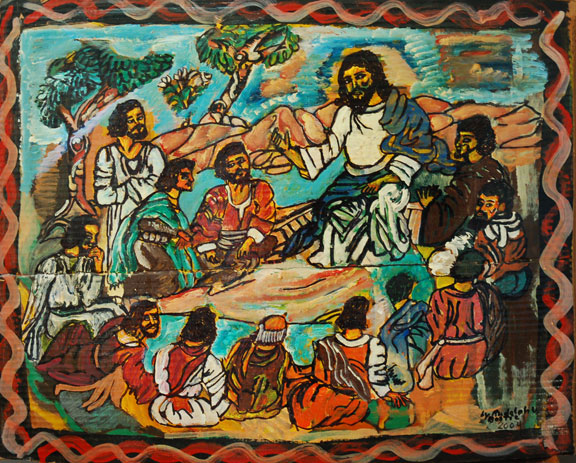
Jesus and the Disciples, by Rudolph Bostic

Jesus went up on a mountainside and called to him those he wanted, and they came to him. He appointed twelve that they might be with him and that he might send them out to preachand to have authority to drive out demons. These are the twelve he appointed: Simon (to whom he gave the name Peter), James son of Zebedee and his brother John (to them he gave the name Boanerges, which means “sons of thunder”), Andrew, Philip, Bartholomew, Matthew, Thomas, James son of Alphaeus, Thaddaeus, Simon the Zealotand Judas Iscariot, who betrayed him. (New International Version)

For me, every place in Holy Scripture is significant, even the seemingly mundane portions of it. Today’s verses might appear rather insignificant. However, there is some important meaning to recording who Christ called as his disciples and why he did it.

Jesus appointed twelve Jewish men to be his close disciples, his apostles. In choosing them, let’s not read into it something that isn’t there. This choosing, in no way, is meant to convey that church leadership boards are always supposed to have twelve men. It seems to me, that if such churches believe this, they ought to go all the way by insisting that they ought also to be Jewish Christians – no Gentiles on the election ballot at the annual meeting!

Excluding women, maintaining a particular number of people to a group, or considering only one ethnicity to leadership is nowhere to be interpreted in this text of Scripture. I can imagine Jesus sitting at the right hand of the Father raising a Spock-like eyebrow to such hermeneutical gymnastics and stating the lone word, “fascinating!”

A disciple is a follower. An apostle is one who is sent out with a specific purpose. Jesus called these particular people in order to send them out with a mission. In other words, Christ’s disciples are really missionaries. And these apostles, these missionaries, are appointed in order that they might be with Jesus, follow him everywhere, learn from him, and then have the received authority to go out and accomplish the mission given them to do.

An apostle can only properly carry out the instructions of the Teacher by first being a disciple who spends copious amounts of time in that Teacher’s presence. Indeed, if we are looking for some contemporary application in these more mundane texts of Scripture, let us find here an insight into our own Christian formation.

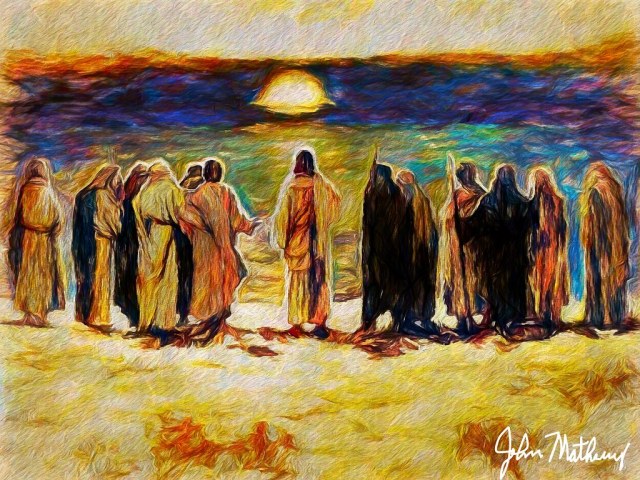
Jesus and the Disciples, by John Mathews

Christian ministry is rightly patterned after the Teacher we follow, Jesus our Lord. Christ himself demonstrated for us the way of mentoring or discipling, through his own words and actions. He called particular individuals, taught them, and equipped them for spiritual warfare in this world by granting them authority to do the work.

If we need a pattern, there it is. It’s a model of mentoring others in the ways of Christian mission and ministry. The idea is that we call, teach, equip, and authorize others in the words and ways of Jesus. I really don’t much care what you call it: Christian discipling, relational mentoring, small group teaching, spiritually forming, or any other word or phrase.

The important thing is to actually understand and do this very Christ-like work of developing mature followers of Jesus who can do the important work of spiritual warfare and ministry, then in turn, develop others. We are to pass on a body of faith and doctrine, of mission and ministry, to a group of people who will do the work. And they then do the same for others.

I rather like the word “mentoring” because for most people it evokes the idea of putting time and effort into some relationships for a specific purpose. And when we look at Christianity as a great mentoring project, perhaps we will see why church is becoming a byword in many parts of the Western world. This also ought to perhaps clue us into how we might move forward as Christians.

I am suggesting that, generally speaking, we have neglected this pattern of Jesus in calling, teaching, equipping, and authorizing. It is one large reason why there is such a decline in church attendance (and participation) in the West. And until we collectively take up this mantle of mentoring ministry, we shall continue to lessen, because we are irrelevant to people’s daily lives – both inside and outside the church.

As a first course of action, I invite you – no matter your age or stage in life – to make it a priority to simply “hang out” with individuals and groups of people. Maybe that sounds like an extrovertish sort of thing to do. However, this invitation is coming from me, an introvert. I didn’t say you have to be the life of the party, or engage in a lot of talking. But I am saying that mature followers of Jesus ought to strongly consider some intentional relationships with people other than family and a few friends.

Hang out around any given church, on any given Sunday, after any given worship service, and you are likely to see small groups of people talking with each other. Those groups typically center around friends according to age. What is often lacking are intentional interactions between the generations.  

Ethiopian Orthodox Church depiction of Christ and his disciples

The younger generations (particularly persons aged 18-29) often need and want to have relationships with more experienced (older!) believers in the faith. Younger adults, however, tend to lack the confidence to go after older adults in order to be mentored or influenced by them. I believe the onus is on the older generations to go after the younger.  

Maybe I’m just old, but it seems like younger generations have an incredible array of relationships, differing levels of friendship, and a complexity to their interactions that I didn’t have “back in my day.” What’s different, it seems, is that their relationships are more gray, and less black and white. And they appear to do a solid amount of hanging out.

Hanging out is typically sitting around with a group of people, eating and drinking, watching movies, studying (or doing bible study) or any other activity. Its doing just about anything, but doing it together with others. And this is the perfect environment for initially establishing how to begin living into the words and ways of Jesus to mentor others.

One of the things we older folks can do is to really understand the reality of younger generations’ relational interactions. For example, when I lived in a university town I used to often just “hang out” with college students, with no agenda other than just being with them. The local Perkins restaurant was at its busiest at midnight, filled with college students hanging out.

There are places in every town and city where young adults go, especially the bar scene. Bars aren’t just places to drink, but are locations of conviviality where persons have the chance to be around one another in a kind of secular church where fellowship happens, looking for a chance to relate meaningfully with others.

All people desire intimacy and want to know that someone else cares about them. This is a very real and felt need. How that need is going to be met can be either legitimate or illegitimate. And we can help with that.

One of the best things we can do for others is to communicate to them that we “have their back,” that we care, love, and genuinely like them.

No one can sniff out a disingenuous attitude quite like a young adult. So, our interactions have to be an authentic desire to be around them. Also, this does not mean we have to pretend to be younger than we are. Instead, one of the greatest needs a young person has is to be in a mentoring relationship with someone older and wiser who can help them navigate life and bring some sort of definition to relationships that they may lack.

The older generations could learn to “hang out” with younger generations and find individuals for whom they can build a solid one on one or group relationship with. If they can have such relationships now, it will serve them for a lifetime.

It seems to me that, as I look at the biblical text, being a mentor, and walking alongside another with love, grace, and wisdom, is built into Christianity by Jesus himself. So, let’s consider how we might best go about this important work.

May your love overflow more and more with knowledge and full insight to help you to determine what really matters, so that in the day of Christ you may be pure and blameless, having produced the harvest of righteousness that comes through Jesus Christ for the glory and praise of God. (Philippians 3:9-11, NRSV)