Truth Stumbles In the Public Square

In these past few months, as an American citizen, I have often wondered what God thinks about the current political situation and climate of the United States.

I must say that with a serious reading of the biblical prophets, it’s rather easy to imagine what the Divine stance likely is:

Justice is far from us,
    and deliverance does not reach us;
we wait for light, but there is only darkness;
    and for brightness, but we walk in gloom.
We grope like the blind along a wall,
    groping like those who have no eyes;
we stumble at noon as in the twilight,
    among the vigorous as though we were dead.
We all growl like bears;
    like doves we moan mournfully.
We wait for justice, but there is none;
    for salvation, but it is far from us.
For our transgressions before you are many,
    and our sins testify against us.
Our transgressions indeed are with us,
    and we know our iniquities:
transgressing and denying the Lord
    and turning away from following our God,
talking oppression and revolt,
    conceiving lying words and uttering them from the heart.
Justice is turned back,
    and deliverance stands at a distance,
for truth stumbles in the public square,
    and uprightness cannot enter.
Truth is lacking,
    and whoever turns from evil is despoiled.

The Lord saw it, and it displeased him
    that there was no justice. (Isaiah 59:9-15, NRSV)

These days, many of my prayers echo the complaint of the ancient prophet Isaiah. I too, have an expectation that God will grant justice and righteousness; and that the Lord will take pity upon us for our ignorance of what is just, right, and good.

And like the prophet Isaiah, I grieve a situation of profuse lying, political malpractice, and socio-economic illiteracy. Many, if not most, Americans and the world community alike, lacks things it needs to live a viable and joyous life. So, I mourn, like a bear growling for a long-awaited meal.

It seems to me that we are failing one another. Our collective vice, and lack of virtue, have led us on a path of injustice. We are a flawed people; we need Divine help.

Perhaps you believe I am being something of a curmudgeon, being too negative – that I’m seeing the glass darkly as only half empty. But no, I’m actually seeing the glass as completely empty, for we are a bereft people.

But just maybe this emptiness can be filled with justice and righteousness, and not shallowness and lack of education, nor gaslighting and manipulative selfishness. Just maybe we can filled to the full in truth.

Our public life together depends upon ethics of accountability.

This insipid business of people stating that they are “being transparent” is nothing but a red flag letting us know that they are doing just the opposite.

We need a new community – a fresh vision of what life can be together. And we are getting anything but that. Instead, in the U.S., we get entrenched yelping from both Republicans and Democrats. And in the face of injustice, we receive an eerie silence from those who ought to know better.

This is not simply a struggle for a political party and its policies. What is happening now transcends each party’s vision of how to live together as a people.

Historically, the Democratic party has generally believed that government ought to raise money through a fair system of taxation. The funds then are to be used to provide basic services that serve the common good of all persons, i.e. ensuring a living wage, protection through laws, maintenance of infrastructure, equal access to healthcare and education, etc.

The Republican party has approached a more individualistic vision of government, believing that each person should manage their own money to make the best use of a market economy. Then, they can create economic growth without reliance upon government regulation of business. Private philanthropy and non-profit organizations are relied upon to provide social services. Private companies are called upon to handle infrastructure needs.

In essence, at the core, Democrats have a vision of community and caring for one another, whereas Republicans have a vision of each person living prosperously under their own fig tree without the interference of others.

This is why things like tax increases and tax cuts become such visceral issues, because they get at the practical outworkings of each party’s vision of how to live together.

But the stakes are even higher than an American two-party system. There is presently leadership in the United States that is openly antagonistic, belligerent, bullying, rude, and frankly, unbiblical and unvirtuous. There is nothing that comes out of the current president’s mouth that reflects the words of Jesus; and there is nothing he does which is consistent with the ways of Jesus.

Many, if not most, “Christian” Republicans are woefully out of touch with their own Bibles; and, at the very least, are complicit in retraumatizing the already traumatized people in the nation (and the world) through supporting unjust leadership.

In the time of the prophet Isaiah, not only was there injustice (common citizens not receiving what they need to build a good life and flourish) but there was no one willing and available, no one engaged and at work to turn around an unjust system so that the government would respect basic human rights for the poor and the needy, the least and the lost in society.

So, the prophet was on the scene to announce that Yahweh, the God of Judah, has noticed. Yahweh has seen that the leadership would not accept responsibility for implementing the Law of God (namely, a set of just, right, and good laws which were to frame all of Jewish society).

Nobody cared. No one bothered to help those without a voice and without hope. And Yahweh knew it. Therefore, a sorry state existed which eventually turned into the people losing their land through an active judgment of God.

Truth matters. And when it is suppressed in the public square, God’s eyebrow is raised.

Lips that speak lies, tongues that mutter wickedness, attitudes which are dishonest, hands that work only for self, and feet which run to violence are all anti-truth practices. (Isaiah 59:3-4)

There is no way on this earth and in this life to get along without government. And because of that, government’s legitimate duty to its people is to provide necessary order, safety, peace, and ensure justice – which means making sure that all citizens have what they need to grow, thrive, and prosper.

Both survival and prosperity must have the glue of truth holding society together – which means that a nation’s government needs to have the basic fundamentals of justice in mind and at heart.

A telltale sign that leaders do not have the best interests of their own people is how they speak to and treat others outside their own nation, people in differing circumstances in different places.

“They did not want to consider their duty. They have distorted their intelligence so as to not understand what ought to be done… They have distanced themselves so far from the truth that they openly combat those who turn away from perversity and choose the good.”

Theodoret (393-457 C.E.)

I cannot think of a better way to describe our current failure of leadership in this world.

Lord, have mercy upon us.

Instead of selfishness we need self-discipline. Rather than a personal concern for earthly wealth and profit, we need to seek first the kingdom of God and God’s righteousness.

Instead of simply loving those who love us, we can  love our enemies and seek to do good. We can actively walk alongside beleaguered people who have had quite enough of belligerent bullying and bogus bellicosity in their lives.

To God belongs the ability to save, deliver, redeem, and judge. To you and I belongs the responsibility for treating our fellow humanity with justice, equity, goodness, and humility with a gentle spirit, holding one another accountable for our attitudes and actions. In short, it means living the truth.

That includes every politician and political party.

“Truth is difficult to reach and endure, but it is always the doorway to new freedom and life.”

John O’Donohue

If you yet are looking for some sort of positive outlook, some kind of hope, it is this: Our present suffering of spirit can serve to burn away any illusions (and delusions) that a politician or political process will save us.

Any disillusionment we may have becomes an opportunity to discover both old and new ways living the truth. It often takes suffering to teach us what is truly most important to us.

Our current malaise, national anxiety, and world troubles can become the means of future possibility, if we will let it. Worrisome circumstances can open to us the light of undiscovered truth about ourselves and our world.

We may stumble, yet there is always the chance to catch ourselves and not fall. So, what does God think of this present national and world situation? The prophet Isaiah insisted:

Let the wicked forsake their way
    and the unrighteous their thoughts;
let them return to the Lord, that he may have mercy on them,
    and to our God, for he will abundantly pardon.
For my thoughts are not your thoughts,
    nor are your ways my ways, says the Lord.
For as the heavens are higher than the earth,
    so are my ways higher than your ways
    and my thoughts than your thoughts. (Isaiah 55:7-9, NRSV)

No matter what happens on this earth, Isaiah’s perspective insists upon the truth and reality of God’s ultimate authority. We shall not always understand divine authority, yet at its core, is full of justice and righteousness. And nothing can stop from it breaking out into the public square.

May it be so, to the glory of God.

Be Careful about Your Decisions (2 Samuel 11:14-21)

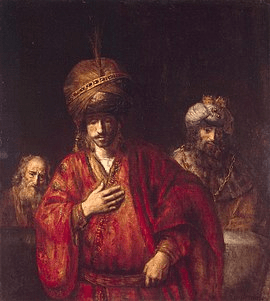
David and Uriah, by Rembrandt, c.1665

In the morning David wrote a letter to Joab and sent it with Uriah. In it he wrote, “Put Uriah out in front where the fighting is fiercest. Then withdraw from him so he will be struck down and die.”

So while Joab had the city under siege, he put Uriah at a place where he knew the strongest defenders were. When the men of the city came out and fought against Joab, some of the men in David’s army fell; moreover, Uriah the Hittite died.

Joab sent David a full account of the battle. He instructed the messenger: “When you have finished giving the king this account of the battle, the king’s anger may flare up, and he may ask you, ‘Why did you get so close to the city to fight? Didn’t you know they would shoot arrows from the wall? Who killed Abimelek son of Jerub-Besheth? Didn’t a woman drop an upper millstone on him from the wall, so that he died in Thebez? Why did you get so close to the wall?’ If he asks you this, then say to him, ‘Moreover, your servant Uriah the Hittite is dead.’” (New International Version)

Today we have a lesson in the middle of a story about King David’s greatest error in judgment and cover up of that decision. Indeed, bad decisions can often beget even more bad decisions.

It would be an understatement to say that David blew it. Our Old Testament books of 1 and 2 Samuel are arranged by the original editor in such a way that the chapter of 2 Samuel 11 is a hinge upon which the life of David moves.

All of the material before 2 Samuel 11 is generally positive, describing a man devoted to God in every way. But everything after this chapter is mostly tragic. The editor wanted readers and listeners to understand that God cares about morality and ethics by showing the consequences of both a life well-lived, as well as a life that is self-centered.

Before our verses for today, the story begins with David choosing adultery and taking another man’s wife. King David should have been doing the work of a king – protecting and serving Israel. But instead, he hung out in Jerusalem and avoided all the needed military stuff. (2 Samuel 11:1)

The editor wants us to see that King David was shirking his responsibility, which then brought a set up for moral failure. It appears David was resting on his laurels, content with his victories and successes. For the most part, at the time, the nation was happy and prosperous.

The king was walking around on the roof of his palace, instead of being in the trenches with his men, leading them in the defense of Israel.

Rather than giving proper orders as a king ought to do, David was sending people to do his personal bidding in satisfying his earthly wants. This is a significant reversal of what we see from earlier chapters in the story of David.

Up to this point we have observed David as a merciful king, seeking to use power for benevolent purposes in the common good of the nation. But in today’s chapter, David turns into the typical earthly king, ordering others around and using his authority to get what he wants.

The editor wants us to learn some lessons from David’s life. One of those lessons is that if the right and just King David can fall, then none of us are immune from falling into bad decisions which alter people’s lives forever.

The moment we think we are above falling, look out, because an arrogant nose dive into depravity is probably not far behind.

The stories of people who fall into immorality are mostly the same. Having some power or authority to wield, they use it to assert control over another person or group in order to get what they want – without being concerned for the needs and wants of others, and usually unconcerned for the negative consequences it brings upon other people.

It’s important that we call such behavior what it is: Evil. Awful. Selfish. Ungodly. A violation of ethics and morality. An offense against God.

David committed adultery, then lied, manipulated others, and covered up his actions. He murdered an innocent man, and was okay with an entire regiment of soldiers getting killed to ensure that an innocent man would be dead.

None of that icky nasty stuff was a mistake, or a lapse in judgment. It was pre-meditated sin.

And the way to deal with such sin is not to say something like “I did it, but it wasn’t really me; I’m not really like that!” Well, apparently, you are. Maybe David thought he was above it all, and believed it wasn’t really something he could ever do. But he did.

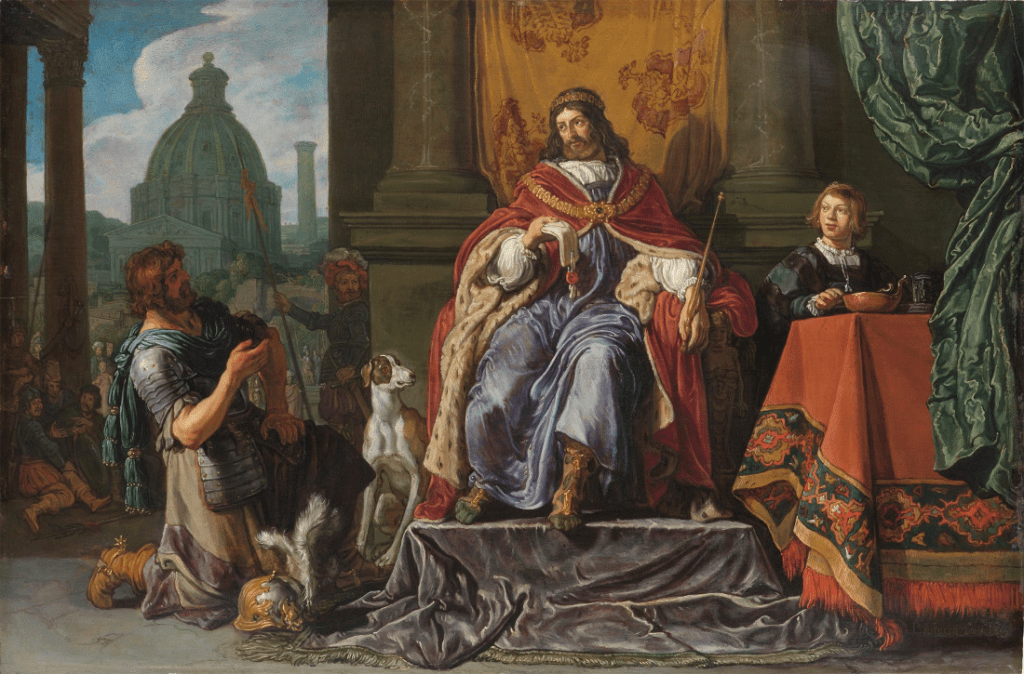
David gives Uriah a letter for Joab, by Pieter Lastman, 1619

Once we make an immoral and ungodly decision, it often causes us to start selling-out our principles and convictions. Sin only begets more sin, until we deal with it squarely.

Truth is a celebration of openness and honesty. Shame keeps to the shadows and prizes secrecy and remaining quiet. If one chooses not to go down the path of truth, then they will be continually encrusting their lives with lies so that no one ever knows.

In fact, much of religious legalism is nothing more than a person piling on the rules in order for others to not see the guilt and shame that hides deep within. Only through confession, repentance, and faith, will forgiveness, wholeness, and happiness ever occur.

Yet another lesson we can learn from this story of David is that the results which may satisfy our wants may not necessarily satisfy our needs, or God.

David accomplished what he wanted. He was successful in covering up his sin, and he got the woman he wanted. But God saw the whole thing, and was not okay with any of it. 

We must not assume that because we do something, and there was no immediate lightning strike, that it was okay. 

To only selfishly satisfy ourselves is to be a spiritual cannibal who eats other people alive.

So, how might we avoid falling into the same sorts of bad decisions which befell David?

  • Make prayers of confession a regular staple of your daily spiritual regimen. Had David engaged in prayer on the roof instead of being bored, we would likely have a very different story.
  • Maintain an active and engaged mind. An idle mind is the devil’s workshop. David was wandering around the palace instead of actively engaged in the government of his kingdom.
  • Keep the Sabbath. A day of rest helps the body to be in healthy rhythms of care, as well as enabling the spirit to connect meaningfully with God. Without adequate rest, we are like the little kid in a grocery store at 9pm throwing a fit and having a meltdown. David got out of a healthy rhythm as king, and it led to a fall.
  • Strengthen your family relationships. If you are married, live from the place of your marriage. Marriage is more than living with someone and having occasional fun; it is a one-flesh relationship that is meant to be a priority. Only from this relational place can a spouse effectively take on the world with all its needs and brokenness. 
  • Submit to accountable relationships. There are far too many lonely people with few friends in this world, even among people who are constantly around others. Everyone needs a small coterie of confidants with whom to share anything and everything with.  David’s close friends were all out with the army, and he was alone. Not a good thing.
  • Avoid stuffing all desire down as selfish and bad. Jettisoning desire only sets us up for a fall. But identifying godly desire enables us to make better decisions which engage the whole person.

Almighty God, you are the fountain of all wisdom and grace. You know our needs before we even ask, and our ignorance in not asking for the things we really need. Have compassion on our weakness, and mercifully give us those things that in our blindness we don’t know to ask for. 

Gracious Lord, we acknowledge and confess our sinful nature, prone to evil and slow to good.  You know our secret sins, and how often we have offended you and damaged others through wandering from your ways, wasting your gifts, and forgetting your love. Cleanse us from our hidden sins and forgive our faults for the sake of your Son, our Savior, Jesus Christ who loved us and gave himself for us. Amen.

The Seven Deadly Sins (Proverbs 12:10-21)

A 14th century personification of the Seven Deadly Sins, by Unknown artist

The righteous care for the needs of their animals,
    but the kindest acts of the wicked are cruel.

Those who work their land will have abundant food,
    but those who chase fantasies have no sense.

The wicked desire the stronghold of evildoers,
    but the root of the righteous endures.

Evildoers are trapped by their sinful talk,
    and so the innocent escape trouble.

From the fruit of their lips people are filled with good things,
    and the work of their hands brings them reward.

The way of fools seems right to them,
    but the wise listen to advice.

Fools show their annoyance at once,
    but the prudent overlook an insult.

An honest witness tells the truth,
    but a false witness tells lies.

The words of the reckless pierce like swords,
    but the tongue of the wise brings healing.

Truthful lips endure forever,
    but a lying tongue lasts only a moment.

Deceit is in the hearts of those who plot evil,
    but those who promote peace have joy.

No harm overtakes the righteous,
    but the wicked have their fill of trouble. (New International Version)

Many of the biblical proverbs are set as contrasts between the way of righteousness and the way of wickedness.

Being aware of both vice and virtue in our personal lives, the workplace, neighborhood, family, and faith communities can create an environment of trust, love, fellowship, and enjoyment. Intentionally pursuing the good, while identifying and forsaking the bad, contributes to a thriving community who intentionally cultivates righteousness.

It’s likely that you have heard of “the seven deadly sins.” In medieval Christianity, these were vices to avoid at all costs, because they eroded personal integrity and poisoned the social community. A “vice” is a bad habit which corrupts character and debases society.

The early church eventually formed a short list of the most corrosive vices, the seven deadly sins, which were considered the most heinous desires/actions of all. We find them in our proverbs for today.

The wicked covet the proceeds of wickedness. Desiring evil is a trap for them. They chase after sinister fantasies.

Lust is an intense desire, coupled with a lack of mental self-control, which is manifested in pursuing that desire in the heart. It is to have a passion for someone (or something) that is neither yours, nor meant for you. Lust leers at and indulges in selfish daydreams, without any concern for another person.

Do not desire to possess anything that belongs to another person—not a house, a wife, a husband, a slave, an ox, a donkey, or anything else. (Exodus 20:17, CEV)

The wicked have their fill of trouble. They’ve gobbled up evil as if dining at an all-you-can-eat buffet.

Whereas lust and covetousness is mostly a lack of mental self-control, gluttony is the lack of bodily self-control.

So, whether you eat or drink or whatever you do, you should do it all for God’s glory. (1 Corinthians 10:31, CEB)

Gluttony doesn’t stop eating, buying, talking, drinking, or binging. It only excessively indulges to the point of physical and/or relational sickness. Addictions and workaholism are some modern-day forms of gluttony – it consumes to the point where it cannot control the consumption any more. The thing desired and indulged becomes the master.

Observe the Sabbath and keep it holy. You have six days in which to do your work, but the seventh day is a day of rest dedicated to me. On that day no one is to work—neither you, your children, your slaves, your animals, nor the foreigners who live in your country. (Exodus 20:8-10, GNT)

The tools of greed are deceit and lies; the greedy person goes to just about any lengths to obtain more wealth. They will misrepresent another and spread gossip and slander to get what they want.

Do not tell lies about others.

The Ninth Commandment (Exodus 20:16, CEV)

Money. More money – is the mantra of the greedy person. It is to have an inordinate desire and pursuit of wealth. Just as sex and food are good, but have their proper boundaries, so money is both good and necessary. 

But money is powerful in more ways than one. It can take over a person’s life in such a way that charging exorbitant interest, rent, or price gouging is justified by satisfying the greed. The greedy person lives every waking moment for leveraging wealth to get more wealth.

People who want to be rich fall into all sorts of temptations and traps. They are caught by foolish and harmful desires that drag them down and destroy them. The love of money causes all kinds of trouble. Some people want money so much that they have given up their faith and caused themselves a lot of pain. (1 Timothy 6:9-10, CEV)

The sloth much prefers get-rich-quick schemes to actual hard work. They spend their time in worthless projects, and are easily annoyed at others.

Sloth is more than laziness. It is also failing to do good when it is in your power and ability to do so. To be slothful is to be indifferent to the great need of the world. 

Whereas the previous sins have a more active pursuit of some desire, the sloth is passive, not wanting to get involved in making a difference. The slothful person always has an excuse why they can’t participate; they expect everyone else to do the work. 

Do your work willingly, as though you were serving the Lord himself, and not just your earthly master.

Colossians 3:23, CEV

The irony is that for all of Ebenezer Scrooge’s hard work and thrift, he was really a sloth who had no intention of improving the condition of humanity; he depended on poor houses and work farms to do all the work. It took supernatural means to get him to think differently. It typically takes a lot for the sloth to go out of their way to honor, respect, and bless another.

You must honor and respect your father and your mother. Do this so that you will have a full life in the land that the Lord your God gives you. (Exodus 20:12, ERV)

A wicked person is often an angry person – so full of anger that they abuse their pets and animals who have done nothing against them. And they let their tongues wag and fly off the handle anytime they are perturbed.

Stop being angry!  Turn from your rage!  Do not lose your temper— it only leads to harm. (Psalm 37:8, NLT)

That doesn’t mean that anger itself is a bad thing. As with most things in life, anger has its proper place. For example, we ought to be angry in the face of evil perpetrators. Anger motivates us to not be slothful, but helpful. 

But excessive selfish anger is a vice. Whereas righteous anger seeks to help a victimized person or group, sinful anger is fueled by hatred. Whether it’s a violent verbal decapitation of another, or a deep seated bitterness, such anger destroys relationships – and even life itself.

No murder.

The Sixth Commandment (Exodus 20:13, MSG)

Envy and lust are kissing cousins. They both traffic in excessive desire for what they don’t possess. 

Envy rots the bones.

Proverbs 14:30, NIV

The subtle difference has more to do with the object of the affection. Lust leers at, longs for, a person who belongs to someone else. Envy fixes its gaze on a material possession or a respected position which someone else has. It is to have a passionate pursuit of taking over someone else’s job or keeping up with Jones’s.

For where there is envy and selfish ambition, there will also be disorder and wickedness of every kind. (James 3:16, NRSV)

The wicked and the proud share a table together for lunch every day. They don’t listen to anybody else, because they believe they already have the answers and know what is best.

Pride is an over-inflated view of one’s opinions, thoughts, and self. Proud persons have an overestimation of themselves. They seem to actually believe that if only others followed their thinking and advice, the world would be a better place.  

Every antagonist in the movies, comics, and classic literature are full of themselves. They justify stepping on others to achieve what they think is the greater good of imposing their agenda in the situation. It’s no wonder that in the Bible, Satan is the ultimate antagonist.

The proud must eventually contend with God. And the Lord has no allowance for the foolishness and idolatry of any human believing they know better.

“No other gods, only me.”

First Commandment (Exodus 20:3, MSG)

Consider the following questions:

How will you respond to the seven deadly sins?

In what ways and/or behaviors do you see these vices being manifested in both the church and the world?

What can the book of Proverbs bring to such a discussion?

The Truth about Lying (Acts 5:1-11)

Now a man named Ananias, together with his wife Sapphira, also sold a piece of property. With his wife’s full knowledge he kept back part of the money for himself, but brought the rest and put it at the apostles’ feet.

Then Peter said, “Ananias, how is it that Satan has so filled your heart that you have lied to the Holy Spirit and have kept for yourself some of the money you received for the land? Didn’t it belong to you before it was sold? And after it was sold, wasn’t the money at your disposal? What made you think of doing such a thing? You have not lied just to human beings but to God.”

When Ananias heard this, he fell down and died. And great fear seized all who heard what had happened. Then some young men came forward, wrapped up his body, and carried him out and buried him.

About three hours later his wife came in, not knowing what had happened. Peter asked her, “Tell me, is this the price you and Ananias got for the land?”

“Yes,” she said, “that is the price.”

Peter said to her, “How could you conspire to test the Spirit of the Lord? Listen! The feet of the men who buried your husband are at the door, and they will carry you out also.”

At that moment she fell down at his feet and died. Then the young men came in and, finding her dead, carried her out and buried her beside her husband. Great fear seized the whole church and all who heard about these events. (New International Version)

We all know what a deceitful liar is because, well, we have all lied and practiced deceit in our lives. How ubiquitous is lying? According to one Harris poll:

  • The average person tells at least 2 lies every day. (That’s the equivalent of 730 lies per year)
  • 60% of people lie at least once in a 10-minute conversation.
  • 40% of people deceive prospective employers by lying on their resumes.
  • 90% of peoplelie on their online dating profiles.
  • 80% of spouses lieto their partner about their spending habits.
  • 50% of teenagers lieto their parents about their whereabouts.

And those are just lies that have been admitted. So, how many more lies and deceptions are there really out there?…

We also all know why we lie. You will likely find yourself in these top five reasons for lying:

  1. Fear of punishment
  2. Protection from harm
  3. Avoidance of shame or embarrassment
  4. To gain advantage and/or power over others
  5. Out of habit and/or compulsion

However, maybe you aren’t in touch with how lying really impacts you, how powerful deceitfulness truly is on your own psyche and personhood. Lying has major consequences for us including:

  • Loss of trust and damage to relationships
  • Loss of physical health and damage to mental health
  • Loss of job and damage to reputation
  • Loss of resources and experience of damages in lawsuits

In the instance of two people, Ananias and Sapphira, it meant loss of life and damage to the fellowship of new believers in the fledgling church.

The couple’s guilt, in front of the Apostle Peter and the entire church, is that they were counterfeit community members. Ananias and Sapphira were not what they seemed to others. They were not truthful because they were not vulnerable.

By lying in order to achieve an honor and a status they had not earned, Ananias and Sapphira not only dishonored and shamed themselves as patrons; they also unwittingly exposed themselves as outsiders who were pretending to be honest believers. In short, the two of them were imposters.

Their deceit demonstrates that they were still functioning within the existing Roman patronage system. Yet, true followers of Christ in the believing community, purposefully practiced a different system. The Christians had an interpersonal relation of giving and receiving love – which worked out itself in sharing all things in common with one another, without the class distinctions of the patronage system.

The cross of Christ abolished walls of separation and established a truly egalitarian society. To feign equality, but actually still live about in the inequitable world, is tantamount to rejecting the work of Christ’s cross.

The deception of Ananias and Sapphira was an attempt to appear just like Barnabas – who was the real deal, and the consummate steward of resources. Barnabas was an encourager, always thinking of others and the needs of the community (Acts 4:36-37).

Ananias and Sapphira wanted to look generous, but their motives were really to give in order to maintain their class status, and not for the sake of love. What’s more, their lie about it and their lack of honesty and vulnerability was clearly seen by Peter and interpreted by him as nothing less than lying to the Holy Spirit of God.

One of the purposes of the Holy Spirit is to form God’s people into a community that uses resources in accordance with a deep concern for others. It’s not surprising, then, that Ananias and Sapphira’s fakery of generosity is presented as falsifying the work of the Spirit. Their deception was an outright threat to Christian spiritual identity and community.

Like Ananias and Sapphira of old, our contemporary lying is typically to misrepresent who we are and how we are really doing and feeling.

The most common lie of people in the United States is saying “I’m fine” when they are really and truly not okay. Anxiety, depression, and the appearance of negativity is a source of guilt and shame for many Americans – so they lie about how they’re really doing.

It’s better to fake it, they believe, because no one actually cares how I’m doing. There is still very much a cultural stigma around people who admit not feeling well or not being okay. And that, my friends, very much needs to change.

It’s always good to begin with being honest with small things and avoiding white lies. Instead of lying, practice gratitude. Being thankful for all the small things in life is a truthful replacement to a lie. I wonder what Anania and Sapphira would have been like with that sort of healthy spiritual practice. But alas, we can only imagine.

In the case of you and I, we need not have to wonder. We can begin today by observing the good, the beautiful, and the truthful, and express gratitude for all the little ways for the good which is seen.

Grant me today, O God, some new vision of your truth. Inspire me with the spirit of joy and gladness. Make me the cup of strength to suffering souls; in the name of the strong Deliverer, our Lord and Savior, Jesus Christ. Amen.