Overcoming the World

Everyone who believes that Jesus is the Christ is born of God, and everyone who loves the father loves his child as well. This is how we know that we love the children of God: by loving God and obeying his commands. In fact, this is love for God: to keep his commands. And his commands are not burdensome, for everyone born of God overcomes the world. This is the victory that has overcome the world, even our faith. Who is it that overcomes the world? Only the one who believes that Jesus is the Son of God. This is the one who came by water and blood—Jesus Christ. He did not come by water only, but by water and blood. And it is the Spirit who testifies because the Spirit is the truth. (1 John 5:1-6, NIV)

Faith, love, and obedience are tightly woven together to such an extent that to pull one of them out is to unravel the whole bunch. These three characteristics of the true Christian are vital and necessary to living the Christian life. They all must be present for the church to overcome the world.

The main verbs throughout the verses are the word “is.” And the verb tense is key. The verb clearly describes a past action of God which we as people need to receive. In other words, the grammar dictates that God has given us new birth.  We do not give ourselves spiritual birth any more than we can tell our mothers that it was us who gave birth to ourselves.

God saves us from sin and grants us forgiveness. This action is from God. We are recipients of God’s good grace toward us. There are three participles connected to this main verb:

  1. Believe
  2. Love
  3. Obey

A participle is a word which is connected to the verb’s action. So then, our actions are a result of God’s action toward us. To put it simply, a person born from God will believe, love, and obey. Just as a newborn baby first breathes, then learns to eat, sleeps, grows-up, learns to walk, and over time develops into an adult just like their mother and father, so the Christian who is born again from God exhibits faith, learns to love, and grows up developing the skills of obeying Jesus and following him, learning to walk in his ways, becoming just like him.

In the same way a child must learn and grow to have the necessary skills for facing the world in all its bigness, trials, and temptations, so the Christian must develop the abilities necessary to overcome the world. Those skills are faith, love, and obedience. Without them, we will be unable to deal with the world. But with them, we experience victory over the world.

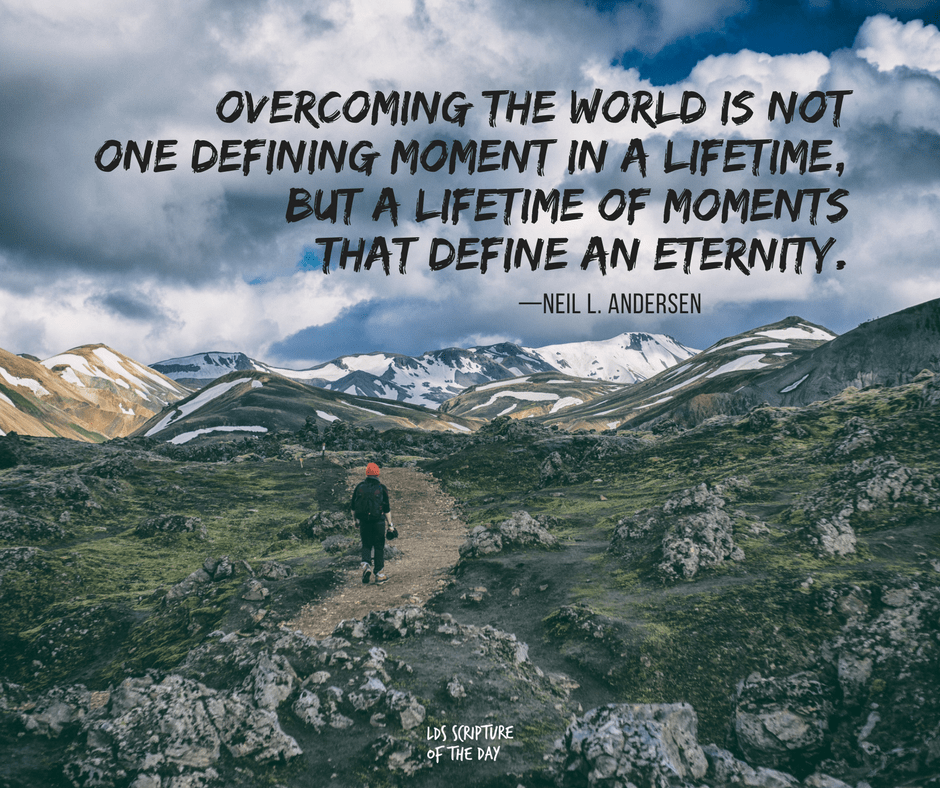
The word, “overcome,” is a cognate word (related to) of “victory.”  That is, to overcome is to have firsthand exposure to the victory the Lord Jesus has achieved on the cross. Through being spiritually born again by God, we are set on a course requiring faith, love, and obedience to overcome the world. As we learn to apply these three spiritual characteristics to our lives, we experience practical victory over the world.
The term “world” are the patterns, systems, and operations of the world in direct contrast to how God operates. For example:

  • The world engages in revenge and payback when wronged, whereas the Christian learns to believe God as the Judge, loves the person who has offended them through prayer for their enemy, and obeys God through good works that seeks the welfare of the other. 
  • The world uses other people as either objects of their pleasure or to get ahead in life, whereas the Christian believes God will take care of their needs, will seek to love the other person instead of use them, and would rather obey God than be selfish. 
  • The world thinks nothing of lying, cheating, and stealing, if they can get away with it, whereas the Christian believes Jesus is the way, the truth, and the life, loves being a person of integrity, and obeys God even when it hurts.

This in no way means we avoid or belittle the world. In facing and overcoming the world, we need principled civility. Using faith, love, and obedience, we respect another’s viewpoint through growing in faith, expanding our hearts in love, and learning obedience through interaction with others for whom we disagree.

Where do we feel “the pull” in life from? Do we feel it from the world, or from God’s Word? We must learn how to deal with the worldly elements of our society in which we feel a pull and a tug to go along with it and want to give in to it. This requires a community of Christians engaging the world through faith, love, and obedience to overcome that pull.

Our call as Christians is not to just survive the world. If anyone could have had that kind of mentality, it was Helen Keller. Deaf, mute, and blind, she could have settled into just getting by and waiting for heaven. Yet, she accepted her situation, coped with it, and even transcended her limitations.  She did more than survive – she thrived. Helen Keller once said:

“The marvelous richness of human experience would lose something of rewarding joy if there were not limitations to overcome. The mountaintop would not be half so wonderful if there were no dark valleys to traverse.”

Helen Keller

We need faith in God, not ourselves. The Scripture says:

Trust in the Lord with all your heart,
    and do not rely on your own insight.
In all your ways acknowledge him,
    and he will make straight your paths. (Proverbs 3:5-6, NRSV)

We need to love God and others, and not the world. The Scripture says:

Don’t love the world’s ways. Don’t love the world’s goods. Love of the world squeezes out love for the Father. Practically everything that goes on in the world—wanting your own way, wanting everything for yourself, wanting to appear important—has nothing to do with the Father. It just isolates you from him. The world and all its wanting, wanting, wanting is on the way out—but whoever does what God wants is set for eternity. (1 John 2:15-17, MSG)

We need to obey the call of God, not the call of the world. Hear what Scripture says: 

The commandment that God has given us is: “Love God and love each other!” (1 John 4:21, CEV)

When faith, love, and obedience are working together as they were intended to, we will overcome the world and all its crud. We will keep ourselves from being polluted and stained by it.

Overcoming the world is a high calling from God. Faith means putting aside fear and taking the kind of risk God wants you to take. Love means putting aside hate and serving others, even when it hurts. Obedience means putting aside selfishness and choosing to do what is best for another person’s welfare. Being characterized by these three Christian virtues will have the effect of overcoming the world. It is not a burdensome or heavy way to live. It’s the way of Jesus.

Blessed Father, Son, and Holy Spirit, the God whom we serve: Sometimes our hearts and minds are flooded with fears. Sometimes we are paralyzed and overwhelmed and feel unable to go on. Yet today we hold onto the victory you have accomplished through the blood of Jesus Christ. You have told us not to fear, for you have overcome the world. So, we cling to you, believing your Word and your promises. In moments of crippling fear, we choose to hold your hand and believe; to love as we have been loved; and, to obey even in the most fearful places because we know that you have risen again.

Loving Lord Jesus, we surrender to you all that we are and hope to be. Holy Spirit, we invite you and all your ministry within us. Holy God of all, we offer you our heart, mind, body, soul, spirit, hopes, plans and dreams. We surrender to you our past, present and future problems, habits, character defects, attitudes, livelihood, resources, finances, medical coverage, occupation and all relationships. We give you our health, physical appearance, disabilities, family, marriage, children, grandchildren, and friendships.

We ask for your Lordship over every aspect of our lives. We surrender to you all our hurt, pain, worry, doubt, fear and anxiety, and ask you to wash us clean. We release everything into your compassionate care. Speak to us clearly, Lord. Open our ears to hear your voice. Open our hearts to commune with you more deeply. Open the doors that need to be opened and close the doors that need to be closed. Set our feet upon the straight and narrow road that leads to everlasting life. Amen.


Stay Connected

Photo by Grape Things on Pexels.com

Jesus said:

“I am the true vine, and my Father is the gardener. He cuts off every branch in me that bears no fruit, while every branch that does bear fruit, he prunes so that it will be even more fruitful. You are already clean because of the word I have spoken to you. Remain in me, as I also remain in you. No branch can bear fruit by itself; it must remain in the vine. Neither can you bear fruit unless you remain in me.

“I am the vine; you are the branches. If you remain in me and I in you, you will bear much fruit; apart from me you can do nothing. If you do not remain in me, you are like a branch that is thrown away and withers; such branches are picked up, thrown into the fire and burned. If you remain in me and my words remain in you, ask whatever you wish, and it will be done for you. This is to my Father’s glory, that you bear much fruit, showing yourselves to be my disciples. (John 15:1-8, NIV)

“Remain in Me”

The word “remain” means to linger in the present moment – to be mindful to ourselves and our situations and stay connected. It is to have continual unbroken fellowship with Jesus.

To have a connection, there must be two ends to connect. The Jesus connection is consistent. It’s always there. We are the other connection. And, frankly, we can be flaky – pulling away and coming close. Which is why Jesus gives a repeated invitation to keep the connection. Here are a few other translations of John 15:4….

Stay joined to me, and I will stay joined to you. Just as a branch cannot produce fruit unless it stays joined to the vine, you cannot produce fruit unless you stay joined to me. (CEV)

Live in me, and I will live in you. A branch cannot produce any fruit by itself. It must stay attached to the vine. In the same way, you cannot produce fruit unless you live in me. (GW)

Abide in Me, and I in you. As the branch cannot bear fruit of itself, unless it abides in the vine, neither can you, unless you abide in Me. (NKJV)

Stay connected to me, and I will stay connected to you! A branch cannot produce fruit on its own but only if it has a vital connection to the vine. In the same way, there’s no way you can produce fruit, at all, unless you have a meaningful connection with me.

Jesus (John 15:4, own translation)

Our task as Christians is to remain connected to Jesus. So, the question is: How do we keep the connection without breaking it? How can we be fruitful?

Focus On the Relationship

Christianity, at its core, is about a living relationship with Jesus. Yes, doctrine is important. And it is necessary to know the basic tenets of Christian faith. Yet, any knowledge and understanding we gain about Christianity is to be channeled into developing the relationship.

Bible trivia is only as good as the understanding we apply to build the relationship. Knowledge makes us proud of ourselves, while love makes us helpful to others. While knowledge makes us feel important, it is love that strengthens the church. Knowledge puffs up but love builds up. (1 Corinthians 8:1)

Christ’s redemptive events of incarnation, holy life, death, resurrection, and ascension are all meant to restore a severed relationship with humanity. Therefore, knowing doctrinal truth is not the same as using the doctrines to connect with God in a loving relationship.

As with all relations, it takes planning, dedication, time, and effort to grow and maintain our relationship with Jesus Christ. If we fail to use our time and energy on that relationship, then the leaves on the branch begin to wither.

Scripture, silence, solitude, community, prayer, giving, and fasting have always been at the center of Christian practices which are designed to put us in a position to hear and receive from God.

Relate Well to the Other Branches

The church is a community. Christ and the church have a vital union with each other. We are a living growing community. I used to live in a place where there was a tree that had grown up next to an old fence post. The tree grew tall and engulfed the post to the degree that now you can only see part of the fence post.

To try and remove the post, you would need to remove the tree. The two have become one. And the tree is still growing. Not only are we connected to the trunk, but we’re also connected to each other. We are all part of the same vine. We aren’t separate vines. So, we all need to do our part in the system of the vine.

Keep Close to the Vine

My grandmother had a grapevine in her backyard when I was a kid. I have firsthand understanding that the best grapes are located closest to the trunk of the vine. The sweetest, juiciest, biggest, and best tasting grapes are found in the middle, securely next to the vine’s trunk.

If you’re into sour grapes, then pick the ones at the end of the branches. Show me a sourpuss Christian, and I’ll show you a Christian who is not close to Christ. Show me a sweet Christian and I’ll show you a believer who daily works at their connection with Jesus.

Pruning is Necessary

Healthy vines need to be pruned, at least once a year. Ideally, twice a year, in the Spring before budding; and in the fall, after the harvest. To ignore pruning is to compromise the vine’s ability to produce both good grapes and lots of grapes. The branches of a grapevine need to be kept short because the nutrients are concentrated in and near the vine. Long branches compromise the harvest.

Pruning hurts. From the perspective of us branches, pruning feels like judgment. But it isn’t. Even though pruning is painful for us, it makes us healthier and tastier. It’s better to do a few things well, rather than try and do a lot of things for which we have limited time and energy. It is a good practice to do some pruning twice a year.

Know Why You are Connected

Christians are joined to Jesus. Yes, we are connected so that we are saved from sin, death, and hell. And, yes, we are also linked with Jesus to experience life to the full. Yet, the goal or the end of the connection is to produce succulent fruit.

If there are no grapes on the vine, the vine is useless. Then we get rid of it. Grapevines exist to produce grapes. Christians and churches exist for the life of the world, to produce the fruit of righteousness consistent with our Christ-connected union: love, joy, peace, forbearance, kindness, goodness, faithfulness, gentleness and self-control. (Galatians 5:22-23)

The church is not an end in and of itself. The church exists for the life of the world. Jesus said:

“You are the salt of the earth. But if the salt loses its saltiness, how can it be made salty again? It is no longer good for anything, except to be thrown out and trampled underfoot. You are the light of the world. A town built on a hill cannot be hidden. Neither do people light a lamp and put it under a bowl. Instead, they put it on its stand, and it gives light to everyone in the house. In the same way, let your light shine before others, that they may see your good deeds and glorify your Father in heaven.” (Matthew 5:13-16, NIV)

Pray

If we live in union with Christ, and if the words and ways of Jesus live powerfully within us—then ask for anything, and it will be done. Prayer is both an event and a process. It is something anyone can do, as well as a spiritual practice that needs growth and development.

God’s Word, the words of Jesus, are the nutrients for our spiritual life. When those words find a home within us, there is a divine/human conversation as well as a mystical union. Christ promises that if we just ask, it’s ours.

As our relationship with Christ grows, we learn to be thoughtful about our asking. Flippantly or selfishly asking for things disrespects the connection we enjoy with God. Claiming or demanding answers to prayer demeans the relationship. However, we can also dishonor God by simply not asking, at all.

Essentially, Jesus said to his disciples, “Go ahead, try me!” Prayer is the delivery system for our nutrients. And prayer is also the means of delivering the blessing of succulent fruit so that the world might live.

Jesus modeled prayer for his disciples, and for us. Those prayers are grounded in connection and unity with the Father. Just as God is One, we are to be one:

I am not praying just for these followers. I am also praying for everyone else who will have faith because of what my followers will say about me. I want all of them to be one with each other, just as I am one with you and you are one with me. I also want them to be one with us. Then the people of this world will believe that you sent me.

I have honored my followers in the same way that you honored me, in order that they may be one with each other, just as we are one. I am one with them, and you are one with me, so that they may become completely one. Then this world’s people will know that you sent me. They will know that you love my followers as much as you love me.

Father, I want everyone you have given me to be with me, wherever I am. Then they will see the glory that you have given me, because you loved me before the world was created. Good Father, the people of this world don’t know you. But I know you, and my followers know that you sent me. I told them what you are like, and I will tell them even more. Then the love that you have for me will become part of them, and I will be one with them. (John 17:20-26, CEV)

Conclusion

We are to live and to pray consistent with who we are and what our mission is. The church is to be one as God is one. Christians are to pray for unity because our triune God is always united. Believers everywhere are to remain and abide in Christ through a vital connection of loving God and loving neighbor.

1 John 3:1-7 – Children of God, Loved by God

Welcome, friends! The Christian’s true status and identity cannot be changed any more than a tiger can change his stripes. An abundant life of love flows freely and organically from the person secure in their identity in Christ. Click the videos below and let us bask in the reality of our position in Jesus Christ….

1 John 3:1-7, Pastor Tim Ehrhardt
Who You Say I Am Lyric Video – Hillsong Worship, 2018. Written by Reuben Morgan and Ben Fielding.

May the love of the Lord Jesus draw you to himself.
May the power of the Lord Jesus strengthen you in his service.
May the joy of the Lord Jesus fill your hearts.
And may the blessing of God almighty – the Father, the Son, and the Holy Spirit – be among you and remain with you always. Amen.

Love the Lord Your God

Jesus replied: “Love the Lord your God with all your heart and with all your soul and with all your mind. This is the first and greatest commandment.” (Matthew 22:37-40, NIV) 

One of the teachers of the law asked Jesus, “Of all the commandments, which is most important?” “The most important one,” answered Jesus, “is this: ‘Hear, O Israel: The Lord our God, the Lord is one. Love the Lord your God with all your heart and with all your soul and with all your mind and with all your strength.’” (Mark 12:28-30, NIV) 

I love my three daughters. I think God made them beautiful to compensate for all the ornery things they did as kids so I would not go crazy. Once the oldest was at the top of the stairs with the youngest (who was two years old at the time). She put her in a laundry basket and pushed her down with the middle kid at the bottom to catch her.   

I love my wife with all my heart and soul. Yet, she always thought it would be a good idea to have an open-door policy for the girls to come into our bed at night whenever they needed us. I have been puked on, peed on, kicked on and pushed out of bed. Sometimes it was like living with a bunch of drunks. Raising this girl version of “Malcom in the Middle” was often stressful. However, I gladly dealt with it all because I love my girls with all my heart, soul, mind, and strength.  

Love God with all your heart. 

God has children across planet earth, and he loves them all. To love God with all our heart is to begin seeing God’s big expansive heart for people all around the world. God’s compassionate heart is close to the broken-hearted, near to those in need. In fact, God’s wrath is a response of love to make things right in this fallen world. As early as the book of Genesis, just a few chapters in, it says: 

The Lord saw that the human beings on the earth were very wicked and that everything they thought about was evil. He was sorry he had made human beings on the earth, and his heart was filled with pain. (Genesis 6:5-6, NCV) 

God is disturbed with violent and evil hearts. God is heartbroken about the dark places within the human heart. God is deeply concerned for suffering, injustice, oppression, and death. Every year fifteen-million children die of starvation. Human trafficking of women and girls has increased six-fold over the past five years resulting in forty-million victims of forced sex worldwide. We recently hit a grim milestone of one-million deaths across the world to COVID-19. Hundreds of millions are locked in grinding poverty, have no clean water to drink, and face a lifetime of illiteracy and poor wages. On and on it goes…. 

This is just a small glimpse of what God sees every day. And God knows each one of their names. For us, people need to move from being numbers to being names. God wants us to champion vital causes and aim our collective love toward people in need of Christ’s compassion and deliverance. 

Love is a deliberate decision to meet a need in another person. One who fails to see the needs of others will suffer a shrinking heart. But the one close to God’s heart and aware of another’s need will gain an expansive heart. God also sees the good and the beautiful: every obedient act done in secret, each prayer uttered in the privacy of our closet, and all the places of selfless love toward another.  

Love God with all your soul. 

We need a newfound sense of God’s wonder and beauty to reclaim the soul of Christianity. If loving God with all my heart means my heart breaks for the things that break God’s heart, then loving God with all my soul has my life flooded with God’s glory – awed by Divine majesty, mystery, and beauty. Loving God with all my soul is to perceive the glory and wonder of God all around me. It is to be profoundly grateful for everything – even and especially for the lessons learned from personal hardship and suffering.  

Without a divine perspective, we only see the world as we are and not as it is. The ways to cultivate a beautiful love for God with all my soul is to meditate on Scripture and creation. Literally take time to smell the roses. If we walk or drive the same route every day, be mindful to observe one thing you have never seen before. Then, praise God for it. Each time Holy Scripture is read, do it slowly and carefully, noticing one thing you have never seen before. Then, praise God for that perception. 

Love God with all your mind. 

True love has an insatiable desire to know more and more about the object of its affection. To love God with all our minds is a desire to learn and experientially know more about the Lord. It is to have a constant curiosity about God.  

We must love God with full faculties and not with half a brain. Left-brain dominant people rely on the logical, analytical, practical, and think chiefly in concrete ways. Right-brain dominant folks are artistic, intuitive, creative, imaginative, humorous, even sarcastic, often speaking poetically and with satire or metaphor. Loving God with all our minds means we will use all our brains, both the right and the left hemispheres. 

One obstacle to loving God with our brains is that the mind of sinful humanity is death (Romans 8:6). A sinful mind is a small brain; it is not interested in genuine critical thinking – only in stubbornly expressing opinions. Such individuals are merely using a ridiculously small part of their brains. God, however, wants to sanctify our whole brains, to transform us by the renewing of our minds (Romans 12:2).   

We are to use our full cognitive capacities to love God – meaning we will value the left brain orientation of  embracing order and discipline, using all the tools of reason and logic, learning critical thinking skills, and pursuing the life of the mind. We will also value the right brain orientation of embracing mystery, paradox, and gray areas, enjoying the process of discovery, and probing the deepest issues of divinity and humanity – being comfortable with asking questions and not always having the answers. 

Love God with all your strength. 

God loves the smell of your sweat. You might stink to high heaven from hard work but for God it is a sweet aroma and sacred incense. Love is measured not only by words spoken but by calories burned. Using our hands and our effort is as valuable to God as using our brains.   

Feel free to go hard after God with all your strength – being mindful that we all have a finite amount of energy. Because of this, we need to ensure we do not inordinately waste our energy pursuing power and control. Pride, anger, and selfishness saps our strength. Guilt, shame, and regret follow it up by draining our spiritual stamina. So, we need to keep busy doing the right things. 

Loving God with all our strength requires respecting boundaries and implementing healthy rhythms of life. We might believe (wrongly) that the answer to most things is to work harder. Try doing that with your car when a red light comes on the dashboard and you will soon not have a car to drive.

Many persons are hellbent on working themselves into the ground. Feeling the pressure of responsibility, the fear of failure, the obsessive need for perfectionism, and the stress of dealing with difficult situations cause some folks to ignore their better judgment. Some individuals find the shame of failure too unbearable to let up on the gas pedal, and so keep going day after day worried that they might be letting someone down.    

Loving God with our strength means we will observe the Sabbath. God rested; therefore, we rest. Sabbath observance avoids loading up a day of “rest” with all kinds of work. We are to use our time to restfully connect with God, take leisurely walks with family, enjoy good friends over a meal, and, of course, delight in a well-deserved nap. Wise and rightly ordered priorities come from well-rested people.  

Summary 

Love God from a large heart because God has a big heart. Love God with your soul through deep feelings because God created us as emotional creatures. Love God cerebrally with a curiosity to know humanity and divinity because God is infinitely interested in us. And love God through hard work done for the things God cares about, just as Christ loved us and gave himself for us.