You Live For Whatever You Love (Luke 16:14-18)

The Pharisees, who loved money, heard all this and were sneering at Jesus. He said to them, “You are the ones who justify yourselves in the eyes of others, but God knows your hearts. What people value highly is detestable in God’s sight.

“The Law and the Prophets were proclaimed until John. Since that time, the good news of the kingdom of God is being preached, and everyone is forcing their way into it. It is easier for heaven and earth to disappear than for the least stroke of a pen to drop out of the Law.

“Anyone who divorces his wife and marries another woman commits adultery, and the man who marries a divorced woman commits adultery. (New International Version)

No one can serve two masters. Everyone is committed to something, based upon who or what they are truly serving. Everybody has a master which informs them of ultimate values in life.

In other words, we live for what or whom we love.

Money

The Gospel writer Luke flatly and unequivocally mentioned the Pharisees as loving money. They lived for it. Money was their ultimate value.

With money as master, God is not.

If one’s thoughts, desires, and motives are fueled by Master Money, then that person can say they love and serve God, but they would be lying through their teeth.

If one’s activities are dominated by investments, buying and selling, and conversations with financial planners, then it isn’t God to whom they are praying; Mammon is their God.

The servants of Master Money may attempt to justify themselves, and rationalize their service to Mammon. They might talk about how much they give to charitable organizations, support their local church with monetary gifts, and underwrite a community building project. Yet, the real muster of benevolence is to whom all the money is truly being directed.

Money itself is not the problem; it’s the love of money that’s the issue (1 Timothy 6:10). Such a love of money had taken root into the Pharisee’s heart. They were offended by the words of Jesus, who exposed their true master.

Kingdom

The religious leaders claimed to be all about the Mosaic Law – which is why Jesus addressed this. In Christ’s view, the law and the prophets were until John the Baptist. John’s ministry caused a kerfuffle, because he was the forerunner of Messiah. He pointed to Jesus as the hoped for Savior.

The kingdom of God was at hand. But the religious establishment was too rooted in money as their ultimate deliverer.

Jesus is the Son over God’s house, and the Ruler of God’s empire. Christ is the kingdom. Since the time of John, the kingdom of God has been proclaimed, and everyone is pressing into it.

Multitudes of people flocked and followed Jesus in his earthly ministry. They listened to him talk of God’s kingdom being near. They seized hold of it, striving and pressing to get in.

There were folks who dropped everything, gave up everything, and forsook everything, just to pursue the kingdom of God. Their press toward the kingdom was a reflection of their values. And money had nothing to do with it.

Those who are Christians, in name only, may know something of Jesus and might talk a good line of theology, but they are far from the kingdom of God. They talk, but they don’t press. Someone who presses cries out with the psalmist:

How lovely is your dwelling place,
    Lord Almighty!
My soul yearns, even faints,
    for the courts of the Lord;
my heart and my flesh cry out
    for the living God. (Psalm 84:1-2, NIV)

Someone who presses is ready and willing to do some heavy spiritual lifting. They’ll put in the time and the effort toward the kingdom of God. It’s Jesus they think about, not money.

Law

Believers and followers of Jesus are concerned for what God cares about. And Jesus was concerned about Holy Scripture. He intended on keeping every jot and tittle of the Torah, the Law.

Although we have many differing interpretations of varying passages in the Bible, Jesus is still concerned for the fulfillment of all God’s good promises. Our own angst about upholding the Bible isn’t shared by Christ. Our arguments and divisions don’t sway Jesus into our anxiety.

Christ knows that every word of God shall not fail. It would be easier for the world to spontaneously blow up than for any one word of God to fall away unfulfilled. Money and stuff will pass away, but not God’s Word.

The basic moral and ethical will and law of God hasn’t gone anywhere. Just because the Ten Commandments are not posted publicly anywhere, doesn’t mean they have disappeared.

God’s holy law is like a mirror in front of us, showing us how we are to judge ourselves. The Apostle Paul likened the law to a schoolmaster that drives us to Christ (Galatians 3:24-27).

Furthermore, the law acts as a restraint to evil in the world. It has the value of revealing to us what is not pleasing to God. And if I am pressing into the kingdom of God, I want to know what God loves and hates.

The Pharisees were supposedly the experts in God’s law. Some folks are quite hard on the Pharisees. Yet, rather than bashing on them as a group of people, we need to let the law be our own mirror; we must be concerned with our own righteousness, or lack thereof.

It’s easy for us, along with the old Pharisees, to be legalists – adding principles and traditions to the law that are not the law itself. Holding to these traditions can become as important, or more, as the actual law. They can end up becoming the standard we judge everything by, instead of the actual law, as it is.

Divorce

The morass of traditions surrounding the law is what Jesus was referring to in speaking about divorce. Christ had no use for a husband who could divorce his wife for various incidents, including not being pretty anymore, breaking a dish, or burning the toast.

All of that rigmarole was why Jesus came back to affirming the sanctity of marriage. He pointed out that divorce under conditions of tradition, not law, were tantamount to adultery. Christ was thinking of women’s rights.

In a society in which women were dependent upon men for having their needs met, Jesus did not want women to experience injustice from men. In God’s economy, men are neither free to do whatever they want with women, nor with marriage. Their money needs to be used for wife and family, and not in cleverly contrived ways to get around the law.

We live for what we love. If someone loves money, it will not end well for them. If someone loves God and doing God’s will, then there is life and peace.

Let’s just make sure that we are truly doing God’s will, and not our own secret or unconscious intentions. Because no one can serve two masters.

Blessed God, help me to do Your revealed will fully, gladly, and immediately; and to love You with all my heart, soul, mind, and strength. Enable us all to love our neighbors as ourselves; and to seek the good of people from everywhere. Save us from being unhappy Christians. Deliver us from the sinful habit of complaint. May we rejoice in You, be constant in prayer, and give thanks in all circumstances; through Jesus Christ our Lord, in the strength of the Holy Spirit. Amen.

Live with Integrity (Psalm 26)

Vindicate me, O Lord,
    for I have walked in my integrity,
    and I have trusted in the Lord without wavering.
Prove me, O Lord, and try me;
    test my heart and mind.
For your steadfast love is before my eyes,
    and I walk in faithfulness to you.

I do not sit with the worthless,
    nor do I consort with hypocrites;
I hate the company of evildoers
    and will not sit with the wicked.

I wash my hands in innocence
    and go around your altar, O Lord,
singing aloud a song of thanksgiving
    and telling all your wondrous deeds.

O Lord, I love the house in which you dwell
    and the place where your glory abides.
Do not sweep me away with sinners
    nor my life with the bloodthirsty,
those in whose hands are evil devices
    and whose right hands are full of bribes.

But as for me, I walk in my integrity;
    redeem me and be gracious to me.
My foot stands on level ground;
    in the great congregation I will bless the Lord. (New Revised Standard Version)

Those with integrity long for, and pray for, justice and righteousness. They despise evil and desire the community of faith to be full of love.

Today’s psalm, as well as all of the psalms, are solid prayers which are meant to be prayed by any individual person, at any time, in any era. Those desiring the right, the just, and the good, will especially gravitate toward the psalter and prayer.

The faithful seek to live a morally upright life of integrity, peace, and wholeness. Yet, the psalm is also for those who find themselves unfaithful. They can pray and ask God to search their hearts and bring them to innocence. So, no matter who you are, this psalm is for anyone who wants to connect with the Lord

We have the ability to come before God because God encourages it, and makes it possible for us to approach. The Lord isn’t looking for perfection; God wants some honesty and vulnerability, and for us to realize how utterly dependent creatures we are.

The steadfast love of God is everywhere, and the psalmist recognized this. No matter the situation or circumstance, no matter the place or time, God’s love is present. The reason why we can wrap our faith and commitment around God is that God is consistently and constantly loving in everything.

And whenever we discern and know that this world spins on the axis of love, then we have no desire whatsoever to hang out with those who practice wickedness; we want nothing to do with worthless conversations and actions.

When one has been touched by divine love, not only is there a desire to avoid all evil, but there is also a longing to remain in that love, and to have love be the dominant operative force in all things on this earth.

Once we receive love, we want to give love. And having given love, we desire for the entire world to know this love, which is the true ballast and support of the world.

Without love, there is nothing. With love, all things are possible.

The one who loves does not consort with liars or hypocrites, because such persons indulge deception and selfishness, not openness and respect for others. The lover of God and of righteousness is not found in the company of evildoers.

The lovers amongst us are much too busy providing justice and goodness. The haters amongst us just sit around and curmudgeon on about everything that is messed up in this world, and make fun of all the do-gooders who are so enamored with love.

Which group of people would you rather be around? The lovers or the curmudgeons? Would you like to be in the group who acts like they have everything together? Or would you instead like to be in the group who knows how much they are dependent on the force of love, and of the originator of love, the one who is Love incarnate?

I, personally, would rather be in the community of the redeemed, who know they have been rescued by grace and could fall into wickedness if not for God’s sustaining grace. I have no desire to be in community with people who talk one way and live another.

I would like to be in the place characterized by integrity and love, the sort of place described by the Apostle Paul in his letter to the Romans:

Therefore, I urge you, brothers and sisters, in view of God’s mercy, to offer your bodies as a living sacrifice, holy and pleasing to God—this is your true and proper worship. Do not conform to the pattern of this world, but be transformed by the renewing of your mind. Then you will be able to test and approve what God’s will is—his good, pleasing and perfect will.

For by the grace given me I say to every one of you: Do not think of yourself more highly than you ought, but rather think of yourself with sober judgment, in accordance with the faith God has distributed to each of you….

Love must be sincere. Hate what is evil; cling to what is good. Be devoted to one another in love. Honor one another above yourselves. Never be lacking in zeal, but keep your spiritual fervor, serving the Lord. Be joyful in hope, patient in affliction, faithful in prayer. Share with the Lord’s people who are in need. Practice hospitality.

Bless those who persecute you; bless and do not curse. Rejoice with those who rejoice; mourn with those who mourn. Live in harmony with one another. Do not be proud, but be willing to associate with people of low position. Do not be conceited.

Do not repay anyone evil for evil. Be careful to do what is right in the eyes of everyone. If it is possible, as far as it depends on you, live at peace with everyone. (Romans 12:1-3, 9-18, NIV)

The only thing better than blessing the Lord, is blessing the Lord with an entire congregation of redeemed people who possess integrity, righteousness, and sincere love.

The psalmist, along with the Apostle Paul, lets us know that each of us is responsible for our moral and spiritual integrity. We bear the responsibility to give and receive love. Prayer then becomes much easier and desirable whenever we can pray with a longing for God and God’s righteousness. We really can follow God’s ways and serve the common good of all people with some solid integrity.

Our Father in heaven,
Hallowed be Your name.
Your kingdom come.
Your will be done
On earth as it is in heaven.
Give us this day our daily bread.
And forgive us our debts,
As we forgive our debtors.
And do not lead us into temptation,
But deliver us from the evil one.
For Yours is the kingdom and the power and the glory forever. Amen. (Matthew 6:9-13, NKJV)

Two Are Better Than One (Ecclesiastes 4:9-16)

Together, by Tamara McCarty

Two are better than one,
    because they have a good return for their labor:
If either of them falls down,
    one can help the other up.
But pity anyone who falls
    and has no one to help them up.
Also, if two lie down together, they will keep warm.
    But how can one keep warm alone?
Though one may be overpowered,
    two can defend themselves.
A cord of three strands is not quickly broken.

Better a poor but wise youth than an old but foolish king who no longer knows how to heed a warning. The youth may have come from prison to the kingship, or he may have been born in poverty within his kingdom. I saw that all who lived and walked under the sun followed the youth, the king’s successor. There was no end to all the people who were before them. But those who came later were not pleased with the successor. This too is meaningless, a chasing after the wind. (New International Version)

Our very brains and bodies were created and hard-wired for relational connection and support. To have a friend is more than a nice thing; it is vital for our survival and wellness.

If disconnected and absent from friends for too long, we become like Tom Hanks in the movie “Castaway.” We end up talking to volleyballs and personifying them as our best friend.

The neurophysiological mechanisms of the human body are designed for human social interaction. For example, the parasympathetic system of the vagus nerve connects the brain’s emotional and cognitive areas to intestinal functions. This is why whenever we are lonely or have relational problems, we may feel sick to our stomach, or have trouble eating anything, or overeat to deal with the emotions.

First and foremost, friends are people who offer each other complete permission to be themselves; they are permission givers. When we are socially and relationally well, our body’s endocrine system can relax and do it’s necessary job of regulation. That’s because we are able to relax completely in the presence of another person who we know will accept us as we are.

Real friendship always requires a deep surrender to the mixing of souls that a friendship brings into being. To have such a friend is a blessing and a rare gift.

Because of friendship’s special and sacred nature, it is necessary to unite with someone who shares your basic values. This means that we need not turn someone away because they don’t match our perfect picture of what a beloved friend is, nor must we settle for a lesser relationship than we deserve.

In order to live and survive, we humans have three necessary requirements in life: food, shelter, and someone else to love and be loved by. If we have these, then there is nothing else we really need; everything else is just filler. Yet, there’s no need for filler whenever you are already full of friendship.

There is yet another friendship which is important for humans to thrive. We are creatures, created by a relational God. Even though humanity may be estranged from divinity – whether we realize it, or not – we are all on a journey back home to a relationship with God.

We need companions through this journey of our earthly life. And the Teacher of Ecclesiastes tells us that in these friendships we find some security against thieves, accidents, and the chill of the night. Indeed, a friend and companion makes life more safe, satisfying, and comfortable.

Which is why, again, our choice of friends and companions along life’s way are important. It is of vital significance whether those closest to us are wise or foolish.

A wise companion helps us stay on task, and encourages us to persevere in doing right. Such a friend assists us in living a good life full of justice and attention to the common good of all persons.

But a foolish companion drags us down into laziness and gossip; they only help us toward selfish interests that help no one. Might as well eat and drink all you want today, for tomorrow we die, they say.

That sort of counsel will not be found on any successful life plan.

We need solid friends who give us sound advice and counsel. And we also need a friend who is willing to accept our own sage insights.

Those who refuse to take advice, and those who listen to foolish counsel, are headed for disaster.

A fickle crowd who is easily swayed, and equally difficult to please, is a group of people who may know each other, but nobody is a friend. That’s because it takes true companions to get things done and work effectively together toward worthy goals.

Businesses everywhere could use some time reflecting on such relational realities as that.

By Bible Art

And a crowd who chases after the latest fad which comes along is a group of people who have not yet understood how much they need the acknowledgement and leading of their Creator.

Apart from the pursuit of both divine and human friendship, people feel as if they need those fillers in their life. So, they end up having absurd strivings to accumulate wealth, money, stuff, prestige, position, and power. They buy into the notion that they can be radically independent, and use others to get what they want.

Good relationships, however, which seek the betterment of the other and give themselves to something higher and greater than themselves, will find all the riches in life they need.

Neither poverty nor riches has anything to do with life’s ultimate satisfaction and fulfillment. Whether one realizes the “American dream” or not, makes no difference whatsoever.

Accomplishing personal goals means very little, if you have no one to share it with, and no one who says “thank you” for what you’ve done (because you didn’t do anything for them, but for yourself).

In the end, all is meaningless, because everything is temporary… that is, except relationships.

Friendships and true companions are permanent. Relationships are the only thing we take with us. The wise person knows that the world truly spins on the axis of Love.

Loving Creator, God and Father of all, You are the provider of all good things. I pray You to  bring good friendships into the life of all your people. Open my eyes to see people who need me to be a friend for them. Help me to be the friend I desire and long to have; and to serve my fellow humanity. Give us all a friend who will exhort us when needed, be gracious in our weakness, forgive our offenses, and bear our burdens. Amen.

Work, Love, and Dignity (Proverbs 27:1-27)

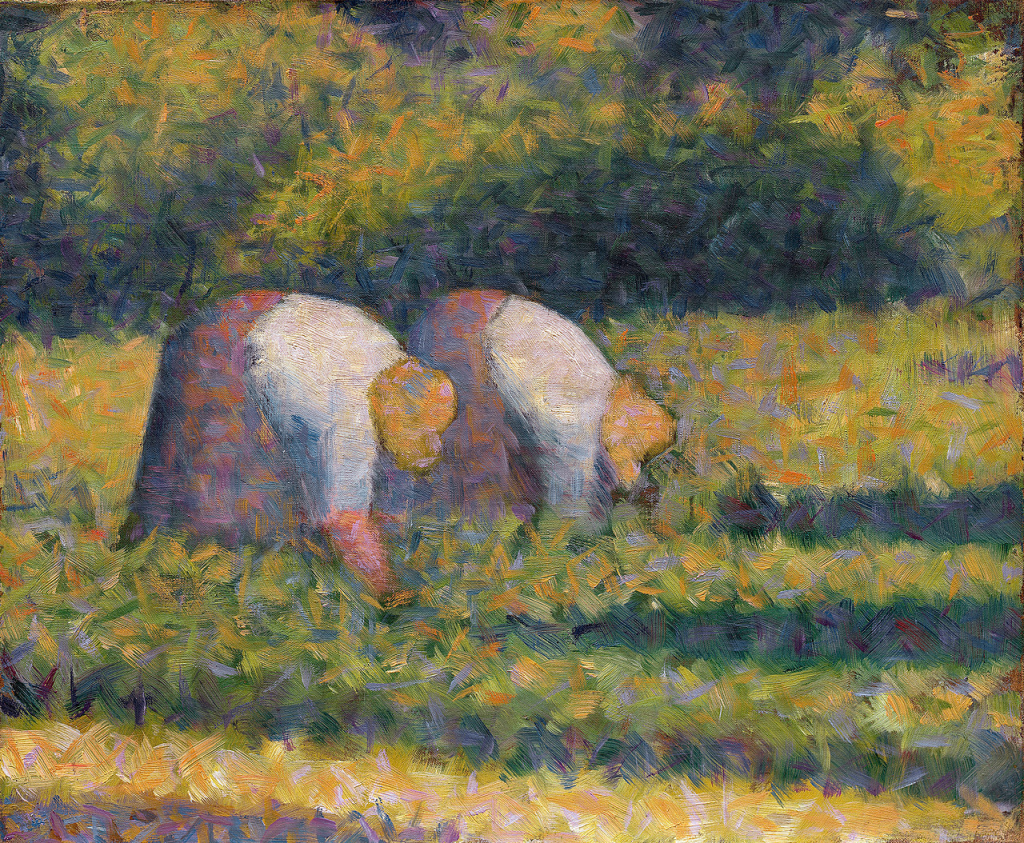
Farm Women at Work, by Georges Seurat (1859-1891)

Do not boast about tomorrow,
    for you do not know what a day may bring.

Let someone else praise you, and not your own mouth;
    an outsider, and not your own lips.

Stone is heavy and sand a burden,
    but a fool’s provocation is heavier than both.

Anger is cruel and fury overwhelming,
    but who can stand before jealousy?

Better is open rebuke
    than hidden love.

Wounds from a friend can be trusted,
    but an enemy multiplies kisses.

One who is full loathes honey from the comb,
    but to the hungry even what is bitter tastes sweet.

Like a bird that flees its nest
    is anyone who flees from home.

Perfume and incense bring joy to the heart,
    and the pleasantness of a friend
    springs from their heartfelt advice.

Do not forsake your friend or a friend of your family,
    and do not go to your relative’s house when disaster strikes you—
    better a neighbor nearby than a relative far away.

Be wise, my son, and bring joy to my heart;
    then I can answer anyone who treats me with contempt.

The prudent see danger and take refuge,
    but the simple keep going and pay the penalty.

Take the garment of one who puts up security for a stranger;
    hold it in pledge if it is done for an outsider.

If anyone loudly blesses their neighbor early in the morning,
    it will be taken as a curse.

A quarrelsome wife is like the dripping
    of a leaky roof in a rainstorm;
restraining her is like restraining the wind
    or grasping oil with the hand.

As iron sharpens iron,
    so one person sharpens another.

The one who guards a fig tree will eat its fruit,
    and whoever protects their master will be honored.

As water reflects the face,
    so one’s life reflects the heart.

Death and Destruction are never satisfied,
    and neither are human eyes.

The crucible for silver and the furnace for gold,
    but people are tested by their praise.

Though you grind a fool in a mortar,
    grinding them like grain with a pestle,
    you will not remove their folly from them.

Be sure you know the condition of your flocks,
    give careful attention to your herds;
for riches do not endure forever,
    and a crown is not secure for all generations.
When the hay is removed and new growth appears
    and the grass from the hills is gathered in,
the lambs will provide you with clothing,
    and the goats with the price of a field.
You will have plenty of goats’ milk to feed your family
    and to nourish your female servants. (New International Version)

Hard Work

The Lord God took the man and put him in the Garden of Eden to work it and take care of it. (Genesis 2:15, NIV)

Work itself is not a result of humanity’s fall. Before Adam and Eve disobeyed God, they were tasked to work and take care of the Garden of Eden. Therefore, work is inherently good. Yet, hard labor is certainly a result of the fall.

What we humans ought to have done through our created nature, now because of the fall into sin and disobedience, we have to work with focused deliberate intention. And even then, we often don’t perform our work as we would like.

“Cursed is the ground because of you;
    through painful toil you will eat food from it
    all the days of your life.
It will produce thorns and thistles for you,
    and you will eat the plants of the field.
By the sweat of your brow
    you will eat your food
until you return to the ground,
    since from it you were taken;
for dust you are
    and to dust you will return.” (Genesis 3:17-19, NIV)

This is why wise persons throughout the ages have given priority to hard work, and branded laziness as detrimental to our human welfare.

Much of our labor is menial and mundane, no matter what the work is. Yet, through vision and persistence, the fruit of our labor eventually breaks through. It is important for us to keep our nose to the grindstone, namely, because this is what it takes to produce, and to keep ourselves out of trouble!

Like a shepherd who cares for the sheep, we are to be present, pay attention, do whatever it takes to help the sheep flourish, and hang in there through the thick and thin of the job.

Diligence and consistency are vital to our hard work. The temptation of get-rich-quick schemes and other supposedly easy paths to success and wealth sometimes rear their heads to lure us away from our daily chores.

Well-kept sheep will produce wool and milk for several years. Riches and achievements and accolades, however, do not necessarily last for long.

Affectionate Love

Hard work and relationships nurtured by affectionate love are meant to go hand-in-hand. In other words, ideally, the duty and diligence of our daily tasks, and the consistency of establishing relational well-being with others, is well-balanced and works seamlessly together.

Loving another entails both encouragement and correction, heartfelt words as well as open words of rebuke. That is, we continually think of what another needs, and what is best for the community as a whole.

Our love must entail what is good for the one being loved, for the one doing the loving, and for the whole community to which both belong. Love leaves angry speeches and jealous motives behind and doesn’t utilize them, because they are tools of hate and hurt.

Gracious Dignity

Everyone is responsible to extend basic human kindness to one another, without exception. We are to listen to and honor our parents and elders; practice self-control and patience with all; and use gentle words in every communication.

Poise under pressure, and motivation to do what is right and good helps to lift the worth and dignity of others. We extend this to people for no other reason than that it is another human being who is in front of us; this is a person in God’s image.

God created mankind in his own image,
    in the image of God he created them;
    male and female he created them. (Genesis 1:27, NIV)

All persons have inherent worth as image-bearers of God. The wise person amongst us knows this and continually applies it in all their words and actions toward others.

Wise people also understand the value of hard work, and the intrinsic worth of work itself. Furthermore, they discern that love is to be the motivation and animating principle in doing work and working with others.

The bottom line of all the proverbial wise saying in today’s lesson is that we are to help and encourage others through both our words and our working actions. Our individual lives are to benefit the whole community, so that we are a blessing to others, as well as to receive blessings from those around us.

In engaging a healthy rhythm of giving and receiving, we reverse the curse, and enable the world to return to Eden.

Almighty God, we pray that You will bless all of our various labor and work in the world. Help us to pray fervently, diligently work hard, and give liberally. In all that we do, enable us to do it with all the love You provide. Amen.