Deuteronomy 11:1-17 – Knowing Our Boundaries

Love the Lord your God and follow his instruction, his regulations, his case laws, and his commandments always. And know right now what your children haven’t known or yet witnessed:

  • The Lord your God’s discipline, his power, his mighty hand and outstretched arm.
  • The signs and the acts that he performed in the heart of Egyptian territory, against Egypt’s King Pharaoh and all his land.
  • What God did to the Egyptian army, to its horses and chariots—how he made the water of the Reed Sea flow over their heads when they chased after you, but the Lord destroyed them, and that’s how things stand right now.
  • What the Lord did for you in the desert, until you arrived at this place.
  • And what he did to Dathan and Abiram, the descendants of Eliab the Reubenite, when the ground opened its mouth and swallowed them, their families, their tents, and every living thing they possessed in the presence of all Israel.

Your own eyes witnessed each of these powerful acts the Lord performed. So, keep every part of the commandment that I am giving you today so that you stay strong to enter and take possession of the land that you are crossing over to possess, and so that you might prolong your life on the fertile land that the Lord swore to your ancestors to give to them and their descendants—a land full of milk and honey.

The land you are about to enter and possess is not like the land of Egypt, where you came from, where you sowed your seed and irrigated it by hand like a vegetable garden. No, the land you are entering to possess is a land of hills and valleys, where your drinking water will be rain from heaven. It’s a land that the Lord cares for: The Lord’s eyes are on it constantly from the first of the year until the very end of the year.

Now, if you completely obey God’s commandments that I am giving you right now, by loving the Lord your God and by serving him with all your heart and all your being, then he will provide rain for your land at the right time—early rain and late rain—so you can stock up your grain, wine, and oil. He will also make your fields lush for your livestock, and you will eat and be satisfied. But watch yourselves! Otherwise, your heart might be led astray so you stray away, serving other gods and worshipping them. Then the Lord’s anger would burn against you. He will close the sky up tight. There won’t be any rain, and the ground won’t yield any of its crops. You will quickly disappear off the wonderful land the Lord is giving to you. (Common English Bible)

“Boundaries define us. They define what is me and what is not me. A boundary shows me where I end and someone else begins, leading me to a sense of ownership. Knowing what I am to own and take responsibility for gives me freedom. Taking responsibility for my life opens up many different options. Boundaries help us keep the good in and the bad out.”

Henry Cloud

God has boundaries. The Lord doesn’t just flit about doing whatever seems alright for the moment. No, God is firmly secure as the divine Being. God has a deliberate will and way. The Creator God is not okay with created humanity having no boundaries. Since we are people created in God’s image, we are to reflect that image in all things, including having the established boundary of taking charge of our own spiritual lives and obeying the Lord in all things.

God has opened the way of redemption for wayward people. It came first in the incredible event of the exodus from Egypt, then in the culmination of our freedom through the cross and resurrection of Jesus Christ. 

Therefore, God expects us to live into this opportunity without blaming divine action or inaction for our problems, as if fault lies outside of us. Just because God stands up to people and does not cave into their demands and their whining does not make the Lord mean or unjust – it simply means God doesn’t need the props or accolades of people. God is secure enough to not be dependent on humans.

Divine expectations are quite clear on where the boundary lines fall: Love. Yes, indeed, it comes down to love. Love the Lord your God and always hold tightly to the law with its statutes, rules, and commandments. There is no fudge factor to that statement, scratching our heads wondering what we ought to be doing. If we obey God, we will discover life as it ought to be lived – free from all the machinations of the world’s brokenness and insecurity – and yet securely confined within godly boundaries. 

God can exhort people to be strong and take the land. That’s because the Lord made it possible for them to do so by acting in history. Therefore, God expects us to respond in obedience to the boundary lines established so that we will flourish and grow as people in a new land.

There is a big divine pasture for us to enjoy and thrive within. Yes, there is a fence around it, marking the boundary of where we can go. It is there for our benefit and protection, and not to simply keep us in line. Longing for the green grass on the other side of the fence is to be unaware of the vast beauty and foliage all around us.

For we already have everything we need – if we possess the awareness and the gratitude to see it.

Great God Almighty, I choose today to obey you in all things out of the grace given to me because of Jesus Christ.  I want to please you in all I say and do, so that you will be seen as the glorious and exalted king of the universe.  Help me to live up to my standing in Christ in the power of the Spirit as I step into your world with the keys of the kingdom.  Amen.

1 Timothy 6:11-12 – How to Fight the Good Fight

But you, Timothy, are a man of God; so, run from all these evil things [the love of money]. Pursue righteousness and a godly life, along with faith, love, perseverance, and gentleness. Fight the good fight for the true faith. Hold tightly to the eternal life to which God has called you, which you have declared so well before many witnesses. (New Living Translation)

Today’s New Testament lesson is a pertinent message for contemporary Christians. These verses come as the conclusion to the Apostle Paul’s letter to a young pastor in Ephesus, Timothy. The epistle is filled with encouragements, exhortations, and warnings of how to go about conducting ministry. 

Paul left Timothy with some pointed instruction to pursue righteousness, godliness, faith, love, steadfastness, and gentleness. These are the qualities which ought to inform every practice in the church and the Christian life. 

The Apostle gave Timothy a sacred trust, to hold tightly and guard the message of faith in Christ given to him. This good news of forgiveness and grace leading to eternal life through Jesus must be continually upheld. Because there will always be other individuals and groups distorting and diluting this wondrous salvation.

Two Exhortations

These two exhortations – pursuit of a godly life and grabbing hold of Christian good news – needs to be always held together. To only pursue virtuous practices apart from grasping the message will cause slow erosion and compromise the faith entrusted to us. To only embrace the gospel without trying our best to live a virtuous life will lead to ornery and combative attitudes, as well as behavior which undermines the very gospel we seek to uphold.

So, then, competing in the arena of spiritual warfare is useless without knowing why we are in that arena to begin with. We are striving for the hearts, minds, and souls of people who need the life-giving message of God’s grace in Jesus Christ. We are to carefully apply the poultice of grace to the incredible need of the world’s people, using all the virtues of righteousness and godliness at our disposal. 

Badgering, bullying, and bludgeoning people with the truth are unbiblical because it ignores the virtuous practices integral to our faith. On the other hand, loving others without careful proclamation of the gospel misses a central thrust of Paul’s letter to Timothy.

Ensure you are putting your energy into the right things. Uphold the faith delivered to us through sacred Scripture. Use love and gentleness in everything said and done. Seek after righteousness and godliness. Clutch eternal life and hold it tightly. With both hands, uphold the sanctity of the Christian message through the sacredness of holy living. We are to pursue the following:

Righteousness and Godliness

Being right with God comes through the justifying work of Jesus. This right standing then is to work out itself in practical daily living. We are to strive toward having right relationships with others.

Once you’re convinced that Christ is right and righteous, you’ll recognize that all who practice righteousness are God’s true children. (1 John 2:29, MSG)

Desire first and foremost God’s kingdom and God’s righteousness. (Matthew 6:33, CEB)

Like righteousness, godliness is given to us so that we are viewed as godly. Yet, living a godly life is a skill which requires much training. Since God is One and Love, so we are to work at unity and loving others with the divine power given to us.

By his divine power, God has given us everything we need for living a godly life. We have received all of this by coming to know him, the one who called us to himself by means of his marvelous glory and excellence. (2 Peter 1:3, NLT)

Train yourself in godliness, for, while physical training is of some value, godliness is valuable in every way, holding promise for both the present life and the life to come. (1 Timothy 4:7-8, NRSV)

Faith and Love

Faith is also a gift of God. Once given, we are to hold onto it, lean into it, and rely on it throughout our lives. We pursue our faith through being above board on all things and listening to our inward conscience, even and especially when outward circumstances are troublesome.

Love is the actionable means of meeting another’s needs. Armed with a robust faith in God, we are to confidently love the world, knowing the Lord has our back.

Cling to your faith in Christ and keep your conscience clear. For some people have deliberately violated their consciences; as a result, their faith has been shipwrecked. (1 Timothy 1:19, NLT)

What you heard from me, keep as the pattern of sound teaching, with faith and love in Christ Jesus. Guard the good deposit that was entrusted to you—guard it with the help of the Holy Spirit who lives in us. (2 Timothy 1:13-14, NIV)

Perseverance and Gentleness

We contend for the faith delivered to us by having the long view of Christianity and the Christian life. A daily walk of faith is rarely glamourous. The growth of our spirits and the construction of our souls is tedious and patient work. It requires a great deal of endurance.

Do not throw away your confidence; it will be richly rewarded.

You need to persevere so that when you have done the will of God, you will receive what he has promised. For,

“In just a little while,
    he who is coming will come
    and will not delay.”

And “But my righteous one will live by faith. (Hebrews 10:35-38, NIV)

The practical working of perseverance in one’s life is marked by gentleness. When we take the long view, we can be gentle, not rushing or hurrying people to be godly beyond their own personal growth capacity.

Let your gentleness show in your treatment of all people. The Lord is near. (Philippians 4:5, CEB)

Holding tight to the gospel message is a very practical affair. It isn’t an abstract doctrinal or dogmatic defense but a righteous, godly, believing, loving, enduring, and gentle application of truth in daily life.

King Jesus, Lord of all, help me to keep your commandments in ways consistent with the gospel of grace so that your church is encouraged, and your world is blessed with both the message and the medium. Amen.

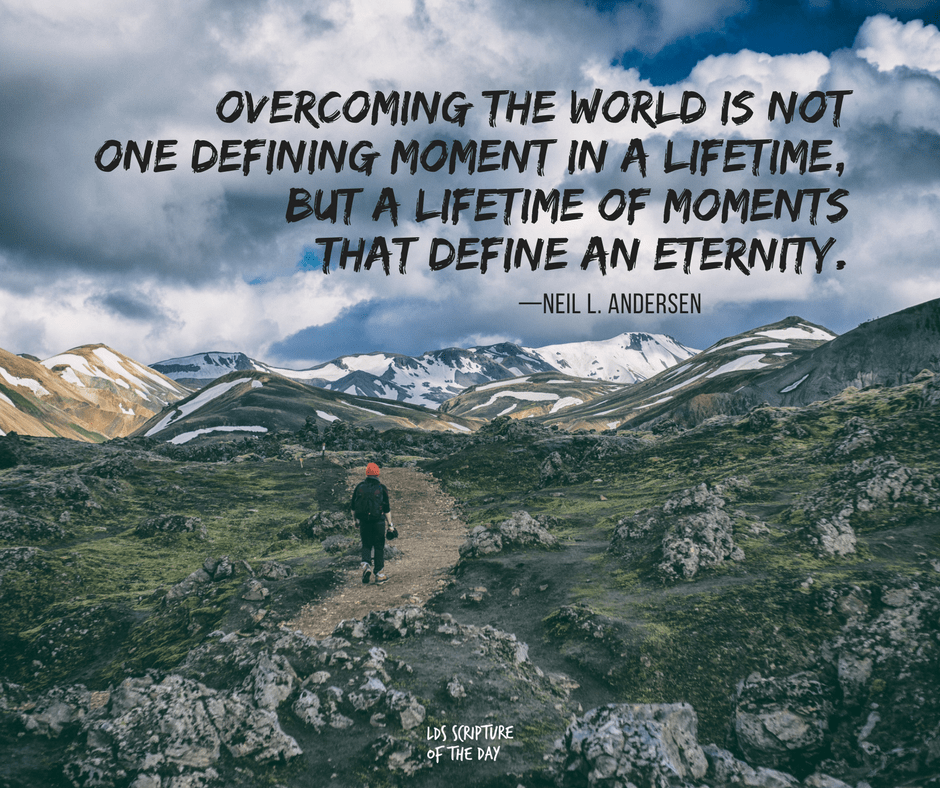
Overcoming the World

Everyone who believes that Jesus is the Christ is born of God, and everyone who loves the father loves his child as well. This is how we know that we love the children of God: by loving God and obeying his commands. In fact, this is love for God: to keep his commands. And his commands are not burdensome, for everyone born of God overcomes the world. This is the victory that has overcome the world, even our faith. Who is it that overcomes the world? Only the one who believes that Jesus is the Son of God. This is the one who came by water and blood—Jesus Christ. He did not come by water only, but by water and blood. And it is the Spirit who testifies because the Spirit is the truth. (1 John 5:1-6, NIV)

Faith, love, and obedience are tightly woven together to such an extent that to pull one of them out is to unravel the whole bunch. These three characteristics of the true Christian are vital and necessary to living the Christian life. They all must be present for the church to overcome the world.

The main verbs throughout the verses are the word “is.” And the verb tense is key. The verb clearly describes a past action of God which we as people need to receive. In other words, the grammar dictates that God has given us new birth.  We do not give ourselves spiritual birth any more than we can tell our mothers that it was us who gave birth to ourselves.

God saves us from sin and grants us forgiveness. This action is from God. We are recipients of God’s good grace toward us. There are three participles connected to this main verb:

  1. Believe
  2. Love
  3. Obey

A participle is a word which is connected to the verb’s action. So then, our actions are a result of God’s action toward us. To put it simply, a person born from God will believe, love, and obey. Just as a newborn baby first breathes, then learns to eat, sleeps, grows-up, learns to walk, and over time develops into an adult just like their mother and father, so the Christian who is born again from God exhibits faith, learns to love, and grows up developing the skills of obeying Jesus and following him, learning to walk in his ways, becoming just like him.

In the same way a child must learn and grow to have the necessary skills for facing the world in all its bigness, trials, and temptations, so the Christian must develop the abilities necessary to overcome the world. Those skills are faith, love, and obedience. Without them, we will be unable to deal with the world. But with them, we experience victory over the world.

The word, “overcome,” is a cognate word (related to) of “victory.”  That is, to overcome is to have firsthand exposure to the victory the Lord Jesus has achieved on the cross. Through being spiritually born again by God, we are set on a course requiring faith, love, and obedience to overcome the world. As we learn to apply these three spiritual characteristics to our lives, we experience practical victory over the world.

The term “world” are the patterns, systems, and operations of the world in direct contrast to how God operates. For example:

  • The world engages in revenge and payback when wronged, whereas the Christian learns to believe God as the Judge, loves the person who has offended them through prayer for their enemy, and obeys God through good works that seeks the welfare of the other. 
  • The world uses other people as either objects of their pleasure or to get ahead in life, whereas the Christian believes God will take care of their needs, will seek to love the other person instead of use them, and would rather obey God than be selfish. 
  • The world thinks nothing of lying, cheating, and stealing, if they can get away with it, whereas the Christian believes Jesus is the way, the truth, and the life, loves being a person of integrity, and obeys God even when it hurts.

This in no way means we avoid or belittle the world. In facing and overcoming the world, we need principled civility. Using faith, love, and obedience, we respect another’s viewpoint through growing in faith, expanding our hearts in love, and learning obedience through interaction with others for whom we disagree.

Where do we feel “the pull” in life from? Do we feel it from the world, or from God’s Word? We must learn how to deal with the worldly elements of our society in which we feel a pull and a tug to go along with it and want to give in to it. This requires a community of Christians engaging the world through faith, love, and obedience to overcome that pull.

Our call as Christians is not to just survive the world. If anyone could have had that kind of mentality, it was Helen Keller. Deaf, mute, and blind, she could have settled into just getting by and waiting for heaven. Yet, she accepted her situation, coped with it, and even transcended her limitations.  She did more than survive – she thrived. Helen Keller once said:

“The marvelous richness of human experience would lose something of rewarding joy if there were not limitations to overcome. The mountaintop would not be half so wonderful if there were no dark valleys to traverse.”

Helen Keller

We need faith in God, not ourselves. The Scripture says:

Trust in the Lord with all your heart,
    and do not rely on your own insight.
In all your ways acknowledge him,
    and he will make straight your paths. (Proverbs 3:5-6, NRSV)

We need to love God and others, and not the world. The Scripture says:

Don’t love the world’s ways. Don’t love the world’s goods. Love of the world squeezes out love for the Father. Practically everything that goes on in the world—wanting your own way, wanting everything for yourself, wanting to appear important—has nothing to do with the Father. It just isolates you from him. The world and all its wanting, wanting, wanting is on the way out—but whoever does what God wants is set for eternity. (1 John 2:15-17, MSG)

We need to obey the call of God, not the call of the world. Hear what Scripture says: 

The commandment that God has given us is: “Love God and love each other!” (1 John 4:21, CEV)

When faith, love, and obedience are working together as they were intended to, we will overcome the world and all its crud. We will keep ourselves from being polluted and stained by it.

Overcoming the world is a high calling from God. Faith means putting aside fear and taking the kind of risk God wants you to take. Love means putting aside hate and serving others, even when it hurts. Obedience means putting aside selfishness and choosing to do what is best for another person’s welfare. Being characterized by these three Christian virtues will have the effect of overcoming the world. It is not a burdensome or heavy way to live. It’s the way of Jesus.

Blessed Father, Son, and Holy Spirit, the God whom we serve: Sometimes our hearts and minds are flooded with fears. Sometimes we are paralyzed and overwhelmed and feel unable to go on. Yet today we hold onto the victory you have accomplished through the blood of Jesus Christ. You have told us not to fear, for you have overcome the world. So, we cling to you, believing your Word and your promises. In moments of crippling fear, we choose to hold your hand and believe; to love as we have been loved; and, to obey even in the most fearful places because we know that you have risen again.

Loving Lord Jesus, we surrender to you all that we are and hope to be. Holy Spirit, we invite you and all your ministry within us. Holy God of all, we offer you our heart, mind, body, soul, spirit, hopes, plans and dreams. We surrender to you our past, present and future problems, habits, character defects, attitudes, livelihood, resources, finances, medical coverage, occupation and all relationships. We give you our health, physical appearance, disabilities, family, marriage, children, grandchildren, and friendships.

We ask for your Lordship over every aspect of our lives. We surrender to you all our hurt, pain, worry, doubt, fear and anxiety, and ask you to wash us clean. We release everything into your compassionate care. Speak to us clearly, Lord. Open our ears to hear your voice. Open our hearts to commune with you more deeply. Open the doors that need to be opened and close the doors that need to be closed. Set our feet upon the straight and narrow road that leads to everlasting life. Amen.

John 14:18-31 – I Will Come

16th century depiction of the Last Supper

I will not leave you as orphans; I will come to you. Before long, the world will not see me anymore, but you will see me. Because I live, you also will live. On that day you will realize that I am in my Father, and you are in me, and I am in you. Whoever has my commands and keeps them is the one who loves me. The one who loves me will be loved by my Father, and I too will love them and show myself to them.”

Then Judas (not Judas Iscariot) said, “But, Lord, why do you intend to show yourself to us and not to the world?”

Jesus replied, “Anyone who loves me will obey my teaching. My Father will love them, and we will come to them and make our home with them. Anyone who does not love me will not obey my teaching. These words you hear are not my own; they belong to the Father who sent me.

“All this I have spoken while still with you. But the Advocate, the Holy Spirit, whom the Father will send in my name, will teach you all things and will remind you of everything I have said to you. Peace I leave with you; my peace I give you. I do not give to you as the world gives. Do not let your hearts be troubled and do not be afraid.

“You heard me say, ‘I am going away and I am coming back to you.’ If you loved me, you would be glad that I am going to the Father, for the Father is greater than I. I have told you now before it happens, so that when it does happen you will believe. I will not say much more to you, for the prince of this world is coming. He has no hold over me, but he comes so that the world may learn that I love the Father and do exactly what my Father has commanded me. Come now; let us leave.” (New International Version)

Grief Amongst the Disciples

“He’s leaving!? What!? Huh!?” Although Jesus had tried to prepare the disciples for his impending cross and resurrection, they didn’t quite catch on. It was in the Upper Room, in their final meal together, that Jesus made it plain he was leaving – going back to the Father. (John 14:1-17)

There was both confusion and distress amongst the men. Anticipatory grief had suddenly smacked them like a golf club upside the head. Dizzied and dazed with thoughts their Lord would no longer be with them, Jesus then sought to assure them that this would be temporary. He is coming, again. In fact, they will experience more than one.

Christ is Coming Again, and Again

Three comings were to be realized:

  • Rising from death and appearing to the disciples.
  • Sending the Spirit as the continuing presence of Christ on earth.
  • Returning at the end of the age to judge the living and the dead.

Jesus was caring for his followers, including us, by providing future hope.

That is just what happened with the first two comings. Christians everywhere celebrate the rising of Christ from death, his ascension into heaven, and the giving of the Holy Spirit at Pentecost. The Christian tradition holds that the Spirit – the Paraclete, Advocate, Comforter, and Counselor – is now presently with us.

Although the world no longer sees Jesus, believers see him with eyes of faith, hope, and love. Christians intuitively perceive another spiritual dimension in which Christ is beside them in the person of God’s Spirit. Some things can’t be intellectually explained. They just are.

Meanwhile, while Christians everywhere await the return of Christ to this earth, they are busy loving their Lord through obedience to his commands. And his command is to love one another as he loved them. Love and obedience go hand in hand. To know the love of God in Christ is to willingly give oneself to obey such a merciful Being.

The Spirit’s Help

We are not left alone to fumble around on this earth, trying to love in our own strength or ability. The Spirit is present, helping us to do loving work. There is real spiritual assistance in applying Christ’s teaching to the practical aspects of life in the here-and-now. Such constructive down-to-earth support gives Christians a sense of peace and integrity of living.

“I am leaving you with a gift—peace of mind and heart. And the peace I give is a gift the world cannot give. So don’t be troubled or afraid.”

Jesus (John 14:27, NLT)

Unlike worldly peace, which typically uses war to try and end war, has merely the absence of conflict as its goal. However, the peace of Christ is intensely personal. It is his very own peace. Through Christ’s suffering and death, he absorbed in himself the malice and hatred of others and introduced peace – a new harmony through love.

The profound absence of love, the rebellion of humanity against concern for the common good of all, and the shame of selfishness that damns the world is overthrown by the obedience and self-sacrifice of Jesus. The world will learn this – either by discovering the love of Christ now or, at the end of the age, with the return of Christ.

Jesus has come, is here, and will come again. These comings are for us and for our deliverance from all that is unjust and broken in this world. We are not alone. There is ever-present help. This is the basis of the Christian’s confidence.

Come, Holy Spirit, and fill the hearts of your faithful with divine love. Come as the wind that blows, come as the fire that refines, come as the dew that refreshes. Convict, convert and consecrate us until we are wholly yours, through Jesus Christ, our Lord. Amen.