Song of Songs 5:2-6:3 – I Am My Beloved’s

Song of Songs by German illustrator Egon Tschirch, 1923

Beloved

I was asleep, but my heart was awake.
    It is the voice of my beloved who knocks:
    “Open to me, my sister, my love, my dove, my undefiled;
    for my head is filled with dew,
    and my hair with the dampness of the night.”
I have taken off my robe. Indeed, must I put it on?
    I have washed my feet. Indeed, must I soil them?
My beloved thrust his hand in through the latch opening.
    My heart pounded for him.
I rose up to open for my beloved.
    My hands dripped with myrrh,
    my fingers with liquid myrrh,
    on the handles of the lock.
I opened to my beloved;
    but my beloved left, and had gone away.
My heart went out when he spoke.
    I looked for him, but I didn’t find him.
    I called him, but he didn’t answer.
The watchmen who go about the city found me.
    They beat me.
    They bruised me.
    The keepers of the walls took my cloak away from me.

I adjure you, daughters of Jerusalem,
    If you find my beloved,
    that you tell him that I am faint with love.

Friends

How is your beloved better than another beloved,
    you fairest among women?
How is your beloved better than another beloved,
that you do so adjure us?

Beloved

My beloved is white and ruddy.
    The best among ten thousand.
His head is like the purest gold.
    His hair is bushy, black as a raven.
His eyes are like doves beside the water brooks,
    washed with milk, mounted like jewels.
His cheeks are like a bed of spices with towers of perfumes.
    His lips are like lilies, dropping liquid myrrh.
His hands are like rings of gold set with beryl.
    His body is like ivory work overlaid with sapphires.
His legs are like pillars of marble set on sockets of fine gold.
    His appearance is like Lebanon, excellent as the cedars.
His mouth is sweetness;
    yes, he is altogether lovely.
This is my beloved, and this is my friend,
    daughters of Jerusalem.

Friends

Where has your beloved gone, you fairest among women?
    Where has your beloved turned, that we may seek him with you?

Beloved

My beloved has gone down to his garden,
    to the beds of spices,
    to pasture his flock in the gardens, and to gather lilies.
I am my beloved’s, and my beloved is mine.
    He browses among the lilies. (World English Bible)

God is love. God rejoices over you. 

There is a reason why so many people in this cruel and calloused world are unloving and unkind: They are unaware that God loves them. 

If we neither believe nor know God’s infinite love for us, then our words and our actions will reflect more of hate than love. God really truly does love you and me. This is crucial. Do not forget this. Believe it. Live it. Enjoy it. Know it. Tell it to yourself until you are thoroughly bathed in it, because it is more wonderful than any ‘70’s sappy love song could ever describe it.

I believe the small book of Solomon’s Song of Songs too often gets a weird hermeneutical spin of literalism from modern-minded simpletons. For nearly all of history, this poetic ode to love was understood as an allegory of divine love for humanity – and the believer’s reciprocal response.

When the beautiful text of Scripture says I am my beloved’s and my beloved is mine, and that his desire is for me, it is a wonderful way of communicating that God’s love for us is not abstract, distant, or detached. (Song of Songs 6:3, 7:10) 

The truth is: We belong to God. The Lord’s desire is for you and me. God has an intense and overpowering longing for you. Let the deep desire of God for you shape and form your thoughts so that fear is replaced with faith; loneliness with enjoyment; the fickle nature of others with satisfaction; praying as duty with praying because I want to be with the God who loves me so much.

Oh, how we need a vision of God singing over us with joy! Yes, God loves you that much! Grab a hold of what the prophet says:

The Lord will take delight in you with gladness.
    With his love, he will calm all your fears.
    He will rejoice over you with joyful songs.

Zephaniah 3:17, NLT

Even the most unlovely of people are made lovely through God’s persistent and pursuing love for them. You are being wholly seen every single day by the infinite gaze and eternal compassion of God, who watches our every step with delight.

Christianity does not “happen” simply by knowing some beliefs about God, as if it is a mere contractual signing-off on a doctrinal statement. Rather, Christianity “happens” when individuals experience the white hot burning love of God in Jesus Christ. 

Jesus came not only for those who skip church and only occasionally read their Bibles. Christ came also for the hard-hearted prick, the immoral adulterer, the strung-out addict, the terrorist, the murderer, and for all those caught in bad choices and failed relationships. 

“I have not come to call respectable people, but outcasts.” (Matthew 9:13, GNT)

“Go out and train everyone you meet, far and near, in this way of life.” (Matthew 28:19, MSG)

“You will be witnesses for me.” (Acts 1:8, GNT)

“Love each other in the same way that I have loved you.” (John 13:34, GW)

All Christ’s words and actions are because of the Lord’s intense desire to love the world, and to love it through the divine beloved people of God.

God’s love is never based on our performance, or how good we look to others; it is never conditioned by our moods. The love of God only looks longingly at you and me with the potential of what we can become in Christ and cares for us as we are. It is a world-altering revolutionary thought that God loves me as I am and not as I should be. 

God loves me as I am, and not as I should be.

God has shown us how much he loves us—it was while we were still sinners that Christ died for us! (Romans 5:8, GNT)

Despite the erosion of church attendance, the majority of people still believe God exists. Conversely, however, many people do not believe God really loves them. We are in a crisis of love. People need to know the God who is pure Love. 

Christianity never begins with what we do for God to make ourselves lovely. Christianity always starts with what God has done for us, the great and wonderful love that exists for us in Christ Jesus.

It wasn’t so long ago that we ourselves were stupid and stubborn, easy marks for sin, ordered every which way by our glands, going around with a chip on our shoulder, hated and hating back. But when God, our kind and loving Savior God, stepped in, he saved us from all that. It was all his doing; we had nothing to do with it. He gave us a good bath, and we came out of it new people, washed inside and out by the Holy Spirit. Our Savior Jesus poured out new life so generously. God’s gift has restored our relationship with him and given us back our lives. And there’s more life to come—an eternity of life! You can count on this. (Titus 3:3-8, MSG)

All the wrong turns in the past, the mistakes and the moral lapses, everything that is ugly or painful, all melts in the light of God’s acceptance and love for us.

If the consuming passion of Christ’s followers is not showing God’s love, then we have lost both our mission and our first love of Jesus. Perhaps we must let time evaporate, as we bow at the foot of the cross, and experientially know the great love of God in Christ for us and for the world.

May it be so, to the glory of God.

Ephesians 5:21–6:9 – Submit to One Another

Submit to one another out of reverence for Christ.

Wives, submit yourselves to your own husbands as you do to the Lord. For the husband is the head of the wife as Christ is the head of the church, his body, of which he is the Savior. Now as the church submits to Christ, so also wives should submit to their husbands in everything.

Husbands, love your wives, just as Christ loved the church and gave himself up for herto make her holy, cleansing her by the washing with water through the word, and to present her to himself as a radiant church, without stain or wrinkle or any other blemish, but holy and blameless. In this same way, husbands ought to love their wives as their own bodies. He who loves his wife loves himself. After all, no one ever hated their own body, but they feed and care for their body, just as Christ does the church— for we are members of his body. “For this reason, a man will leave his father and mother and be united to his wife, and the two will become one flesh.” This is a profound mystery—but I am talking about Christ and the church. However, each one of you also must love his wife as he loves himself, and the wife must respect her husband.

Children, obey your parents in the Lord, for this is right. “Honor your father and mother”—which is the first commandment with a promise— “so that it may go well with you and that you may enjoy long life on the earth.”

Fathers do not exasperate your children; instead, bring them up in the training and instruction of the Lord.

Slaves, obey your earthly masters with respect and fear, and with sincerity of heart, just as you would obey Christ. Obey them not only to win their favor when their eye is on you, but as slaves of Christ, doing the will of God from your heart. Serve wholeheartedly, as if you were serving the Lord, not people, because you know that the Lord will reward each one for whatever good they do, whether they are slave or free.

And masters, treat your slaves in the same way. Do not threaten them, since you know that he who is both their Master and yours is in heaven, and there is no favoritism with him. (New International Version)

Submission – the word itself may stir a less than positive reaction within us.

For many people, submission implies someone else is going to have authority over me – and they might not like that. To submit to another person smacks of being forced into something we don’t want, like some mixed-martial-arts submission hold where the other person taps out.

It doesn’t help when many people have past experiences in which individuals in authority neither liked them nor treated them with respect. Their visceral reaction to the word “submit” is very raw and real.

Biblically, within the first pages of Genesis, the disobedience of Adam and Eve resulted not only in a separation between God and people, but also between man and woman. The Fall had terrible consequences for them. The entire world now lives under a curse. Relations between the sexes, because of the Fall and the curse, are twisted.

To the woman, God said,

“I will make your pains in childbearing very severe;
    with painful labor you will give birth to children.
Your desire will be for your husband,
    and he will rule over you.” (Genesis 3:16, NIV)

The phrase “your desire will be for your husband” is a Hebrew idiom (a metaphorical phrase with a special meaning). This refers to women’s urge for independence from men. 

“He will rule over you” is also a Hebrew idiom, referring to man putting woman “under his thumb” (an American idiom). 

Women, in their fallen state, work to be independent from men. They diligently try and function without them. 

Men, in their fallen state, bring a “heavy hand” (another American idiom) to women by insisting on always “calling the shots” (yet another idiom) and dismissing females as if what she has to say or think doesn’t matter, or at least doesn’t “carry much weight” (idiom again!) as a man’s words do.

The way gender relations, in the Christian tradition, are supposed to happen is based in who God is:

  • The Son (Jesus) submits to the Father by placing himself under authority. The Father, in turn, lifts up the Son to share in reigning with him in the kingdom of God.
  • The Church submits to Christ, and Christ, in turn, lifts up the Church so that she reigns with him in the kingdom of God.
  • The wife submits to husband, and he, in turn, lifts her up so that she reigns with him in the kingdom of God.

This is mutual submission – and not a matter of the boss and the bossed.

To submit simply means we willingly place ourselves under authority – the choice is with us. Forced submission is slavery and oppression – not true submission.  

To function without submitting to one another brings disorder and chaos, keeping the curse going into generation after generation. Christians, however, are to reverse the curse.

“God has bound us together in such a way that none of us should reject submission. Where love reigns, this spirit of service is mutual….  Since there is nothing more opposed to the human spirit than the desire to submit to others, Paul calls us to it by reminding us of the reverence we owe to Christ. He is the only one who can tame our rebellious spirit and subdue our pride, so that we are willing to serve our neighbors.”

John Calvin

It is important to understand how the grammar of today’s New Testament lesson is set up, because if we don’t get this, we will not practice submission well.

The main verb of the section is “be filled” with the Spirit (Ephesians 5:18). There are five participles which explain how the action of the main verb is to be done. Submitting is one of those participles. Submitting to one another is everyone’s responsibility.

Submission is a spiritual practice. The following people and relationships are mentioned (Note: these were intended by the Apostle Paul to be a representative list, not an exhaustive list):

  • Wives to husbands (respect)
  • Husbands to wives (sacrificial love) The head and body metaphor is meant to convey intimacy, union, and relationship, not any kind of silliness in husbands doing all the brain work and making all the decisions. Spouses are two people in one, just as the Father and Son are two in one. You cannot have two independent persons doing their own thing, any more than a head and body can operate independently.
  • Children to parents (obedience)
  • Parents to children (compassionate and empathic spiritual support)
  • Slaves to masters (obedience)
  • Masters to slaves (fair and equitable treatment)

Scripturally, we do a disservice if we only focus on how husbands, children, and slaves must submit, because we are all to submit to one another, including husbands, parents, and masters. 

Christians bring order out of chaos when there is submission to one another out of reverence for Christ.

Misunderstandings and misinterpretations of today’s text typically result in one group of people trying to force authority on another group. Proper understandings will always result in practicing humble and compassionate service to each other.

Submitting to one another means we must cooperate with one another instead of competing against each other. For example, women are to respect men by not acting as autonomous persons who have no need of those stupid men. And men are to not abuse women by ignoring and dismissing them as inferior emotional beings. Instead, both sexes will volitionally choose to submit to each other and act in accord, comity, and harmony.

All believers are to function together as God’s co-heirs and God’s co-rulers in and over God’s creation. This is the good order to which God has called us, and it is a high calling for which we need the filling of God’s Spirit to help us.

Lord Jesus, we bow down and humbly bring to you our gift of submission. Thank you for submitting to the Father until the end, achieving salvation for us. Teach us the meaning of meekness, and may our wills submit to your will. Graciously remove our disobedience and pride and shape us to your will. Guide us on the road of resigning our wills to yours. Mold our souls into total divine submission. Help us to walk in the path of righteous submission to each other, hand in hand. May we be filled with the Holy Spirit so that we will completely embody a submissive and teachable spirit. Amen.

John 4:7-26 – Living Water

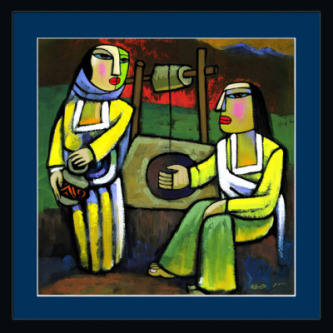
Samaritan Woman at the Well by He Qi

When a Samaritan woman came to draw water, Jesus said to her, “Will you give me a drink?” (His disciples had gone into the town to buy food.)

The Samaritan woman said to him, “You are a Jew, and I am a Samaritan woman. How can you ask me for a drink?” (For Jews do not associate with Samaritans.)

Jesus answered her, “If you knew the gift of God and who it is that asks you for a drink, you would have asked him, and he would have given you living water.”

“Sir,” the woman said, “you have nothing to draw with and the well is deep. Where can you get this living water? Are you greater than our father Jacob, who gave us the well and drank from it himself, as did also his sons and his livestock?”

Jesus answered, “Everyone who drinks this water will be thirsty again, but whoever drinks the water I give them will never thirst. Indeed, the water I give them will become in them a spring of water welling up to eternal life.”

The woman said to him, “Sir, give me this water so that I won’t get thirsty and have to keep coming here to draw water.”

He told her, “Go, call your husband and come back.”

“I have no husband,” she replied.

Jesus said to her, “You are right when you say you have no husband. The fact is, you have had five husbands, and the man you now have is not your husband. What you have just said is quite true.”

“Sir,” the woman said, “I can see that you are a prophet. Our ancestors worshiped on this mountain, but you Jews claim that the place where we must worship is in Jerusalem.”

“Woman,” Jesus replied, “believe me, a time is coming when you will worship the Father neither on this mountain nor in Jerusalem. You Samaritans worship what you do not know; we worship what we do know, for salvation is from the Jews. Yet a time is coming and has now come when the true worshipers will worship the Father in the Spirit and in truth, for they are the kind of worshipers the Father seeks. God is spirit, and his worshipers must worship in the Spirit and in truth.”

The woman said, “I know that Messiah” (called Christ) “is coming. When he comes, he will explain everything to us.”

Then Jesus declared, “I, the one speaking to you—I am he.” (New International Version)

Jesus and the Samaritan Woman by He Qi

Many years ago, I was the pastor of a small congregation north of Detroit, Michigan. Many of the people in the community viewed the big city as a place of disrepute. So, they avoided going into the heart of the great city as much as possible.

The locale of Samaria was viewed much the same way by many Jews back in Christ’s day. Samaritans were seen as untrustworthy, a mongrel people with a mix of Jewish and ancient Assyrian blood. And their religion was most suspect of all – an amalgam of Jewish and Gentile practices.

Jesus, however, didn’t avoid the territory. He confidently walked through Samaria and had no problem stopping to rest on his journey in a foreign area. That’s because Jesus didn’t class people into groups, nor did he attach adjectives to people, such as “those” Samaritans.

Jesus had no obstacles between himself and others.

Which is why an organic conversation happened between Jesus and a Samaritan woman. Christ simply saw a human being who happened to be a woman and a Samaritan. He acknowledged both her gender and her ethnicity without those being a problem. Not even Christ’s knowledge of her string of husbands was a problem in conversing with her.

Every time I read this narrative of Jesus interacting with the Samaritan woman, I wonder and use my imagination about all the non-verbal communication. I am sure the conversation was as much about Christ’s affect, gestures, and tone of voice, as it was his well placed words. I fully believe his verbal and non-verbal communication was perfectly congruent with each other, giving the woman a compelling sense that her ultimate needs could be met with the living well of a person in front of her.

Water gives life. And Jesus, as living water, gives new life. A bunch of failed relationships testified to the woman’s dissatisfaction. Even though we hear no more about her after this story in the Bible, we as readers get the overwhelming sense that the woman finally found satisfaction. The love which kept slipping through her fingers now had staying power.

I am sure the Samaritan woman discovered true worship, in spirit and in truth.

I still remember my first encounter, at least my first aware experience, with the living Christ. I am quite sure Jesus was near me for a long time, without me knowing his presence. Words will never truly capture the overwhelming sense of love, acceptance, mercy, kindness, and deep satisfaction – a contentment and gratification which has stuck with me now for decades.

Messiah, “Savior,” is an apt term for Jesus. He certainly saved me from myself. And Christ has never left me nor forsaken me – always there, always available, always loving with both tender love and tough love.

I’m glad that Jesus didn’t consider this earth like the city of Detroit – a place to avoid – but willingly came to encounter people like the Samaritan woman, and me. And this is the basis of true worship.

“Have faith in me, and you will have life-giving water flowing from deep inside you, just as the Scriptures say.” (John 7:38, CEV)

Lord Jesus, Son of God, Savior of humanity, there is a river flowing straight from your heart into mine — replenishing, renewing, sustaining. May you, as Living Water, be persistent in me, breaking through every barrier in its path. Send this hydro-power through the dark crevices of my heart like a mighty flood overcoming and pushing everything out of the way that blocks its path. I want my heart to be washed clean of any debris cluttering and blocking your life-giving flow. May your love overflow onto your people — your grace, your mercy — into the lives of those we encounter, to your glory and honor, in spirit, and in truth. Amen.

Psalm 57 – Prayer and Praise in the Middle of Trouble

Above the Heavens by painter Melani Pyke

Be merciful to me, O God, be merciful to me,
    for in you my soul takes refuge;
in the shadow of your wings I will take refuge,
    until the destroying storms pass by.
I cry to God Most High,
    to God who fulfills his purpose for me.
He will send from heaven and save me,
    he will put to shame those who trample on me.
God will send forth his steadfast love and his faithfulness.

I lie down among lions
    that greedily devour human prey;
their teeth are spears and arrows,
    their tongues sharp swords.

Be exalted, O God, above the heavens.
    Let your glory be over all the earth.

They set a net for my steps;
    my soul was bowed down.
They dug a pit in my path,
    but they have fallen into it themselves.
My heart is steadfast, O God,
    my heart is steadfast.
I will sing and make melody.
    Awake, my soul!
Awake, O harp and lyre!
    I will awake the dawn.
I will give thanks to you, O Lord, among the peoples;
    I will sing praises to you among the nations.
For your steadfast love is as high as the heavens;
    your faithfulness extends to the clouds.

Be exalted, O God, above the heavens.
    Let your glory be over all the earth. (New Revised Standard Version)

One thing we all share about the human experience is that, sooner or later, someone or a group of people will let us down. 

On top of that, many have experienced, or will experience, some sort of abuse and victimization from another person or group – leaving one scarred by trauma. What’s more, there are those who have even had their very lives at risk because someone intentionally sought to actually kill them. That is the company David found himself in when King Saul, and when his son Absalom, sought to do away with his life.

To David’s credit, he never retaliated and did not try and turn the tables by putting a hit out on either Saul or Absalom. Instead, David cried out to God. And we get to listen in on the prayer. Today’s psalm is David’s prayerful reliance upon the God in whom he put all his trust and praise. 

The entire basis of prayer is to let God be God. So, how do we exactly do that?

When the storms of life assail us, calloused persons trample on us with impunity, devious individuals set traps for us, and greedy organizations prey upon us, we refuse to respond in kind. Instead, we deliberately praise God and rely on divine protection, praying to the Lord and steadfastly holding to our confidence that if God is for us, nothing can be against us.

That advice may seem like some sort of pie-in-the-sky rot of ginning up positive thoughts when there is nothing positive to be seen in the experience. Indeed, we must never, and I repeat, never invalidate another’s experience nor our own, when those experiences are hellish.

Yet, there is also always hope. There are two unshakable truths which are constant and never diminished by any adverse circumstance: God is present. And God loves.

If we know nothing else, and all else seems to be descending into the abyss of tragedy, the twin towers of divine presence and attention stand tall as the strongest sentinels over our dilapidated situation and struggling faith.

Letting God be God means not trying to exercise control over things we have no control over – but affirming that the Lord is willing and capable of handling our worst. It could be that we are stuck in the belly of whale because, without our knowing, there are sharks surrounding us who cannot get to us.

Our perspective of matters is, at best, severely limited. It is much better to place faith in the God who sees it all with an expansive eye which misses nothing.

One of the best things about the psalms is that they are a wonderful collection of prayers we can adopt for our own. Not only can we use them for ourselves, but we are also obliged to do so. If anyone has been in an adverse situation so deep that it feels like having ambled into a pride of lions, it is quite likely that the experience leaves one with no adequate words to say. It’s as if you are paralyzed with fear. 

So, let the psalm say for you what you cannot even begin to utter yourself. The Word of God is not meant to sit on a coffee table or rest on a shelf; it is meant to be opened and used for prayer. Allow it to do its intended purpose.

Who knows? Perhaps your faith in the mercy of God and your praises lifted to God will give rise to settled confidence and peace so that you can rest secure even when all around you is going to hell.

Be merciful to me, O God, for in you my soul takes refuge.  Even though I feel the slash of people with tongues as swords, my heart is steadfast and will exalt your name above the heavens.  Let your glory be over all the earth!  Amen.