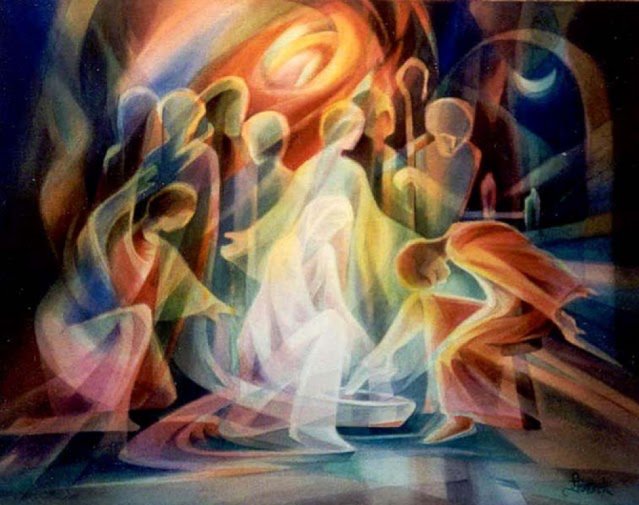
Jesus the King (Mark 11:1-11)

Entry Into the City, by John August Swanson (1938-2021)

As they approached Jerusalem and came to Bethphage and Bethany at the Mount of Olives, Jesus sent two of his disciples, saying to them, “Go to the village ahead of you, and just as you enter it, you will find a colt tied there, which no one has ever ridden. Untie it and bring it here. If anyone asks you, ‘Why are you doing this?’ say, ‘The Lord needs it and will send it back here shortly.’”

They went and found a colt outside in the street, tied at a doorway. As they untied it, some people standing there asked, “What are you doing, untying that colt?” They answered as Jesus had told them to, and the people let them go. When they brought the colt to Jesus and threw their cloaks over it, he sat on it. Many people spread their cloaks on the road, while others spread branches they had cut in the fields. Those who went ahead and those who followed shouted,

“Hosanna!”

“Blessed is he who comes in the name of the Lord!”

“Blessed is the coming kingdom of our father David!”

“Hosanna in the highest heaven!”

Jesus entered Jerusalem and went into the temple courts. He looked around at everything, but since it was already late, he went out to Bethany with the Twelve. (New International Version)

We are presently in the 12 Days of Christmas (December 25–January 5), the annual celebration of Christ’s birth on the Christian Calendar. It may seem odd that the Revised Common Lectionary daily readings have included a text associated with Palm Sunday. However, this is reminder to us that Jesus was born a king – which is why old King Herod saw a little baby as such a threat. (Matthew 2:1-18)

“Christ” is not the surname of Jesus, but instead is a title, meaning “anointed one.” In other words, in the New Testament Gospels, Jesus is referred to as an anointed king. It was broadly understood, within the religious milieu of the ancient Jews, that the Messiah (the Hebrew term for Christ) would come and beat up God’s enemies, restore God’s people to their former glory, and usher in an everlasting state of peace.

Jerusalem had a history as the royal city – the place where ancient Jewish kings lived and ruled. So, most ancient Jews made a clear connection between the Messiah, the king, returning to reign in Jerusalem. They anticipated that the City of David would once again be the seat of power, without any meddling Gentiles to complicate things.

Nativity, by John August Swanson

So, when Jesus entered Jerusalem – in what turned out to be the final week of his earthly life – many people looked upon this as a triumphal entry. He was close to ascending the ancient throne. The disciples of Jesus were waiting for this, and ready for a future of greatness and glory alongside their Rabbi.

Not only did people lay their palm fronds on the road in front of him declaring the ancient refrain, “Blessed is he who comes in the name of the Lord!” (Psalm 118:26) but they also added an explicit reference to the days of King David stating, “Blessed is the coming kingdom of our ancestor David!” The city was awash in the messianic hope of no longer being subject to foreign rule.

Yet we know the tragic and ironic end of the week. Jesus knew it, too, even at the time. He knew what fate awaited him by entering Jerusalem (Mark 8:31; 10:33-34). And Jesus knew without a shadow of a doubt that he was not going to be a king who gains and keeps power through military might and the bloodshed of war. Instead, only his own blood would be offered, as a sacrifice for many. The power of Love will overcome any and every earthly power.

Those with the eyes to see and the spirit to discern could understand this Jesus riding on a humble donkey instead of the proud warhorse. It made complete sense. Jesus did not enter this world with the fanfare of the rich and powerful, but quietly slipped onto the earth in a non-descript and poor Jewish family. His birth, life, and ministry, were all counter cultural. So, why not also his eventual death, resurrection, ascension, and glorification?

Yes, Jesus is a king. But no, he is not a king in any conventional sense. It is Jesus, beginning with his incredible and unexpected incarnation, who helps us reimagine what power and authority can and ought to look like.

All the trappings of control we can get so enamored about, such as wielding influence through economic wealth, social status, political power, and religious weight, all get tossed aside as mere stuffed animals compared to the real deal of moral dignity, ethical love, and compassionate justice shown to people who had absolutely no ability to either pay back Jesus or prop up a throne for him to sit upon.

Jesus is a king who gives his life for the healing of humanity – all people everywhere – including the ones we don’t much like or care about. I have no problem calling Jesus a king, just as long as we understand what sort of kingship we are actually talking about.

I serve King Jesus because he throws a monkey wrench into oppressive systems that seek to keep other people under a heavy hand of injustice. My allegiance is with Christ the Lord because he uses his prodigious authority to bring peace, light, wholeness, and integrity to all the places of the world (and the human heart) that are dark and clueless.

Today I celebrate in this Christmas season the birth of a baby who was born to die to the world and for the world. I rejoice with the angels that Christ is born in Bethlehem, the king of kings and lord of lords, the prince of peace who himself became peace so that we might live in peace.

May you discover deliverance from guilt, shame, and regret, through the One who came and was wounded for us so that we might be healed. Amen.

Mercy, Not Sacrifice (Hosea 6:1-6)

“Come, let us return to the Lord,
    for it is he who has torn, and he will heal us;
    he has struck down, and he will bind us up.
After two days he will revive us;
    on the third day he will raise us up,
    that we may live before him.
Let us know, let us press on to know the Lord;
    his appearing is as sure as the dawn;
he will come to us like the showers,
    like the spring rains that water the earth.”

What shall I do with you, O Ephraim?
    What shall I do with you, O Judah?
Your love is like a morning cloud,
    like the dew that goes away early.
Therefore I have hewn them by the prophets;
    I have killed them by the words of my mouth,
    and my judgment goes forth as the light.
For I desire steadfast love and not sacrifice,
    the knowledge of God rather than burnt offerings. (New Revised Standard Version)

My favorite word in all of Holy Scripture is the Hebrew word chesed (חֶסֶד pronounced “hes-ed” with a guttural sound on the “h”). It’s such a rich word that no single English word can capture its depth. 

So, chesed is translated in various ways across the English translations of the Bible as “mercy,” “grace,” “steadfast love,” “covenant loyalty,” “kindness,” “compassion,” and more. It’s no wonder, then, that since chesed marks the character and activity of God, the Lord very much desires people to reflect this same stance toward others. 

In today’s Old Testament lesson, God was calling and wooing wayward people to return to a divine life of closeness with the Lord. God demonstrated chesed by not putting the people away, like a spouse outright divorcing an unfaithful partner. But instead, God committed to loving the Israelites even when they were unlovely.

At all times, the response God wants is not simply going through the motions of outward worship. Ritual practices mean little if there is no heart behind them. The Lord longs for people to demonstrate both fidelity and fealty through mercy and a steadfast love to God and neighbor. Both our work and our worship are to be infused with divine mercy. 

God deeply desires a close relationship with humanity and is profoundly pained when people seek after other gods to meet their needs and to love them. Hosea’s prophecy is an impassioned plea for all persons to find their true fulfillment and enjoyment in a committed loving divine/human union, just like a marriage.

In Christian readings of Hosea’s prophecy, repentance means accepting God’s chesed through Jesus Christ. The believer is to allow the character of God to rule and reign in their heart so that commitment comes flowing out in loving words, actions, thoughts, and dispositions. Mercy finds its highest expression in the person and work of Jesus. Thus, Advent is a season of anticipating the great love and mercy of God through the incarnation of Christ.

It, therefore, ought to be no surprise that Jesus lifted Hosea’s prophecy as a treasured principle of operation when asked why he deliberately made connections with “questionable” people:

While Jesus was having dinner at Matthew’s house, many tax collectors and sinners came and ate with him and his disciples. When the Pharisees saw this, they asked his disciples, “Why does your teacher eat with tax collectors and sinners?” On hearing this, Jesus said, “It is not the healthy who need a doctor, but the sick. But go and learn what this means: ‘I desire mercy, not sacrifice.’ For I have not come to call the righteous, but sinners.” (Matthew 9:10-12, NIV)

And when confronted about “questionable” activities Jesus appealed to the same source of Hosea’s prophecy:

“Look! Your disciples are doing what is unlawful on the Sabbath.” Jesus answered, “Haven’t you read what David did when he and his companions were hungry? He entered the house of God, and he and his companions ate the consecrated bread—which was not lawful for them to do, but only for the priests. Or haven’t you read in the Law that the priests on Sabbath duty in the temple desecrate the Sabbath and yet are innocent? I tell you that something greater than the temple is here. If you had known what these words mean, ‘I desire mercy, not sacrifice,’ you would not have condemned the innocent.” (Matthew 12:2-7, NIV)

One can never go wrong with mercy and grace. If in doubt between whether to judge another or show mercy, the Christian’s choice is clear. Grace and love create connections – reconnecting the disconnected. The heart of true Christian spirituality is a deep kinship with the divine. Whenever that relation is broken or severed, it is vital to restore it. The means of doing so is not judgment but mercy.

Chesed is more than a word; it is a way of life. God wants mercy. Grace is the Lord’s divine will.

So, let us today receive the forgiveness of Jesus and devote ourselves to prayer and works of love which come from a heart profoundly touched by grace. May the result be healing of that which has been broken, and reconciled relationships with others.

Merciful and loving God, the One who shows amazing grace, forgive us for our wanderings away from the divine life. Return us, again, to the grace of Jesus Christ our Savior so that our hearts will be renewed and aflame with love for others. In the Name of the Father, Son, and Spirit, the Great Three in One. Amen.

God Will Make a Way (Exodus 2:1-10)

Moses is saved from the water by Pharaoh’s daughter, by Marc Chagall, 1966

Now a man from Levi’s household married a Levite woman. The woman became pregnant and gave birth to a son. She saw that the baby was healthy and beautiful, so she hid him for three months. When she couldn’t hide him any longer, she took a reed basket and sealed it up with black tar. She put the child in the basket and set the basket among the reeds at the riverbank. The baby’s older sister stood watch nearby to see what would happen to him.

Pharaoh’s daughter came down to bathe in the river, while her women servants walked along beside the river. She saw the basket among the reeds, and she sent one of her servants to bring it to her. When she opened it, she saw the child. The boy was crying, and she felt sorry for him. She said, “This must be one of the Hebrews’ children.”

Then the baby’s sister said to Pharaoh’s daughter, “Would you like me to go and find one of the Hebrew women to nurse the child for you?”

Pharaoh’s daughter agreed, “Yes, do that.” So the girl went and called the child’s mother. Pharaoh’s daughter said to her, “Take this child and nurse it for me, and I’ll pay you for your work.” So the woman took the child and nursed it. After the child had grown up, she brought him back to Pharaoh’s daughter, who adopted him as her son. She named him Moses, “because,” she said, “I pulled him out of the water.” (Common English Bible)

A new Pharaoh was enthroned in Egypt. Enough time had gone by that the legacy of Joseph as the administrator in saving many Egyptian people was lost. So, because the Israelites had grown to such large numbers, Pharaoh was afraid.

The politics of fear typically results in somebody getting oppressed. Indeed, fear became the driving force to a series of escalating oppressive policies initiated by Pharaoh, even to the point of planned infanticide. The Jewish midwives were instructed toward this end.

But the midwives did not fear the Egyptian Pharaoh. Instead they had a healthy fear of God (Exodus 1:17, 21). With such rightly ordered fear, the Jewish midwives defied the order of Pharaoh and openly disobeyed the royal command to murder Hebrew boys.

Here then, we have the setting for a special Hebrew baby to be born named Moses. He is the healthy child of two devout Levites. And although God’s name is not referenced in the verses for today, we can nonetheless see the providence and protection of the Lord within the narrative.

Through a complex chain of events, both the birth mother and the royal daughter care for this baby, protecting his life, with a divine provision for the needs of the infant Moses. Most stories in the Old Testament have contrasting characters within them, and today’s is no exception.

Pharaoh was the ruler over all of Egypt, and yet, he feared a loss of power and the status quo because of the Israelites – even though he reigned during a time of political peace, with hegemony reaching into the Middle East. As Pharaoh’s paranoid fear rose, so did God’s response of divine sovereignty over him, by providing protection against his diabolical intentions.

In contrast to Pharaoh, a powerless and non-descript Hebrew couple were married, conceived and bore a family of a daughter and two sons – Moses being the youngest. They had nothing, yet everything; whereas Pharaoh had everything, yet nothing. Thriving and flourishing has to do with a lot more than wealth and material resources.

Maternal care is powerful. And it finds a way to win the day and not only save a baby, but also to ensure that the baby grows, lives, and thrives. No royal edict can defeat the resilient strength of maternal compassion.

Despite Pharaoh’s increasing oppression, the compassion of several women ends up raising the very one who will lead the Israelites into liberation from this oppression.

With the Lord, a way will be found where there is no way. God + nothing = everything.

For us today, there is often a tendency to look back on the good old days when God did great things, and to look ahead when the Lord will return and make all things new and right. Yet we too often neglect to be mindful and live in the present moment, and know the God who is present with us right now.

We may remember the awesome deeds that God once did; and rejoice in biblical stories which demonstrate the Lord’s power, provision, and protection. We may look forward to the fulfillment of God’s promises in the person of Jesus when he returns, and gain hope from that.

Now, in this present evil age, and in this messed up world, we also have the God of the present tense. God will make a way, in this present time, where there seems to be no way. God is doing something new and amazing for us today.

And that way will be clear enough for us to know – and incredible enough for us to not predict or imagine. For God’s watch-care and deliverance can (and does) take many forms. When the Lord fulfills divine plans, it sometimes comes in the most creative and incredible way possible, so that we will have no doubt where it came from.

“God Will Make a Way” by Don Moen

God will make a way, Where there seems to be no way
He works in ways we cannot see, He will make a way for me
He will be my guide, Hold me closely to His side
With love and strength, For each new day
He will make a way He will make a way

By a roadway in the wilderness, He’ll lead me
And rivers in the desert will I see
Heaven and earth will fade
But His Word will still remain
He will do something new today

Real Life (1 Thessalonians 3:6-13)

But Timothy has just now come to us from you and has brought good news about your faith and love. He has told us that you always have pleasant memories of us and that you long to see us, just as we also long to see you. Therefore, brothers and sisters, in all our distress and persecution we were encouraged about you because of your faith. 

For now we really live since you are standing firm in the Lord. How can we thank God enough for you in return for all the joy we have in the presence of our God because of you? Night and day we pray most earnestly that we may see you again and supply what is lacking in your faith.

Now may our God and Father himself and our Lord Jesus clear the way for us to come to you. May the Lord make your love increase and overflow for each other and for everyone else, just as ours does for you. May he strengthen your hearts so that you will be blameless and holy in the presence of our God and Father when our Lord Jesus comes with all his holy ones. (New International Version)

What does it mean to really live? Everyone has their own conceptions of what the good life is. But to live life to the full, to really live in sync with how life actually is (and is supposed to be) brings us true satisfaction, contentment, and meaning.

In the radical individualism of the West, it may seem foreign or strange to us that the Apostle Paul’s life was very much bound up in the lives of others – in the churches he established and with the believers who had come to faith in Christ. For Paul, to really live was to see spiritual growth and development in the places where he ministered.

The thing that really got Paul excited, what really melted his butter, was leading others to Christ, forming them into churches, and watching them carry out their missional mandate by doing the same things that he did with them. I can relate to Paul’s joy and satisfaction over Christian discipleship.

There’s nothing quite like mentoring others in the faith, helping them mature in that faith, and sending them out to live according to the model of faith that you’ve demonstrated for them. To see the Word of God take root in individuals and communities of people is like no other sort of joy and contentment.

In the midst of discouraging circumstances of persecution and distressing situations of opposition, it was gratifying, encouraging, and motivating for Paul to hear a good spiritual report from his protégé Timothy about the Thessalonian church’s faith.

Whether we acknowledge it or not, or like it or not, every one of us is inextricably connected to the other. And that is especially true in families, and in the family of God. The Thessalonian believers’ steadfast commitment to Christ and the Christian faith was a crucial and important dimension of Paul’s own persevering faith.

The Apostle had been on the front lines of faith – taking the good news of grace and forgiveness in Christ to the nations. To have his churches endure through all their own troubles and challenges is a great boon to Paul. They each derive confidence and inspiration from the other. Everyone’s faith is confirmed and strengthened when everyone is striving to live for Christ.

All the believers in Christ were really living because they stood firm in the Lord and were immovable in their faith commitments. Assurance and reassurance comes not in isolation, but through the interdependence and interaction with others who share the same values.

Parents don’t really live, unless they see their children living a life of abundant joy and satisfaction. And it’s the same with spiritual mothers and fathers; they truly live when their spiritual children are walking in faith and patience with the Lord.

This is why Paul was grateful and could not thank God enough for the Thessalonians’ life of faith. God’s powerful and gracious work in the church brought out all kinds of thanksgiving. With that sort of dynamic happening, Paul could face any tribulation with the confidence and trust needed to keep going.

Prayer is the logical response to a healthy spiritual and relational dynamic of faith. The greater the good relations, the greater the desire to come and keep imparting needed teaching and encouragement for the Christian life. In other words, spiritual growth begets spiritual growth.

The best way the Thessalonian converts and all the churches become rooted in faith is by God helping them to have their love increase and overflow for each other, and for everyone else. What’s more, God intends that the love Christians have for one another be a model and a witness to and for the world.

Christian community is the place we learn to love. As we practice again and again how to love one another in the church, we then take this love into the world in loving even our enemies. For if we are to follow our model and leader, Jesus Christ, then we will infuse each word and every action with the love of God in Christ – which is the light that draws others into a healthy spiritual and relational dynamic.

We must pray, as Paul did, for love to increase amongst us, so that our hearts are strengthened with genuine purity and holiness of life. For unless love grows and flowers, selfish desires will increase and turn our love inward to the point of taking love away from God and the world.

It is imperative that we have a genuinely loving stance toward each other as believers, and toward others in the world. Apart from this love – given graciously to us through the cross and resurrection of Christ – there is little hope for anything bad in this old fallen world to ever be better.

The bottom line is that churches wither and die because they lose sight of love; Christians lose faith and go their own way because they forget about love; and believers throughout the world continue on because loving prayers, loving ways, and loving words come their way, despite difficulty and hardship they face.

So, let us love one another as Christ loved us. For this is the way our faith is strengthened and our hope is kindled to keep enduring until Jesus returns to this earth and makes all things new and right. This is real life.

May almighty God give you grace to persevere with joy, so that the work of love begun in you may be completed, through Jesus Christ our Lord. Amen.