Persecuted (Acts 8:1b-8)

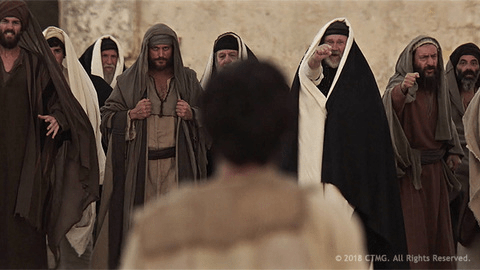
A scene from the movie, “Paul, Apostle of Christ,” in which Saul sought to wipe out Christians beginning with the stoning of Stephen

On that day a great persecution broke out against the church in Jerusalem, and all except the apostles were scattered throughout Judea and Samaria. Godly men buried Stephen and mourned deeply for him. But Saul began to destroy the church. Going from house to house, he dragged off both men and women and put them in prison.

Those who had been scattered preached the word wherever they went. Philip went down to a city in Samaria and proclaimed the Messiah there. When the crowds heard Philip and saw the signs he performed, they all paid close attention to what he said. For with shrieks, impure spirits came out of many, and many who were paralyzed or lame were healed. So there was great joy in that city. (New International Version)

Just because Christians experience the blessing of God through new life in Christ, does not mean that the rest of this earthly life will be bunnies and unicorns without any hardship.

Sometimes we forget that rabbits and horses produce manure, and we’ll have to muck out the barn. And even more than that, blessings from God are not limited to an abundance of earthly resources; blessing also comes through suffering. Jesus said:

“Great blessings belong to those who suffer persecution for doing what is right. God’s kingdom belongs to them.

“People will insult you and hurt you. They will lie and say all kinds of evil things about you because you follow me. But when they do that, know that great blessings belong to you. 

“Be happy about it. Be very glad because you have a great reward waiting for you in heaven. People did these same bad things to the prophets who lived before you.” (Matthew 5:10-12, ERV)

Saul was an up and coming Jewish Pharisee. He was intelligent, driven, and pious. Saul had the pedigree, passion, and position to go a long way and make a big splash in Judaism. And he was more than ready to do whatever it took to stamp out a heretical and dangerous sect of Jesus followers – even to the point of giving approval to the stoning of the Christian Stephen; and leading a persecution against believers like him.

Jesus not only promised abundant and eternal life to his followers, but he also promised that the cost of Christian discipleship would be persecution. Believers in Jesus Christ can expect to suffer in this life for their faithful commitment. Yet, because Christ overcame the world, we too, can accept, cope, and transcend any persecution and trouble we face in our embrace of faith. Jesus said:

“The world will make you suffer. But be brave! I have defeated the world!” (John 16:33b, GNT)

Even though the unity the believers enjoyed together in Jerusalem was disrupted and destroyed by the leadership of Saul, God bent the adverse situation toward blessing. Christians were flung all over the known world. In their going, they obeyed the words of their Lord Jesus to proclaim the message they so wholeheartedly embraced.

When Jesus came near, he spoke to them. He said, “All authority in heaven and on earth has been given to me. So wherever you go, make disciples of all nations: Baptize them in the name of the Father, and of the Son, and of the Holy Spirit. Teach them to do everything I have commanded you.

“And remember that I am always with you until the end of time.” (Matthew 28:18-20, GW)

The ancient prophesies were becoming realized. Grace, mercy, and peace were overcoming bitterness, judgment, and enmity toward one another. Even though persecution was happening, there was now a very different response to it, which will lead to a new outcome. In the last days…

The Lord will mediate between nations
    and will settle international disputes.
They will hammer their swords into plowshares
    and their spears into pruning hooks.
Nation will no longer fight against nation,
    nor train for war anymore. (Isaiah 2:4, NLT)

Suffering can be tolerated, even embraced, whenever we are aware that it can lead us to peace and joy – both personally and communally. Instead of evil taking root amongst a people, good seeds can be planted in the heart of humanity. And when those seeds are watered and nurtured, they grow to become a blessing for the world.

Finally, Jesus said, “What is God’s kingdom like? What story can I use to explain it? It is like what happens when a mustard seed is planted in the ground. It is the smallest seed in all the world. But once it is planted, it grows larger than any garden plant. It even puts out branches that are big enough for birds to nest in its shade.” (Mark 4:30-32, CEV)

Spiritual growth is built into Christianity. The faith formation and development of both individual believers and churches is important. Without it, Christians devolve into cliques of special interest groups.

But with it, Christianity becomes a blessing to the world, that is, if believers focus on producing and harvesting the spiritual fruit of love, joy, peace, patience, kindness, generosity, faithfulness, gentleness, and self-control. (Galatians 5:22-23)

Whenever and wherever believers and followers of Jesus are spiritually growing in their faith, they become like exorcists who organically purge unhealthy institutional systems of their moral corruption, selfishness, idolatry, hate, in-fighting, obsessions, bitterness, rage, competitive oppositions, conflict, and polarizing group rivalries. (Galatians 5:19-21)

Christianity is meant to bring joy and healing of both body and soul. If it doesn’t do this, then it has become just another unjust and unhealthy organization that is in need of purging its impurities; and embracing its mandate to uphold the common good of all persons through proclamation of good news and committed to a lifestyle of loving one another as Christ has loved us.

For people pay attention to that which is right, just, and good – because righteousness, justice, and goodness are in everyone’s spiritual DNA.

Almighty and gracious God of all:
Remember Christ, your Son, who is peace itself,
and who has washed away our hatred with his blood.
Because you love all men and women everywhere,
look with mercy on all who are engaged in battles of the flesh and the spirit.
Banish the violence and evil within all combatants of both body and soul
so that one day, we may all deserve to be called your sons and your daughters.
Grant this through Christ our Lord, in the enablement of the Spirit. Amen.

Mercy Is Coming (Micah 7:8-20)

“Justice Tempered with Mercy,” an oil painting by Emil Bisttram, 1936

Do not rejoice over me, my enemy,
        because when I fall, I will rise;
            if I sit in darkness, the Lord is my light.
I must bear the raging of the Lord,
    for I have sinned against him,
        until he decides my case and provides justice for me.
    He will bring me out into the light;
        I will see by means of his righteousness.
    Then my enemy will see;
        shame will cover her who said to me:
            “Where is the Lord your God?”
    My eyes will see her ruin;
        now she will become something to be trampled,
            like mud in the streets.

A day for the building of your walls!
        On that day, the boundary will be distant.
        On that day, they will come to you from Assyria and the cities of Egypt,
            from Egypt to the River,
            from sea to sea,
            and from mountain to mountain.
And the earth will become desolate because of her inhabitants,
        because of the fruit of their actions.

Shepherd your people with your staff,
        the sheep of your inheritance,
        those dwelling alone in a forest in the midst of Carmel.
    Let them graze in Bashan and Gilead, as a long time ago.

As in the days when you came out of the land of Egypt,
        I will show Israel wonderful things.

Nations will see and be ashamed of all their strength;
        they will cover their mouths;
        their ears will be deaf.

They will lick dust like the snake,
        like things that crawl on the ground.
They will come trembling from their strongholds to the Lord our God;
        they will dread and fear you!
Who is a God like you, pardoning iniquity,
        overlooking the sin of the few remaining for his inheritance?
    He doesn’t hold on to his anger forever;
        he delights in faithful love.
He will once again have compassion on us;
        he will tread down our iniquities.
You will hurl all our sins into the depths of the sea.
You will provide faithfulness to Jacob, faithful love to Abraham,
        as you swore to our ancestors a long time ago. (Common English Bible)

The prophecy of Micah was directed to the people because of the nation’s messed up social and political relations. Unrighteousness had thoroughly drenched the land. In this situation, the nation groaned; Micah responded to them and interceded for the people; God agreed with it all; and Micah concluded with a theological reminder of who God is and what God is like.

The nation of Israel was in a bad way during the eighth century B.C.E. because of their injustice toward one another. The leaders only thought of themselves, and not the people as a whole. Unfaithfulness ran so deep that not even one’s closest friends or relatives could be trusted.

To be a faithful and righteous person during that time required a resolve to wait for God’s deliverance – because there was no way any one person or group of people could fix any of it.

And this is the nature of hope – it can only be understood and realized by knowing, sensing, and feeling hopelessness in all of its despair. We do not hope for something we already possess.

The prophet Micah recognized the situation of the nation for what it was, as well as the consequences to having injustice throughout the land. Yet, he also looked forward to a time when God’s wrath will move from God’s people to the people’s enemies.

It may seem as if the Lord is either slow, not paying attention, or doesn’t care; but God’s timing is not the same as ours. Divine deliverance will come when divine deliverance will come.

The circumstances of Israel’s national sins were ripe not only for God’s judgment, but also for Micah’s prayers on behalf of the people. He called on the Lord to shepherd Israel, while at the same time, to put Israel’s enemies in their place.

And God, out of the storehouse of divine mercy, granted an assurance of pardon.

But if we confess our sins, he is faithful and just to forgive us our sins and cleanse us from everything we’ve done wrong. (1 John 1:9, CEB)

Micah affirmed the grace and mercy of God. He had the confident expectation that the Lord would cast all of Israel’s sins into the depths of the sea. Guilt, shame, and despair will not have the last word; the final word belongs to mercy.

Into a world full of cynicism and sarcasm, hopelessness and despair, it is vitally important that we have faithful and godly individuals who have a settled hope. This is what it means to be a remnant, a small minority of people who hold onto that which is just, right, and good.

We are to quietly go about our business of bringing justice, mercy, and love to this world with a quiet and confident expectation that God’s grace will overcome and overwhelm everything in its path.

Most merciful God, we confess that we have sinned against you in thought, word, and deed, by what we have done, and by what we have left undone. We have not loved you with our whole heart; we have not loved our neighbors as ourselves. We are truly sorry and we humbly repent. For the sake of your Son Jesus Christ, have mercy on us and forgive us; that we may delight in your will, and walk in your ways, to the glory of your Name. Amen.

The Good Shepherd (John 10:11-18)

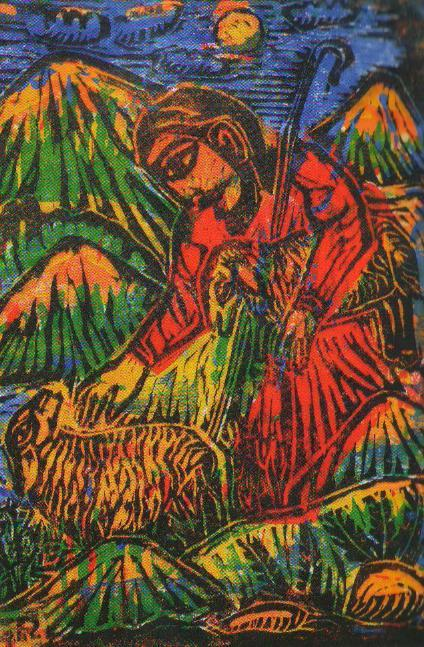
Jesus the Good Shepherd, by Solomon Raj (1921-2019)

“I am the good shepherd. The good shepherd lays down his life for the sheep. When the hired hand sees the wolf coming, he leaves the sheep and runs away. That’s because he isn’t the shepherd; the sheep aren’t really his. So the wolf attacks the sheep and scatters them. He’s only a hired hand and the sheep don’t matter to him.

“I am the good shepherd. I know my own sheep and they know me, just as the Father knows me and I know the Father. I give up my life for the sheep. I have other sheep that don’t belong to this sheep pen. I must lead them too. They will listen to my voice and there will be one flock, with one shepherd.

“This is why the Father loves me: I give up my life so that I can take it up again. No one takes it from me, but I give it up because I want to. I have the right to give it up, and I have the right to take it up again. I received this commandment from my Father.” (Common English Bible)

This is a beautiful passage of Scripture, as we look at it now, two-thousand years removed from its original context. Yet, at the time, Jesus spoke these words after a smack down conflict with the religious authorities, complete with plans to stone him.

In healing a man born blind, Jesus not only restored his physical sight, but he also gave him clear spiritual vision. In contrast, Christ’s opponents remained in their spiritual darkness, unable to see the light of life. And in their spiritual blindness, they couldn’t lead anybody anywhere without falling into a pit and making things worse.

Jesus is the good shepherd, the caring leader who is aware, and has the sheep’s best interests in mind, and at heart. The religious authorities proved to be bad shepherds who only wanted to fleece the sheep of their wool; such persons steal, harm, and kill. Jesus, however, offers abundant life.

The good shepherd provides altruistic care at a great cost. Whereas the hired hand runs away when the wolves come and threaten the flock, Jesus as the Good Shepherd puts his life on the line to protect the sheep. Three times we are told that Christ lays his life down for the benefit of others.

Bad shepherds have no such concern. And, unfortunately, such leaders have been around ever since the fall of humanity into sin. They cut and run when things get risky and dangerous.

This is what the Sovereign Lord says: “Woe to you shepherds of Israel who only take care of yourselves! Should not shepherds take care of the flock? You eat the curds, clothe yourselves with the wool and slaughter the choice animals, but you do not take care of the flock. You have not strengthened the weak or healed the sick or bound up the injured. You have not brought back the strays or searched for the lost. You have ruled them harshly and brutally. 

So they were scattered because there was no shepherd, and when they were scattered they became food for all the wild animals. My sheep wandered over all the mountains and on every high hill. They were scattered over the whole earth, and no one searched or looked for them.” (Ezekiel 34:2-6, NIV)

Jesus, in his incarnation, embodies the love and concern of God for the people of this world. Christ takes the initiative to do what needs to be done for the benefit of the at-risk sheep.

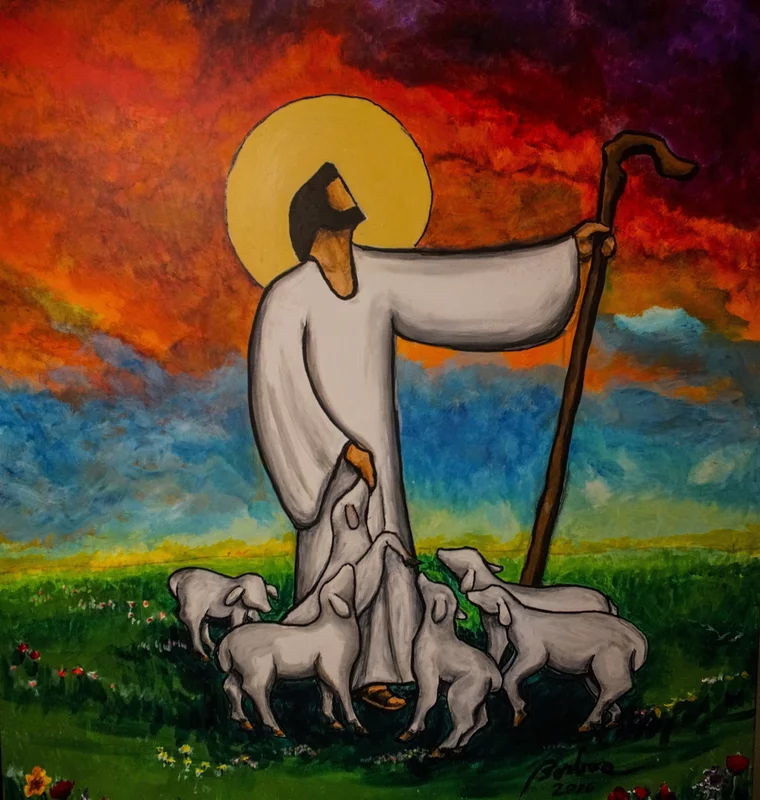
Jesus the Good Shepherd, by Francisco Borboa

For this is what the Sovereign Lord says: “I myself will search for my sheep and look after them. As a shepherd looks after his scattered flock when he is with them, so will I look after my sheep. I will rescue them from all the places where they were scattered on a day of clouds and darkness. I will bring them out from the nations and gather them from the countries, and I will bring them into their own land. I will pasture them on the mountains of Israel, in the ravines and in all the settlements in the land. I will tend them in a good pasture, and the mountain heights of Israel will be their grazing land.

There they will lie down in good grazing land, and there they will feed in a rich pasture on the mountains of Israel. I myself will tend my sheep and have them lie down, declares the Sovereign Lord. I will search for the lost and bring back the strays. I will bind up the injured and strengthen the weak, but the sleek and the strong I will destroy. I will shepherd the flock with justice.” (Ezekiel 34:11-16, NIV)

Since Jesus is the Good Shepherd, he has the unique ability and authority to decide who is in the sheep fold, and who is out. Nobody else gets to make those sorts of decisions. This way, ultimate issues of eternal life and abundant life are handled with perfect justice and righteousness.

It’s okay that this is all a mystery to us. We sheep need only to keep the Shepherd in our line of sight, and let him do his job of caring for us – without whining or complaining. After all, we could easily have a bad shepherd herding us around like a bunch of stupid cows, and treating us with indifference, even meanness.

The Holy Trinity of God – Father, Son, and Spirit – work as One. The Father loves the Son and the Spirit, and also loves those whom the Son and Spirit have touched. The Son loves the Father and the Spirit, and obeys all things from the Father, while listening to the Spirit. And the Spirit loves the Father and the Son, knowing them intimately and always operating in love for the benefit of the sheep’s deliverance from wolves.

In particular, the Son, Jesus, lays down his own life, but takes it up again. He does so because of love. The perfect unity and love of the blessed Holy Trinity spills out in Christ’s care for us.

The laying down and taking up of life on the part of the Good Shepherd is not only an expression of great love and faithfulness toward us sheep, but it is also a deep abiding love and commitment toward the Father from whom all blessings flow.

To put it another way, this motley flock of sheep are purposely drawn into the unity, harmony, and love between the Father and the Son. And when we glimpse and experience such overwhelming love, we choose to remain connected to this incredible loving dance.

Our world is much too characterized by selfish concerns and shortsighted actions. In the loving embrace of the Good Shepherd, we have an opportunity to experience peace and rest, grace and abundance, light and life. To know such love is to never turn back to old self-centered ways of living.

Shepherd of all, by laying down your life for the flock, you reveal your love for all. Lead us from the place of death to the place of abundant life, so that guided by your care for us, we may rightly offer our lives in love for you and our neighbors. Amen.

The Lord Is My Shepherd (Psalm 23)

Psalm 23, by Cliff Gleason

The Lord is my shepherd;
    I have all that I need.
He lets me rest in green meadows;
    he leads me beside peaceful streams.
    He renews my strength.
He guides me along right paths,
    bringing honor to his name.
Even when I walk
    through the darkest valley,
I will not be afraid,
    for you are close beside me.
Your rod and your staff
    protect and comfort me.
You prepare a feast for me
    in the presence of my enemies.
You honor me by anointing my head with oil.
    My cup overflows with blessings.
Surely your goodness and unfailing love will pursue me
    all the days of my life,
and I will live in the house of the Lord
    forever. (New Living Translation)

This is one of the best known places in the Bible – even for people who are not religious. And that is for good reason. The psalm is timeless in it’s relating to us in our human condition. It taps into our human need for a compassionate presence, secure protection, and abundant provision. I believe that, most of all, Psalm 23 effectively goes to our inner selves and reminds us of our greatest need: God.

My underlying conviction concerning this wonderful psalm is that the reason we adore it so much is because we humans have an innate primal desire for God. Whether we are consciously religious or not, our deepest longing is for connection with the Divine.

Much of humanity, it seems to me, have repressed this desire. Many people bury this longing underneath multiple layers of other interests and competing desires. Others experience the primal desire for God as a yearning for wholeness, completion, or fulfillment.

Yet, regardless of how particular individuals or groups may frame it, humanity’s basic need is to love and be loved – to move ever closer to the source of love. This inner craving is the essence of the human spirit, and it is captured well in a biblical psalm which pictures a person who settled into the God who is Love.

“Our hearts are forever restless until we rest in God.”

St. Augustine

With Psalm 23, our human longing is spelled out in a mere 50 or so words – we can imagine not only being transported, but also being actually transformed into an enjoyable divine/human relationship, set within an idyllic landscape of settled peace, safety, and strength.

Serenity for our anxious racing thoughts becomes a real hope, for there is a shepherd who protects the human flock and ensures that they have everything they need.

It is understandable that the relationship between God and humans is likened to that of a shepherd and sheep. In reality, sheep need a shepherd. They require someone to look out for them and provide for them. Sheep, in my opinion, are not stupid and clueless; they are skittish animals who only function well if they are non-anxious and at peace.

The presence of a caring shepherd makes all the difference. And, more than that, the shepherd does a myriad of needed things for the sheep that they are not able to do themselves, such as protecting them from wolves, finding adequate pasture to feed upon, and relieving them of the intestinal gas from eating all that grass which would literally kill them without the shepherd’s intervention.

Whereas human shepherds may or may not be faithful in their duties and extend genuine care to the flock, God is always present and loving. Moving to the rich pasture of the New Testament, Jesus is described as the Good Shepherd who will care for and preserve the sheep in every way needed. (John 10:1-21)

Psalm 23, by Cliff Gleason

Indeed, with Jesus as the consummate shepherd, people want for nothing and have everything they need. No wolf can snatch them out of his hand, and the mundane tasks of washing their feet is lovingly done for them. With Jesus, the deep yearning of the inner person becomes satisfied; the soul is restored.

Even the implements of a rod and a staff are used for good, and not for ill. An unfaithful shepherd will likely beat the sheep and berate them, only concerned for fleecing them to sell their wool on the market. But Jesus uses the rod to guide and direct in the way we ought to go, for our benefit and well-being. And the staff – the shepherd’s crook – is benevolently used to rein in the strays who don’t realize how in danger they’re in.

Truly, discipline and encouragement are not mutually exclusive concepts; they instead go together as two forms of loving leadership and care. Only those who take the time and effort to correct another are the ones who really care enough to do so.

In the shepherd’s presence, we can exist with a sense of security, even though there is danger all around us. Our longing for peace, and to be secure within oneself, is not a pipe dream, but a real possibility. To be provided for by God in the face of hard circumstances strengthens faith, awakens hope, and fosters love. It becomes an overflowing feast of the soul.

And this goodness is not fleeting. It can be a continuous present reality. Since God is good, all the time, and there is never a time when God is not good, we are continually and actively pursued and shepherded by goodness and not by harm, all the days of our lives.

The threat of death – and even death itself – cannot thwart the avenues of righteousness from being available to us. We can walk the true path toward inner peace and fulfillment, of genuine connection with God and others, without moral or spiritual harm.

There are good and right paths of life. Those avenues are guarded by a gracious God; they will never be destroyed or damaged. If the psalm is correct, and if my core convictions are right, then there is no longer any reasonable or justified basis for fear.

A good care-taking Shepherd is protecting the flock, and providing the sheep with everything they need. We can live a morally strong, ethically sound, and eminently happy life, without being constantly afraid.

Blessed and Good Shepherd of all, by laying down your life for the flock, you reveal your love for all. Lead us from the place of death to the place of abundant life, so that guided by your care for us, we may rightly offer our lives in love for you and our neighbors. Amen.