
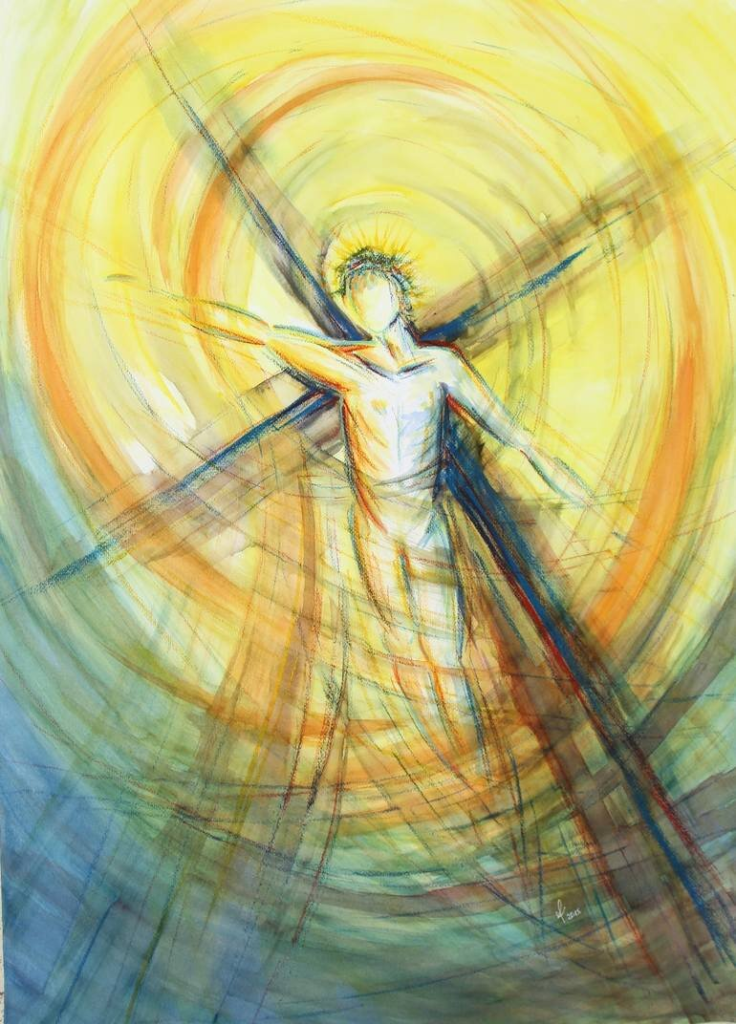
Filled with Divine Fullness (Colossians 2:6-15)

Resurrection, by Oliver Pfaff

As you therefore have received Christ Jesus the Lord, continue to walk in him, rooted and built up in him and established in the faith, just as you were taught, abounding in thanksgiving.

Watch out that no one takes you captive through philosophy and empty deceit, according to human tradition, according to the elemental principles of the world, and not according to Christ. 

For in him the whole fullness of deity dwells bodily, and you have come to fullness in him, who is the head of every ruler and authority. In him also you were circumcised with a spiritual circumcision, by the removal of the body of the flesh in the circumcision of Christ; when you were buried with him in baptism, you were also raised with him through faith in the power of God, who raised him from the dead. 

And when you were dead in trespasses and the uncircumcision of your flesh, God made you alive together with him, when he forgave us all our trespasses, erasing the record that stood against us with its legal demands. He set this aside, nailing it to the cross. He disarmed the rulers and authorities and made a public example of them, triumphing over them in it. (New Revised Standard Version)

On the television gameshow “Let’s Make a Deal,” selected members of the studio audience are offered something of value, and then given a choice of whether to keep it or exchange it for a different item.

The game’s drama is that the other item is hidden from the person until that choice is made. The participant does not know if the alternative item is of equal or greater value; or an item purposely chosen to be of little or no value.

The “deal” with Christianity is that Christians already have something of significant value. But they often lose it by going after something they aren’t even sure they actually want, or not.

Followers of Jesus have been given a valuable gift. And the Apostle Paul’s exhortation to the Church at Colossae was to go ahead and keep going with the prize you already possess.

Believers in Jesus have received him. Therefore, the believer is not to trade the words and ways of Jesus, and the redemption secured in Christ, for something else.

Having been redeemed by the Cross of Christ, believers are deeply rooted in Jesus. They are on a firm foundation of faith. Christians possess a faith full of hope and love.

So then, believers are encouraged by the Apostle Paul to take everything they have been taught, and everything they have received, and run with it.

It doesn’t matter what is behind another door, or what is on the other side of the curtain; grab ahold of what you possess in Jesus Christ. Stop considering a better way to live, and start living the life that’s been given to you.

Allow gratitude and thanksgiving to arise within you, and to come forth out of you. Quit looking how much greener the grass is on the other side of the fence. That pasture isn’t really greener; and there is not really a better way.

Many people have become disillusioned with institutional religion. They’ve had it with church. So, some of them end up throwing out the baby with the bath water, entertaining all sorts of ideas and approaches other than the grace-filled Christianity they once received.

Unfortunately, there are plenty of spiritual charlatans who seek to bedazzle people with fine sounding words. But it’s all nothing but a bunch of pseudo-intellectual philosophical babble.

Yet, because the messenger appears confident and makes grand pronouncements, they let themselves be captured, and go with it. And there are others who become enamored with endless theological talk, that has neither any real effect on one’s daily life, nor eternal life.

The Apostle was warning the Colossian believers about getting lost in the myriad traditions and superstitions that have an absence of Christ in the middle of them.

The way of Jesus has Christ directly and purposefully at the core of one’s life. Anything less is to make a deal and see what is behind another door.

The way of Jesus has very little to do with a particular theological tradition about the end times, or a certain literal interpretive stance, or a liturgical or non-liturgical approach to the Christian life.

Everything of God is right, just, and good. And according to Christianity, it comes through the person and work of Jesus, through Christ’s words and ways as expressed in the New Testament Gospels.

It seems to me that the Apostle Paul would be aghast today at how many supposed Christian believers worship him and his epistles! Instead of giving their full adoration to Christ.

The last word doesn’t come from Paul, but from Jesus. Keep in mind that Paul worshiped Christ, and did not point people to himself as the be-all-end-all of any philosophical approach.
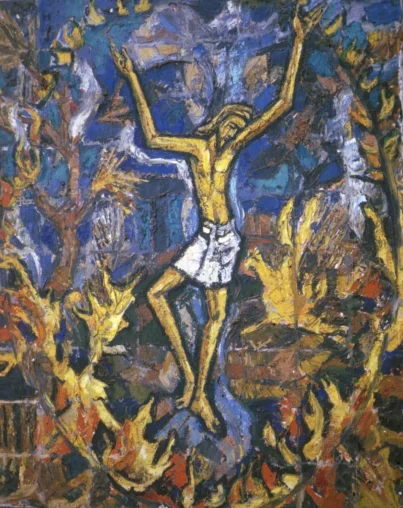
Jesus the Dancer, by Jyoti Sahi

Everything the Christian needs is within the fullness of Jesus Christ.

All things are empty without Christ, including the vast universe. The power and authority of Christ extends over all things and all people everywhere. Paul was insistent on this in all of the churches he established.

Thus, Christians must enter into the fullness of their Lord Jesus.

You can spend a lifetime, even an eternity after death, trying to figure out how God works, but you will never get to the end of it. God’s arm has that long of a reach. The fullness of Jesus is that big and filling. The strength of the Spirit is that powerful.

The heart and center of Christianity has nothing to do with circumcision, modes of baptism, keeping long lists of laws, or maintaining multiple spiritual practices. Because the Christian is already in, and already united with Christ.

This is why Paul prayed for believers to explore and realize what they already have in Christ, so that, with the eyes of their heart enlightened, they may perceive what is the hope to which God has called them, the riches of God’s glorious inheritance among the saints, and the immeasurable greatness of divine power for those who believe. (Ephesians 1:18-19)

The Christian has been spiritually raised from the dead, just as Christ was physically raised from death to life. And believers will also be physically raised, as Jesus was, if they have the spiritual eyes to see it.

Think of all those times in the past when you were stuck, and living a dead-end existence. Remember how God made you alive in Christ. All of your guilt and shame forgiven. All the stuff that kept you down and out, all that kept you from God, was nailed to the Cross of Christ.

The malevolent forces of this world have been stripped of their power, and can be seen as the sham they actually are.

It will not be nearly as valuable nor practical – not even close.

Being grounded in the person and work of Christ is where it’s at, my friend.

Watch out that nobody comes along and tries to sway you from Jesus. Don’t make any deals. You and I have Jesus. He is all we need.

Lord Jesus, you are worthy of our adoration, affection, and allegiance. Because of you, we don’t have to guess what God is like; there is no need to create our own image of God. Everything we need to know about God is revealed in and through you. Along with the Father and the Spirit, you have always existed in perfect relationship and unimaginable wonder.

Blessed Holy Trinity, the God whom I serve, may your divine dance of Father, Son, and Spirit pulsate within me, and flow out of me in a trust that you are enough. Then I will know that I, too, am enough as I avoid the false philosophies and promises of this world.

Almighty God, you fill the center of my being, so that I can let You be You, and so, be content and at peace, despite the alternative voices that chatter constantly around me. May your will be done, today and every day, to the glory of Jesus Christ my Lord. Amen.

Build Spiritual Wealth (1 Timothy 6:11-21)

But you, man of God, flee from all this [love of money] and pursue righteousness, godliness, faith, love, endurance and gentleness. Fight the good fight of the faith. Take hold of the eternal life to which you were called when you made your good confession in the presence of many witnesses. 

In the sight of God, who gives life to everything, and of Christ Jesus, who while testifying before Pontius Pilate made the good confession, I charge you to keep this command without spot or blame until the appearing of our Lord Jesus Christ, which God will bring about in his own time—God, the blessed and only Ruler, the King of kings and Lord of lords, who alone is immortal and who lives in unapproachable light, whom no one has seen or can see. To him be honor and might forever. Amen.

Command those who are rich in this present world not to be arrogant nor to put their hope in wealth, which is so uncertain, but to put their hope in God, who richly provides us with everything for our enjoyment. 

Command them to do good, to be rich in good deeds, and to be generous and willing to share. In this way they will lay up treasure for themselves as a firm foundation for the coming age, so that they may take hold of the life that is truly life.

Timothy, guard what has been entrusted to your care. Turn away from godless chatter and the opposing ideas of what is falsely called knowledge, which some have professed and in so doing have departed from the faith.

Grace be with you all. (New International Version)

Whether we like it, or not, every one of us is a slave. I don’t mean slavery in the sense of nineteenth century antebellum black chattel slavery; but a slave in the vein of being a bondservant – one who is bound to a particular master by choice, and not by coercion.

Jesus put the matter this way:

“No one can serve two masters. Either you will hate the one and love the other, or you will be devoted to the one and despise the other. You cannot serve both God and money.” (Matthew 6:24, NIV)

Both Jesus and Paul had the assumption that we are all in service to something or someone, without exception. So, the question then becomes, “Who is your master?”

Becoming a bondservant to Master Mammon will cause a person to place their ultimate hopes and dreams in wealth and possessing financial resources. However, money will possess them, and not the other way around. Their relationships will suffer, wither, and become disconnected.

Conversely, being a bondservant to the Lord Jesus will lead a person to place their ultimate hope in God. Possessing a godly life, faith, love, endurance, and gentleness will be their way of life. They will give themselves to a spirit of generosity and the pursuit of good deeds. These servants of God will take hold of eternal life, and find themselves possessed by it.

The Apostle Paul, in writing one of his final letters on this earth, reminded his young protégé Timothy to teach his congregation the importance of being bonded in service to the right master, to build spiritual wealth in heaven, and not just financial wealth here on this earth.

The letter of Paul to Timothy is given as a relational gift, reminding the young pastor of the many things taught to him in the apprenticed relationship they enjoyed together. In this sense, it was a personal letter, designed to recall the importance of keeping tethered to Christ their Lord.

Through written language, Paul came alongside Timothy and spoke to him, saying to never become intimidated by riches or rich persons. Financial wealth is merely superficial, and holds no credit or influence in the kingdom of God.

God is far richer, and infinitely more powerful than anyone or anything in this world, Paul insisted. So, keep serving God alone; continue being bonded and united to Christ, which Paul knew was not an easy thing to do.

In a world of looking out for number one, survival of the fittest, and hyper-capitalistic economies, many succumb to the allure of trusting in Master Mammon. Instead, stay focused on the Lord Jesus, his words and his ways, and on living an exemplary life.

What is more, Paul exhorted Timothy to command those who are rich in this world to become rich in good deeds. It is possible to be wealthy and be a bondservant of Christ; yet, it is not at all easy to do so.

Which is why the rich person needs continual encouragement, exhortation, and accountability, in order to remain bound to what is most important. Such persons need the command to put their hope continually in God, and not in money or bit-coins; in Christ, and not in building a strong financial portfolio that will keep one swimming in plenty of financial resources.

Again, none of this teaching of the Apostle means that having an array of financial capital is somehow wrong or ungodly. Rather, it means that we must be quite intentional and careful to build our equity in the kingdom of God, and use our worldly wealth for good and just purposes that reflect a righteous life—a life of wonder, faith, love, steadiness, and kindness.

Guard the precious treasure given to you, that is, the great spiritual riches entrusted to you. Allow the overwhelming grace of God in Jesus Christ to keep you faithful and loving in this greedy and feckless world.

The Lord Jesus taught us in his Sermon on the Mount:

“Don’t hoard treasure down here where it gets eaten by moths and corroded by rust or—worse!—stolen by burglars. Stockpile treasure in heaven, where it’s safe from moth and rust and burglars. It’s obvious, isn’t it? The place where your treasure is, is the place you will most want to be, and end up being.” (Matthew 6:19-21, MSG)

Lord of our lives, teach us how to use our money and our possessions. Deliver us from stinginess and wasteful extravagance; inspire our giving with the spirit of true generosity. Help us always to remember your generous love for us, that we may be wise and faithful stewards of the good gifts you have given us. Amen.

The Lord of Life (John 6:56-69)

Bread of Life, by Kennedy Paizs

“Those who eat my flesh and drink my blood abide in me and I in them. Just as the living Father sent me and I live because of the Father, so whoever eats me will live because of me. This is the bread that came down from heaven, not like that which the ancestors ate, and they died. But the one who eats this bread will live forever.” Jesus said these things while he was teaching in a synagogue at Capernaum.

When many of his disciples heard it, they said, “This teaching is difficult; who can accept it?” But Jesus, being aware that his disciples were complaining about it, said to them, “Does this offend you? Then what if you were to see the Son of Man ascending to where he was before? It is the spirit that gives life; the flesh is useless. The words that I have spoken to you are spirit and life. But among you there are some who do not believe.”

For Jesus knew from the beginning who were the ones who did not believe and who was the one who would betray him. And he said, “For this reason I have told you that no one can come to me unless it is granted by the Father.”

Because of this many of his disciples turned back and no longer went about with him. So Jesus asked the twelve, “Do you also wish to go away?” Simon Peter answered him, “Lord, to whom can we go? You have the words of eternal life. We have come to believe and know that you are the Holy One of God.” (New Revised Standard Version)

This is a hard teaching – which is why a fair number of Christ’s disciples unfollowed him, literally, and not just socially and virtually.

Perhaps they believed they were following a great moral teacher, only to find Jesus prattling-on about being bread from heaven and divinely related to God.

The late great C.S. Lewis commented on Jesus, saying this:

“I am trying here to prevent anyone saying the really foolish thing that people often say about Him: I’m ready to accept Jesus as a great moral teacher, but I don’t accept his claim to be God. That is the one thing we must not say. A man who was merely a man and said the sort of things Jesus said would not be a great moral teacher. He would either be a lunatic — on the level with the man who says he is a poached egg — or else he would be the Devil of Hell. You must make your choice. Either this man was, and is, the Son of God, or else a madman or something worse. You can shut him up for a fool, you can spit at him and kill him as a demon or you can fall at his feet and call him Lord and God, but let us not come with any patronizing nonsense about his being a great human teacher. He has not left that open to us. He did not intend to.” C.S. Lewis, Mere Christianity

It seems Jesus cares little about whether we think of him as a moral teacher or some monstrosity. But he does care about moving people to a spirit-filled confession, a settled claim of faith, and a bold proclamation of his person and work.

Indeed, Jesus Christ, Son of Humanity, Son of God, leads us to hear his own confession, claim, and proclamation: “I Am.”

The crowd of people listening to Jesus were having a hard time wrapping their heads around his message. There were simply no existing categories of thought to which they could put Jesus neatly into. Everyone was rather puzzled with Christ’s words.

Jesus was in the Capernaum synagogue, a village on the Sea of Galilee, 30 miles from where he grew up in Nazareth. Any talk of eating and drinking and religion within any faith community is likely to be a charged discussion. Typically the politics of faith is not for the faint of heart.

We are to abide in Christ, to be in vital union with him. To have Jesus close, to have his words and ways within us, is akin to eating a satisfying meal that goes throughout our entire body and effects our being. Connecting and remaining with Jesus is true living and abundant life.

But the synagogue crowd wasn’t having any of this crazy talk of eating flesh and drinking blood. The lines between meat and metaphor were severely blurred for them. They did not accept the wedding of the spiritual and the material, of word and flesh, of God and Jesus together as Father and Son.

Jesus was causing the men to fold their arms in disgust, and the ladies to squirm in their pews with agitation. They looked upon this Jesus in front of them as causing a religious scandal of the first degree.

Rather than back off the scandalous words, Jesus stuck with them. Furthermore, he intensified what he was saying. At the heart of it was a claim to be the ladder between heaven and earth, the one who is manna from above, given for the life of the people.

His flesh is bread, and his blood is drink. He is life itself. He is even spirit, the one who breathes new life into people. At this point, Jesus was being as scandalous as it gets for his audience in the synagogue.

All of Christ’s talk is meant to bring people to consider him, to contemplate God, and to come to a point of response. Because nobody encountered Jesus without deciding if he is a liar, a lunatic, or the Lord who is life itself.

Many of Christ’s own disciples bailed on him. The scandal was too much. They didn’t sign up for this. To stay with Jesus means to really stay, to abide, to believe and know who he is.

Throughout the New Testament Gospels, Jesus honors people with questions and choices – and does not simply bypass human dignity and worth. He asked his closest twelve disciples if they also wanted to retreat from the scandalous message and messenger they’d been following.

Peter, of course, still had to learn this lesson of respect; he answered for the entire group. Jesus is where, and in whom, he found life, along with the rest of them. They didn’t know how all of the scandalous talk was going to shake-out specifically, although I think each of them had a pretty good idea.

But it didn’t matter. The twelve disciples were stuck on Jesus. Or, to be more accurate, the eleven disciples. Perhaps it was at this point that Judas Iscariot no longer had to wonder what was going to happen, and what exactly Jesus was up to.

Abiding in a movement that did not include a Roman takeover and a glorious wealthy kingdom was something Judas was unwilling to invest in. Maybe it was here that he began considering his exit plan.

Recognizing Jesus as Son of Humanity, Son of God, and the Word made flesh for us, requires both belief and knowledge – because you must have the one to have the other. C.S. Lewis discovered this. So did I. And may you, as well, my friend. For Jesus is the Lord of life.

Gracious God, although we once were strangers, you receive us as friends and draw us home to you. Set your living bread before us so that, feasting around your table, we may be strengthened to continue the work to which your Son commissioned us. Amen.

Who Is In Control? (Psalm 47)

Ascension, by Angela Taylor Perry

Clap your hands, all you peoples;
    shout to God with loud songs of joy.
For the Lord, the Most High, is awesome,
    a great king over all the earth.
He subdued peoples under us
    and nations under our feet.
He chose our heritage for us,
    the pride of Jacob whom he loves.

God has gone up with a shout,
    the Lord with the sound of a trumpet.
Sing praises to God, sing praises;
    sing praises to our King, sing praises.
For God is the king of all the earth;
    sing praises with a psalm.

God is king over the nations;
    God sits on his holy throne.
The princes of the peoples gather
    as the people of the God of Abraham.
For the shields of the earth belong to God;
    he is highly exalted. (New Revised Standard Version)

Who is in control? This is really a big question. We humans seem almost obsessed with the issue of control.

Some people want to be in charge of regulating everything. Others want to exert force over nothing at all. And there are those who continually want to know the clear lines of authority and who is in control, at all times.

Control, in and of itself, is not a bad thing. In fact, it’s a good thing. Taking charge of a situation – and especially of oneself – is often needed. Leadership that is informed, decisive, humble, true, and right, is a must.

The problem comes whenever we try to exert domination over another person, or attempt to command an organization when it isn’t our responsibility to do so.

Ultimate control of all things belongs to God, and not to you or me. The psalmist is insistent that God is the Ruler of the universe; and that all things belong to the Lord. God’s commands are good.

The Lord’s dominion is known as the kingdom of God. Whenever people are in sync with this reality, then they are able to be joyful and celebrate the good, right, and just Being who is in control.

Yet, if people have problems trusting another; desire to always call the shots on everything; and command everyone; there you will find a host of miserable people – with the one trying to exert control as the most miserable of all.

People, instead, are called to self-control. We are to have charge over our own thoughts and actions. It’s important to have sobriety in our lives in which we can use proper restraint, as well as needed initiative.

Be alert and be of sober mind. Your enemy the devil prowls around like a roaring lion looking for someone to devour. (1 Peter 5:8, NIV)

In order to get our lines of authority in the proper places, and to participate in the established rhythms of control in the universe, we are commanded to clap, shout, and sing. Because God has ultimate control, divine initiatives are grounded in goodness, justice, righteousness, and deliverance from evil. The Lord has mercifully acted on behalf of people.

The Lord only asks of us to do things that he himself has done. The psalm states that “God has gone up with a shout.” We shout because God shouts. God rules over the nations, and was not simply some local deity that the ancient Israelites served and worshiped. The divine presence is with those who acknowledge God; they will hear the Lord’s shout.

“No misfortune is seen in Jacob,
    no misery observed in Israel.
The Lord their God is with them;
    the shout of the King is among them.
God brought them out of Egypt;
    they have the strength of a wild ox.” (Numbers 23:20-22, NIV)

We are also told to sing. The reason we do so is because the Lord is high above all people, and is king over the nations. This is something we need to say out loud and to sing, and to not only read silently in our heads. Our ears need to listen to the psalm, to hear the praises of God reverberating on our ear drums.

My people, hear my teaching;
    listen to the words of my mouth. (Psalm 78:1, NIV)

It is perfectly appropriate for Christians to use today’s psalm in reflection upon Ascension Day. Jesus has been lifted up into the sky; God has gone up with a shout. The Lord has equipped us for citizenship in the kingdom of God. We have solid grounds for celebration, shouting, and singing. Jesus is our King.

God put this power to work in Christ when he raised him from the dead and seated him at his right hand in the heavenly places, far above all rule and authority and power and dominion and above every name that is named, not only in this age but also in the age to come. And he has put all things under his feet and has made him the head over all things for the church. (Ephesians 1:20-22, NRSV)

Because of Christ’s ascension, believers in Jesus have the memory of the past, the experience of the present, and a hope for the future. With Jesus in control, there is no need for fear, or for trying to gain control for oneself.

Grant, we pray, Almighty God, that as we believe your only-begotten Son our Lord Jesus Christ to have ascended into heaven, so we may also in heart and mind there ascend, and with him continually dwell; who lives and reigns with you and the Holy Spirit, one God, for ever and ever. Amen.