

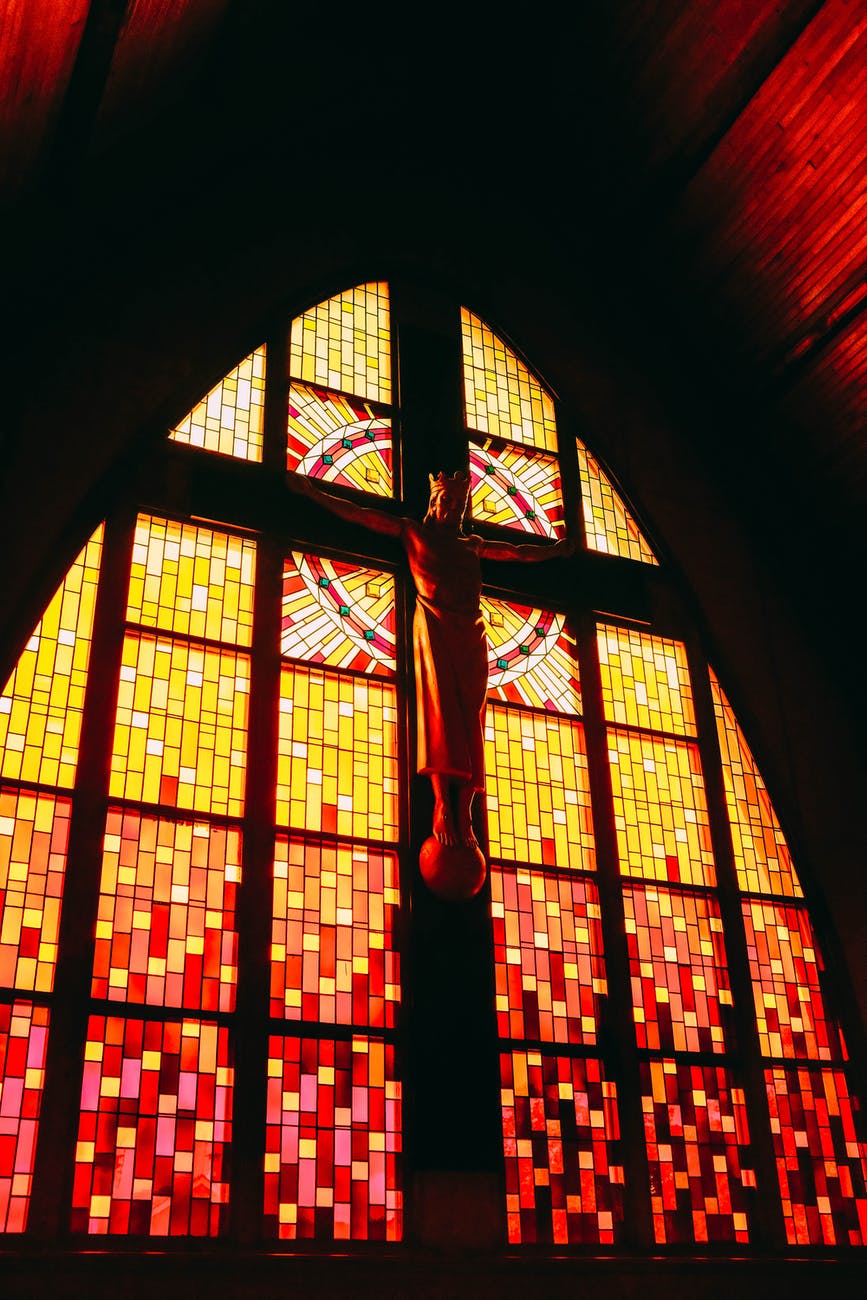
John 12:44-50 – The Light of Christ

Photo by Adrien Olichon on Pexels.com

Then Jesus cried out, “Whoever believes in me does not believe in me only, but in the one who sent me. The one who looks at me is seeing the one who sent me. I have come into the world as a light, so that no one who believes in me should stay in darkness.

“If anyone hears my words but does not keep them, I do not judge that person. For I did not come to judge the world, but to save the world. There is a judge for the one who rejects me and does not accept my words; the very words I have spoken will condemn them at the last day. For I did not speak on my own, but the Father who sent me commanded me to say all that I have spoken. I know that his command leads to eternal life. So, whatever I say is just what the Father has told me to say.” (NIV)

Jesus is the light of the world. (John 8:12)

Jesus told his followers they are the light of the world. (Matthew 5:14)

Simple observation: Neither Jesus nor his followers become light. They are light. So, what does that mean?

To be light means we take a particular posture toward the world. It means we have a unique role in society.

Sometimes its important to say what something is not before we talk about what it is. To be light means we are not:

  • The Judge. The incarnation of Jesus was not for the purpose of playing Sheriff in the Old West, riding into the town of this world and gunslinging the bad guys either out of town or into the cemetery. Just because the world shot the sheriff, does not mean they’re off the hook for not shooting the deputy. There is judgment coming. It’s just that you nor I are the judge. “Do not judge,” said Jesus, unless you’re interested in getting judged yourself. (Matthew 7:1-2)
  • Cave-Dwellers. Rabbit-hole Christians. Dorm toads. Or any other metaphor for separating oneself from society and hiding out. Cave-dwellers want to hide out and start little fires that will only warm themselves. A rabbit-hole Christian scurries from hole to hole trying to avoid the world. Dorm toads never leave the friendly confines of their apartment swamp.

Rather than judging and hiding, people of the light possess are:

  • Encouragers. They speak constructive words of edification. Encouragers know there is a bit of light in everyone, so they see through the darkness to the good which can be enlightened and called forth in others. People who encourage have a glow about them which is attractive and winsome.
  • Aware. Being light causes one to see themselves in high definition. Both the image of God and the fallen nature of humanity is seen and held together. People of the light are aware of their identity. They are then able to act with humility, gentleness, and meekness. Since they know they are infinitely loved by God, this brings a great freedom to speak and act with confidence.
  • Believers. Faith begins with receiving grace. It then works its way from an internal truth to an outward expression. People of the light follow in the footsteps of their Lord Jesus. They love, lead, and linger in society as spiritual beings who help illumine the path.
  • Merciful. Since they were once in darkness themselves, people of the light set aside pre-meditated judgment and deal compassionately with those who are spiritually blind.
  • Pure. The light has its way of exposing impurities. People of the light squarely face their own reality and purposely seek purity in all their dealings with society.
  • Peacemakers. Being characterized by the light means we not only possess personal peace; we also make peace through creating and sustaining harmonious relations with others. The light enables us to be spiritual ombudsmen who carefully and effectively bring peace between warring factions.

Jesus is the light of the world. We are the light of the world. That means we do not hide but are present and involved in our families, neighborhoods, communities, local institutions, national affairs, and world problems. Being characterized as followers of Jesus causes a person and a faith community to be visible, to show the world who Jesus is, and what he is like.

The earliest followers of Jesus allowed their light to shine in the world through:

  • Taking in unwanted children, orphans, and babies left exposed to infanticide.
  • Ministry to the sick and dying during times of plague and disease, as well as visiting those in prison without families.
  • Help and kindness to the poor, foreigners, immigrant strangers, and widows, especially when no one else would.

Where light is present, no one needs to remain in darkness. Even a small flickering flame can illumine enough to make a way. And when many small flames come together, there is a great light for all to see.

Our message is not about ourselves. It is about Jesus Christ as the Lord. We are your servants for his sake. We are his servants because the same God who said that light should shine out of darkness has given us light. For that reason, we bring to light the knowledge about God’s glory which shines from Christ’s face. (2 Corinthians 4:5-6, GW)

May the light of Christ, the living Word, dispel the darkness of our hearts so that we may walk as children of light and sing the praises of a merciful God throughout the world. Amen.

Acts 7:30-40 – Full Acceptance, Not Partial

“After forty years had passed, an angel appeared to Moses in the flames of a burning bush in the desert near Mount Sinai. When he saw this, he was amazed at the sight. As he went over to get a closer look, he heard the Lord say: ‘I am the God of your fathers, the God of Abraham, Isaac and Jacob.’ Moses trembled with fear and did not dare to look.

“Then the Lord said to him, ‘Take off your sandals, for the place where you are standing is holy ground. I have indeed seen the oppression of my people in Egypt. I have heard their groaning and have come down to set them free. Now come, I will send you back to Egypt.’

“This is the same Moses they had rejected with the words, ‘Who made you ruler and judge?’ He was sent to be their ruler and deliverer by God himself, through the angel who appeared to him in the bush. He led them out of Egypt and performed wonders and signs in Egypt, at the Red Sea and for forty years in the wilderness.

“This is the Moses who told the Israelites, ‘God will raise up for you a prophet like me from your own people. ’He was in the assembly in the wilderness, with the angel who spoke to him on Mount Sinai, and with our ancestors; and he received living words to pass on to us.

“But our ancestors refused to obey him. Instead, they rejected him and, in their hearts, turned back to

Egypt. They told Aaron, ‘Make us gods who will go before us. As for this fellow Moses who led us out of Egypt—we don’t know what has happened to him!’ (NIV)

We humans are a confusing paradox of sinner and saint. We are majestic people, created in the image and likeness of a good God. We are also profoundly fallen, touched by sin in every area of our lives. Our hearts exist with both light and darkness, having the capacity for both incredible altruism as well as inexplicable evil.

So then, it will do no good to retreat into binary definitions of people as being either good or bad. No, we shine and shadow at the same time. What really gets us into a terrible mess is when we ignore or deny our shadow selves. We then demonize the other while claiming purity for ourselves.

This is precisely what occurred with Stephen and a group of his fellow Jews who refused to acknowledge their shadow side. And it resulted in Stephen’s stoning and death. Whereas Stephen lifted and brought to light the unseemly aspects of their collective heritage, the people wanted nothing to do with it. In our present day, the response might be something like, “Quit being so negative. We focus on the positive. Expel this recalcitrant troublemaker once and for all!”

Oy. Acceptance cuts two ways. We must accept both our blessings and our curses. And acceptance of reality will not occur apart from a solid self-acceptance of who we are and how we are feeling in any given situation. On the practical level, it works something like the following story…

Several years ago, I went on a leadership retreat in the Canadian wilderness. We were so far out in the sticks that we needed special first aid training before leaving because if someone got severely injured it would be hours before any medical attention could be received. There was no cell phone service, no towns, no anything except mile after square mile of wilderness. 

One day, it was very windy and several of us were on a lake canoeing to a destination. It was late May, which means the water was still ice cold in Canada. One of the canoes capsized and we had to act quickly and deliberately – which was no small feat in a stiff wind. More than fifteen minutes would result in hypothermia for the two people in the water.

I did not like being in that situation. In fact, I didn’t much like the Canadian wilderness. Too many black flies and giant mosquitoes for me. My shadow side was coming out. But here I was, and I had to accept the reality I was in. One of the lessons I learned in that moment was that acceptance can sit alongside other reactions and emotions.

For example, a person can be outraged by an injustice, as Stephen was, and accept that it is a reality. Acceptance does not mean complacency or giving up. We can accept something while at the same time trying to make it better.

I also needed to accept what was happening inside of me. I was cold and worried. Trying to push those feelings away would have only added to the stress of the situation. If I failed to accept what was true about myself, I would be less able to deal with the situation, and so, would compromise my ability to help two people at risk.

I needed to accept the whole circumstance, including myself. Accepting what is inside gave me more influence over the situation, not less. Self-acceptance became the key to acceptance of unwanted conditions, and more importantly, acceptance of one another as human beings.

In that moment of rescuing two people (which ultimately proved successful) I became aware of a part of myself – the part that gets afraid and irritated – and chose not to stuff it or deny its existence. I became the guy who talked to the panicked people in the water and kept them as calm as possible so that the others could get them out. I was able to do my part to help fearful people because I acknowledged and accepted my own fear.

Unlike my situation, however, Stephen’s experience ended in martyrdom. Just because we respond rightly is no guarantee that everything will work out for our benefit. Rather, we say and do the things we must say and do, while leaving the results to a sovereign Lord. It is our responsibility to work on ourselves, not others. And acceptance is the path to get there, all of it, not just part of it.

Jesus, let your mighty calmness lift me above my fears and frustrations. By your deep patience, give me tranquility and stillness of soul in you. Make me in this, and in all things, more and more like you. Amen.

John 12:36-43 – The Shadow Self

“Believe in the light while you have the light, so that you may become children of light.” When he had finished speaking, Jesus left and hid himself from them.

Even after Jesus had performed so many signs in their presence, they still would not believe in him. This was to fulfill the word of Isaiah the prophet:

“Lord, who has believed our message
    and to whom has the arm of the Lord been revealed?”

For this reason, they could not believe, because, as Isaiah says elsewhere:

“He has blinded their eyes
    and hardened their hearts,
so they can neither see with their eyes,
    nor understand with their hearts,
    nor turn—and I would heal them.”

Isaiah said this because he saw Jesus’ glory and spoke about him.

Yet at the same time many even among the leaders believed in him. But because of the Pharisees they would not openly acknowledge their faith for fear they would be put out of the synagogue; for they loved human praise more than praise from God. (NIV)

The season of Lent is a time of preparation for Easter, and of repentance from sin. It is a time to consider our ways and the state of our hearts. In doing so, we find that the grace of God in Christ can heal all wounds. 

Today’s Gospel lesson gives perhaps the most succinct and convicting statement about the shadow places of our lives. Many of the religious authorities believed in Jesus, but they did not speak of it because they were afraid of being put out of the synagogue by the Pharisees. When push came to shove, they cared more for human approval than for God’s glory.

The word “glory” has its roots in the Old Testament and has the meaning of being heavy or having weight. In other words, we might picture God descending to earth among humankind with divine gravity and heft. If we were back in the ‘70s we could say, “heavy, man, heavy!” Glory is really a reference to God’s presence among us. So, if we plug this thought into the religious authority’s attitude, we see that they preferred the presence and accolades of their peers to God. To put the matter even more succinctly, the leaders wanted the limelight and would push their weight around to get it.

Carl Jung (1875-1961) described this hidden shadow self as an unconscious aspect of the human personality. In other words, the shadow results from the conscious self being unaware or unconscious concerning areas of its own personality. Without the light of conscious awareness, the shadow self runs amok within the psyche of a person and far too often calls the shots in speaking and behavior.

“Everyone carries a shadow,” Jung wrote, “and the less it is embodied in the individual’s conscious life, the blacker and denser it is.” (Psychology and Religion, 1938). According to Jung, the shadow side of a person is prone to psychological projection, in which a perceived personal inferiority is recognized as a perceived moral deficiency in someone else. If those projections remain hidden, they eventually come out sideways by harming others because there is a dark illusion, even delusion, that others are stealing what is rightfully mine. Hence, the sinless Jesus is tortured and killed by those who think they are doing a good thing.

It is easy to be hard on the religious rulers in the New Testament, but this is Lent, and, so, we must shine the light of Scripture upon ourselves. This is the time to deliberately gain awareness of our own shadow selves. Perhaps the burning question for all believers at this time of year is: Do I seek the presence of God more than the presence of anything or anyone else?  

Over the decades, I have preached in many churches. Many of them have empty pews or seats in the first several rows during worship. I admit that has always bugged me. I don’t like it. There are times when I am more concerned about the presence of people than the presence of God in a worship service. Maybe you live in fear at work and are more concerned about the presence of people around you than the presence of God, so you keep quiet when you ought to speak up or turn a blind eye to the shadows of an organization.

Lent is not just about identifying sin; it is also about receiving grace. So, let us find that the cleansing work of the Spirit through the work of Jesus is active through our confession of sin. And let us pursue the glory and praise of God in all we do and say as grace permeates deep in our souls. Let the shadows dispel, and the light shine, for the benefit of self and others.

Glorious God lighten our darkness—be our true light. Keep us from the powers of darknessthe perils and dangers of the night. Shine as a kindly light in our spiritual darkness—in our mental turmoil and anxious confusion. We pray this for the love of your Son, our Savior, Jesus Christ who with you and the Holy Spirit lives and reigns as one God, now and forever. Amen.