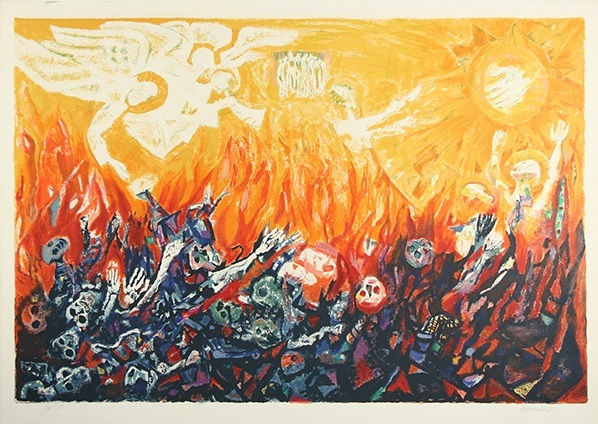
Speak To the Dry Bones (Ezekiel 37:1-14)

Valley of the Dried Bones, by Abraham Rattner (1895–1978)

The power of the Lord came over me. The Lord brought me out by his Spirit and put me down in the middle of a valley. The valley was filled with bones. He led me all around them. I saw that there were very many bones at the bottom of the valley, and they were very dry.

Then he asked me, “Son of man, can these bones live?”

I answered, “Only you know, Almighty Lord.”

Then he said to me, “Prophesy to these bones. Tell them, ‘Dry bones, listen to the Lord’s word. This is what the Almighty Lord says to these bones: I will cause breath to enter you, and you will live. I will put ligaments on you, place muscles on you, and cover you with skin. I will put breath in you, and you will live. Then you will know that I am the Lord.’ ”

So I prophesied as I was commanded. While I was prophesying, suddenly there was a rattling noise, and the bones came together, one bone attaching itself to another. As I looked, I saw that ligaments were on them, muscles were on them, and skin covered them. Yet, there was no breath in them.

Then the Lord said to me, “Prophesy to the breath! Prophesy, son of man. Tell the breath, ‘This is what the Almighty Lord says: Come from the four winds, Breath, and breathe on these people who were killed so that they will live.’ ”

So I prophesied as he commanded me, and the breath entered them. Then they came to life and stood on their feet. There were enough of them to form a very large army.

The Lord also said to me, “Son of man, all the people of Israel are like these bones. The people say, ‘Our bones are dry, and our hope has vanished. We are completely destroyed.’ So prophesy. Tell them, ‘This is what the Almighty Lord says: My people, I will open your graves and take you out of them. I will bring you to Israel. Then, my people, you will know that I am the Lord, because I will open your graves and bring you out of your graves. I will put my Spirit in you, and you will live. I will place you in your own land. Then you will know that I, the Lord, have spoken, and I have done it, declares the Lord.’ ” (God’s Word Translation)

Dry. It might be good for humor or a martini. Dry, however, doesn’t feel good when it’s a time of spiritual dryness.

Perhaps you are dry. It seems the entire world is dry. Wars, conflict, death, violence, uncertainty, unrest, and upset people everywhere is evidence that there is dryness across the earth. Many institutions, organizations, companies, and faith communities have become so withered and dry, that they have folded and died.

The hard circumstances of our world, stress in our families, and challenging personal lives may easily create anxiety, and, so, parch our souls and leave our spirits bone dry. There is, however, a God who can breathe new life into us and move us from old-worn ruts in our thinking, feeling, and behaving, to renewed ways of being in the world. 

The prophet Ezekiel’s vision is a promise and a hope of resurrection, revival, and new life. Regardless of who we are and the situations in front of us, we are all displaced people – cast out of Eden and in need of restoration. 

We, along with the ancient Israelites, are in exile and long to return to our true home with God. Along with St. Augustine we declare that our “hearts are forever restless until they find their rest in God.”

Maybe you are presently experiencing the dry bones of hopelessness and despondency. Perhaps you are in a dark night of the soul where all of life seems like one huge rut. It could be you are wondering if God is really listening, or is even there at all, because of the dry bones surrounding you.

In my work as a hospital chaplain I often encounter patients who are, ironically, bone dry from too much drinking. Their alcoholism is like a massive desert littered with thousands of dry bones. Attempting to reanimate themselves while dulling the pain of incredibly hard dry circumstances, they drink liter after liter of “spirits” to replace the dead spirit inside them. Some become so dry and dead inside their immaterial selves, that they seek to end their material lives through suicide.

But it need not be this way. We might believe we will be able to live life and pursue God better without danger or hardship – that somehow difficulty is not to be part of life. The dry bones exist, however, as an opportunity for God to give life. That’s why Alexander Solzhenitsyn’s reaction to his exile in a Soviet labor camp in Siberia was to bless it, because it was there he said:

“I discovered that the meaning of earthly existence lies not, as we have grown used to thinking, in prospering, but in the development of the soul.”

Alexander Solzhenitsyn

God not only gives life; God restores life. And this is an important truth to know and remember in the inevitable dry times of our lives. God is not only a helper; the Lord reanimates us from spiritual rigor mortis to lively resurrection through breathing on us. And this is done for a reason. Jesus came to his disciples after his resurrection and said:

God resuscitates us for a purpose, so that we might be a blessing to the world. Faith is not only a possession to keep, but a gift to give. We glorify God in loving one another and loving the world as Jesus did.  God could have resurrected the bones without Ezekiel. Instead, the Lord used Ezekiel and had him participate in the revival by speaking to the bones. 

Such a challenge to speak to the dry bones can seem overwhelming to us. What do you do when your life is upended, even shattered – when such a profound change comes to you that it is impossible for your life to be as it was? 

The questions and commands of God seemed totally absurd to Ezekiel, speaking to dead dry bones. Yet methinks we ought to operate more in the realm of the absurd than in the realm of the safe routine.

Perhaps we ought to expect our faith to be exercised and look for God to breathe new life into the dead and decaying. To believe that something, someone, or even myself can change is to have internalized this amazing story of dry bones living again. 

Our self-imposed graves cannot hold us because God is among us.

We need a genuine heaven-sent, Spirit-breathed, glorious reanimation in which God sends reviving grace and raises the dead. 

Lord of Resurrection, please be attentive to our prayers; and make what is impossible possible:

For those without hope – feeling dried up and cut off from you – open their graves and bring them back to the land of the living.

For those spiritually oppressed – held captive by sin – release them from their chains and let them go! For those who weep – lost and lifeless in a tomb of fear and shame – give them the peace of your presence, and show them what your love can do.

For those complacent – withering on the vine, and living a dull dry existence without any spiritual vigor – awaken them, O Lord! Breathe into them new life!

Pour out your Spirit, gracious God, and awaken all kinds of people to a revival of obedience, love, and courage.

May your people be so full of your Spirit that life comes rolling off our tongues and the strength of life empowers our hands for service. Amen.

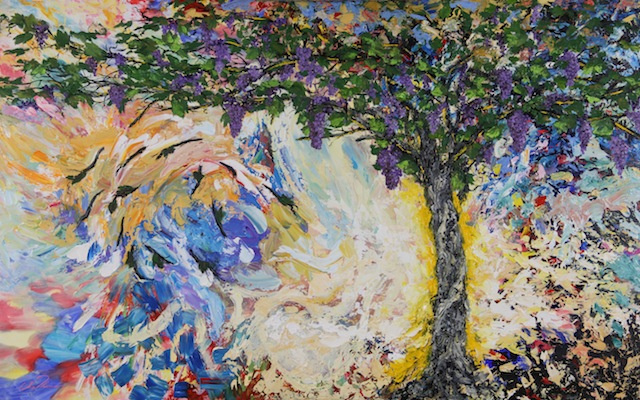
Remain In Me (John 15:1-8)

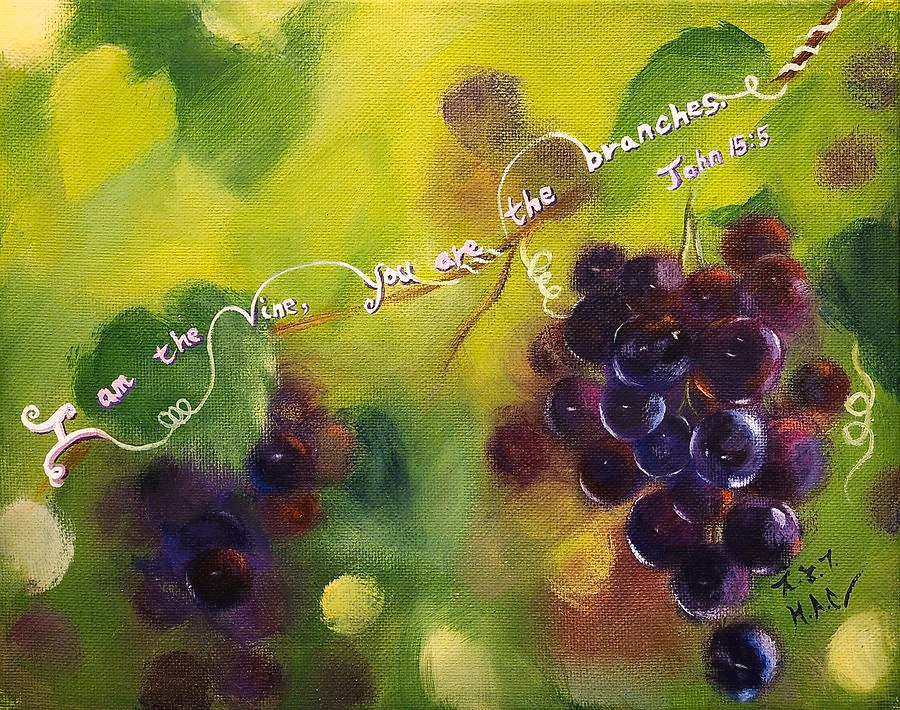
The Vine and the Branches, by Irene Thomas

I am the true vine and my Father is the gardener. He cuts off every branch in me that bears no fruit, while every branch that does bear fruit he prunes so that it will be even more fruitful. You are already clean because of the word I have spoken to you. Remain in me, as I remain in you. No branch can bear fruit by itself; it must remain in the vine. Neither can you bear fruit unless you remain in me.

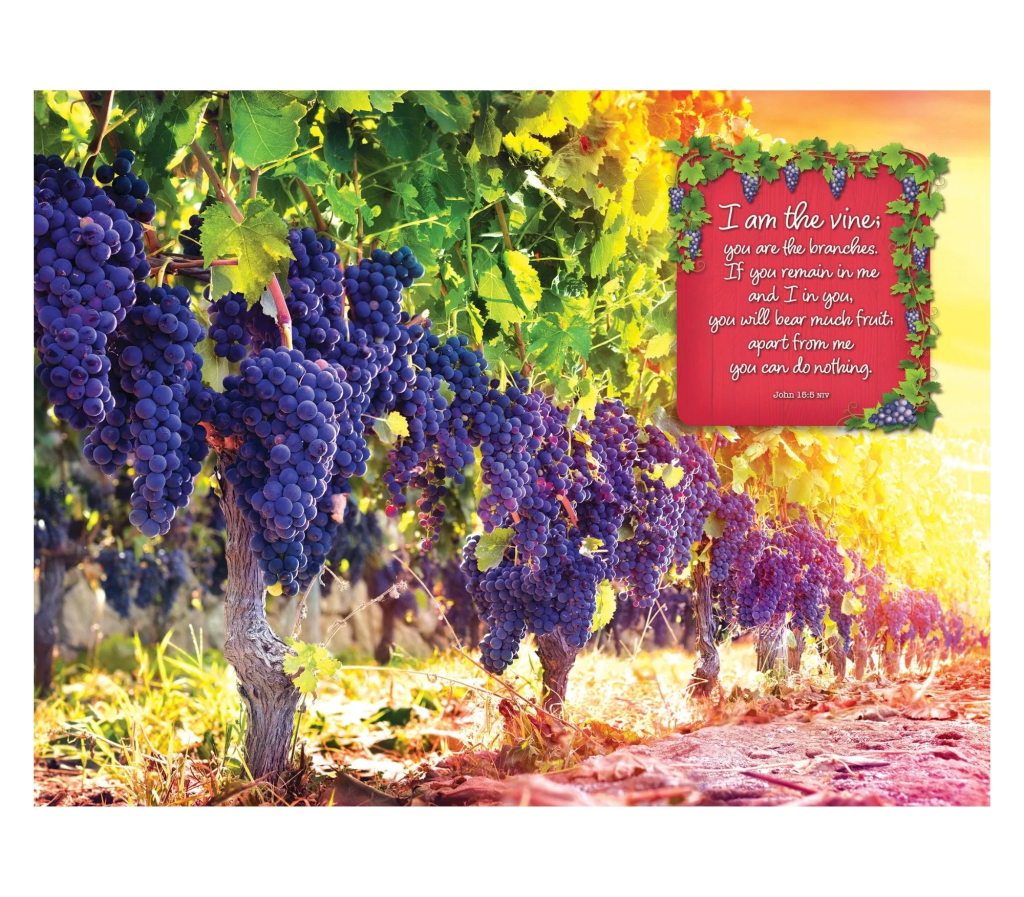
I am the vine; you are the branches. If you remain in me and I in you, you will bear much fruit; apart from me you can do nothing. If you do not remain in me, you are like a branch that is thrown away and withers; such branches are picked up, thrown into the fire and burned. If you remain in me and my words remain in you, ask whatever you wish, and it will be done for you. This is to my Father’s glory, that you bear much fruit, showing yourselves to be my disciples. (New International Version)

In the New International Version of the Bible, the word “remain” is repeated 8 times in 8 verses. The original Greek word translated as “remain” is μένω (pronounced “men-oh”). It means to linger in the present moment; to be mindful to ourselves and our situations; to stay connected.

Remaining with Jesus means we that have continual unbroken connection of unity and fellowship with him.

In order to have a connection, there must be two ends to connect. The Jesus connection is always there. We are the other connection. And, frankly, we can be flaky – pulling away and coming close – which is why Jesus gave a repeated invitation to keep the connection.

Some other translations of John 15:4 may help to fill out an understanding of this invitation to remain in Christ (emphasis mine):

Stay joined to me, and I will stay joined to you. Just as a branch cannot produce fruit unless it stays joined to the vine, you cannot produce fruit unless you stay joined to me. (CEV)

Live in me, and I will live in you. A branch cannot produce any fruit by itself. It must stay attached to the vine. In the same way, you cannot produce fruit unless you live in me. (GW)

Abide in Me, and I in you. As the branch cannot bear fruit of itself, unless it abides in the vine, neither can you, unless you abide in Me. (NKJV)

Stay connected to me, and I will stay connected to you! A branch cannot produce fruit on its own but only if it has a vital connection to the vine. In the same way, there’s no way you can produce fruit at all, unless you have a meaningful connection with me. (my own translation)

The task of every Christian is to remain connected to Jesus. So, the question is: How do we keep the connection without breaking it? How can we be fruitful?

Focus on the Relationship

Christianity, at its core, is a living relationship with Jesus. Yes, doctrine is important; and it’s necessary to know the basic tenets of Christian faith. Yet, any knowledge we gain about Christianity is to be channeled into developing the relationship.

By Helian Cornwell

Bible trivia is only as good as the understanding we apply to build the relationship. Knowledge makes us proud of ourselves, while love makes us helpful to others. Knowledge makes us feel important, yet love strengthens the Church. Knowledge puffs up but love builds up. (1 Corinthians 8:1)

Christ’s redemption – his incarnation, holy life, death, resurrection, and ascension – are meant to restore the severed relationship with humanity. Only knowing doctrinal truth is not the same as using the doctrines to connect with God in a loving relationship.

It takes planning, dedication, time, and effort to grow and maintain our relationship with Jesus Christ. If we fail to use our time and energy on that relationship, then the leaves on the branch begin to wither.

Scripture, silence, solitude, community, prayer, giving, and fasting have always been at the center of Christian practices designed to put us in a position to hear and receive from God.

Relate Well to the Other Branches

The Church is a living growing community. Christ and the Church have a vital union with each other. I used to live in a place where there was a tree that had grown up next to an old fence post. The tree grew tall and engulfed the post to the degree that now you can only see part of the fence post.

To remove the post, you would have to remove the tree; the two have become one. Not only are we connected to the trunk, but we’re also connected to each other. We are all part of the same vine; we aren’t separate vines. So, we all need to do our part in the vine’s system.

Keep Close to the Vine

My grandmother had a grapevine in her backyard when I was a kid. I have firsthand understanding that the sweetest, juiciest, biggest, and best tasting grapes are found in the middle, securely next to the vine’s stem.

The sour grapes are found at the end of the branches. Show me a sourpuss Christian, and I’ll show you a Christian who is not close to Christ. Show me a sweet Christian and I’ll show you a believer who daily works at their close connection with Jesus.

Pruning is Necessary

Healthy vines need pruning, at least once a year; ideally, twice a year, in the Spring before budding, and in Autumn, after the harvest. Without pruning, the vine’s ability to produce good and abundant grapes is compromised. The grapevine’s branches need to be kept short because the nutrients are concentrated in and near the vine stem.

Pruning hurts. From the perspective of us branches, pruning feels like judgment. But it isn’t. Even though pruning is painful, it makes us healthier and tastier.

It’s better to do a few things well, rather than try and do a lot of things for which there is limited time and energy. So, do some spiritual pruning twice a year!

Know Why You are Connected

Yes, Christians have a connection with Jesus so that we are saved from sin, death, and hell. And, yes, we are connected to experience abundant life. Yet, the goal of that connection is to produce succulent fruit.

If there are no grapes on the vine, the vine is useless. Grapevines exist to produce grapes. Christians and Churches exist for the life of the world, to produce the fruit of righteousness consistent with our Christ-connected union: love, joy, peace, patience, kindness, goodness, faithfulness, gentleness, and self-control. (Galatians 5:22-23)

The Church is not an end in itself, but exists for the life of the world. Using other metaphors, Jesus said:

“You are the salt of the earth. But if the salt loses its saltiness, how can it be made salty again? It is no longer good for anything, except to be thrown out and trampled underfoot.

“You are the light of the world. A town built on a hill cannot be hidden. Neither do people light a lamp and put it under a bowl. Instead, they put it on its stand, and it gives light to everyone in the house. In the same way, let your light shine before others, that they may see your good deeds and glorify your Father in heaven.” (Matthew 5:13-16, NIV)

Pray

If we live in union with Christ – with the words and ways of Jesus powerfully within us—then ask for anything, and it will be done. Prayer is both an event that anyone can do, as well as a spiritual practice that needs growth and development.

The words of Jesus are the nutrients for our spiritual life. When those words find a home within us, there is a divine/human conversation. Christ promises that if we just ask, we’ll receive.

As the relationship with Christ grows, we learn to be thoughtful about our asking. Flippantly or selfishly asking for things disrespects the connection we enjoy with God. Claiming or demanding answers to prayer demeans the relationship. We can also dishonor God by simply not asking, at all.

Prayer is the delivery system for receiving our nutrients; and is also the means of delivering fruitful blessing so that the world might live. Jesus modeled a prayer for us that is grounded in connection and unity with the Father:

I am not praying just for these followers. I am also praying for everyone else who will have faith because of what my followers will say about me. I want all of them to be one with each other, just as I am one with you and you are one with me. I also want them to be one with us. Then the people of this world will believe that you sent me.

I have honored my followers in the same way that you honored me, in order that they may be one with each other, just as we are one. I am one with them, and you are one with me, so that they may become completely one. Then this world’s people will know that you sent me. They will know that you love my followers as much as you love me.

Father, I want everyone you have given me to be with me, wherever I am. Then they will see the glory that you have given me, because you loved me before the world was created. Good Father, the people of this world don’t know you. But I know you, and my followers know that you sent me. I told them what you are like, and I will tell them even more. Then the love that you have for me will become part of them, and I will be one with them. (John 17:20-26, CEV)

We must live and pray consistent with who we are, and what our mission is. The Church is to be one as God is One. Christians are to pray for unity because the triune God is always united. Believers everywhere need to remain in Christ through a vital connection of loving God and loving their neighbors. Amen.

Life (Genesis 1:20-2:4a)

The Creation of Heaven and Earth, by Unknown artist, c.18th century

God said, “Let the waters swarm with living things, and let birds fly above the earth up in the dome of the sky.” God created the great sea animals and all the tiny living things that swarm in the waters, each according to its kind, and all the winged birds, each according to its kind. God saw how good it was. Then God blessed them: “Be fertile and multiply and fill the waters in the seas, and let the birds multiply on the earth.”

There was evening and there was morning: the fifth day.

God said, “Let the earth produce every kind of living thing: livestock, crawling things, and wildlife.” And that’s what happened. God made every kind of wildlife, every kind of livestock, and every kind of creature that crawls on the ground. God saw how good it was. Then God said, “Let us make humanity in our image to resemble us so that they may take charge of the fish of the sea, the birds in the sky, the livestock, all the earth, and all the crawling things on earth.”

God created humanity in God’s own image,
        in the divine image God created them,
            male and female God created them.

God blessed them and said to them, “Be fertile and multiply; fill the earth and master it. Take charge of the fish of the sea, the birds in the sky, and everything crawling on the ground.” Then God said, “I now give to you all the plants on the earth that yield seeds and all the trees whose fruit produces its seeds within it. These will be your food. To all wildlife, to all the birds in the sky, and to everything crawling on the ground—to everything that breathes—I give all the green grasses for food.” And that’s what happened. God saw everything he had made; it was supremely good.

There was evening and there was morning: the sixth day.

The heavens and the earth and all who live in them were completed. On the sixth day God completed all the work that he had done, and on the seventh day God rested from all the work that he had done. God blessed the seventh day and made it holy, because on it God rested from all the work of creation. This is the account of the heavens and the earth when they were created. (Common English Bible)

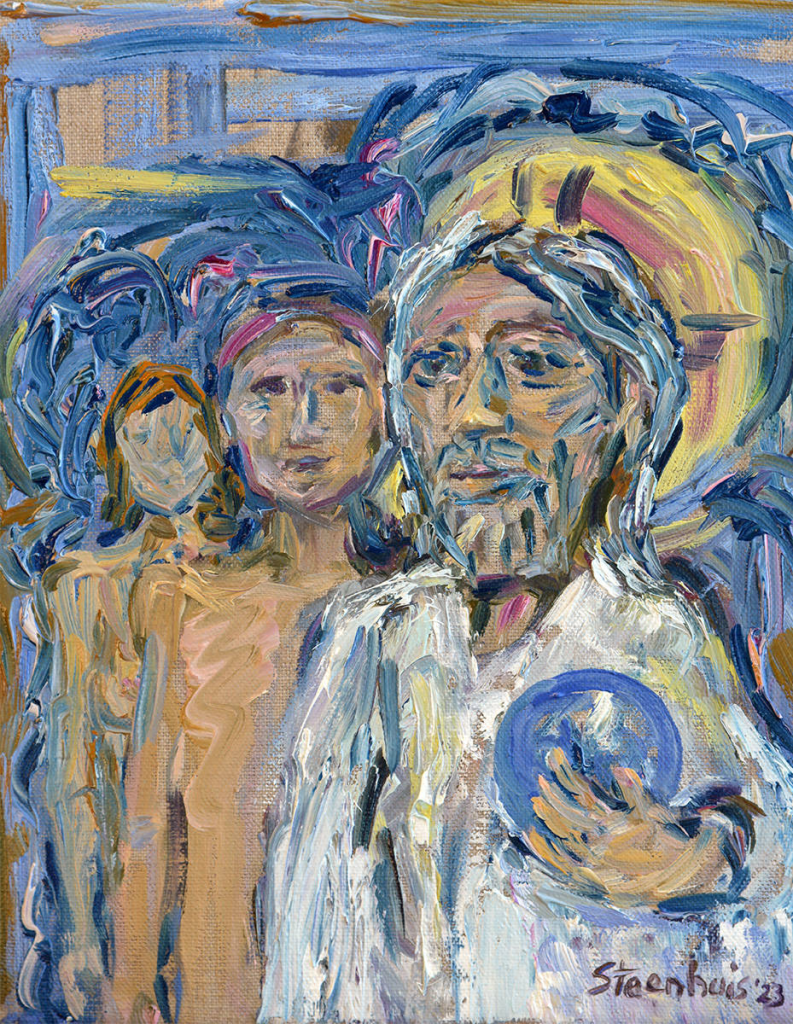
God Created Man in His Image – Male and Female, by Jill Steenhuis

In this Christian season of Eastertide, believers remember and celebrate new life in Jesus Christ. In today’s Old Testament lesson, the lectionary reminds us of original life – when God created the heavens and the earth.

The Beginning of Life

This was the beginning, before there were any words like sin, disobedience, guilt, and shame. This was the time when the original people, Adam and Eve, knew nothing about trying to chase after unconditional love. They had no concept of estrangement or heartache. Everything was fresh and alive and shiny. Disappointment, hurt, and sadness were unknown to them. Everywhere, the earth was teeming with abundant life.

God made it all; and all that was created was very good, supremely reflecting the goodness of the Creator. Life existed everywhere. The predictable and consistent rhythms of the universe were in place. Day and night, work and rest, creation and care, were all woven into the fabric of the world’s sights and seasons. The possibilities for growth were incredible. Life was indeed good.

“New” was simply part of all there was. Without any want or need, every day was an adventure of discovering all the newness which existed.

The Complicated Life

We all, however, know that it did not remain this way. People are now all too familiar with the myriad ways of injustice, and with the film of sin that covers the entire world like a noxious pollutant. And it is this situation, of course, which created the need for a “new” life, because the present life had become a moldy old leftover in the refrigerator of a life that doesn’t keep anything cold nor fresh.

People were created as good human beings. Even though sin has profoundly touched everything in creation, goodness is still within us as God’s image-bearers. The later introduction of human sin into the world in no way whatsoever removes the inherent stamp of the divine image upon us.

Humanity is the only creature who bears this likeness to God. We are related to the animal world, having been created on the same day, and sharing the same blessings of life. Yet, people are distinctive, set above all other creatures.

The Responsible Life

This is why people are given dominion over all other creatures. This is not a claim to privilege; it is, however, very much a claim to responsibility. People have been tasked with being faithful stewards of creation, entrusted with caring for other creatures and the created order.

And humanity was created as both male and female, together expressing the will and character of God in creation as they tend to it and care for it. Together with God, we are relational beings, and not just a race of individuals inhabiting the same earth.

God is a social being, existing as a community within the Godhead. Therefore, to exist as an image-bearer of God means that people are social creatures who need community – with both God and other people.

After God did all the work of creating the world with all its plants and animals and birds and fishes and people, God “rested.” This is why the seventh day is set aside as sacred; its different than the other days, sort of like how people are similar but different from the other creation.

God is clearly separated from the work and the creation itself, that is, God is transcendent and above all things as the Creator. The world is good, but the world is not divine. In the same way, by observing a day of rest, humanity recognizes and affirms and remembers that the work they have done is not divine.

Our human works, good as they may be, are not a thing to be worshiped or equated with God. Therefore, the Sabbath both celebrates the creation and the created order of things, as well as separates us from the idol worship of our hands.

To live into our inherent image of God means that we will work hard and tend to the gardens that are around us. Yet, at the same time, we will understand that in doing our responsible tasks, people are to live in community and love one another, without idolizing any other part of creation or what we creatively build with our own two hands. That is for God alone, who is distinct from all that God has created.

God our Father, you created the world and sent your own Son to live among us, made of the same stuff, breathing the same air, marveling at sunrise and sunset just as we do. Help us to participate in the life around and within us as your life, as you living in us and we living in you and in each other.

God of love and life, restore us to your peace, renew us through your power and teach us to love all that you have created and to care for the earth as your gift and our home. Amen.

Life Through Death (John 12:20-33)

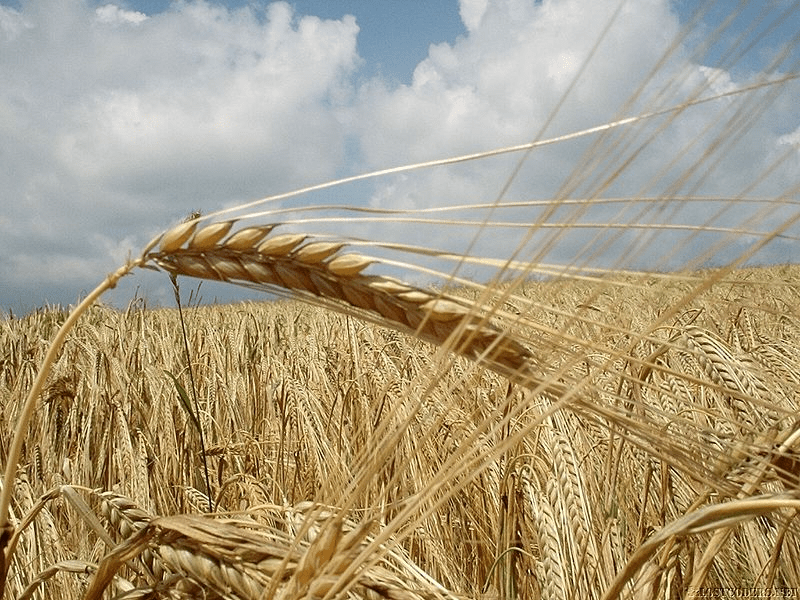
Now among those who went up to worship at the festival were some Greeks. They came to Philip, who was from Bethsaida in Galilee, and said to him, “Sir, we wish to see Jesus.” Philip went and told Andrew, then Andrew and Philip went and told Jesus. Jesus answered them, “The hour has come for the Son of Man to be glorified. Very truly, I tell you, unless a grain of wheat falls into the earth and dies, it remains just a single grain, but if it dies it bears much fruit. Those who love their life lose it, and those who hate their life in this world will keep it for eternal life. Whoever serves me must follow me, and where I am, there will my servant be also. Whoever serves me, the Father will honor.

“Now my soul is troubled. And what should I say: ‘Father, save me from this hour’? No, it is for this reason that I have come to this hour. Father, glorify your name.” Then a voice came from heaven, “I have glorified it, and I will glorify it again.” The crowd standing there heard it and said that it was thunder. Others said, “An angel has spoken to him.” Jesus answered, “This voice has come for your sake, not for mine. Now is the judgment of this world; now the ruler of this world will be driven out. And I, when I am lifted up from the earth, will draw all people to myself.” He said this to indicate the kind of death he was to die. (New Revised Standard Version)

The fifth Sunday in Lent is now here. We are quickly approaching Jerusalem. Holy Week will be here before you know it. 

Why is this all significant? Because Jesus is important. By taking advantage of Lent with its focus on spiritual discipline, prayer, and repentance, we come face-to-face with the shadowy parts of our selves. We discover that within us there is the pull to hold-on to unhealthy rhythms and habits of life, as well as a push to arrange our lives with the fragmentation of disordered love.

Perhaps our reflexive response to things we do not like about ourselves is to either use sheer willpower to change or try to somehow manage our brokenness, as if we could boss our way out of darkness. The problem and the solution are much more radical than we often would like to admit.

We must die. 

Yes, you heard that right. This is the teaching of Jesus – to die to ourselves. Sin cannot be managed or willed away – it must be eradicated and completely cut out, like the cancer it is. Transformation can only occur through death. 

Jesus used the familiar example of a seed to communicate his point. A tiny little seed can grow, break the ground, and develop into something which provides sustenance for others. It does no good to remain a seed in the ground.

Christ was only telling others to do, what he himself was willing to do. Jesus is the ultimate example of the one who died to himself, and literally died for us. Through suffering and death, he secured deliverance for us from guilt and shame. 

By his wounds we are healed. Through his tortuous death a resurrection became possible – and we must always remember that there must be a death if there is to be a resurrection. Death always precedes life. There is suffering before glory.

Through dying to self, and following Jesus, there is the hope of transformative change which the world so desperately needs. If we persist in making puny attempts at trying to straddle the fence in dual/rival kingdoms, we will be spiritually schizophrenic and left with a divided soul. 

Following Jesus – leaving all to walk with him – is true repentance and authentic discipleship. The act of journeying with Christ is the means to a new life. Change is possible by letting Jesus Christ be the center from which all of life springs.

Maybe you think I’m being too forceful, too insistent about this Jesus stuff. 

Yes, you have perceived well. I am being quite single-minded about the need for dying to self and living for Christ. 

Somehow, within many corners of Christianity, this wrongheaded notion that suffering is not God’s will has made it into the life of the church. But I’m here to say, on the authority of God’s Holy Word (not to mention your own internal gut and conscience) that dying to ourselves is necessary. And it hurts. The epistle reading for today bears this out:

In the days of his flesh, Jesus offered up prayers and supplications, with loud cries and tears, to the one who was able to save him from death, and he was heard because of his reverent submission.  Although he was a Son, he learned obedience through what he suffered; and having been made perfect, he became the source of eternal salvation for all who obey him. (Hebrews 5:7-9, NRSV)

Christians are not above their Master. Even Christ’s life on this earth, before his death and resurrection, was marked with suffering. Even Jesus learned obedience through struggle and adversity. Jesus Christ did what he now asks of us. 

The Son gave up himself to do the Father’s will. So, we must give up ourselves in submission to King Jesus.  Jesus offered loud cries and tears, and submitted to what the Father wanted. His followers must do no less. 

We don’t get to choose which parts of Christ’s life and teaching we will adhere to, and which ones we won’t, as if Jesus were some spiritual buffet line. All who live for Jesus, follow him into the path of suffering, of death to self, and of new life through the power of his resurrection.

Those who love their life lose it, and those who hate their life in this world will keep it for eternal life.

How do we follow Jesus through dying to self? What does that mean for you and me on a practical daily basis?

Surrender

Every moment of every day is an opportunity for giving ourselves to Jesus. We have hundreds, maybe thousands, of small daily decisions with the use of our time, money, energy, and relationships. 

If we have tried to fix what is broken inside of us, we will likely just try to hastily fix the problems and the people in our lives – and then move on with getting things done on our to do list. 

Instead, there is a need to surrender ourselves – to create the sacred space for solitude and silence, prayer and repentance. 

Take the time to sit with a person in pain and listen. Reflect on how to use your money in a way which mirrors kingdom values. Begin to see your life as a holy rhythm of hearing God and responding to what he says. It takes intentional surrender to do that.

Sacrifice

Holding-on to our precious stuff and time is the opposite of sacrifice. 

Are we truly willing to give-up everything to follow Jesus? 

It is more than true that we are not Jesus. Our sacrifice and suffering are not efficacious, that is, it doesn’t deliver other people from sin. Only Christ’s death does that. Yet, we are still called to sacrifice. The Apostle Paul understood this, with a statement that I’ll let you wrestle with and mull over without comment on my part:

I am now rejoicing in my sufferings for your sake, and in my flesh I am completing what is lacking in Christ’s afflictions for the sake of his body, that is, the church. (Colossians 1:24, NRSV)

Happiness is important; but it isn’t the summum bonum of life. There is more to life than living for self. Jesus calls us to see our communities, neighborhoods, and families as a mission field of grace to a world who needs him. That takes sacrificial love on our part.

Christianity is not really a religion that’s for people who have put neat theological answers and tidy packaged certainties to all of life’s questions. 

Rather, Christianity is a dynamic religion of learning to follow Jesus, discovering how to die to self, and struggling to put Christ’s teaching and example into practice. 

Those who don’t struggle are in big trouble. But those who go through the pain of dying to themselves for the sake of their Lord, find that the fruit they harvest leads to eternal life.

May you struggle well, my friend.