
I Am Responsible and Accountable (Ezekiel 18:1-32)

The word of the Lord came to me: “What do you people mean by quoting this proverb about the land of Israel:

“‘The parents eat sour grapes,
    and the children’s teeth are set on edge’?

“As surely as I live, declares the Sovereign Lord, you will no longer quote this proverb in Israel. For everyone belongs to me, the parent as well as the child—both alike belong to me. The one who sins is the one who will die.

“Suppose there is a righteous man
    who does what is just and right.
He does not eat at the mountain shrines
    or look to the idols of Israel.
He does not defile his neighbor’s wife
    or have sexual relations with a woman during her period.
He does not oppress anyone,
    but returns what he took in pledge for a loan.
He does not commit robbery
    but gives his food to the hungry
    and provides clothing for the naked.
He does not lend to them at interest
    or take a profit from them.
He withholds his hand from doing wrong
    and judges fairly between two parties.
He follows my decrees
    and faithfully keeps my laws.
That man is righteous;
    he will surely live,
declares the Sovereign Lord.

“Suppose he has a violent son, who sheds blood or does any of these other things (though the father has done none of them):

“He eats at the mountain shrines.
He defiles his neighbor’s wife.
He oppresses the poor and needy.
He commits robbery.
He does not return what he took in pledge.
He looks to the idols.
He does detestable things.
He lends at interest and takes a profit.

Will such a man live? He will not! Because he has done all these detestable things, he is to be put to death; his blood will be on his own head.

“But suppose this son has a son who sees all the sins his father commits, and though he sees them, he does not do such things:

“He does not eat at the mountain shrines
    or look to the idols of Israel.
He does not defile his neighbor’s wife.
He does not oppress anyone
    or require a pledge for a loan.
He does not commit robbery
    but gives his food to the hungry
    and provides clothing for the naked.
He withholds his hand from mistreating the poor
    and takes no interest or profit from them.
He keeps my laws and follows my decrees.

He will not die for his father’s sin; he will surely live. But his father will die for his own sin, because he practiced extortion, robbed his brother and did what was wrong among his people.

“Yet you ask, ‘Why does the son not share the guilt of his father?’ Since the son has done what is just and right and has been careful to keep all my decrees, he will surely live. The one who sins is the one who will die. The child will not share the guilt of the parent, nor will the parent share the guilt of the child. The righteousness of the righteous will be credited to them, and the wickedness of the wicked will be charged against them.

“But if a wicked person turns away from all the sins they have committed and keeps all my decrees and does what is just and right, that person will surely live; they will not die. None of the offenses they have committed will be remembered against them. Because of the righteous things they have done, they will live. Do I take any pleasure in the death of the wicked? declares the Sovereign Lord. Rather, am I not pleased when they turn from their ways and live?

“But if a righteous person turns from their righteousness and commits sin and does the same detestable things the wicked person does, will they live? None of the righteous things that person has done will be remembered. Because of the unfaithfulness they are guilty of and because of the sins they have committed, they will die.

“Yet you say, ‘The way of the Lord is not just.’ Hear, you Israelites: Is my way unjust? Is it not your ways that are unjust? If a righteous person turns from their righteousness and commits sin, they will die for it; because of the sin they have committed they will die. But if a wicked person turns away from the wickedness they have committed and does what is just, and right, they will save their life. Because they consider all the offenses they have committed and turn away from them, that person will surely live; they will not die. Yet the Israelites say, ‘The way of the Lord is not just.’ Are my ways unjust, people of Israel? Is it not your ways that are unjust?

“Therefore, you Israelites, I will judge each of you according to your own ways, declares the Sovereign Lord. Repent! Turn away from all your offenses; then sin will not be your downfall. Rid yourselves of all the offenses you have committed, and get a new heart and a new spirit. Why will you die, people of Israel? For I take no pleasure in the death of anyone, declares the Sovereign Lord. Repent and live! (New International Version)

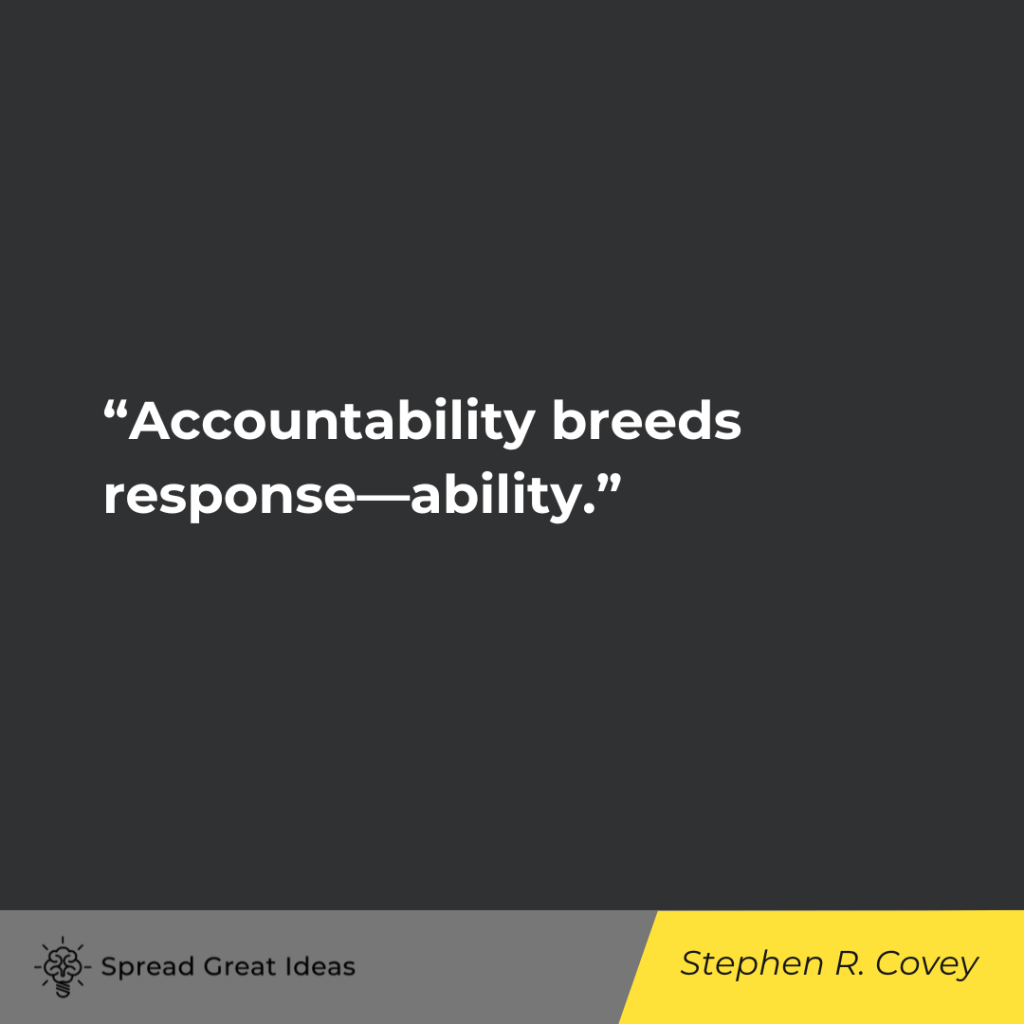
Every single one of us is accountable to one another for what we say and how we conduct ourselves. Above all, we are accountable to God for our motives, words, and actions in this life.

The flipside to stating that we are accountable, is saying that none of us are responsible for another person’s intentions, words, or actions.

Other people may influence us. We may be either participants in or victims of another’s actions. Some folks might take credit for something another person said or did. Yet, ultimately, we are responsible for our own life.

Whatever I think, say, or do is on me, period.

What’s more, one’s past actions do not replace our current actions. The prophet Ezekiel emphasized individual responsibility and accountability. All of the other Old Testament prophets addressed whole nations, and not individuals. They denounced the social, economic, and political systems and institutions, upholding communal ideals of justice.

Ezekiel communicated that children shall not be punished for their parent’s sins. Only the person who sins will face judgment.

A person ought only to pay for their own sins; punishment should not carry forward to future generations. The prophet also insisted that each individual person has the opportunity to change their behavior, and so, avoid their deserved penalty.

Every individual has the opportunity to change their personal ways of injustice or unrighteousness. For those who refuse, there is a and right and just Judge who knows how to dispense what is needed for each person – whether it is judgment to the arrogant, comfort to a victim, or justice for the underprivileged.

God cares that every person on earth receives what they need to thrive and flourish in this life. And to those who don’t give a wit about others, the Lord gives an opportunity to turn from arrogance and change.

Refusing to change, however, will end badly for the stubborn person.

The prophet Ezekiel calls on individuals to speak and act in ways that are helpful, not harmful. And whenever one harms another, that one must acknowledge the irresponsibility, because I am held accountable for what I say and do.

All words and actions come with consequences. It would do us a lot of good to consider how what we say and do (or fail to say and do) impacts the next generation of people. Everyone leaves a legacy of some sort – whether good or bad – so we need to be aware of how we live.

Each person must take up the mantle to do good, not evil; and to live righteously, not wickedly. Living selfishly with impunity leads to divine judgment. Yet, mercy is always there, if we seek to amend our ways.

Conversely, living righteously, and then resting on my laurels and living however I want, does not inoculate me from divine judgment.

You and I must live one day at a time, trusting God and seeking the welfare of others. And when I mess up, I am to keep a short account with God by admitting my fault and receiving grace.

We humans have quite enough responsibility in our lives without taking on the extra job of exacting judgment on another person. If we live a righteous life to begin with, then there is no need for a new heart and life.

Yet, if I need it, a new existence is there, through a change of direction which humility grants us.

Almighty God, help me to prioritize your values, and put my faith into action. Enable me to use the talents, resources, and time with which I have been blessed. Empower me to serve my community and my world. May I serve you always, and pray with a joyful spirit. Amen.

Facing Death (1 Kings 1:1-30)

Mural of King David, in the Wilshire Boulevard Temple, Los Angeles

King David was now a very old man, and although his servants covered him with blankets, he could not keep warm. So his officials said to him, “Your Majesty, let us find a young woman to stay with you and take care of you. She will lie close to you and keep you warm.” 

A search was made all over Israel for a beautiful young woman, and in Shunem they found such a woman named Abishag, and brought her to the king. She was very beautiful, and waited on the king and took care of him, but he did not have intercourse with her.

Now that Absalom was dead, Adonijah, the son of David and Haggith, was the oldest surviving son. He was a very handsome man. David had never reprimanded him about anything, and he was ambitious to be king.

He provided for himself chariots, horses, and an escort of fifty men. He talked with Joab (whose mother was Zeruiah) and with Abiathar the priest, and they agreed to support his cause. But Zadok the priest, Benaiah son of Jehoiada, Nathan the prophet, Shimei, Rei, and David’s bodyguards were not on Adonijah’s side.

One day Adonijah offered a sacrifice of sheep, bulls, and fattened calves at Snake Rock, near the spring of Enrogel. He invited the other sons of King David and the king’s officials who were from Judah to come to this sacrificial feast, but he did not invite his half-brother Solomon or Nathan the prophet or Benaiah or the king’s bodyguards.

Then Nathan went to Bathsheba, Solomon’s mother, and asked her, “Haven’t you heard that Haggith’s son Adonijah has made himself king? And King David doesn’t know anything about it! If you want to save your life and the life of your son Solomon, I would advise you to go at once to King David and ask him, ‘Your Majesty, didn’t you solemnly promise me that my son Solomon would succeed you as king? How is it, then, that Adonijah has become king?’” And Nathan added, “Then, while you are still talking with King David, I will come in and confirm your story.”

So Bathsheba went to see the king in his bedroom. He was very old, and Abishag, the young woman from Shunem, was taking care of him. Bathsheba bowed low before the king, and he asked, “What do you want?”

She answered, “Your Majesty, you made me a solemn promise in the name of the Lord your God that my son Solomon would be king after you. But Adonijah has already become king, and you don’t know anything about it. He has offered a sacrifice of many bulls, sheep, and fattened calves, and he invited your sons, and Abiathar the priest, and Joab the commander of your army to the feast, but he did not invite your son Solomon. Your Majesty, all the people of Israel are looking to you to tell them who is to succeed you as king. If you don’t, as soon as you are dead, my son Solomon and I will be treated as traitors.”

She was still speaking, when Nathan arrived at the palace. The king was told that the prophet was there, and Nathan went in and bowed low before the king. Then he said, “Your Majesty, have you announced that Adonijah would succeed you as king? This very day he has gone and offered a sacrifice of many bulls, sheep, and fattened calves. He invited all your sons, Joab the commander of your army, and Abiathar the priest, and right now they are feasting with him and shouting, ‘Long live King Adonijah!’ But he did not invite me, sir, or Zadok the priest or Benaiah or Solomon. Did Your Majesty approve all this and not even tell your officials who is to succeed you as king?”

King David said, “Ask Bathsheba to come back in”—and she came and stood before him. Then he said to her, “I promise you by the living Lord, who has rescued me from all my troubles, that today I will keep the promise I made to you in the name of the Lord, the God of Israel, that your son Solomon would succeed me as king.” (Good News Translation)

King David, by Sefira Lightstone

Death isn’t exactly a popular subject. You might think, since all of us will eventually experience it personally, and most of us have seen it up close through dying loved ones, we would talk it up as something to face and deal with squarely. And yet, we don’t.

Ideally, death ought to teach us how to live, how to face our limitations, and how to accept hardship and the inevitable.

If we will let today’s Old Testament lesson speak to us concerning the subject of death, we can observe four differing responses to the impending death of King David…

King David’s servants: death as a problem to solve

The servants of David treated his downward health as a problem to be solved. They essentially sidestepped the issue of death. Perhaps they believed it to be too negative a subject, or were simply too uncomfortable with the prospect of losing their king.

King David’s servants remembered well the vigorous David who took on enemies and problems. They wanted him to act like a king, so they looked for the miracle cure of a virgin who would be some sort of fix for David.

In the ancient world, a king’s vitality was always linked to his sexual vigor. The servants thought if they could arouse David, he would be back to his old kingly self. In other words, the servants were trying to avoid death. And, of course, it didn’t work.

King David’s son Adonijah: death as an opportunity to seize

Whereas the servants were scheming a way to get the old David back in the saddle, Adonijah was impatient to see his father David in the grave. He sought to use death for his own advantage.

Adonijah wanted his dad, the king, out of the way, so that he could pursue his own kingship. So, he simply proclaimed himself king, hoping to hasten David’s death.

The guy was looking for an opportunity; and, I might add, Adonijah ended up losing his own life for it. He never understood the true dynamics of life and death – that life is complicated, death should be honored, and not used for personal gain.

King David’s wife Bathsheba: death as a difficulty to navigate

Honestly, I have a lot of compassion for Bathsheba, because she got a raw deal earlier in her life with David. Bathsheba was married to Uriah, and was used by David, ending up in her husband’s death.

But then King David took her in and made Bathsheba one of his many wives. After their first child together died, they had Solomon. And this was the person Bathsheba really cared about. She wanted to make sure her son Solomon became king.

Reading today’s narrative, you may wonder why King David needed a virgin – where was his wife? Bathsheba showed up to see David, not because she wanted to keep him warm and comfort him, but because she was concerned for her son.

For Bathsheba, David became a means to an end – someone who could help her negotiate a difficult situation. She sought to navigate the complicated politics around death.

King David’s caregiver Abishag: death as a reality to witness

Throughout the story, we have no recorded words from Abishag. Everyone else had plenty to say. In contrast to all of the other people, Abishag was simply a witness to David’s deteriorating health, and eventual death.

She seems to me like a hospice worker, who exists to ease the person’s pain at end of life. In this, we can perhaps learn more from Abishag than from anyone else – to be present, listen, and serve.

Unfortunately, death brings out the worst in some people. But if we will face death, and not view it as a problem to be solved, an opportunity to be seized, or a difficulty to be negotiated, I believe we will find the grace of God when we become sacred witnesses to death.

Jesus faced death. He did not try and avoid death; was not impatient to get death over with; and did not stoically endure death as a difficulty. Christ’s death is life – bringing meaning to both life and death.

Into your hands, O merciful Savior, we commend all your servants staring death in the face today. We humbly ask that you acknowledge these sheep of your own fold, these lambs of your own flock, and these sinners of your own redeeming. Receive them into the arms of your mercy, into the blessed rest of everlasting peace, and into the glorious company of the saints in light. Amen.