
Worship Is a Lifestyle (1 Chronicles 15:1-2, 16:4-13)

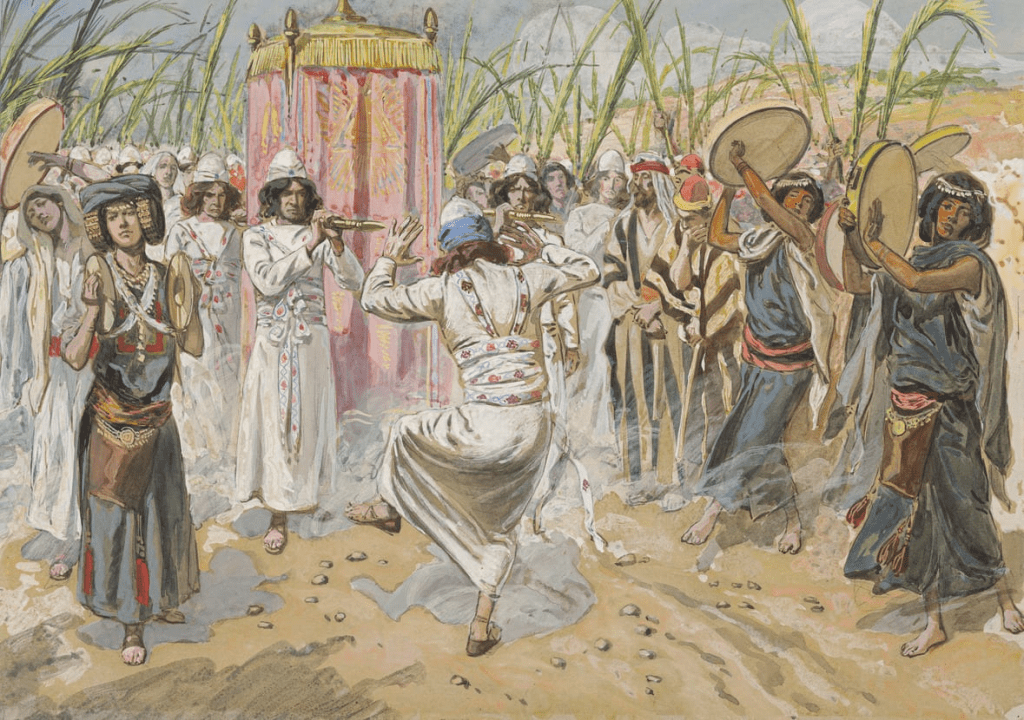
David Dancing Before the Ark, by James Tissot, c.1900

David built houses for himself in Jerusalem. Then he prepared a place for the Ark of God, and he set up a tent for it. David said, “Only the Levites may carry the Ark of God. The Lord chose them to carry the Ark of the Lord and to serve him forever….”

Then David appointed some of the Levites to serve before the Ark of the Lord. They had the job of leading the worship and giving thanks and praising the Lord, the God of Israel. Asaph, who played the cymbals, was the leader. Zechariah was second to him.

The other Levites were Jaaziel, Shemiramoth, Jehiel, Mattithiah, Eliab, Benaiah, Obed-Edom, and Jeiel. They played the lyres and harps. Benaiah and Jahaziel were priests who blew the trumpets regularly before the Ark of the Agreement with God. That day David first gave Asaph and his relatives the job of singing praises to the Lord.

Give thanks to the Lord and pray to him.
    Tell the nations what he has done.
Sing to him; sing praises to him.
    Tell about all his miracles.
Be glad that you are his;
    let those who seek the Lord be happy.
Depend on the Lord and his strength;
    always go to him for help.
Remember the miracles he has done,
    his wonders, and his decisions.
You are the descendants of his servant, Israel;
    you are the children of Jacob, his chosen people. (New Century Version)

Art by Sefira Lightstone

David was anointed as the future king by the priest and prophet Samuel, because God had rejected Saul as king. Yet, King Saul was still on the throne, still in power.

It’s a credit to David that he was faithful to the Lord, trusted God, and did nothing morally wrong or ethically suspect, such as trying to kill Saul. But King Saul certainly tried to kill David!

Saul’s jealousy morphed into murderous intent and evil machinations. Saul eventually died in battle, and David became king of Judah, then of all Israel. He did it the Lord’s way, and not his own.

So, it’s no surprise that once King David was securely on the throne, he paid attention to the Ark of the Covenant – the symbol of God’s presence with Israel – and made plans to have it in a protected and central place within the life of the Jewish people. What’s more, David sought to obey all of God’s laws and instructions which were graciously given to the people through Moses.

King David relocated the Ark from the house of Obed-Edom to Jerusalem – with the Levitical priests handling all of the sacred objects, as prescribed in the law of God.

The liturgical procession which moved the Ark of the Covenant was a grand and festive group, including military commanders, the elders of Israel, and the Levites. It was a celebration involving plenty of music, singing, and sacrifices. (1 Chronicles 13-14; 2 Samuel 6:12-19)

David prepared a tent for the Ark, in the tradition of the Tabernacle of Moses, to be located in Jerusalem at the heart of Jewish life.

After God’s Ark was moved and established in the new capitol, King David then organized the Levites for continued ministry around it. The work of the Levites was prayer, music, song, and praise, with Asaph as their leader.

Asaph along with Zechariah and eight other Levites, were responsible to ensure that musical instruments were played and trumpets blown before the Ark. (1 Chronicles 15:17-18)

All of the praise, singing, and music was to be a permanent ministry, because for David and the Jews, worship was a lifestyle, and not just an event.

So, we see that one of King David’s first initiatives in coming to power was to establish dozens of full-time Levites in the work of worship. David clearly knew where his royal position came from, and how he was supposed to rule. The king ensured that all of Jewish life was going to revolve around God, not himself. And he proved it both by his words and his actions as Israel’s leader.

Levites singing chapters from Psalms in Jerusalem, photo by Dor Pazoelo

The approach and attitude of David makes sense, because he was the one, along with Asaph the musical director, who crafted songs of praise such as Psalm 96. We might imagine a great Levite choir singing out with lots of spiritual gusto:

Sing to the Lord a new song;
    sing to the Lord, all the earth.
Sing to the Lord and praise his name;
    every day tell how he saves us.
Tell the nations of his glory;
    tell all peoples the miracles he does,

because the Lord is great; he should be praised at all times.
    He should be honored more than all the gods,
because all the gods of the nations are only idols,
    but the Lord made the heavens.
The Lord has glory and majesty;
    he has power and beauty in his Temple.

Praise the Lord, all nations on earth;
    praise the Lord’s glory and power.
Praise the glory of the Lord’s name.
    Bring an offering and come into his Temple courtyards.
Worship the Lord because he is holy.
    Tremble before him, everyone on earth.
Tell the nations, “The Lord is king.”
    The earth is set, and it cannot be moved.
    He will judge the people fairly.
Let the skies rejoice and the earth be glad;
    let the sea and everything in it shout.
Let the fields and everything in them rejoice.
Then all the trees of the forest will sing for joy
before the Lord, because he is coming.
    He is coming to judge the world;
he will judge the world with fairness
    and the peoples with truth. (Psalm 96, NCV)

Amen.

Set Apart for the Lord (Numbers 8:5-22)

Consecration of the Levites, by Dutch artist Jan Luyken (1649-1712)

The Lord said to Moses: “Take the Levites from among all the Israelites and make them ceremonially clean. To purify them, do this: Sprinkle the water of cleansing on them; then have them shave their whole bodies and wash their clothes. And so they will purify themselves. Have them take a young bull with its grain offering of the finest flour mixed with olive oil; then you are to take a second young bull for a sin offering.

“Bring the Levites to the front of the tent of meeting and assemble the whole Israelite community. You are to bring the Levites before the Lord, and the Israelites are to lay their hands on them. Aaron is to present the Levites before the Lord as a wave offering from the Israelites, so that they may be ready to do the work of the Lord.

“Then the Levites are to lay their hands on the heads of the bulls, using one for a sin offering to the Lord and the other for a burnt offering, to make atonement for the Levites. Have the Levites stand in front of Aaron and his sons and then present them as a wave offering to the Lord. In this way you are to set the Levites apart from the other Israelites, and the Levites will be mine.

“After you have purified the Levites and presented them as a wave offering, they are to come to do their work at the tent of meeting. They are the Israelites who are to be given wholly to me. I have taken them as my own in place of the firstborn, the first male offspring from every Israelite woman. Every firstborn male in Israel, whether human or animal, is mine. When I struck down all the firstborn in Egypt, I set them apart for myself. And I have taken the Levites in place of all the firstborn sons in Israel. 

“From among all the Israelites, I have given the Levites as gifts to Aaron and his sons to do the work at the tent of meeting on behalf of the Israelites and to make atonement for them so that no plague will strike the Israelites when they go near the sanctuary.”

Moses, Aaron and the whole Israelite community did with the Levites just as the Lord commanded Moses. The Levites purified themselves and washed their clothes. Then Aaron presented them as a wave offering before the Lord and made atonement for them to purify them. After that, the Levites came to do their work at the tent of meeting under the supervision of Aaron and his sons. They did with the Levites just as the Lord commanded Moses. (New International Version)

Levite priests, by Sefira Lightstone

Holiness is very important to God; therefore, people are to be properly set apart for special divine work.

Perhaps we might think about this in the context of a professional vocation – which requires a good deal of training and development. The process, as well as the participants, need to be certified by a certification body. Without a specialized training, their work may hurt others, and even harm themselves.

Setting apart the Levites for the special work of caring for all the aspects of worship required a particular sort of calling, initiation, and ritual in order to have them ready – without harming themselves, or others. Because God is holy, things must be done in a way that helps, not harms.

The ritual for preparation essentially involved de-sinning the Levites, and purifying them from any ceremonial uncleanness. The community was to lay their hands on them, setting them apart for service as representatives of the people.

The Levites served before the Lord in a vicarious position, that is, all Israel came to God through them. They performed the needed sacrifices, handled the worship symbols and implements, and protected the sacred objects in the tent of God’s presence, the tabernacle.

With the Levites in their sacred role, they were near to the people, but distinct from them. They acted as a conduit between God and the people. Levites were something like the sunglasses protecting the people from the bright sun of the Lord’s presence; and like the workers laboring to make people thrive and flourish before God.

In the holiness of worship, the Levites were living sacrifices, offered to God for sacred purposes. So, as such, they understood their need to be continually pure of heart and free from anything that would defile them.

Sacrificial service was literally the job description of the Levites. They absolved themselves of any self-assertive ambitions, and pursued God’s will for the lives without question. This is, of course, the expected ideal, which would soon become deflated in the lives of the two older sons of Aaron the high priest.

Nevertheless, the descendants of Levi were a permanent visual aid and a daily reminder for God’s people of their unique status before Yahweh, as well as the redemption secured for them from Egyptian slavery. Whenever the people saw a Levite – consecrated to God – they knew that the Lord was with them.

God had said that the Levites belonged to him, were completely given over to the Lord, and set apart for dedicated holy and divine work. Moving into the New Testament, every Christian belongs to God, and those who labor for Christ and maintain holiness of life, demonstrate God’s ownership and special relationship to them.

Self-surrender and commitment to the common good of everyone in the community is supposed to be a hallmark of every Christian person. Whereas others may give themselves to self-discovery and self-fulfillment, followers of Jesus are to wholly dedicate themselves to self-sacrifice.

All believers, much like the ancient Levites, are called to a different life, with Christ as their constant mentor and model.

Loving God and Father of our Lord Jesus Christ, may the holy sacrifice of your Son cleanse my soul, strengthen my heart, pardon my past, and restore me in your peace. May I always adore you through my sacrificial service, fueled by your divine love. May I learn to sacrifice my own comfort, plans, and dreams, if it is not for your glory and the good of others. Amen.