Fasting


The season of Lent begins with Ash Wednesday and treks the next forty days to the climax of Easter Sunday.  Associated with this time are spiritual disciplines such as fasting.  True fasting does not abstain from food just to get noticed by God, but has as its purpose a generous spirit and a giving heart.  Both abstinence and generosity are necessary in the practice of fasting (Isaiah 58). 
 
            Fasting is such a neglected spiritual practice today that we need to make sense of the reason to do without food for a set amount of time.  Fasting ought to put us in touch with our vulnerability and should remind us of our mortality and our frailties. Through fasting we remember that if we are not fed we will die.  Standing before God hungry, we realize we are dependent and desperate before him.  We discern through fasting that we are actually poor, called to be rich in a way that the world does not understand. We are empty, called to be filled with the fullness of God. We are physically hungry, called to taste all the goodness that can be ours in Christ as we get in touch with a hunger for God.
 
            But fasting does not end with only abstinence from food.  In other words, fasting is not just a private individual thing, but is meant to open our eyes and our hearts to the truly needy among us and in the world.  We are to be open to both the spiritual needs of people, and their very real material needs.  In addressing the spiritual needs of people, St. Jerome said in the 4thcentury concerning fasting that “When you see people freezing outside in the frigidity of unbelief, without the warmth of faith, impoverished and homeless, lead them home to the church and clothe them with the work of incorruption, so that, wrapped in the mantle of Christ, they will not remain in the grave.”
 
            True fasting, however, addresses not just the spiritual but the quite real daily physical needs of people for the basic necessities of life.  Fasting abstains from food in order to provide.  For example, fasting and prayer can go together so that we stop eating in order to take that time to pray; giving up a meal can be done in order to put the food that would have been eaten into the pantry for the needy; fasting from lunch at our jobs can be done not just to get more work done but so that we might share both our food and our friendship with those in need.
 
            There are intimate connections between worship, fasting, justice, and reconciliation.  We cannot separate these out as if they do not relate to one another.  All of this is really designed for us to get back in touch with the real meaning of repentance, which is what the season of Lent is all about.  To repair a broken relationship with God or with another person; to grieve over the state of a certain situation; to devote oneself to service are just some ways that fasting leads to repentance which leads to new life.
 
            It is a good idea to use this season to deal honestly with our own complicity in the sins of our world, our nation, our church, and our families.  The worship that God desires is inescapably corporate as well as compellingly personal.  To ensure that all people around us flourish as human beings is not merely an obligation but is necessary to our collective fulfillment as God’s people.
 
            The result of true fasting is repentance from sin that has the fruit of renewal and restoration because fasting connects us to God so that we seek to repair and rebuild what has been torn down. 
 
            We fast during Lent in order to practice repentance, attach ourselves to God, and become more generous toward others.  For most of the history of the church Christians were expected to observe regular fasts on Wednesdays and Fridays every week year round.  When the season of Lent came the church was united in their commitment to use the forty days as a time of introspection, confession, and fasting in order to prepare for the miracle of forgiveness on Good Friday and its life-giving power on Easter.  It was understood to be a time to respond to sin, to be purged of bad desires, to yearn for forgiveness, and to develop godly habits of living. 
 
            When the Reformation came, no one feared the danger of empty ritual more than the Reformers, especially Luther.  Yet, they were still all agreed that fasting ought to be an outward Christian discipline practiced at regular intervals.  As for me, I think the least I could do is fast two meals a week – one on Wednesday and one on Friday, to not only be in solidarity with the faithful that have gone before us, but in order to let the season of Lent do what it was intended to do.


            I would encourage us all to consider implementing some sort of regular fast through Lent, if for no other reason, to fulfill the spirit and intent of biblical fasting.  Let us, through fasting, connect deeply with Christ in these next forty days of purposeful Christian living.

Palm Sunday


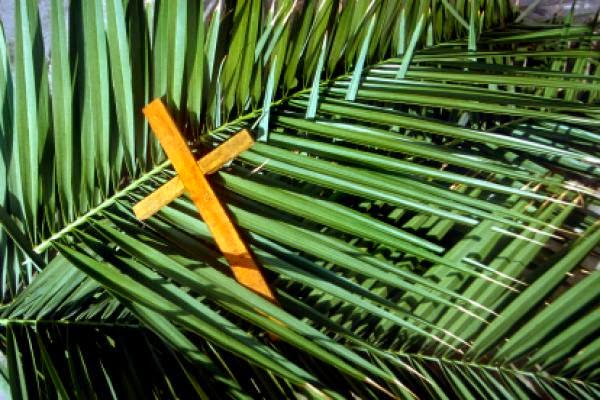
            Palm Sunday is a day to begin focusing on the events of Holy Week by journeying with Jesus as he rides into Jerusalem to the shouts of “hosanna!”  It is ironic that those shouts of praise by the week’s end turn to the visceral cries of “crucify him!”  Capturing that irony makes remembering the love of God even more profound as we consider the depth of grace Jesus went to in order to secure deliverance for us from sin.
 
            Every year on Palm Sunday thousands of Christians, from all over the world, gather together in the small town of Bethphage, located just 2½ miles outside of Jerusalem. They gather to walk from Bethphage to Jerusalem like Jesus did in his triumphal entry on a donkey.  Many of those pilgrims will carry palm branches and olive branches.  All of the people sing hymns as they walk up over the Mount of Olives, down into the Kidron Valley, and then up Mount Moriah into the Old City of Jerusalem. It is a worship experience filled to the brim with gratitude. “Give thanks to the Lord, for he is good; his steadfast love endures forever!” (Psalm 118:1).
 
Psalm 118 was an actual liturgy for worshipers coming to Jerusalem and the temple from all parts of Israel in order to celebrate Passover.  Like the Christian pilgrims today on Palm Sunday, the ancient Jewish worshipers would walk into Jerusalem with great anticipation of their Holy Week together.  And they would sing of God’s love and remember that love expressed to them in taking them from Egypt and slavery into the freedom of the Promised Land.  It is not just love itself; it is the love of God.  This word for “love” throughout Psalm 118 is my very favorite word in the entire Old Testament.  It is a rich word that is difficult to translate in English because the term is so pregnant with meaning.  The Hebrew word is “chesed” and the NIV translates it in various ways:  grace, covenant loyalty, mercy, compassion, kindness, and consistently translated in Psalm 118 as love.  It is the kind of love that is graciously given despite whether a person deserves it or not.  It is a steadfast love that holds on and never lets go.  Our God is the God who shows and demonstrates grace when we sin; who has unflagging commitment where we are fickle; who gives unbounded mercy when we are broken; who provides constant compassion when we have been hurt; who gives a forever kindness even when we are unkind; and, who dispenses steadfast love that will never pass away and finds its ultimate expression in the person of Jesus Christ, our Savior, who literally embodied chesed for us so that we might live and experience life to the full.  That’s the kind of God we worship and serve.
 
On Palm Sunday let us not take for granted the fact that we may take a spiritual pilgrimage each and every day to the very heart of God and meet his great love there at the throne of Jesus.  Our Christian life might be a bit like The Book of Heroic Failures, which contains a story about the 1978 strike of British firefighters, when the army filled the gap for the missing firemen. One afternoon the replacement firefighters got a call to rescue a cat caught high in a tree. The soldiers rushed to the scene, put up a ladder, brought down the cat, and gave it back to the owner. The woman was grateful and invited them in for tea. After a nice time together, they said goodbye, got in the truck, and backed away—over the cat.  Let us never replace God’s love with human love because we desperately need God and the saving love he has shown through Jesus who has gone before us and made the way clear to a life-giving relationship with the divine.  Let us never take for granted the ability to take a spiritual pilgrimage to God through the saving acts of Jesus that made it all possible.  Let us be thankful and be forever grateful to God for his unique and eternal love, for he is good, and his love endures forever.  Let us come to King Jesus, and allow his sovereign rule to so deeply penetrate our hearts that there is no room for complaint but only thanksgiving.  Let us enter through the gates of righteousness and give thanks to the LORD.
 
True and genuine joy cannot be manufactured, but is a spontaneous response to being deeply thankful for the love of God in Christ.  The season of Lent, the forty days between Ash Wednesday and Easter, is a time of seriousness, self-evaluation, and looking at one’s heart and practicing repentance.  So, to have this joyous worship celebration toward the end of the season might seem a bit out of place, maybe even weird.  But that would be to misunderstand repentance because repenting of sin might be a hard thing to do, but it is a joyful act.  It is a joyful act because it is a beautiful thing to say “good-bye” to old sins and idolatrous liturgies that vie for our love and attention.  And there is no love-loss here – it is a happy occasion to let go of those long established sinful liturgies of life, those routines that do not develop us as faithful followers of God, and throw ourselves upon the mercy, the chesedof God.
 
Turning from old sinful liturgies of life and turning to a new liturgy of following Jesus is like walking through a gate into a new reality and rejoicing with all the other redeemed pilgrims who are walking the road to Jerusalem to be with Jesus.  Our Lord himself said, “I am the gate; whoever enters through me will be saved.  He will come in and go out, and find pasture.  The thief comes only to steal and kill and destroy; I have come that they may have life, and have it to the full” (John 10:9-10).


So let us enter worship on Palm Sunday, as well as each and every day, with the heart of a pilgrim. Let us enter with a song on our lips and joy in our hearts. Let us enter knowing that this is the place where we come in contact with the love of God through our Lord and our Savior, Jesus Christ. Let us enter expecting to come out of worship changed, expecting great things to happen.  Soli Deo Gloria.

Hiding from God


Our human nature tends to look at the one thing we cannot do, instead of seeing all the range of possibilities that we can do.  The serpent, the devil, was successful in getting Adam and Eve to focus on that one tree they needed to avoid (Genesis 3:1-7).  Instead of seeing all the prospects of life with God, in our fallen condition just tell us what we cannot do and we will probably be sure to do it.  More than that, the devil subtly planted a terrible and untruthful idea in the heads of Adam and Eve – that God was somehow holding out on them and was not providing everything they really needed and wanted in life.  Sin looks really good, and even initially tastes really good.  Yet, sin has an awful aftertaste and reeks inside us.  Sin always over-promises and under-delivers.
 
            We all face temptation, sin, and the effects of sin.  Perhaps the greatest impact of sin is sewing fig leaves for ourselves and hiding – hiding from God, hiding from one another, and even hiding from ourselves.  All this hiding causes us to be spiritually blind, and to sleepwalk through hell unaware of our true spiritual condition.  Because of this reality, we all need a Savior to deliver us.  Apart from God we are only dust.  We need God’s Spirit to breathe life into us.  We need God’s Spirit to breathe life into the church.  We need God’s Spirit to grace us with conviction of sin, and breathe new life into us so that we may again enjoy him in Paradise.  Just as we did not give ourselves life and cause ourselves to be born, so we cannot give ourselves new life but must be born again by God’s Spirit.
 
            Hiding with fig leaves is the symbolic way of demonstrating that Adam and Eve were acting independently, and were now going to operate on their own apart from God.  Our fallen spiritual condition does not want to acknowledge our need for the sheer grace of God.  Instead, we hide our true motives and desires.  Through The Fall we are inclined to look for ways to deal with problems in our lives apart from God.
 
            We want to return to Paradise, and we devise all kinds of thoughts and ways of doing that.  Paradise always seems to be “out there” somewhere.  In our fallen condition, we buy into the “if only” syndrome instead of dealing with the sin in our own hearts.  If only we had that one thing, then we would be happy and be in Paradise.  Single people may look for that special someone, believing that Paradise will come if they meet Mr. Right or Miss All That.  Married persons may think that if only their spouse would be more like _____, then Paradise will come.  Kids might believe that when they grow up, then there will be independence and they can do whatever they want and there will be Paradise.  “If only” we had more money.  “If only” we had a bigger house, another car, or more power and influence.  “If only” other people would stop being jerks, care more, serve more, love more.  “If only” I had my way then, we think, there would surely be a restoration to Paradise.
 
We often expect way too much of relationships with others.  A woman will never find a man who completes her because no man can fix what is broken within her heart.  Even If every woman had a man who thought of nothing but her, how to romance her, how to love and encourage her, she would still be empty.  No man is enough.  Every woman needs a Savior.  And a man will never find a woman that takes care of everything in his life.  Even if every man came home each evening to a woman who was all dolled-up with a freshly grilled steak on the table for him, he would still be empty because no woman can fix what is broken within his heart.  Neither red meat nor any woman can provide for a man what he really needs.  Men need a Savior.  We all need a Savior.  We all need deliverance from our disordered loves and misguided attempts to find Paradise in this life apart from God.  The temptation after The Fall is to try and find Paradise outside of God through perfect relationships and ideal circumstances.  Yet, what we really need is to repent of the sin of our own hearts, and deal with the brokenness of our own lives.  And that is what the season of Lent is all about.
 
In this season of Lent, we must repent of our hiding and wishing for everything and everyone else to be different without any cost to ourselves.  What do you need to repent of in this season?  Who are the people that you look to do for you what only God can do?  Have you forsaken your first love of Jesus Christ?  Has your relationship with God been non-existent?  Has it been stale, dull, and lacking passion, desire, and energy?  Has distance replaced intimacy between you and God?  Do you avoid the spiritual disciplines of bible reading and prayer because you believe something else will satisfy the real needs of your heart?  Are you keeping up appearances and hiding, while on the inside you have doubt, depression, and despair that things will never change? 


May you have the courage to face the empty places of your heart and allow the unconditional grace of Jesus to cleanse and fill your soul.  Soli Deo Gloria.

Idolatry

            Truth is one of the greatest possessions we own.  To know the truth and to practice it is the key to success in every area of life.  This is especially true for the Christian.  All truth finds its source in the person and work of Jesus Christ, who is the way, the truth, and the life (John 14:6).  Jesus taught that if anyone would live in fellowship with Him through the practice of truth they would have the “light of life” (John 8:12).  God expects us to practice the truth He has revealed to us.  One of our most serious hindrances is the neglect of learning truth and our failure to practice what we know to be true.  An important truth which every believer in Jesus must accept is that the Christian will serve that which he yields to himself/herself (Romans 6:16).
 
            Jesus Christ, as our representative, fulfilled all the demands of Old Testament law for us.  His work is imputed to the believing sinner who thereby becomes righteous and forgiven (Romans 3:24-31; 5:1-11).  Through identification with Jesus in his crucifixion and resurrection the believer is set free from the penalty and bondage of sin and will no longer be characterized by the dominion of sin (Romans 6:1-14; 1 John 3:9).
 
            This does not mean, however, that the believer never sins again in this life.  What it means is that when we sin we not only disobey God, lose fellowship with Him, hinder our spiritual progress, and fail to be a good example – we become characterized by and enslaved to our sin.  When we seek to have something or someone else replace the atoning work of Jesus on the cross to meet the most basic needs of our lives, we have set that something or someone up as our idol to worship.
 
            Jesus said that we cannot serve both God and money (Matthew 6:19-24).  When we serve God we live in freedom; when we serve money we become idol worshipers and become enslaved to it, trusting that money will be our ticket to real freedom and happiness.  The issue here is not how much or how little money we actually possess, but the place of money of in our lives and what it stands for – how it figures in our list of priorities.  Many believers today serve God with their lips, but in reality they are in bondage to money.  The evidence is in how we live.  If we are willing to sacrifice almost anything and everything to gain money, then we have set up financial security as the thing we really worship and adore.


            Jesus said that when we know the truth, it is truth that can make us free (John 8:32).  Whenever we commit a sin, we become the servant of that sin.  This is more than being caught in addictions such as alcohol, gambling, pornography, and overeating.  Persons with “clean” lives can also fall prey to the errors of believing that regular church attendance, giving ten percent of income to the church, being nice, growing up with Christian parents, working hard, or being an all-around “good” person are the things that secure a right relationship with God and provide the best things in life.  Idolatry is not only tied to addictions; it can be tethered to our virtues, good deeds, and self-righteousness.
 
            This season of Lent is to be a time of healthy introspection, taking a fierce moral and spiritual inventory of our lives, and identifying and repenting of everything that we have replaced God with as an idol. 
 
–What or whom do you identify as your primary means of security and significance?
–Do you have any anger or resentment toward those who pose a threat to whatever it is you tie your security and significance to?
–What fears do you have about giving up certain possessions, activities, or even relationships?
–List the activities and behaviors that you continue to do even though you know it is not in your best interest to do them.  Admit your helplessness to God, receive the work of Jesus on your behalf, and tell a trusted pastor or church leader about your issue.


            We must not allow ourselves to live careless lives, but to live in the freedom that comes from knowing and practicing the truth.  May our Lenten journey lead us to new hope and life in Christ.