Joel 2:1-2, 12-17 – Ash Wednesday

Blow the horn in Zion;
    give a shout on my holy mountain!
Let all the people of the land tremble,
    for the day of the Lord is coming.
It is near—
    a day of darkness and no light,
    a day of clouds and thick darkness!
Like blackness spread out upon the mountains,
    a great and powerful army comes,
        unlike any that has ever come before them,
        or will come after them in centuries ahead…

Yet even now, says the Lord,
    return to me with all your hearts,
        with fasting, with weeping, and with sorrow;
tear your hearts
        and not your clothing.
    Return to the Lord your God,
        for he is merciful and compassionate,
        very patient, full of faithful love,
            and ready to forgive.
Who knows whether he will have a change of heart
    and leave a blessing behind him,
    a grain offering and a drink offering
            for the Lord your God?
Blow the horn in Zion;
        demand a fast;
        request a special assembly.
Gather the people;
        prepare a holy meeting;
        assemble the elders;
        gather the children,
            even nursing infants.
Let the groom leave his room
        and the bride her chamber.
Between the porch and the altar
        let the priests, the Lord’s ministers, weep.
    Let them say, “Have mercy, Lord, on your people,
        and don’t make your inheritance a disgrace,
        an example of failure among the nations.
    Why should they say among the peoples,
        ‘Where is their God?’” (CEB)

Imagine you are out for a hike on a beautiful spring day and you come to a creek. You notice that someone has dumped trash into the stream—not a pretty sight. Judging by some of the empty soda cans, the trash has been there awhile. And there is an ugly film on top of the water. You do not want to leave the scene as you found it, because it would bother your conscience.

So, you stoop down and begin gathering the trash. It ends up taking several hours before you can begin to see a difference. It is amazing, you muse, on how much junk is there. You sit back, rest for a moment, and realize you will have to keep coming each day until the site is truly clean. But when you come back the next day, it is as if you did not even do any work at all.  In fact, there is more trash than the day before. It seems the garbage bred overnight. You think about the unlikelihood of someone coming to this very spot to dump their garbage just in the one measly day you were away.

Then, you realize that something smells fishy—so to speak. So, you begin to follow the creek upstream. Sure enough, there is a nasty garbage dump that has been there for years. The waste from it is emptying into the passing creek. Your cleaning job was only a small opening to a world of filth. You could try and clean every day. But if you really want your creek to be free of pollution, this means going directly to the source and dealing with the crud that is there.

Our hearts are the source from which our lives flow. Unfortunately, we spend great amounts of time, money, and energy—even in the church—doing trash removal “downstream.” But real transformation begins when we travel upstream to the source. Our real struggles and sins take place where no one sees them down deep in the heart.

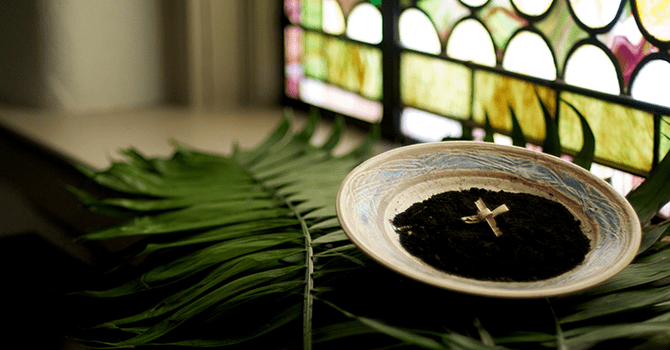
Today is Ash Wednesday, the first day in the season of Lent. Ashes remind us that we live in a polluted world full of garbage. That pollution is fouling up our lives and we must respond to the mess with a humble return to God. Lent is a 40-day cleaning project on the inside of our hearts, instead of trying to keep up dealing with all the scum on the outside of our lives. 

Entrance to confronting the dump of garbage requires fasting, self-examination, prayer, and repentance. The Lord said through the ancient prophet Joel that it is not too late to return to God with our whole hearts. To do so requires grieving and lamenting our stinky sin and turning back around to a merciful God who does not like to be angry and punish people.

We find that at the end of the Lenten journey, Jesus is there. He swallows all the massive tonnage of the world’s garbage on the cross. The refuse is so rotten that it kills him, and there is only darkness. Then, three days later, Christ is risen, having shaken off the filthy stench of death. Jesus Christ is the ultimate fulfillment of the prophet’s words, the merciful one who has taken care of the filthy source of garbage once and for all.

May you find on this day and every day that the spiritual practices of prayer, fasting, and repentance put you in a place to receive Jesus. As you lean into the mess throughout the next six weeks of Lent, may you discover the cleansing and healing agent, Jesus Christ, the Savior who scrubs the heart clean of toxic waste.

Holy God, our lives are laid open before you: rescue us from the chaos of sin and through the death of your Son bring us healing and make us whole in Jesus Christ our Lord. Amen.


Job 19:23-27 – His Journey is My Journey

Journey with Jesus by He Qi

I wish that my words
could be written down
    or chiseled into rock.
I know that my Savior lives,
and at the end
    he will stand on this earth.
My flesh may be destroyed,
yet from this body
    I will see God.
Yes, I will see him for myself,
    and I long for that moment. (CEV)

I am going to let you in on the reasons why I observe the Church Calendar each year and follow the Christian seasons. First, it is a way for me to know Jesus better. The Year is thoroughly centered around the person and work of Christ. Much like the seasons of Spring and Fall, I look forward to entering a new season and discovering the beauty of my Lord in a fresh way.

Second, observing the Christian Year reorients my use of time. Rather than think of time in secular terms or as my time, I submit to time that is dictated by a thorough attention to Jesus. And finally, moving through the Year is a journey with Jesus – his journey is my journey. 

All of Christ’s life was an act of redemption for us. His redemptive events of incarnation, holy life, teaching, death, resurrection, ascension, and glorification demonstrate that Christ is my Redeemer. What is more, I enjoy a union with Jesus, an intimate connection which is so close that his journey is my journey. Christ identified with me in his life on this earth. Jesus took on the death which should have been mine. He rose from death, ascended to heaven, and was glorified as King of all. 

I know that my Redeemer lives because I have walked with him. I, too, just like my Savior, will someday rise from death, ascend with him, and reign with him forever in his glorious presence. Jesus has made it all possible, and that is why I enter the Christian Year, time and time again, with expectancy, faith, and hope.

With the ashes of Ash Wednesday (the beginning of Lent) this is more than a reminder of my mortality. It is full of meaning and imbibed with hope. Yes, I am dust, and I will return to dust. But that dust will rise again and live with Jesus forever.

Merciful Lord and Savior, you lived the life on this earth which I could not in my weakness and shortcoming.  Through the gift of faith, I have an inheritance and a hope that someday I will be with you forever. Thank you for your abundant grace and the constant reminders throughout the Year that you are with me – your journey is my journey.  Amen.

Hebrews 2:1-4 – Learning to Pay Attention

We must give our full attention to what we were told, so that we won’t drift away. The message spoken by angels proved to be true, and all who disobeyed or rejected it were punished as they deserved. So, if we refuse this great way of being saved, how can we hope to escape? The Lord himself was the first to tell about it, and people who heard the message proved to us that it was true. God himself showed that his message was true by working all kinds of powerful miracles and wonders. He also gave his Holy Spirit to anyone he chose to. (CEV)

My three girls all have attention deficit disorder (A.D.D.). You might think this is a disadvantage. Rather, since the biology of their brains do not have good filters for sifting out all the stimuli which they hear each day, each of them are much more intentional about picking out the voice they want to hear and engaging with it. Whereas you and I might take this for granted, my girls know the value of creating the skills to pay attention.

We stand at the cusp of Lent, just two days from now. A healthy way of looking at this important season in the Christian Year is that it is a time to listen. It is the opportunity and privilege of giving our complete attention to Jesus as we plod along the 40-day path to Easter. And we need to develop some solid skills in paying attention, whether we have A.D.D. or not.

The cost of not developing such skills is that we will drift away. Taking for granted that we are Christians, that we know something about salvation, and are basically good people, might only be setting us up for spiritual failure. That is, we think we already know about Christ’s person and work of salvation, so we fail to really pay attention. Bad idea.

Assuming we are paying attention is not the same thing as actually doing it. Assumptions lead to drifting away from truth. We are meant to have continual and constant reminders of Christ and his redemptive events. This is what Lent intends for us. To ignore the wisdom of two-thousand years of church practice puts us in a precarious position of being lost at sea.

For the next six weeks, make the choice that you will pay attention to Christ each day through the following:

  • Reading Scripture every day with a combination of standing and sitting, reading silently and out loud.
  • Holding a cross or other Christian reminder in your hand and feeling free to fidget with it.
  • Journaling your thoughts in a notebook.
  • Imposing time limits on yourself each day for the next 40 days.
  • Using different versions of the Bible to read throughout Lent.
  • Going outside occasionally and praying while walking.
  • Focusing on your breathing. Breathe out: “Speak Lord.” Breathe in: “I am listening.”
  • Drinking some coffee, tea, or something soothing.
  • Being mindful of distractions and acknowledging them without judging yourself.

The point is to have an intentional plan for paying attention. Do not assume you will be focused. May your journey with Jesus this season be a fresh experience in knowing him better.

Lord God, the world is rushing by. The days are sometimes a blur. But in those moments when I stop, time almost stands still. Keep my heart open to the simplicity of the day – to virtual interactions and connections with others without being distracted – and paying attention. Help me, Lord. Open my eyes. Open my ears. Open my heart to know you are with me, if I just pay attention. Amen.  

Responding to COVID-19

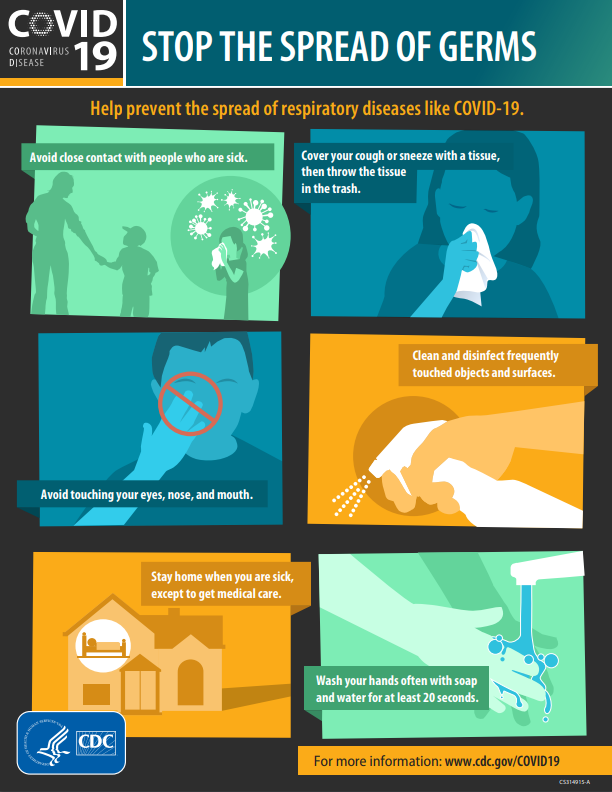
CDC-stop-spread-of-germs_english

I encounter many different people in my daily workaday world as both a church pastor and hospital chaplain.  Perhaps it goes without saying that this rapidly changing environment of taking precautions with the COVID-19 virus has us all stressed, me included.  From my vantage of daily spiritual ministry with both parishioners and patients, it is important and necessary to take the coronavirus seriously without panicking.  Here’s what I see works and what doesn’t work when it comes to the pandemic.

What works is taking the situation seriously.  Last year 32 million people contracted the flu in this country.  Yes, every year people die from the flu.  What’s different about COVID-19 is that, thus far, 1% of everyone who has the virus died.  Stick with me here.  If there were no precautions, no social distancing, and business as usual, it is likely that tens of millions of people would get the virus.  With a 1% death rate, 320,000 Americans would die.  Ignorance really does kill people.

  • Getting your information from reputable sources works.  It is available.  Use it.  The Center for Disease Control keeps its website updated with an abundance of helpful information.  And, if you think you may have symptoms of the virus or have been exposed, please, don’t go to your local hospital’s ED.  Call the COVID-19 HOTLINE at 866-443-2584.  You will likely need to wait, so, please, be patient.
  • Social distancing works.  If I can stop the spread of the virus through canceling church services for a while and speaking with patients on the phone instead of in person, then I’ll do it.  If my actions prevent the immunocompromised people I love and even the ones I will never meet to live, then this is not even a question about whether I’ll practice social distancing, or not.
  • Practicing self-care works.  It does neither me nor anyone else any good if we constantly give without receiving. Healthy relationships have a healthy rhythm of both giving and receiving.  Taking the time to do what makes your soul happy is vital.  I am presently being stretched in new and different ways.  Handling two jobs isn’t easy to begin with.  Under these present conditions, it could be a crushing load – that is, if I neglect caring for myself.

What doesn’t work is being in panic mode.  80% of the people who contract the virus will be just fine, if they care for themselves, stay home, and get better.  Yes, we don’t have a choice whether to go to the gym or eat out at a restaurant.  There are things we can’t do, whether it is going to our jobs or our schools.  The pandemic is straining our economy and personal finances.  That doesn’t mean the sky is falling.

  • Practicing the age-old sin of avarice through hoarding doesn’t work.  Folks panicking through inordinate stocking of meds, goods and services are needlessly and wantonly stretching the healthcare and service systems which are trying to help.  We do not live in a culture of scarcity.  Hoarding helps no one.
  • Brazenly telling people to get a grip doesn’t work.  Within the same conversation I have heard individuals express things like “It’s all a conspiracy,” to the other extreme of “What are you even doing here? Trying to get me sick?” and overreacting in fear.  If I am honest with myself, I sometimes do the same thing in my own head.  One minute I want to enter patient rooms and parishioner homes, wanting to help any way I can in a precautions-be-damned sort of mode.  The next minute I’m pondering going full Grizzly Adams, secluding myself in the Northwoods and befriending a bear – all in the concern for not passing on the virus to people I care about.  All these words and thoughts are windows into people’s grief over the significant losses and changes thrust upon them.  They need to express their grief without flippantly being told they need to get a hold of themselves.  This is a time for patient listening and basic kindness toward our fellow humanity so that we all get through this experience. It doesn’t work to frame the situation as God’s judgment or people’s lack of faith.  Even if that were so, we still need to exercise grace and compassion in a time of need.  I invite you to interpret another’s complaining and/or quarreling as a window into their grief of the changes they are experiencing.
  • Making a joke of the current COVID-19 doesn’t work.  Although wise and well-timed levity and laughter can aid in coping within all the brevity, misplaced humor can be cruel and damaging.  Those who know me expect funny stuff from me.  Yet, there’s nothing funny about a virus going around that could do some real harm to the immunocompromised people that I love and care for.  I would suggest this rule of thumb: If making jokes is a way of avoiding your own emotions and feeling the sadness and heaviness of the circumstance, then don’t make jokes; and, if the meme or joke is thoughtful and could lighten people’s load a bit, then, yes, thank you of thinking of others.

There is for us a unique opportunity in this season of Lent.  For many Christians, each year during these weeks becomes a focus on solitude, silence, fasting, prayer, spiritual reading, repentance and other disciplines of faith.  We seek to journey with Jesus in the desert, following him in his ways.  Whether we like it, or not, solitude has been forced upon us.  We have the chance to come face to face with our own inner selves; to check-in on our elderly neighbors; to connect with our family; to creatively find new green pastures; to pay attention to the values which are most important to us.  We can bless small business owners with our patronage.  We can find ways to bless the world.

May the Lord bless you and protect you.

May the LORD make his face shine on you and be gracious to you.

May the Lord lift-up his face to you and grant you peace.  Amen.