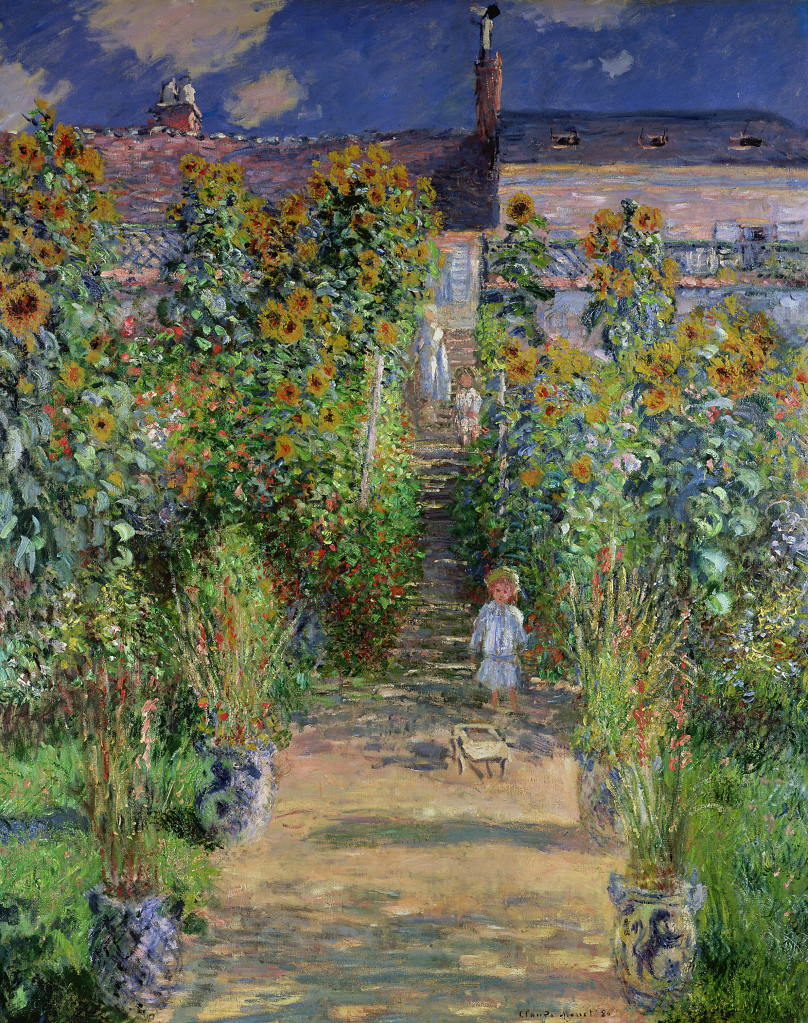
The Artist’s Garden at Vétheuil, by Claude Monet, 1881
The fruit of the Spirit is love, joy, peace, patience, kindness, goodness, faithfulness, gentleness, and self-control. (Galatians 5:22-23, Common English Bible)
Soon it will be Spring. Many people are already planning for the soil in fields and gardens to be turned over for planting and cultivating.
Healthy plants grow and feed many. They don’t simply occur by happenstance. And neither does things like morality, ethics, and living an altruistic life; they don’t just happen.
Virtue and a good life are the result of solid and robust inner work within the soul.
The daily overall trajectory of personal and institutional life demonstrates whether they are driven by egoistic desires, or influenced from an inner garden of delectable fruit which has been wisely plucked for others to enjoy.
“A good tree doesn’t produce bad fruit, nor does a bad tree produce good fruit. Each tree is known by its own fruit. People don’t gather figs from thorny plants, nor do they pick grapes from prickly bushes. A good person produces good from the good treasury of the inner self, while an evil person produces evil from the evil treasury of the inner self. The inner self overflows with words that are spoken.”
Jesus (Luke 6:43-45, Common English Bible)
The Apostle James learned well from his Teacher when he said:
My brothers and sisters, can a fig tree produce olives? Can a grapevine produce figs? (James 3:12, Common English Bible)
The soul is a garden which must have a faithful gardener to continually attend to it. There is a constant need for paying attention to the plants through consistent weeding, watering, and nurturing the seeds placed in good rich soil.
If we will but only allow it, the Holy Spirit of God can be our Divine Gardener, being the elements we need for growth, maturity, and a good life which produces good succulent fruit for many to enjoy.
Apart from the Spirit’s warming, watering, and protecting, people can easily degenerate into all kinds of illicit thinking and behavior such as immorality, moral corruption, doing whatever feels good, idolatry, substance abuse, casting evil spells, hate, fighting, obsessive behaviors, violent anger, competitive opposition, conflict, selfishness, group rivalry,jealousy, and lying.
The Christian virtues which flower and produce the fruit of love, joy, peace, patience, kindness, goodness, faithfulness, gentleness, and self-control occur through a close intimate connection with the Divine Gardener.
Our Divine spiritual Gardener knows that all things are connected – that below the surface the roots of every plant become connected with one another. There is really no such thing as a person who is disconnected from the rest of humanity.
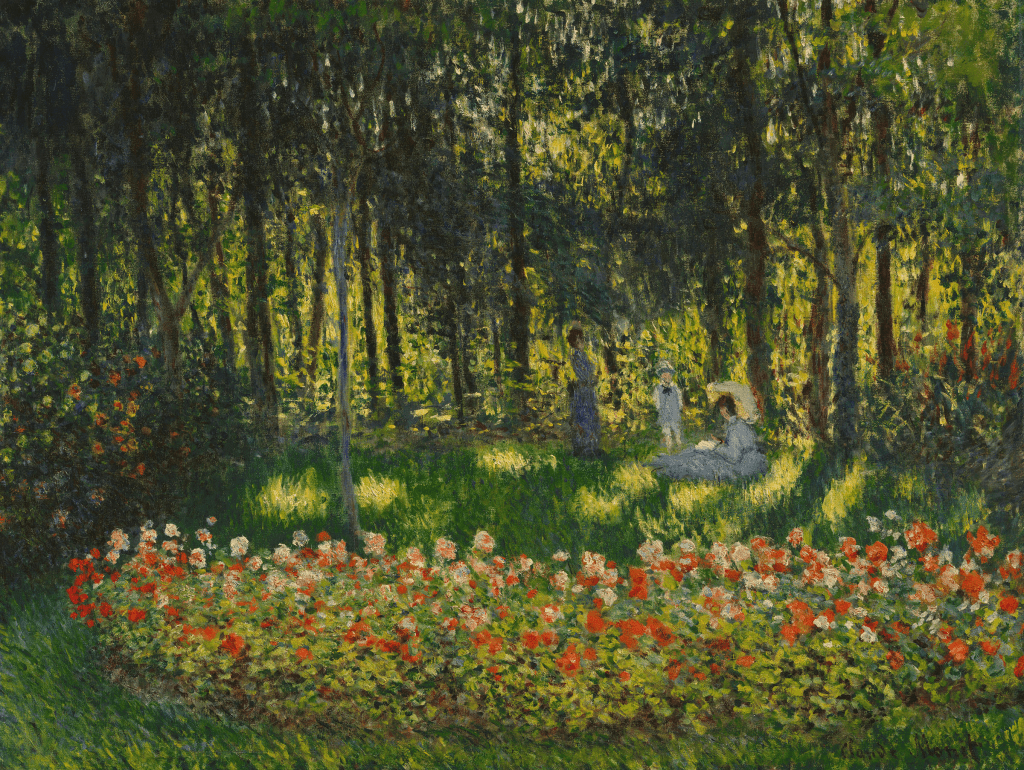
The Artist’s Family In the Garden, by Claude Monet, 1875
Thus, the Apostle Paul, having also learned well, understood that there are not spiritual “fruits,” but only spiritual “fruit.” That is, the nine virtues Paul mentioned are the “fruit of the Spirit,” not “fruits.”
In other words, all virtuous words and behavior are connected with each other. When a person or an organization has the Divine Gardener attending to them, all nine of the Christian values are a collective basket of fruit which cannot be separated from one another.
So then, if we look at the list of spiritual fruit in the New Testament book of Galatians and say something like, “Well, I’m pretty good at kindness and goodness, but I don’t have much peace or patience,” then what this really means is that we are likely doing kindness and goodness from a different place than by means of the Holy Spirit.
Because when the Spirit is manifested in us, we exhibit spiritual fruit. We cannot separate the nine spiritual virtues any more than we can separate the Trinity. They’re all one spiritual fruit, cultivated and produced within the inner person by the agency of God’s Spirit, our Divine Gardener.
Perhaps we need to consider what is happening in the ground, underneath the surface, which is the shadow side of our lives that no one sees.
For example, it could be that we are driven far more by our ego and our anxiety about most things than about genuine altruism and love. The results of our actions and words may look the same or similar, but the motivation might be far from truly altruistic.
Any sort of “fruit” will simply not last if our actions spring from a place of ego control and worry – because it is not of the Spirit.
Both persons and institutions must mortify (put to death) the deeds and the weeds of the sinful nature.
I have been crucified with Christ and I no longer live, but Christ lives in me. And the life that I now live in my body, I live by faith, indeed, by the faithfulness of God’s Son, who loved me and gave himself for me.
The Apostle Paul (Galatians 2:20, Common English Bible)
The Spirit will always have us in the good rich soil of Christ, so that when we are planted and receive the proper amounts of spiritual sun and living water, we will most certainly produce a hundredfold crop.
Then, we learn to make proper and right judgments about what is happening in our world. We are able to see the thief in the garden who cares only to pick fruit he has neither planted nor cared for, having no intention of sharing anything, but instead seeks to amass a gluttonous basket for his own self.
There is a great need for virtuous living, ethical sensibilities, and wise discernment among everyone in this world.
We are now observing what happens when a people are ignorant of how true righteousness, justice, goodness, and peace are grown and developed in any culture, society, and government. Fools are allowed to roam the garden, and they make a complete mess of things.
Let us all do our part in ensuring that genuine spiritual fruit is produced, coming from the true self. Disconnection, destruction, and chaos are the fruit of a bad tree. Then, it is only fit to cut down and thrown into the fire.
Jesus said:
“Every good tree produces good fruit, and every rotten tree produces bad fruit. A good tree can’t produce bad fruit. And a rotten tree can’t produce good fruit. Every tree that doesn’t produce good fruit is chopped down and thrown into the fire. Therefore, you will know them by their fruit.” (Matthew 7:17-20, Common English Bible)
Therefore, beware, watch out, and be wise in the way your own soul is cultivated, and how you discern the souls of others.
For the Christian, the season of Lent is the best and most appropriate time to focus upon spiritual disciplines which help connect us with Christ and with one another.
Daily attention to the garden of our soul prepares us for Holy Week by participating with Jesus in both his crucifixion and resurrection. All that is wrong and sinful in this old fallen world is put to death, and a new life of virtuous and altruistic living is enjoyed.
And the beauty of it all is that it will organically spring from the depths of a well-cultivated soul garden. The Divine Gardener stands ready with both hose and hoe to bring about the fruit of the Spirit.
At that time I, Daniel, mourned for three weeks. I ate no choice food; no meat or wine touched my lips; and I used no lotions at all until the three weeks were over.
On the twenty-fourth day of the first month, as I was standing on the bank of the great river, the Tigris, I looked up and there before me was a man dressed in linen, with a belt of fine gold from Uphaz around his waist. His body was like topaz, his face like lightning, his eyes like flaming torches, his arms and legs like the gleam of burnished bronze, and his voice like the sound of a multitude.
I, Daniel, was the only one who saw the vision; those who were with me did not see it, but such terror overwhelmed them that they fled and hid themselves. So I was left alone, gazing at this great vision; I had no strength left, my face turned deathly pale and I was helpless. Then I heard him speaking, and as I listened to him, I fell into a deep sleep, my face to the ground.
A hand touched me and set me trembling on my hands and knees. He said, “Daniel, you who are highly esteemed, consider carefully the words I am about to speak to you, and stand up, for I have now been sent to you.” And when he said this to me, I stood up trembling.
Then he continued, “Do not be afraid, Daniel. Since the first day that you set your mind to gain understanding and to humble yourself before your God, your words were heard, and I have come in response to them. But the prince of the Persian kingdom resisted me twenty-one days. Then Michael, one of the chief princes, came to help me, because I was detained there with the king of Persia. Now I have come to explain to you what will happen to your people in the future, for the vision concerns a time yet to come.”
While he was saying this to me, I bowed with my face toward the ground and was speechless. Then one who looked like a man touched my lips, and I opened my mouth and began to speak. I said to the one standing before me, “I am overcome with anguish because of the vision, my lord, and I feel very weak. How can I, your servant, talk with you, my lord? My strength is gone and I can hardly breathe.”
Again the one who looked like a man touched me and gave me strength. “Do not be afraid, you who are highly esteemed,” he said. “Peace! Be strong now; be strong.”
When he spoke to me, I was strengthened and said, “Speak, my lord, since you have given me strength.” (New International Version)
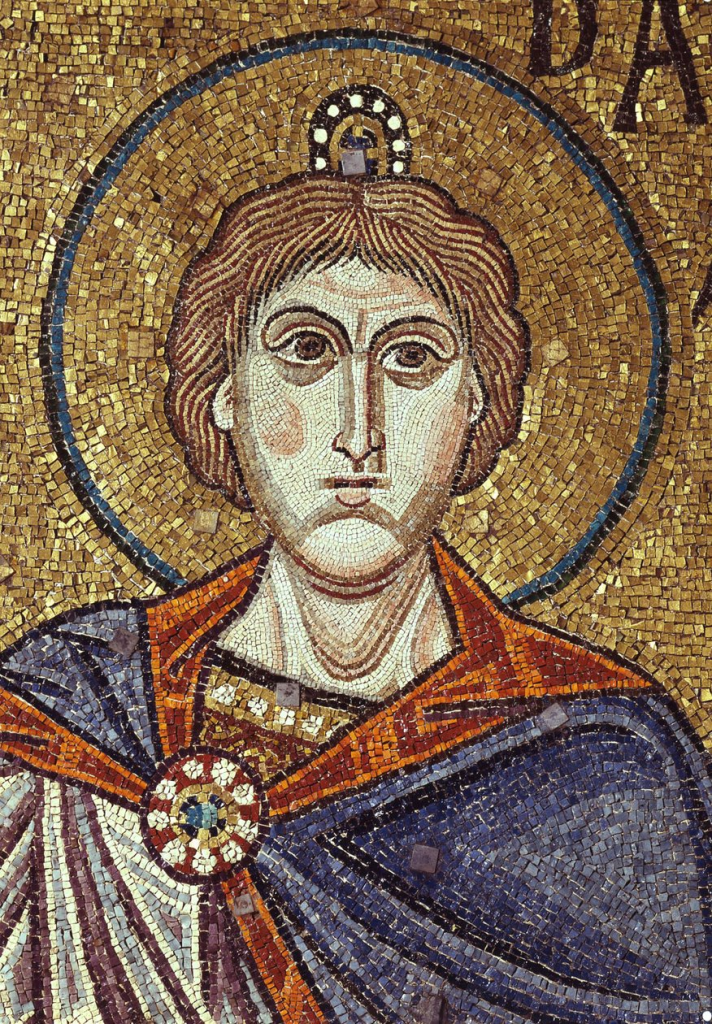
Byzantine mosaic of the prophet Daniel, 12th century, in St. Mark’s Basilica, Venice, Italy
Perhaps you, like me, have had the experience of praying, and feeling as if those prayers were only bouncing off the ceiling and never heard by God. But the Lord has been watching and listening all along. Although we may not get an immediate response, we will most certainly receive an answer to our prayers.
I am encouraged that God listened and was attentive to Daniel. The prophet had put himself in a position to hear God, so that when the Lord responded, Daniel was able to receive what was given to him.
The spiritual disciplines which Daniel was practicing almost seems like the guy was observing Lent. For three weeks, he gave up certain foods, did not eat meat, drank no wine; and he didn’t take a bath. He did all of this because he was troubled in spirit.
Daniel’s outward practices were congruent with his inward disposition. This is a far cry from our modern predilection for keeping up appearances, even though we are dying inside. But Daniel was not like us. He stopped his normal routines in order to give himself to prayer and a partial fast.
The Jews had been in exile for 70 years, and there was no sign of them going back to Jerusalem. And that troubled Daniel to no end – because the prophet Jeremiah had said the people would be in captivity for that long (Jeremiah 29:10). Daniel knew that fulfillment of the Lord’s promises would come by living in Palestine, and not by being exiled in Babylon.
While Daniel and his friends were together in a prayer meeting, Daniel experienced a vision; it was as if the veil separating this three-dimensional space from the spiritual dimension was lifted, and Daniel could see what was happening in the invisible realm.
Daniel’s prayers were being heard; they were not bouncing off the ceiling. And they were heard, I believe, because Daniel prayed according to his understanding of what God wants. He desired to participate in what God wanted, and not what he himself necessarily wanted.
And that is essentially what the Lord Jesus taught his followers in how to pray. We need not try and persuade God, as if we must be spiritual lawyers advocating for what we want. The Lord does not operate by twisting arms or harassing people; and neither ought we to try and treat God that way.
Prayer puts us in sync with what God wants. And as we desire to do God’s will, our prayers will reflect that desire. We only then need to ask. (Matthew 6:5-15; James 4:1-3)
Although God answers prayer, those responses are not always immediately put into effect. Daniel’s vision allowed him to see that there are other forces at work – dark forces – that oppose what God is doing. Sinister monkey wrenches are thrown into good plans and responses for people.
Behind the scenes of our lives, there are invisible powers which are influencing people. This is why our ultimate struggle is not on this visible realm; it is, instead, against the invisible demonic spirits of this present evil age.
Daniel saw and heard that behind the affairs of this world is a hierarchy of evil which seeks to control us for purposes contrary to God’s justice, peace, and goodness. Yet there is also an angelic host who are involved in ensuring that the Lord’s will is accomplished on this earth as it is always done in heaven.
Therefore, sometimes our delays in answered prayer have nothing to do with us; it may be because there is a great conflict happening in a dimension that you and I don’t see. In fact, if we do not have immediate answers to prayer, this is precisely the best time to persevere in prayer and not give up.
Through our perseverance in prayer, like Daniel, we are strengthened in faith. Our connection with God brings us peace and courage, emboldening us for continued wrestling in prayer and dealing with the structural and systemic evil that exists everywhere.
Faith is a belief in things we cannot see. Hope is the confidence of things which can happen. Love is a culmination of faith and hope coming together in order to make a difference in this fallen world. The Lord provides all the strength we need for the struggle. And there is perhaps no better model of how to deal with things and gain spiritual power than the prophet Daniel.
Strengthen us, O Lord, by your grace, so that we may overcome all spiritual enemies; and with pure hearts serve you; through Jesus Christ our Lord, who lives and reigns with you and the Holy Spirit, one God, for ever and ever. Amen.
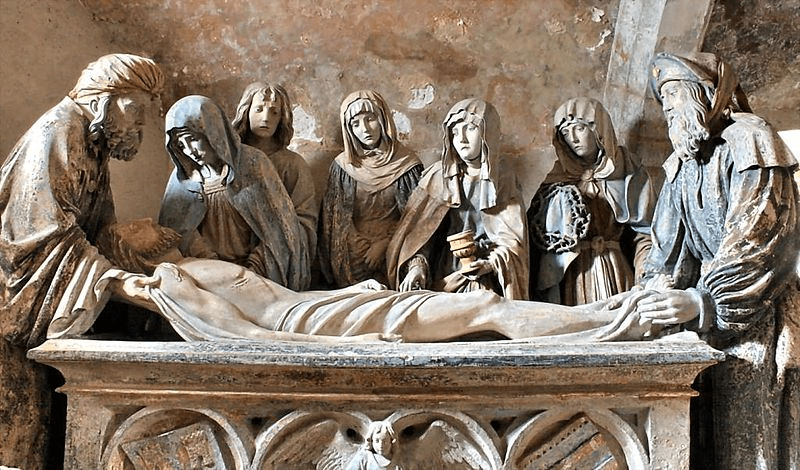
The Entombment, by the French sculptor Maître de Chaource, 16th century
After these things, Joseph of Arimathea, who was a disciple of Jesus, though a secret one because of his fear of the Jews, asked Pilate to let him take away the body of Jesus. Pilate gave him permission, so he came and removed his body. Nicodemus, who had at first come to Jesus by night, also came, bringing a mixture of myrrh and aloes, weighing about a hundred pounds.
They took the body of Jesus and wrapped it with the spices in linen cloths, according to the burial custom of the Jews. Now there was a garden in the place where he was crucified, and in the garden there was a new tomb in which no one had ever been laid. And so, because it was the Jewish day of Preparation and the tomb was nearby, they laid Jesus there. (New Revised Standard Version)
Today is Holy Saturday – a quiet place sandwiched between the ignominy of the cross and the celebration of resurrection – a day of solitude, silence, and stillness.
This isn’t a particularly popular day. People don’t rave about Holy Saturday, in fact, many Christians haven’t had a thought that this day could have any significance. Yet, this very day has its place in the scheme of the Christian life.
There cannot be resurrection and new life without a death and dying to self. There must be suffering before there can be glory. Whenever Christians quickly jump to triumphal language about victory and speak little-to-nothing about suffering, then we are left with a cheap grace which has been purchased with the counterfeit currency of velocity.
This day is meant for us to get out of our heads and wrap our hearts around the important reality that Jesus Christ was truly in the grave – very much dead.
It was real suffering on Good Friday, and it is a real death in the grave on Holy Saturday. There is no movement. All is silent and still. Jesus is in the solitude of a dark tomb.
My friends, there is absolutely no getting around the fact that if we want a Resurrection Day with all its celebration and glory, then we cannot and must not circumvent Holy Saturday.
On Holy Saturday, Christ’s disciples were experiencing an awful and real grief. Jesus suffered. He was tortured and humiliated. Jesus died. It was surreal for the disciples. They could barely believe there could ever be a day like today. Their Lord was dead and buried in a tomb.
Holy Saturday sits us down and asks some hard questions:
Are you ready to follow Jesus and suffer as he did?
Are you willing to stop your striving, manifested through constant movement, and embrace solitude, silence, stillness with its contemplation and embrace of suffering?
Will you have sense enough to pray?
Will you practice a Christian counter-cultural shift and face the ridicule of friends so that you might take some much-needed time to be with Jesus in the tomb?
Are you so antsy and anxious that you just want to leap into Easter with no solidarity with your Lord who is in the grave?
You may think that I’m being a bit too hard, or harsh, or cold…. That’s because Jesus is cold. He has a bonified cold dead body. It’s no fake death. There’s no “swoon theory” here, as if Christ only passed-out and did a weird divine fainting spell. No, he is dead. And if you and I want to live with Jesus, we must die with Jesus.
Anyone who tries to promise a new life apart from journeying with Jesus into the grave is a spiritual charlatan.
Only through death can there be life.
On this Holy Saturday, let us intentionally slow down, do less, give ourselves a large chunk of unstructured time, and put aside routine things for a while. In its place, fill the time with unfettered access to God in Christ.
O God, Creator of heaven and earth: Grant that, as the crucified body of your dear Son was laid in the tomb and rested on this holy Sabbath, so may we await with him the coming of the third day, and rise with him to newness of life; who now lives and reigns with you and the Holy Spirit, one God, for ever and ever. Amen.
Today’s Gospel lesson encompasses the full two chapters of events surrounding the arrest, torture, crucifixion, and death of Christ. Jesus died not only for white European heritage persons (like me) but for people of all races and ethnicities everywhere. And so, it is good and appropriate that the following comes from the First Nations Version: An Indigenous Translation of the New Testament.
Every English translation of the Bible is accomplished by people translating from their own cultural perspectives and understandings. This particular translation comes through the cultural lens of American Indigenous peoples. And, in my view, this is a much needed addition to the many versions of the Bible now in print.
We have so many various translations, because we deem Holy Scripture important enough to be translated for all of the various peoples who exist – with all of their particular societal assumptions, and angles on spirituality.
So, please read this slowly, out loud if you can, and let the redemptive events of Jesus be seen in a way that will help your own understanding of Christ and his loving sacrifice for the whole world. This is Good Friday…
When he finished sending up his prayers, he and the ones who walked the road with him walked across the Valley of Darkness (Kidron) and entered a garden with many olive trees.
Speaks Well Of (Judas), the betrayer, knew about this place because Creator Sets Free (Jesus) would often go there with his followers. The betrayer came into the garden, and with him came a band of lodge soldiers sent from the scroll keepers, head holy men, and Separated Ones (Pharisees), representing the elders of the Grand Council. The air was filled with the smell of burning torches as they entered the garden carrying clubs and long knives.
Creator Sets Free (Jesus) knew all this would happen, yet he turned to the soldiers and asked, “Who have you come for?”
With one voice they answered back, “Creator Sets Free (Jesus) from Seed Planter Village (Nazareth)!”
The betrayer, Speaks Well Of (Judas), was standing there with the lodge soldiers when Creator Sets Free (Jesus) answered, “I am he!”
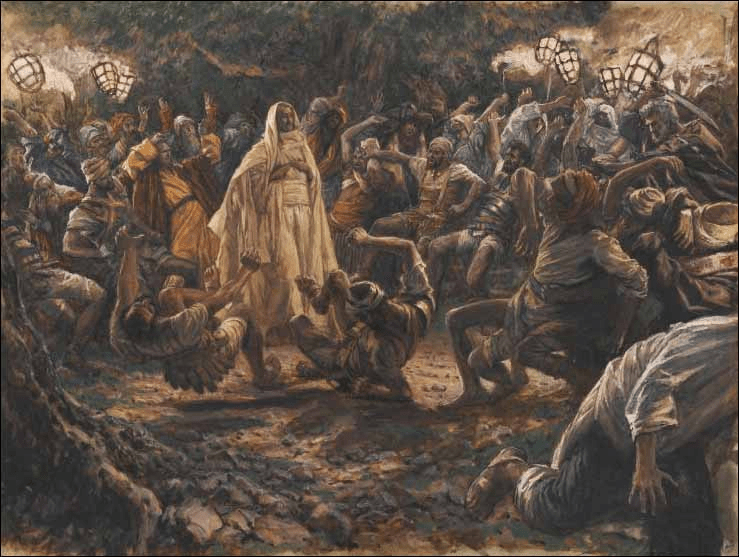
The Guards Falling Backwards, by James J. Tissot (1836-1902)
At the sound of his voice they all moved back and fell to the ground.
He asked them again, “Who have you come for?”
They answered, “Creator Sets Free (Jesus) from Seed Planter Village (Nazareth).”
“I told you already, I am the one you are looking for,” he said, “Let these other men go.”
He said this to fulfill his promise, “None of the ones you gave to me have been lost.”
Right then, Stands on the Rock (Peter) drew his long knife from its sheath and cut off the right ear of the servant of the chief holy man. The servant’s name was Chieftain (Malchus).
Creator Sets Free (Jesus) turned to Stands on the Rock (Peter) and cried out, “Enough of this! Put your long knife back into its sheath. Shall I not drink the cup of suffering my Father has asked of me?”
The lodge soldiers, along with their head soldier and the Grand Council representatives, the took hold of Creator Sets Free (Jesus), tied him securely with cowhide strips, and took him first to Walks Humbly (Annas), one of the high holy men. He was the father of the wife of Hollow in the Rock (Caiaphas), the chief holy man who had advised the Grand Council by saying, “It will be better if one man dies for all the people.”
Stands on the Rock (Peter) and one other follower had been watching from a distance. Since this follower was known by the chief holy man, he entered the courtyard of the house. But Stands on the Rock (Peter) stood outside the gate. This follower spoke to the gatekeeper, a young woman, who then let Stands on the Rock (Peter) in.
The Denial of St. Peter, by Gerard Seghers, c.1620
She said to him, “Are you not one of his followers?”
“No!” he told her, “I am not.”
The night was growing cold, so some of the men, along with the solider guards from the lodge, built a fire in the courtyard to keep warm. Stands on the Rock (Peter) stood there with them, trying to stay warm.
Back inside, the chief holy man began to question Creator Sets Free (Jesus) about his followers and his teachings. Creator Sets Free (Jesus) said to him, “I have spoken openly to all, in the gathering houses and the sacred lodge. I said nothing in secret. Why ask me? Ask the ones who heard me. They will know.”
One of the head soldiers struck him in the face and said, “Is that how you answer a chief holy man?”
Creator Sets Free (Jesus) answered him back, “If I have spoken wrongly, tell what I said wrong. If I spoke what is true, then by what right do you strike me?”
Walks Humbly (Annas) decided to send Creator Sets Free (Jesus) to Hollow in the Rock (Caiaphas), the chief holy man. So they took him, still bound by ropes, to Hollow in the Rock (Caiaphas).
Outside in the courtyard, Stands on the Rock (Peter) was still warming himself by the fire. The other asked him, “You are not one of his followers, are you?”
“No!” Stands on the Rock (Peter) denied. “I am not!”
One of the servants of the chief holy man, a relative of the man whose ear had been cut off, looked at him, and said, “Yes, you are! I saw you in the garden with him!”
Stands on the Rock (Peter) shook his head in denial – and right then a rooster began to crow.
Creator Sets Free (Jesus) was taken from the house of Hollow in the Rock (Caiaphas) to the lodge of the governor of the People of Iron (Romans). The tribal leaders stayed outside, for they did not want to become ceremonially unclean by going inside. It was early in the morning, and many of them had not yet eaten the ceremonial meal of Passover.
Spear of the Great Waters (Pilate) came outside to meet them.
They took Creator Sets Free (Jesus) and stood him before Spear of the Great Waters (Pilate). He took a good long look at him, then turned back to the crowd.
“What has this man done wrong?” he asked them.
“If he were not a criminal, would we have brought him to you?” they answered.
“Take him away!” Spear of the Great Waters (Pilate) said to them. “Use your own law to decide what to do.”
“Our tribal law will not permit us to put him to death,” they answered.
This proved that Creator Sets Free (Jesus) was right when he told them how he would die – by being nailed to a tree-pole – the cross.
Christ Before Pilate, by Duccio di Buoninsegna, 1310
Spear of the Great Waters (Pilate) went back into his lodge and had Creator Sets Free (Jesus) brought to him, so he could question him in private.
Once inside, he said to him, “Are you the chief of the tribes of Wrestles with Creator (Israel)?
“Is this your question,” Creator Sets Free (Jesus) asked, “or are you listening to others?”
“I am not from your tribes,” Spear of the Great Waters (Pilate) answered. “It is your own people and their head holy men who have turned you over to me. What have you done?”
“My way of ruling is a good road. It is not in the ways of this world. If it were, my followers would have fought to keep me from being captured.”
“So, then, you are a chief,” he said back to him.
“It is you who have said it,” Creator Sets Free (Jesus) answered. “I was born for this and have come into the world for this purpose – to tell about the truth. The ones who belong to the truth will listen to my voice.”
Spear of the Great Waters (Pilate) shook his head and said, “What is truth?”
Then Spear of the Great Waters went outside to the tribal leaders and said to them, “I find no guilt in this man. By your own tradition we set free one criminal during your Passover Festival. Do you want me to release Creator Sets Free (Jesus), your chief?”
“No! Not him,” the crowd roared back. “Release Son of His Father (Barabbas)!”
Son of His Father (Barabbas) was a troublemaker who had caused an uprising.
Spear of the Great Waters (Pilate) turned Creator Sets Free (Jesus) over to his soldiers to have him beaten. The soldiers twisted together a headdress from a thorn bush, pressed the thorns into his head, and wrapped a purple chief blanket around him. They bowed down before him, making a big show of it, and kept mocking him, saying, “Honor! Honor to the Great Chief of the tribes of Wrestles with Creator (Israel).”
Christ Mocked by Soldiers, by Georges Rouault (1871-1958)
They took turns hitting him on his face until he was bruised and bloodied.
Spear of the Great Waters (Pilate) stood before the crowd again and said, “I bring to you the one in whom I have found no guilt.”
Creator Sets Free (Jesus) was brought forward, blood flowing down his bruised face. He was wearing the headdress of thorns and the purple chief blanket that was wrapped around him.
“Behold the man!” Spear of the Great Waters (Pilate) said to them, “Take a good long look at him!”
The crowd stared at him in stunned silence.
But then the head holy men and the lodge guards began to shout, “Death! Death on the cross!”
“Then take him and kill him yourselves,” Spear of the Great Waters (Pilate) said to them. “I find no guilt in him!”
They answered him back, “Our law tells us he must die, for he has represented himself as the Son of the Great Spirit.”
When Spear of the Great Waters (Pilate) heard this, his fear grew stronger, so he took Creator Sets Free (Jesus) back inside his lodge.
“Who are you, and where are you from?” he questioned him.
Creator Sets Free (Jesus) stood there and remained silent.
“Speak to me! Do you not know I have the power of life and death over you? I can have you killed or set you free,” he warned him. “Have you nothing to say?”
“The only power you have is what has been given you from above,” he answered. “The ones who turned you over to me carry the greater guilt.”
Spear of the Great Waters (Pilate) tried harder to have Creator Sets Free (Jesus) released, but the people would not have it.
They stood their ground, saying, “If you release a man who says he is a chief, you are not honoring the ruler of your people, for anyone who claims to be a chief challenges his power.”
When Spear of the Great Waters (Pilate) heard this, he took Creator Sets Free (Jesus) and went to the Stone of Deciding, called Gabbatha in the tribal language, and sat down. It was now midday on the Day of Preparation for the Passover Festival.
He brought Creator Sets Free (Jesus) before the people and said, “Here is your chief.”
“Take him away! Take him away!” the crowd shouted with one voice. “Nail him to the cross!”
“Would you have me nail your chief to the cross?” he asked them.
This time the head holy men answered back, “We have no other chief than the Ruler of the People Iron (Caesar).”
Spear of the Great Waters (Pilate) then turned Creator Sets Free (Jesus) over to the soldiers to have him put to death on a tree-pole – the cross – so they took him away.
The cross was an instrument of torture and terror used by the People of Iron (Romans) to strike fear into the hearts of any who dared to rise up against their empire. The victim’s hands and feet would be pierced with large iron nails, fastening them to the cross. The victims would hang there, sometimes for days, until they were dead. This was one of the most cruel and painful ways to die ever devised by human beings.
The soldiers placed a wooden crossbeam on his back and forced him to carry it to the place where he would be executed.
Creator Sets Free (Jesus) carried the crossbeam to the Place of the Skull, which is called Golgotha in the tribal language. There they nailed his hands and feet to the cross, along with the two others, and placed his cross between the two of them.
Spear of the Great Waters (Pilate) fastened a sign to the top of the cross where they attached the crossbeam with these words written on it:
CREATOR SETS FREE
FROM SEED PLANTERS VILLAGE
CHIEF OF THE TRIBES
OF WRESTLES WITH CREATOR
This was near Village of Peace (Jerusalem). So that many of the Tribal Members could read it, the sign was written in Aramaic, their tribal language, but also in Latin and Greek, the languages of the People of Iron (Romans).
The chief head holy men and the tribal leaders said to Spear of the Great Waters (Pilate), “Do not write ‘chief of the tribes.’ Instead write, ‘He said he is chief.’”
But he answered, “What I have written will stand.”
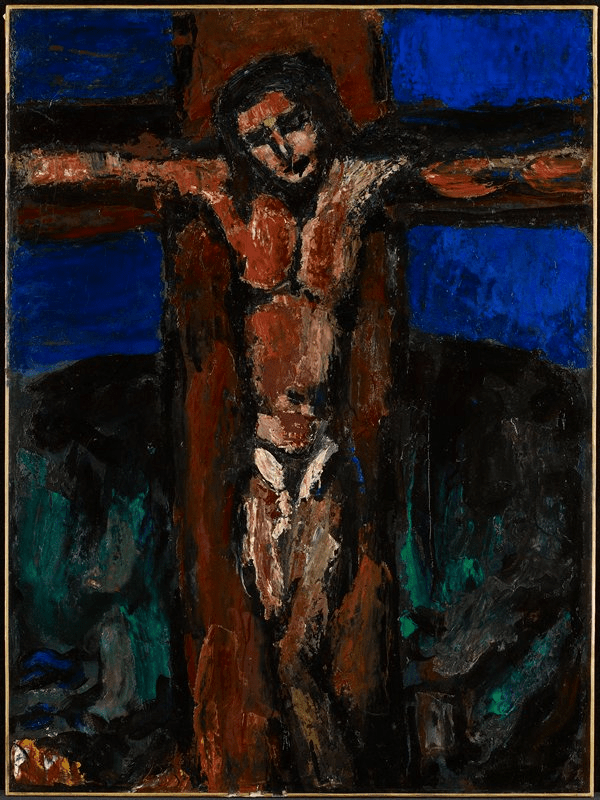
The Crucifixion, by Georges Rouault
The soldiers stripped his clothes from him when they nailed his hands and feet to the cross. They tore one of his garments in to four pieces, one for each guard. His long outer garment was woven together into one piece, so they said, “Let us not tear this, we can draw straws for it.”
This gave full meaning to the Sacred Teachings that said, “They divided my clothes between them and gambled for my garment.” This is what the soldiers did as they kept watch over Creator Sets Free (Jesus).
Standing near the cross was Bitter Tears (Mary), the mother of Creator Sets Free (Jesus), who had come to see him, along with her sister. Two other women also came with her, Brooding Tears (Mary) the wife of Trader (Clopas), and Strong Tears (Mary) from Creator’s High Lodge (Magdala). He Shows Goodwill (John), the much loved follower of Creator Sets Free (Jesus), was also there with them.
When Creator Sets Free (Jesus) looked down and saw them, he said to his mother, “Honored woman, look to your son.” The he said to his follower, “Look to your mother.”
From that time the follower took Bitter Tears (Mary) into his family and cared for her.
Creator Sets Free (Jesus), knowing he had done all the ancient Sacred Teachings had foretold, said, “I thirst.”
There was a vessel of sour and bitter wine standing nearby. One of the soldiers dipped a cloth in it to soak up some wine. He wrapped the cloth around the tip of a hyssop branch and held it up to the mouth of Creator Sets Free (Jesus).
He then tasted the bitter wine, turned his head to the sky and cried out loud, “It is done!”
He then lowered his head to his chest and, with his last breath, gave up his spirit.
Creator Sets Free (Jesus) was dead.
Soon the sun would set and a special Day of Resting would begin when no work could be done. It was time to prepare for this day, so the Tribal members asked Spear of the Great Waters (Pilate) to have the legs of the men on the crosses broken, which would make them die sooner. Then they could take the bodies down and prepare them for burial.
The soldiers came and broke the legs of the two men on each side of Creator Sets Free (Jesus). When they came to him, they saw he was already dead. Instead of breaking his legs, one of the soldiers took a spear and pierced his side. Blood and water flowed out from the wound.
The one who saw these things with his own eyes is telling the truth about this – so that all will believe. This was foretold in the ancient Sacred Teachings that say, “Not one of his bones was broken,” (Psalm 34:20) and, “They will look upon the one they have pierced.” (Zechariah 12:10)
Christ being lifted by Joseph of Arimathea and Nicodemus, by Antonio Canova (1757–1822)
He Gets More (Joseph) from High Mountain (Arimathea), a man with many possessions, was a follower of Creator Sets Free (Jesus), but in secret, because he feared the tribal leaders. Since it would soon be sunset, when the Day of Resting would begin, he went to Spear of the Great Waters (Pilate) and asked permission to remove the body of Creator Sets Free (Jesus) from the cross.
Spear of the Great Waters (Pilate) released the body to him. So he and another man, Conquers the People (Nicodemus), who had come to Creator Sets Free (Jesus) in secret at night, took his body away to prepare it ceremonially for burial. Conquers the People (Nicodemus) had brought a mixture of myrrh and oils weighing about seventy-five pounds. Together they ceremonially wrapped his body for burial in the traditional way, using strips of cloth and herbal spices and oils.
So because it was the Day of Preparation for the Passover Festival, and the day of resting was about to begin, they laid the body of Creator Sets Free (Jesus) in a nearby burial cave that had never been used and then returned to their homes.










 Rev. Tim Ehrhardt