A Spiritual Wedding (Psalm 45:1-2, 6-9)

My thoughts are filled
with beautiful words
    for the king,
and I will use my voice
as a writer would use
    pen and ink.

No one is as handsome as you!
    Your words are always kind.
That is why God
    will always bless you…

You are God, and you will rule
    forever as king.
Your royal power
    brings about justice.
You love justice and hate evil.
    And so, your God chose you
and made you happier
    than any of your friends.
The sweet aroma of the spices
myrrh, aloes, and cassia
    covers your royal robes.
You enjoy the music of harps
in palaces decorated
    with ivory.
Daughters of kings are here,
and your bride stands
    at your right side,
wearing a wedding gown
    trimmed with pure gold. (Contemporary English Version)

A Royal Wedding?

Today’s psalm is a love song meant to be used for a wedding. Whether it was designed only for royal weddings, or for ordinary couples to be a king and queen for a day, the psalm’s overall challenge is for the groom to exercise a right use of power.

Back in biblical times, within a patriarchal society, men held the power and authority within every aspect of the culture, especially in the family.

If the psalm is meant for only royal weddings, it communicates that, in effect, the king has been placed on the throne by God, and acts as God’s extension of justice and righteousness to the people.

And if the psalm is intended for any leader, or anyone who possesses power and authority, then being in such a position requires great responsibility. Power is to be wielded for good, with an eye toward doing what is just and right for all of the people in which the leader exercises authority over.

So, whether one is in a hierarchical or an egalitarian structure, all persons in authority are to give themselves to being faithful.

Symbolism and Allegory

There is a symbolic and allegorical aspect to the psalm. Just as the royal robe or wedding clothes of the groom emit sweet aromatic spices, so the leader who loves justice and acts with integrity is pleasing to all those under their authority.

But thanks be to God, who always leads us as captives in Christ’s triumphal procession and uses us to spread the aroma of the knowledge of him everywhere. For we are to God the pleasing aroma of Christ among those who are being saved and those who are perishing. To the one we are an aroma that brings death; to the other, an aroma that brings life. And who is equal to such a task? (2 Corinthians 2:14-16, NIV)

Those in responsible positions – and those sharing authority with one another – are to do what is life-giving for people; and not do things which are death-dealing. Promoting connection and being encouraging are vital. Causing division and being critical are destroyers of people’s welfare.

The psalmist praises a king who loves righteousness and hates wickedness. Such a ruler defends the cause of truth and upholds justice. These are ideals which have a pertinent message for public servants in every age.

Christ the Bridegroom, and the Church as Bride

For most of church history, Christian interpreters took a committed Christ-centered approach to the psalm. They saw Jesus as the beautiful king who reigns in justice and righteousness, faithfully ruling the people.

Through this view, every psalm, in some way, points to Jesus. In Psalm 45, the wedding poem directs believers to the coming wedding of Christ and the Church. The king is Jesus, who is worthy of praise and adoration. The bride is Christ’s Church.

Whether one discerns the psalm as literal or allegorical, the Christian understands that Jesus Christ is the ultimate fulfillment of all God’s promises. So, in that sense, everything in Holy Scripture – including the Old Testament and all of the Psalms – have to do with Christ.

All good earthly kings, rulers, and leaders hold an office which points forward to Christ, who rules over a kingdom to end all kingdoms. In looking at Psalm 45, the author of the New Testament Book of Hebrews takes such a view, since he looks back to this very psalm in speaking about Jesus:

But about the Son he [God] says,

“Your throne, O God, will last for ever and ever;
    a scepter of justice will be the scepter of your kingdom.
You have loved righteousness and hated wickedness;
    therefore God, your God, has set you above your companions
    by anointing you with the oil of joy.” (Hebrews 1:8-9, NIV)

The Reformer John Calvin (1509-1564) stated the reason we know the Psalm is about Jesus, because neither Jew nor Gentile talks this way about any human king – therefore, it is a reference to Messiah.

From St. Augustine to Martin Luther, scholars and interpreters saw in Psalm 45 a praise to Christ, who is the betrothed king.

The psalm’s celebration exalts the union of Christ and the Church. The song of love anticipates the great wedding feast at the end of the age, sung in honor of Jesus the bridegroom and the Church as the bride of Christ.

Weddings Are About Love

The psalmist unabashedly loves the king, and wants everyone to know it. Indeed, it is love which makes life worth living. It’s love that animates our words and actions. Apart from love, we are lost and lonely – languishing without an object of love to orient life around.

An affectionate love for Jesus Christ drives the Christian to live into goodness, justice, and righteousness. And we become what we love – which is why Christianity has the power to change the world for the better (and not in the weird sense of trying to conquer the world through politics and Christendom).

Such love elicits praise and adoration. Love brings about God’s good purposes. And God is determined to bring a spouse for his Son.

“God created the world to provide a spouse and a kingdom for His Son: and the setting up of the kingdom of Christ, and the spiritual marriage of the spouse to Him, is what the whole creation labors and travails in pain to bring to pass.” Jonathan Edwards (1703-1758)

It is far too easy for one’s love to fade in the Christian life. Living an ethical life, and maintaining doctrinal purity, may be kept up; and yet, it all can be done without love behind it.

Jesus said to the Church at Ephesus:

I know your deeds, your hard work and your perseverance. I know that you cannot tolerate wicked people, that you have tested those who claim to be apostles but are not, and have found them false. You have persevered and have endured hardships for my name, and have not grown weary. Yet I hold this against you: You have forsaken the love you had at first. (Revelation 2:2-4, NIV)

Let’s allow today’s Psalm to evoke and stir up our love for God by reminding us of God’s great love for us in Christ, and the love we have, or once had, for Jesus.

Let us see what great lengths God went to love us through Christ. And let us retain and maintain the joyous passion of life with God in Christ, by means of the Spirit.

Amen.

Labor and Building the Temple (1 Kings 5:13-18)

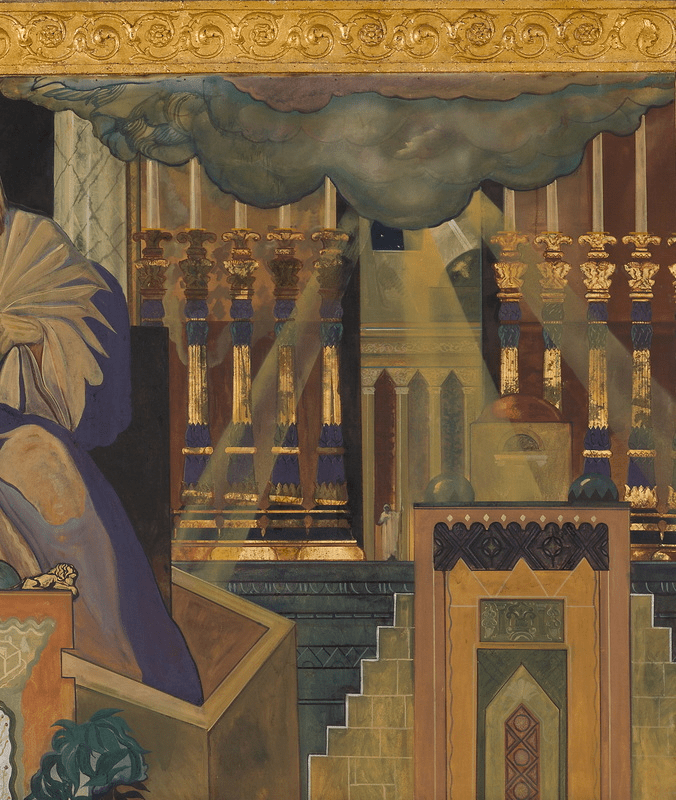
Mural of King Solomon and building the Temple, Wilshire Boulevard Temple, Los Angeles

Solomon ordered 30,000 people from all over Israel to cut logs for the temple, and he put Adoniram in charge of these workers. Solomon divided them into three groups of 10,000. Each group worked one month in Lebanon and had two months off at home.

He also had 80,000 workers to cut stone in the hill country of Israel, 70,000 workers to carry the stones, and over 3,000 assistants to keep track of the work and to supervise the workers. He ordered the workers to cut and shape large blocks of good stone for the foundation of the temple.

Solomon’s and Hiram’s men worked with men from the city of Gebal, and together they got the stones and logs ready for the temple. (Contemporary English Version)

A lot of labor went into construction of the temple in Jerusalem. King Solomon raised a massive workforce, and placed them under the command of Adoniram. The work was not voluntary, but compulsory; no tribe or citizen in Israel or Judah had a choice of whether to labor in the forest and the quarry, or not.

This treatment of the Israelite people, in being required to work in Lebanon one month out of every three months, became a significant reason for the kingdom’s split after Solomon’s death. (1 Kings 11:26-28; 12:1-16)

There was an even larger group of workers to quarry and dress the stones in the hill country. The workforce was likely made up of both Jewish and non-Jewish persons, because of the needed manpower.

King Solomon was a master administrator. All of the planning, and movement of supplies and people, was a major endeavor to pull off. And this gets to the nub of working relations, both then and now.

Cedars of Lebanon, in “The Land of the Book,” by W.M. Thomson, 1894

Oftentimes, what looks good on paper, and makes sense to those in charge, is short-sighted. The actual people who will do the work are rarely consulted. This is especially strange and unacceptable in this day and age.

If companies can put a lot of time, energy, and expenditures into marketing focus groups to determine things like what color to use on packaging in order to sell more, then it is curious that no time and energy is placed into communication and interaction with workers.

It is sad and tragic that the corporation with high levels of effective engagement between management and employees is so very rare.

At the core of it all, I believe, is our anthropological view. Show me a workplace with sour relations and strained negotiations, and I will show you a management and executive team who use workers as replaceable parts in a machine.

But show me a company that discerns people as inherently worthy of respect and kindness, and I will show you a place where effective communication flows freely, and worker satisfaction is high.

Furthermore, our anthropology determines how we treat safety on the job. Rather than putting some safe policies in place because of government oversight and pressure, a view of people as important above all else will ensure that both the physical and psychological environment are secure – and they will take a zero tolerance approach to any and all unsafe practices, in order to preserve human dignity and life.

Therefore, why we do what we do is just as important as what we do.

And the only effective way to answer the why is through a broad and involved connection with a diversity of people within an organization. There is absolutely no substitute for this. Taking shortcuts only leads to ineffectiveness, and more importantly, to human duress and harm.

In order to achieve such an ambitious goal of constructing a temple – along with a palace and administrative buildings – a large corporate government was required to make it all happen.

Essentially, King Solomon enacted a massive administration akin to ancient Egypt and their construction of pyramids. With such a government came classes and ranks and opportunities. Frankly, it was a lot like a totalitarian regime, in which the major function was to bless what was happening.

This resulted in a humungous structure and system that became intolerant of any alternative thinking. Thus, the kingdom (the government) was prepared to crush anything or anyone that threatened the established status quo of how to operate. This is why the Old Testament prophets were not viewed well by the state, and many of them were killed.

So, if you have been following me through these reflections on King Solomon over the past several days, you may wonder if I like him, or loathe him. The fact of the matter is that Solomon, like us, is a complicated person. He tends to get hailed as the wisest person who ever lived, to the neglect of some of his unwise choices. For many, Solomon too easily gets off the hook.

Along with all of Solomon’s grandeur and sagacity, he also had a slave labor force that toiled in quarries, forests, and mines. He was given to excess in most things, and didn’t seem to have a stop button. And, later in life, he honored forbidden gods with sinister sacrifices at shrines on the outskirts of Jerusalem.

The truly wise person in the room will view Solomon in his totality; will have a broader and more contextual view of work and labor; and will discern people as majestic creatures in God’s image, who also have a tragically twisted heart which can easily be prone to foolishness and harming others.

So, as we remember the temple Solomon built, we can keep in mind its beauty and architectural wonder, and the skill needed to make it happen, as well as the thousands of people who endured harsh and sometimes inhumane treatment.

Looking at history from only one angle is really not seeing history at all. We need a full-orbed understanding of people, their situations, the context of events, and the challenges they faced. Otherwise, we’ll get a sanitized version which only ends up demeaning everyone.

Lord God Almighty, who has made all the peoples of the earth for your glory, to serve you in freedom and in peace: Give to the people of this world a zeal for justice and the strength of forbearance, so that we may use our liberty in accordance with your gracious will; through Jesus Christ our Lord, who lives and reigns with you and the Holy Spirit, one God, now and forever. Amen.

Skilled Work (1 Kings 5:1-12)

King Solomon and King Hiram, by Unknown artist

Because King Hiram of Tyre was loyal to David throughout his rule, Hiram sent his servants to Solomon when he heard that Solomon had become king after his father. Solomon sent the following message to Hiram: 

“You know that my father David wasn’t able to build a temple for the name of the Lord my God. This was because of the enemies that fought him on all sides until the Lord put them under the soles of his feet. Now the Lord my God has given me peace on every side, without enemies or misfortune. So I’m planning to build a temple for the name of the Lord my God, just as the Lord indicated to my father David, ‘I will give you a son to follow you on your throne. He will build the temple for my name.’ Now give the order and have the cedars of Lebanon cut down for me. My servants will work with your servants. I’ll pay your servants whatever price you set, because you know we have no one here who is skilled in cutting wood like the Sidonians.”

Hiram was thrilled when he heard Solomon’s message. He said, “Today the Lord is blessed because he has given David a wise son who is in charge of this great people.” Hiram sent word back to Solomon:

“I have heard your message to me. I will do as you wish with the cedar and pinewood. My servants will bring the wood down the Lebanon Mountains to the sea. I’ll make rafts out of them and float them on the sea to the place you specify. There I’ll dismantle them, and you can carry them away. Now, as for what you must do for me in return, I ask you to provide for my royal house.”

So Hiram gave Solomon all the cedar and pinewood that he wanted. In return, Solomon gave an annual gift to Hiram of twenty thousand kors [2,000 tons] of wheat to eat, and twenty thousand kors [4,000 liters] of pure oil for his palace use. Now the Lord made Solomon wise, just as he had promised. Solomon and Hiram made a covenant and had peace. (Common English Bible)

King Solomon was granted by God all the wisdom necessary to rule over Israel and Judah (1 Kings 3:1-15). Early in his reign, he began the construction of a permanent Temple in Jerusalem – a task that was originally in the heart of his father King David.

Today’s Old Testament lesson is the beginning of the account of Solomon’s grand building project. It focuses on the assistance offered by King Hiram of Tyre.

Skilled Leaders

The city of Tyre was a major port in Lebanon. The cedar trees of Lebanon were renowned in the ancient world as being large and strong. Solomon – always the savvy one in knowing where to find the best of the best – looked to King Hiram for the cedar logs needed for building the Temple.

What’s more, Solomon asked Hiram for the builders to help in construction of God’s Temple. King Solomon not only had a broad knowledge of just about everything in creation, but he also understood human nature. He named the reality that the Sidonians were the best at handling their exceptional lumber.

Furthermore, Solomon was clear about the reason for the ambitious building project of the Temple. He believed that the task of erecting the Temple was divinely given to him. Solomon therefore trusted God to help him complete the job.

As a result, the two kings negotiated a treaty in which Hiram provided the lumber and the lumbermen, with Solomon providing grain and olive oil for Hiram’s court. In recounting this, the editor of Kings emphasized Solomon’s wisdom, and the peaceful relations that Jerusalem and Tyre enjoyed.

Perhaps all of this rehashing of an old agreement between a couple of ancient kings seems irrelevant to the modern and post-modern person. Yet, it is a classic example of the realities concerning communication and theology.

Skilled Communication

Hiram had the resources for building, and the skilled builders; Solomon had the money, goods, and administrative knowledge to make their relationship a mutually beneficial one.

Each king negotiated successfully, namely because there was no disadvantage in their treaty relationship. The two nations balanced one another by offering it’s advantages to the other.

Solomon and Hiram came to a genuine win-win agreement. Each of them stated exactly what they wanted and what they would provide, without apology. Both kings promoted their own interests while showing concern for the other’s interests, as well.

The success of their deal was based on mutual trust, which began years earlier with King David.

Skilled Theology

Today’s narrative is more than an example of how to negotiate a deal. It fits into a larger narrative of what God was doing with the nation of Israel. Central to every biblical story is God, who is both object and subject of Holy Scripture.

The Lord revealed a slow and unfolding drama of redemption for people. The construction of the Temple was a prominent way of God revealing divine mercy to the people. It’s central place at the highest point in Jerusalem communicated that the Lord is in the middle of everything, and high above it all.

And the way in which Solomon went about constructing the Jewish Temple included non-Jewish builders. God, through divine sovereignty and grace, led Gentiles to hob-nob with Jews who worship Yahweh, and to thus experience a glimpse of the Lord through the people and the place.

Indeed, all things work together for good to those who love God. (Romans 8:28)

Gracious God, I ask that your love and goodness will have its way for all those who seek to live according to justice and righteousness. You are full of steadfast in love and abounding in mercy. Help me accept your love and mercy. May it flow powerfully in me, and through me, to your glory and honor. Amen.

Divine Sovereignty and Human Responsibility (2 Samuel 8:1-18)

In the course of time, David defeated the Philistines and subdued them, and he took Metheg Ammah from the control of the Philistines.

David also defeated the Moabites. He made them lie down on the ground and measured them off with a length of cord. Every two lengths of them were put to death, and the third length was allowed to live. So the Moabites became subject to David and brought him tribute.

Moreover, David defeated Hadadezer son of Rehob, king of Zobah, when he went to restore his monument at the Euphrates River. David captured a thousand of his chariots, seven thousand charioteers and twenty thousand foot soldiers. He hamstrung all but a hundred of the chariot horses.

When the Arameans of Damascus came to help Hadadezer king of Zobah, David struck down twenty-two thousand of them. He put garrisons in the Aramean kingdom of Damascus, and the Arameans became subject to him and brought tribute. The Lord gave David victory wherever he went.

David took the gold shields that belonged to the officers of Hadadezer and brought them to Jerusalem. From Tebah and Berothai, towns that belonged to Hadadezer, King David took a great quantity of bronze.

When Tou king of Hamath heard that David had defeated the entire army of Hadadezer, he sent his son Joram to King David to greet him and congratulate him on his victory in battle over Hadadezer, who had been at war with Tou. Joram brought with him articles of silver, of gold and of bronze.

King David dedicated these articles to the Lord, as he had done with the silver and gold from all the nations he had subdued:Edom and Moab, the Ammonites and the Philistines, and Amalek. He also dedicated the plunder taken from Hadadezer son of Rehob, king of Zobah.

And David became famous after he returned from striking down eighteen thousand Edomites in the Valley of Salt.

He put garrisons throughout Edom, and all the Edomites became subject to David. The Lord gave David victory wherever he went.

David reigned over all Israel, doing what was just and right for all his people. Joab son of Zeruiah was over the army; Jehoshaphat son of Ahilud was recorder; Zadok son of Ahitub and Ahimelek son of Abiathar were priests; Seraiah was secretary; Benaiah son of Jehoiada was over the Kerethites and Pelethites; and David’s sons were priests.(New International Version)

“God’s sovereignty does not negate our responsibility; it empowers us to live out God’s purposes.”

D. A. Carson

In every biblical story, the real hero is God. That’s because, in each scriptural narrative, God’s sovereignty, power, and authority works on behalf of the people. The secondary characters – if they are good people – take up their mantle of responsibility by working for the people in fulfillment of God’s good promises to them.

Divine sovereignty and human responsibility work together. When that happens, it doesn’t matter what the odds of a situation are, because God’s people will emerge as recipients of God’s gracious promises.

It’s good to always keep in mind that God is working – albeit, mostly behind the scenes where we never see it – and that therefore we must remember to be ourselves continually responsible for acting consistent with God’s revealed will to us.

Up to this point in today’s story, the Ark of the Covenant has been brought to the new national capitol of Jerusalem. The Ark signifies the presence of God, and it’s central placement in the life of the Jewish nation, signifies King David’s desire to be responsible in working on God’s behalf.

So, this is why we have a litany of David’s successes, in order to show us the connection between God’s presence and the national advancement of Israel’s people in the region. King David was able to defeat Jewish enemies in all the geographic places around Israel and Judah.

King David’s Jerusalem, by Julia Goddard

All of the areas mentioned in today’s text fit the boundary promises given to the original Jewish ancestor Abraham, centuries earlier. (Genesis 15:18-21)

David defeated Judah’s main enemy in the West, the Philistines, by capturing their main city, and thus, controlling their entire territory. Philistia had been the major thorn in Judah’s side for a very long time. After David’s victory over them, the Philistines never regained their power again.

David defeated Israel and Judah’s enemies in the East. The Moabites were ancient foes, having tried to put a curse on Israel so that they could enter the Promised Land (Numbers 24:17). But the curse backfired. King David was perhaps merciful to them by not wiping out Moab altogether, but only humbling them with limited violence.

David defeated Israel’s enemies in the North by achieving an overwhelming decisive victory against the Arameans and the city of Damascus, despite insurmountable odds. Yahweh, Israel’s God, clearly outdid Aram’s storm god Hadad – proving to the people once and for all that the Lord is not limited to the geography of Israel.

David defeated Judah’s enemies in the South. The Edomites were always looking to take advantage of their brother Jews, constantly playing out the ancient rivalry between Esau and Jacob. Overcoming the nation of Edom, along with the other surrounding nations, allowed David’s kingdom to more than double in size.

The hallmark description of any good and godly leader is that they do what is right and just for all the people – which is precisely what King David sought to do, and did. And he didn’t do it alone, but had a solid group of good and godly people helping him in his royal administration.

King David acted according to his understanding of God’s will for the Jewish nation, which meant decisively handling the ancient enemies which previous leaders either could not or would not take on. David moved with confidence, believing that God was with him in all his endeavors, based upon divine promises from God’s covenant with Israel.

The God of David is still watching over the nations, and still yet remains sovereign. People are still responsible to act according to their understanding of God’s will – not confusing that responsibility with Israel’s, but knowing what their place is in the kingdom of God with King Jesus as the ultimate Sovereign.

Today, I believe that two significant problems plague us: 1) A lack of knowing God and God’s will for us; and 2) An unwillingness to act confidently in faith and take a risk based on a solid understanding of God. The result of these two problems is pervasive spiritual immaturity and mediocrity.

We have a lot of work to do. And it’s high time we roll up our sleeves and deal with the primary problems in front of us – not with military weapons and shedding blood – but by the means of knowledgeable prayer and loving actions.

May it be so, to the glory of God and for the blessing of the nations. Amen.