
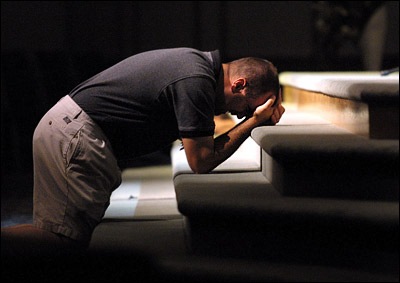
The Need for Lament, Part 2


We all accumulate a host of losses over the course of a lifetime.  Many of them are small losses; some of them are devastating losses.  The death of children, disability, rape, abuse, cancer, infertility, suicide, and betrayal are all examples of crushing loss – losses that need to experience lament.  All these losses are irreversible; we cannot return to how things once were.  We must push forward by grieving each loss.  And as we lurch ahead we cling to these words from Holy Scripture:  Because of the LORD’s great love we are not consumed, for his compassions never fail.  They are new every morning; great is your faithfulness (Lamentations 3:22-23).
 
            So, how do we lament our losses in a healthy way?  Here is what the prophet Jeremiah did in the book of Lamentations:
  1. Jeremiah remembered his afflictions and his losses.  We need to avoid superficial repentance and forgiveness.  We must own and feel the pain of the loss before we can begin to offer a mature forgiveness.
  2. Jeremiah paid attention to faith, hope, and love.  This can only be done if we are alert to the process of grieving.  Elizabeth Kubler-Ross was the person who identified the famous five stages of grief:  denial, anger, bargaining, depression, and resolution/acceptance.  We rarely move neatly through each stage.  The important thing is that we get to the place of seeing God’s committed love to us not just in spite of the suffering but because of it.
  3. Jeremiah did not minimize his pain and suffering.  We must sit with our pain.  Do not sluff off a loss by saying others have it worse, or that it is nothing.  Year after year many Christians do not confront the losses of life, minimizing their failures and disappointments.  The result is a profound inability to face pain, and has led to shallow spirituality and an acute lack of compassion.
  4. Jeremiah prophesied about how Jesus grieved.  His message predicted what Jesus faced in his passion.  The prophet Isaiah described the Messiah as a man of sorrows and acquainted with grief (Isaiah 53:3).  Peter Scazzero, in his book The Emotionally Healthy Church, points out what Jesus did not say, and what he did say at particular events in his ministry.  At the tomb of Lazarus, Jesus did not say “Come on everyone, stop all this crying” but wept with the people.  When entering Jerusalem, Jesus did not say “too bad guys, I’m moving on without you” but lamented over the city desiring to gather them as a hen does her chicks.  On the cross, Jesus did not say “Lighten up everyone; God is good; he will be victorious!”  But instead said, “My God, my God, why have you forsaken me?”  Hebrews 5:8 tells us that Jesus “learned obedience from what he suffered.”
Grieving is an indispensable part of a full-orbed spirituality and emotional health.  Life does not always make sense.  There is deep mystery to the ways of God.  The Lord is doing patient and careful work inside of each one of us.  While he is busy within our souls, we will likely feel lost and disconnected, not seeing the full tapestry of what he is creating.  Weariness, loneliness, a sense that prayers are not being heard, and a feeling of helplessness are all common experiences of God’s reconstruction of a broken spirit.
 
People who have truly lamented their losses are not hard to spot.  They have a greater capacity to wait on God and be patient toward others.  They are kinder and more compassionate.  They lack pretense and are liberated from trying to impress others.  They are comfortable with mystery, not having to be certain about every theological minutiae.  They are humble, gentle, and meek.  They are able to see God not only in the glorious and victorious, but in the mundane, banal, and lowly.  They are more at home with themselves and with God.  People transformed through the power of lament are equipped to live and love others as Jesus did.


            So, then, the church really ought to be the best place on planet earth for people to be open in their grief, find openness in love, and effectively move through a process of lament so that they become mature disciples able to help others with the comfort they have received.  Let us pray toward that end.

The Need for Lament

 
We all face situations at some point in our lives which cause us to grieve.  In fact, grief can and does attach itself to any significant change or loss.  Bereavement, divorce, major surgery, losing a job, bankruptcy, and a host of adverse circumstances are all, understandably, events that bring grief to our lives.  They are all events we would rather not face.  What is more, grief can also attach itself to the positive changes of life:  moving to a new house in a new area; the empty nest; getting married; having children; a beloved pastor leaving a congregation; or, beginning a new job.  These all result through some sort of loss, even if that loss were chosen and necessary.
 
            The worst possible way to approach any of these kinds of situations, for good or for ill is to ignore them, minimize them, say they are simply in the past, and just move on.  It is actually unbiblical to take such an attitude because Scripture discerns that we need to lament our losses.  We have an entire book of the Bible given to lamenting a grievous loss (Lamentations).
 
            The prophet Jeremiah was called by God to pronounce judgment against Jerusalem.  And not only was Jeremiah to proclaim a very unpopular message, he was given the promise that the people would not listen to him and that Jerusalem would be destroyed with the people being sent into exile.  The prophecy of Jeremiah is a long extended message of a melancholy messenger preaching exactly what the Lord wanted him to preach.  God’s words came true.  The people did not repent of their empty worship and wayward lifestyles.  They persecuted Jeremiah for speaking words of judgment.  The Babylonians came and tore down the walls of Jerusalem, decimated the city and the temple, and carried off the people into exile.
 
            Jeremiah, in his grief over the ruined city of Jerusalem, wept and lamented the loss of this once great city with its grand temple.  It was only after an extended lamentation that Jeremiah turned his attention toward the love of God, his compassions becoming new every morning, and the hope of a new existence without Jerusalem at the center of Jewish life (Lamentations 3:19-33).  Jeremiah lost everything but his own life.  He had much to grieve over.
 
            Without exception, none of us can have the hope of love, compassion, and new life apart from the need to first lament our losses.  There is a popular phrase in our culture that we need to use very sparingly in our conversations with others who have experienced loss: “Get over it!” is often used much too quickly and can short circuit the grief process and puts grieving people in the awkward position of not seeing the power of lament through to its end of acceptance, resolution, and fresh hope.  Far too many people in both the world and even the church remain stuck in some stage or level of grief, unable to effectively move on because others expect them to be joyful and triumphant when they really feel downright awful and now guilty on top of it for being sad.
 
            Embracing lament is the only pathway to knowing compassion and becoming a compassionate person like Jesus.  Wallpapering over our losses without lamenting them is at the root of many if not most of the emotional problems in the church today.  Jerry Sittser wrote an important book, A Grace Disguised: How the Soul Grows Through Loss.  He was driving his family’s minivan when a drunk driver crossed the road and hit them head on.  In an instant he watched three generations of his family die in front of his eyes:  his mother, his wife, and his daughter.  If anyone knows the need and the power of lament it is Jerry Sittser.  Here is what he says:  “Catastrophic loss by definition precludes recovery.  It will transform us or destroy us, but it will never leave us the same….  I did not get over my loved ones loss; rather I absorbed the loss into my life until it became part of who I am.  Sorrow took up permanent residence in my soul and enlarged it.”
 
Grieving is an indispensable part of a full-orbed spirituality and emotional health.  Life does not always make sense.  There is deep mystery to the ways of God.  The Lord is doing patient and careful work inside of grieving people.  While he is busy within our souls, we will likely feel lost and disconnected, not seeing the full tapestry of what he is creating.  Weariness, loneliness, a sense that prayers are not being heard, and a feeling of helplessness are all common experiences of God’s reconstruction of a broken spirit.


Maybe we are always running, working, and playing because we are constantly trying to keep grief from catching up to us.  Slow down and let it catch you.  Let it do its intense and powerful work within you.  Let the church be a place of deep healing where the need for lament results in a more compassionate congregation.  

Good Grief


            It is a terrible reality that by living in a fallen world we will all be faced at various times with grief and bereavement.  One of the most significant ministries that a church can engage in is a ministry of comforting those experiencing loss.  The words and actions of people make a difference, for either good or ill, when faced with traumatic times.
 
            When my wife’s brother died in the early ‘90s due to complications from AIDS, we heard some comforting words, and we heard calloused words that simply did not help.  Phrases such as, “Well, you know he just reaped what he sowed!” and, “You should move on and forget him,” were not only unhelpful but downright hurtful.  On the other hand, there were people who offered a genuine and heartfelt “I’m sorry,” or hugs with no words attached.
 
In the first chapter of the New Testament book of 2 Corinthians, the word “comfort” is used ten times in five verses (2 Corinthians 1:3-7).  It is a beautiful word; one for which the Apostle Paul knew all too well for the many times he faced his own set of trials and tribulations.  He understood God’s design that those who have seen the face of evil and overcame are in the best position to give grace to those who need it most.
 
Grief attaches itself to any significant change or loss.  Whether it is the loss of a loved one, the loss of a job, or health, or the empty nest syndrome, or any of a number of losses, it is both natural and necessary to grieve.  Most people are familiar with the five stages of grief, observed by Elizabeth Kubler-Ross:
  1. Denial – “I’m ok” or “this can’t be happening”
  2. Anger
  3. Bargaining – “if only…”
  4. Depression
  5. Acceptance
We are to come alongside and walk with another through grief, offering helpful words and actions, until the person can accept the new situation and move on.  With any change or loss, there becomes a new normal that we must adjust to.  Everyone’s grief is personal; each individual moves through their own stages of grief, and each one moves on their own timetable.  Sometimes people get “stuck” in one stage and need help getting out.
 
The way people get unstuck, and the way they come to resolution and acceptance is through telling their story.  So, our role is to listen well.  Our place is neither to give advice, nor to quote a lot of scripture about how everything will be okay.  Our place is to let the grieving person grieve, and come out the other end having grieved well.  Grieving well can only happen if we listen well to those in grief.  We will not listen well if we do not respect the reality that we all must grieve. 


What is more, God always has a listening ear.  He knows grief and bereavement better than all of us, because he experienced seeing the agonizing death of his one and only Son.  And it is through Jesus that genuine acceptance is realized.  Because Christ died and rose again, there is a future resurrection awaiting us and our loved ones.  May you, by faith, enter into life that is truly life by embracing Jesus Christ.  May your grief be turned to joy, and may your comfort overflow.

Death


          Death may not be the most popular of topics, especially at the first of the year, but it is still all around us.  Death does not take a break between semesters.  We typically don’t deal well with death in our American culture simply because we don’t like to think about it. Yet, it is a reality we all must face. Whether it is seeing the tragedy of murder on the news, or a more personal touch of experiencing the loss of a loved one, the specter of death haunts us.  Death is topic we must confront. As a pastor I do my fair share of funerals.  Many families want to just get it all over quickly.  More just don’t know what to do, how to act, or even how to feel.  The process from death to grave occurs in just a few days.  Typically we “enlightened” Westerners give three days for the process of grief. Most employers give only three days of bereavement pay. Most professors at school still want the work in on time. The expectation is that we get this grief thing all over with and move on with our lives as if nothing has happened.

Biblically, grief unfolds over a much longer stretch of time. It takes time to come to grips with what has happened and come to a resolution of the reality of the loss. Emotions need time to come out and be expressed through talking about the deceased, through lots of tears, and through listening to the stories of others about the loved one we no longer have. When, in the Old Testament, Jacob died, an extended time of bereavement occurred where the body was embalmed (a long process in Egyptian culture), a funeral procession ran from Egypt to Israel, and, once at the burial site, a period of thirty days was observed in mourning. Contrasted with our bereavement rituals, it is no wonder that people often exhibit long periods of depression and anger months, sometimes even years after a death of a friend or family member.  Sometimes they may drop out of normal routines altogether and are never quite the same.

Our well-meaning words to the bereaved can also add to the suppression of emotions. When words are offered that God works for the good of the death, that we can be joyful despite our loss because of heaven, or that it is time to move on and put the past behind us, we can unwillingly short circuit the needed process of grief, leaving the bereaved feeling guilty for not being able to cope better with the loss. Everyone’s grief is personal, and everyone must have another who will offer a listening ear. Deeds often say much more than words for the bereaved. Bringing meals, helping with the dishes or laundry, or taking the dog for a walk are all examples of mercy and love that speak volumes to those experiencing loss.

So, let’s not avoid death. Let’s embrace it. Let’s feel the full range of pain that is inevitable in such a loss. For, through the process of grief we can better experience the solidarity of identifying with the suffering Savior of our souls, and we can be agents of God’s grace to the hurting. It is through these needs met that a grief observed can bring people to know Jesus and the power of salvation.