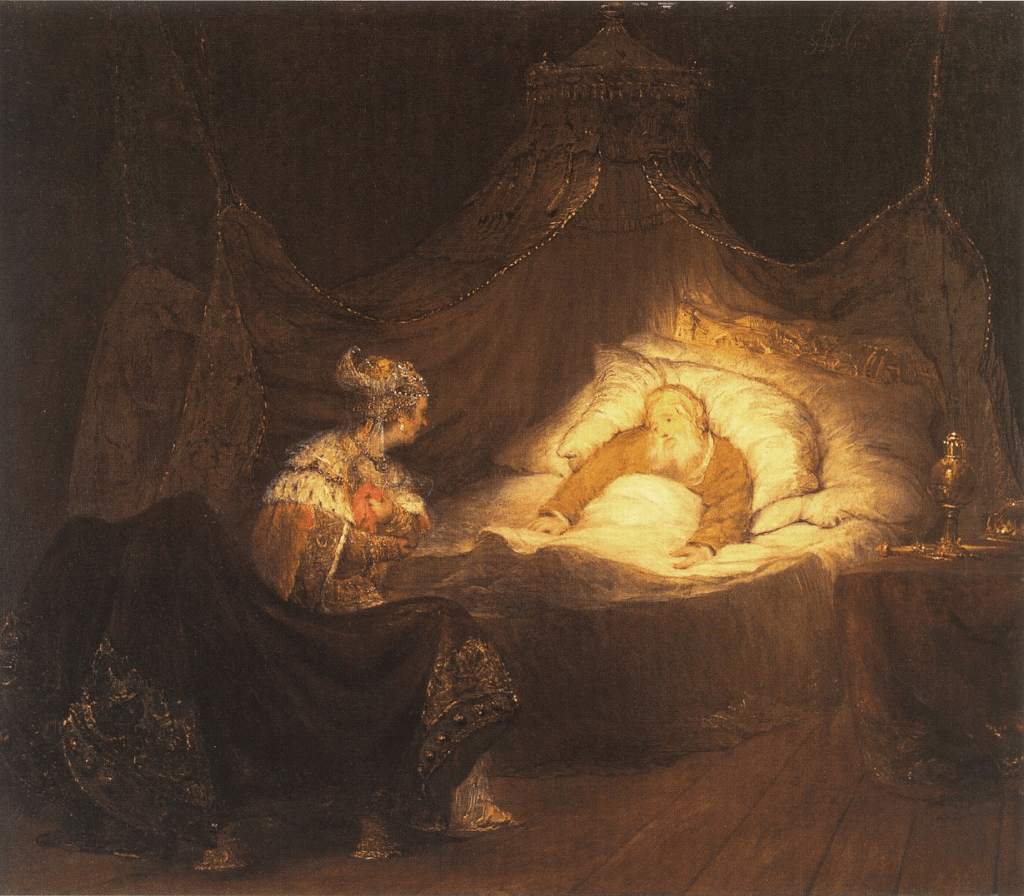
Pass Along Values (1 Kings 2:1-11)

David’s Dying Charge to Solomon, by Ferdinand Bol (1616-1680)

David’s time was coming to an end. So he commanded Solomon his son, “I’m following the path that the whole earth takes. Be strong and be a man. Guard what is owed to the Lord your God, walking in his ways and observing his laws, his commands, his judgments, and his testimonies, just as it is written in the Instruction from Moses.

“In this way you will succeed in whatever you do and wherever you go. So also the Lord will confirm the word he spoke to me: ‘If your children will take care to walk before me faithfully, with all their heart and all their being, then one of your own children will never fail to be on the throne of Israel.’ 

You should know what Joab, Zeruiah’s son, has done to me and what he did to the two generals of Israel, Abner, Ner’s son, and Amasa, Jether’s son. He murdered them, spilling blood at peacetime and putting the blood of war on the belt around his waist and on the sandals on his feet. So act wisely: Don’t allow him to die a peaceful death. 

“As for Barzillai’s sons from Gilead, show them kindness. Let them eat with you. When I was running away from your brother Absalom, they came to me. 

“Now as for this Shimei, Gera’s son—a Benjaminite from Bahurim—who is with you, he cursed me viciously when I went to Mahanaim. When he came down to meet me at the Jordan, I swore to him by the Lord, ‘Surely I won’t execute you with the sword.’ But you don’t need to excuse him. You are wise and know what to do to him. Give him a violent death.”

Then David lay down with his ancestors and was buried in David’s City. He ruled over Israel forty years—seven years in Hebron and thirty-three years in Jerusalem. (Common English Bible)

David

On David’s deathbed, he ensured that his son Solomon would be king. And David had some pragmatic advice to pass along, before he himself passed away.

Along with an encouragement to remain faithful to God’s covenant stipulations, David communicated some personal scores to Solomon that needed to be settled. Old general Joab, as well as Shimei, a servant from Saul’s old house, were threats to the new king’s reign in Israel and Judah.

Joab and Shimei

King David had a complicated relationship with Joab. At issue for David was the murder of two opponents to the king. Joab had killed them in a time of peace, and not because of a wartime situation.

On top of that, Joab had thrown his lot in with Adonijah, Solomon’s half-brother, who had tried to wriggle onto the throne before David was even gone.

And then there was the character Shimei. He had cursed David repeatedly when yet another half-brother to Solomon, Absalom, engaged in a coup attempt against his father.

Once the threat had passed, Shimei made a quick about face back to David. The king told Shimei that he would not kill him. But with Solomon, David communicated that he was completely free to do what needed to be done with the old rascal Shimei.

Fathers

Ideally, all fathers would have the chance to communicate to their children at the end of their lives. Yet, having been at the bedside of many a father in my work as a hospital chaplain, I’ve not seen many who pass along wisdom and instructions on their deathbed.

Fortunately, there are times when I can help facilitate the conversation between father and family. Yet, unfortunately, there are far too many times when fathers simply die with no loved ones present; or they badger someone to promise to stop doing something.

Rare, however, are the experiences of expressing some sound instruction, along with instructions about how to deal with life.

I realize that wills and documents do much of this work nowadays, yet I still argue that face-to-face communication which reinforces one’s values is always a good idea – especially at the end of one’s life.

Honestly, nobody really needs to wait until they are nearly gone to communicate important values and sage advice to loved ones. It can be done now, before it’s too late.

I’m talking about more than healthcare decisions for the actual end of life situation – but about the grace, forgiveness, wisdom, and/or moral values one wants their loved ones to know; or to reinforce those things that are of upmost importance.

It seems to me that thinking through the following values, and how to communicate them, can be done now, and, if appropriate and possible, at the end of one’s life:

Empathy

Treat others with compassion and understanding. Practice kindness. Consider the emotions of others. Seek to understand another’s point of view. Encourage family members to talk about their feelings. 

Therefore, as God’s choice, holy and loved, put on compassion, kindness, humility, gentleness, and patience. (Colossians 3:12, CEB)

Relationships

In the end, the only thing permanent and enduring is relationships. We cannot take any of our stuff with us. Prioritize time with people, especially family. It only makes sense to value loved ones by putting our time into them.

Be happy with those who are happy, and cry with those who are crying. Consider everyone as equal, and don’t think that you’re better than anyone else. (Romans 12:15-16, CEB)

Honesty

Telling the truth is not always easy, but it’s essential to maintaining trust between people. Life requires knowing and living by the truth.

“You are truly my disciples if you remain faithful to my teaching. Then you will know the truth, and the truth will set you free.” (John 8:31-32, CEB)

Love

Deep affection and attachment connects people and keeps them together. It’s important to verbally express love, as well as to demonstrate it with actions.

Don’t be in debt to anyone, except for the obligation to love each other. Whoever loves another person has fulfilled the Law. (Romans 13:8, CEB)

Commitment

Support one another in difficult times; and do not intentionally harm each other. Don’t shame your family for mistakes they’ve made. Instead, express loyalty and encouragement.

Be the best in this work of grace in the same way that you are the best in everything, such as faith, speech, knowledge, total commitment, and the love we inspired in you. (2 Corinthians 8:7, CEB)

Respect

Treat everyone, and especially family members, with the upmost care and politeness; and discourage disrespectful words and offensive behavior.

Submit to each other out of respect for Christ. (Ephesians 5:21, CEB)

Perseverance

Your family will face many complex challenges in the years ahead. Encourage them to embrace shared goals, practice self-care, and patiently work together in order to overcome obstacles. 

We even take pride in our problems, because we know that trouble produces endurance, endurance produces character, and character produces hope. (Romans 5:3-4, CEB)

It is always open season on passing along wise and good values, no matter whether it’s in a calm or a calamitous season of life.

Almighty God, enable me to be mindful of your mercy and happy to do your will. Bless my family with honest work, sound learning, and good manners. Save us all from violence, division, and confusion; and from pride and arrogance, and all evil. Protect us, and keep us united.

Grant Your wisdom to all in positions of authority and influence, so that there may be justice and peace at home, and obedience and submission everywhere. In times of prosperity, fill our hearts with grace and gratitude, and in times of trouble, help us trust in Your divine justice, righteousness, and goodness; through Jesus Christ our Lord. Amen. 

Dealing with Injustice (1 Kings 1:28-48)

Bathsheba appeals to David, by Arent de Gelder, c.1685

Then King David said, “Call in Bathsheba.” So she came into the king’s presence and stood before him.

The king then took an oath: “As surely as the Lord lives, who has delivered me out of every trouble, I will surely carry out this very day what I swore to you by the Lord, the God of Israel: Solomon your son shall be king after me, and he will sit on my throne in my place.”

Then Bathsheba bowed down with her face to the ground, prostrating herself before the king, and said, “May my lord King David live forever!”

King David said, “Call in Zadok the priest, Nathan the prophet and Benaiah son of Jehoiada.” When they came before the king, he said to them: “Take your lord’s servants with you and have Solomon my son mount my own mule and take him down to Gihon. There have Zadok the priest and Nathan the prophet anoint him king over Israel. Blow the trumpet and shout, ‘Long live King Solomon!’ Then you are to go up with him, and he is to come and sit on my throne and reign in my place. I have appointed him ruler over Israel and Judah.”

Benaiah son of Jehoiada answered the king, “Amen! May the Lord, the God of my lord the king, so declare it. As the Lord was with my lord the king, so may he be with Solomon to make his throne even greater than the throne of my lord King David!”

So Zadok the priest, Nathan the prophet, Benaiah son of Jehoiada, the Kerethites and the Pelethites went down and had Solomon mount King David’s mule, and they escorted him to Gihon. Zadok the priest took the horn of oil from the sacred tent and anointed Solomon. Then they sounded the trumpet and all the people shouted, “Long live King Solomon!” And all the people went up after him, playing pipes and rejoicing greatly, so that the ground shook with the sound.

Adonijah and all the guests who were with him heard it as they were finishing their feast. On hearing the sound of the trumpet, Joab asked, “What’s the meaning of all the noise in the city?”

Even as he was speaking, Jonathan son of Abiathar the priest arrived. Adonijah said, “Come in. A worthy man like you must be bringing good news.”

“Not at all!” Jonathan answered. “Our lord King David has made Solomon king. The king has sent with him Zadok the priest, Nathan the prophet, Benaiah son of Jehoiada, the Kerethites and the Pelethites, and they have put him on the king’s mule, and Zadok the priest and Nathan the prophet have anointed him king at Gihon. From there they have gone up cheering, and the city resounds with it. That’s the noise you hear. Moreover, Solomon has taken his seat on the royal throne. Also, the royal officials have come to congratulate our lord King David, saying, ‘May your God make Solomon’s name more famous than yours and his throne greater than yours!’ And the king bowed in worship on his bed and said, ‘Praise be to the Lord, the God of Israel, who has allowed my eyes to see a successor on my throne today.’” (New International Version)

Solomon at the deathbed of King David, by Giulio Romano (1499-1546)

One of King David’s sons, Adonijah, was a stinker. He tried to pull a fast one on his aging father, in order to try and take the throne. But some of the people caught wind of what was afoot.

Even Nathan the prophet got involved and gave some sage instructions to Bathsheba, Solomon’s mother, so that the king’s wishes could come to fruition – namely, that Solomon would succeed David.

As a result, despite King David’s struggles toward the end of life, he had enough wherewithal to attempt some decisive leadership. He confirmed Solomon as his royal successor.

Despite Adonijah’s attempt to take advantage of his father’s failing capacity and execute a coup d’état, the king immediately took action by anointing and enthroning Solomon without any delay.

The installation of Solomon as king was accomplished so quickly that it caught the conniving Adonijah and his cohorts off guard. King David may have lost several steps in his old age, but he was still someone to be reckoned with. That underestimation would cost the connivers dearly.

To be honest, I don’t like Adonijah. And that’s what the storyteller wants us to feel. We are meant to read the narrative and walk away saying to ourselves that we don’t want to be like Adonijah; we don’t want injustice to have the day; instead, we want King David’s wishes honored, and to see a just and right Ruler ensconced as king.

The Lord is a just God. And since we are people created in God’s image and likeness, we have an inherent sense of justice down deep inside us. So, it drives people nuts whenever there are things happening which are not right nor good.

Everyone faces injustice, and things that are not right, in this life. The trick is to deal with it, without becoming unjust ourselves. It’s not an easy thing to do. It’s tough. So, how do we maintain being just while handling injustice?

The feeling of helplessness is rather uncomfortable, even painful. It doesn’t feel good to think that your efforts at doing right and being just don’t accomplish much of anything, and are only a drop in the bucket of what’s needed. It also doesn’t feel right whenever we see others going through injustice, and we have little to no way in helping the situation.

The first step in dealing with the world’s injustice is to acknowledge it. Don’t purposely ignore it, avoid it, or pretend that it isn’t there. Everything in life must be acknowledged before anything can be done about it – whether it’s dealing with an event, or your own emotions.

So, it is imperative that your care for yourself. And it’s the most important thing in being of service and help to others. Attend to the whole self – body, mind, emotions, and spirit – because it is necessary in order to move through unjust circumstances with health, confidence, and sobriety.

When facing injustice and dealing with it, no matter whether it concerns yourself or another, it’s good to keep in mind that our brains tend to gravitate toward the negative, to the detriment of seeing good and positive things.

Therefore, we must work at keeping our “compassion quotient” high, and not let our compassion turn to fatigue, then burn-out.

It seems that King David continually worked on maintaining a robust spirit and healthy self, so that, even when he was old, his compassionate and wise instincts kicked in – the ones he had spent a lifetime developing.

In contrast, Adonijah appears to have nurtured a self-centered and bitter spirit. He did not attend well to his spiritual and emotional health. His mind turned to the dark thoughts of intrigue and rebellion. Arrogance clouded his right mind. This would not end well for him.

Dealing with injustice is never easy. And it very much requires us to be healthy and just ourselves, so that when we are faced with issues of justice, we can deal with them in a good and right manner.

Almighty God, you have given all peoples one common origin.
It is your will that they be gathered together
as one family in yourself.
Fill the hearts of humanity with the fire of your love
and with the desire to ensure justice for all.
By sharing the good things you give us,
may we secure an equality for all
our brothers and sisters throughout the world.
May there be an end to division, strife and war.
May there be a dawning of a truly human society
built on love and peace. Amen.

The Wealth and Wisdom of Solomon (2 Chronicles 9:29-31)

King Solomon, by British artist Simeon Solomon, c.1874

Everything else Solomon did while he was king is written in the records of Nathan the prophet, Ahijah the prophet from Shiloh, and Iddo the prophet who wrote about Jeroboam son of Nebat. After Solomon had ruled 40 years from Jerusalem, he died and was buried in the city of his father David. His son Rehoboam then became king. (Contemporary English Version)

The life of King Solomon can be found in the biblical books of 1 Kings (chapters 1-11) and 2 Chronicles (chapters 1-9). Solomon is also traditionally viewed as the author of three biblical books: Ecclesiastes, Proverbs, and Song of Songs.

Solomon was the son of Bathsheba and King David. He is most known for building the first Jerusalem Temple, as well as his immense wealth, wisdom, and numbers of wives.

Although his reign as king was marked by peace and prosperity, it fell apart after his death. Late in his life Solomon succumbed to worshiping many other gods, which the biblical editor connects with the split of the kingdom under his son Rehoboam.

King Solomon presides over the Old Testament as a sort of larger than life individual. He reigned over a united kingdom of Israel and Judah nearly a thousand years before Christ.

Coming to the throne after his father’s death, Solomon carried out a purge. He cunningly did away with his older brother Adonijah, and the commander of the army Joab. Both of them were characters only concerned with themselves and not the overall good of the kingdom. (1 Kings 2:13-46)

Once firmly ensconced in power, Solomon famously asked God for wisdom – after the Lord came to him in a dream and offered to grant the king any wish he wanted. In asking for wisdom instead of riches, glory, or long life, God was pleased to give him a great degree of discerning wisdom that no one before or since would ever have. (1 Kings 3:5-15)

The Judgment of King Solomon, by Frans Floris, c.1547

The proof of King Solomon’s wisdom came in many forms, including the rendering of justice. The biblical story is told of two women who came before the king, both claiming to be the mother of a baby. Solomon called for a sword and said the solution to the dilemma would be to cut the baby in two, and give each half to each woman.

One woman finds the solution agreeable, but the other woman protested, stating that she would give up the child rather than see the baby killed. King Solomon therefore concluded that this woman, not the other, was the child’s mother. (1 Kings 3:16-28)

King Solomon engaged in many building projects, but none more great than the Temple. To this day, Jerusalem continues as the center of Jewish prayer and worship. Indeed, Solomon’s impact is felt all these millennia later.

And then there were the wives. Lots of them. According to scripture, Solomon had 700 wives and 300 concubines (a concubine was a lesser wife who was not born of royalty or nobility). Many of his wives worshiped gods other than the Lord, which is why Solomon eventually allowed idols into the city.

A famous encounter with Solomon included the Queen of Sheba, which is a story told in both 1 Kings and 2 Chronicles. The country of Sheba, in the south of the Arabian peninsula, heard about Solomon’s renown. The queen decided to travel to Jerusalem with a large entourage in order to meet him for herself.

The Visit of the Queen of Sheba to King Solomon, by Edward Poynter, 1890

The queen was overwhelmed with what she saw and experienced; and was so impressed with Solomon’s wisdom and wealth that she gifted him with spices, precious gems, and gold from her own country. All sorts of various Jewish stories came out of this original biblical account.

The many wives of Solomon included women from the nations God commanded the Israelites not to marry, because they would lead their husbands astray to worship foreign gods. And that is exactly what happened, even to the wisest man in the world.

Because of this, we get some different takes on Solomon’s spiritual commitment in scripture and according to tradition. On the one hand, Solomon is presented as fully devoted to God, and careful to worship the Lord and communicate divine precepts. Yet, on the other hand, the Bible doesn’t hedge from stating that Solomon committed evil in God’s sight and was not loyal like his father David.

In truth, we are all a bit of a mix of sinner and saint, showing steadfast loyalty in many ways, along with a curious bent toward indulging our desires and letting them carry us to unfaithful places.

Yet, no one can doubt King Solomon’s influence and legacy on the religious world. His writings and collection of wise sayings, along with the colorful stories, are still read and retold by Jews and Christians to this day.

The biblical text tells us that after ruling for four decades, King Solomon was laid to rest in Jerusalem. He was the last ruler of a united Jewish kingdom. Because of this, and his legendary wisdom and wealth, Solomon’s reign is remembered by many as a golden era in history.

But whatever you think about the story of Solomon’s life, his legacy of proverbial sayings and experiential truth can continue to inform and teach us. Our lives will never come close to Solomon’s material riches, but perhaps we can gain something of the immaterial blessings through his wisdom.

Almighty God, I humbly ask that You grant me wisdom to make sound choices and decisions. Open my eyes to see Your truth clearly. Give me spiritual discernment to distinguish right from wrong. Help me not rely solely on my own limited understanding, but trust in Your wisdom to guide my steps. Grant me a heart eager to gain wisdom from Your Word and wise counselors. Let Your wisdom shape my thoughts, words, and actions each day. Amen.

The Way of Love (Song of Songs 3:1-11)

Song of Songs III, by Marc Chagall, 1960

Night after night on my bed
I looked for the one I love.
I looked for him but did not find him.
I will get up now and roam around the city,
in the streets, and in the squares.
I will look for the one I love.
I looked for him but did not find him.
The watchmen making their rounds in the city found me.
I asked,
“Have you seen the one I love?”
I had just left them when I found the one I love.
I held on to him and would not let him go
until I had brought him into my mother’s house,
into the bedroom of the one who conceived me.

Young women of Jerusalem, swear to me
by the gazelles
or by the does in the field,
that you will not awaken love
or arouse love before its proper time.

Who is this young woman coming up from the wilderness
like clouds of smoke?
She is perfumed with myrrh and incense
made from the merchants’ scented powders.
Look! Solomon’s sedan chair!
Sixty soldiers from the army of Israel surround it.
All of them are skilled in using swords,
experienced in combat.
Each one has his sword at his side
and guards against the terrors of the night.
King Solomon had a carriage made for himself
from the wood of Lebanon.
He had its posts made out of silver,
its top out of gold,
its seat out of purple fabric.
Its inside—with inlaid scenes of love—
was made by the young women of Jerusalem.
Young women of Zion, come out and look at King Solomon!
Look at his crown,
the crown his mother placed on him on his wedding day,
his day of joyful delight. (God’s Word Translation)

Song of Songs III, by Marc Chagall, 1960

Eastertide is a celebration of new life through exploring the implications of living a resurrected life. A significant dimension to that life is a new awakening and awareness of love. Being raised to a new life of love means that we can dispense with old ways of looking at love that were unhealthy for us.

King Solomon’s Song of Songs has been viewed throughout the history of biblical interpretation in various ways. It’s been seen as a celebration of sexual love between a man and a woman. Others view the Song as a description of the mutual love between God and Israel or Christ and the Church.

With whatever approach we examine this unique book of Holy Scripture, I believe it’s helpful for us to avoid looking at it too literally, as if it were a sex manual for spiritually minded newlyweds.

For most of church history, the book has been viewed allegorically and metaphorically, not literally. So, it seems to me, this warrants the interpreter to walk mindfully and wisely through its wonderful prose, and not like some arrogant and supposed Romeo who believes they are God’s gift to scripture interpretation.

The Song of Songs, at its heart, is really an ode to Love itself. Love is the force that binds us together as humans, and comes from the One who is pure Love. As such, Love is perhaps the most potent strength in the universe. Thus, Love needs to be respected. Love must be handled with care, because its power can harm us if we are careless with it.

Longing for love is a universally understood feeling. The need for love is so great that the woman in today’s Old Testament lesson will put herself at considerable risk in order to seek and find her beloved in the middle of the night on the city streets.

“You have to keep breaking your heart until it opens.”

Rumi, 13th century Persian poet

Love, however, is not to be awakened before its proper time. Certainly, to love is to risk, for we choose to put ourselves out there for the sake of giving and receiving love. Yet, there are to be limits on that pursuit. Seeking love can put one in a hazardous situation. It’s best, therefore, to allow some patience with love, to not rouse love with blind desire.

Love will have its way; we need not force it before its true readiness.

The woman longs for her beloved. The pain of separation is almost too much for her to bear. Love hurts. There is, however, good pain and bad pain. The pain of waiting and wondering has a purpose which we need to submit to, and follow. It is an opportunity for careful reflection, mindful contemplation, and healthy introspection.

Without these spiritual disciplines, the problem of fear arises – not love – and begins to gnaw at us, that perhaps we are unloved. Thoughts and feelings of insecurity can creep in and dog us with incessant and obnoxious barking.

But we must trust in Love. Love cannot be domesticated, nor fully defined, and that is a good thing – because Love is much bigger than any of us. And it’s also good that we cannot precisely interpret nor explain all of the contents within the Song of Songs. The book is a good reminder that Holy Scripture stands above us, and not the other way around.

God is Love. And Love is God. True human love serves as a symbol of divine love. We not so much come to understand the ways of God and Love, as we discover it, describe it, and then determine to live it.

People never fully connect to God, at least this side of heaven, in much the same way as the desired rendezvous of the lovers in the Song never explicitly occurs. The God we seek is the God who corresponds to our needs and desires, our loves and our fears.

And yet, God is also wholly other than us; God is revealed to humanity by means of Scripture. God issues decrees and commands that may not seem as if they sync with our perceived needs. From this perspective, people must obey, regardless of any feeling.

God is, therefore, both approachable to us and completely apart from us, at the same time, all the time. God engages with us in intimate personal spiritual experiences; and God also reaches out through Scripture in human/divine encounters. Both ways are approaches of love, initiated by the One who loves us.

No matter what the question is, Love is always the answer. This is the way.

Creator God, by the mercies of your son, our Lord, Jesus, compel us to turn our hearts to the way of Love, so that we may follow Christ as your faithful people. Guide us, we pray, to Love. Amen.