Nothing Makes Sense (Ecclesiastes 1:1-18)

Statue of “The Thinker,” by Auguste Rodin, 1880. Photo by Robert Reynolds.

When the son of David was king in Jerusalem, he was known to be very wise, and he said:

Nothing makes sense!
Everything is nonsense.
    I have seen it all—
    nothing makes sense!
What is there to show
for all of our hard work
    here on this earth?
People come, and people go,
but still the world
    never changes.

The sun comes up,
    the sun goes down;
it hurries right back
    to where it started from.
The wind blows south,
    the wind blows north;
round and round it blows
    over and over again.
All rivers empty into the sea,
    but it never spills over;
one by one the rivers return
    to their source.

All of life is far more boring
    than words could ever say.
Our eyes and our ears
are never satisfied
    with what we see and hear.
Everything that happens
    has happened before;
nothing is new,
    nothing under the sun.
Someone might say,
    “Here is something new!”
But it happened before,
    long before we were born.
No one who lived in the past
    is remembered anymore,
and everyone yet to be born
    will be forgotten too.

I said these things when I lived in Jerusalem as king of Israel. With all my wisdom I tried to understand everything that happens here on earth. And God has made this so hard for us humans to do. I have seen it all, and everything is just as senseless as chasing the wind.

If something is crooked,
    it can’t be made straight;
if something isn’t there,
    it can’t be counted.

I said to myself, “You are by far the wisest person who has ever lived in Jerusalem. You are eager to learn, and you have learned a lot.” Then I decided to find out all I could about wisdom and foolishness. Soon I realized that this too was as senseless as chasing the wind.

The more you know,
    the more you hurt;
the more you understand,
    the more you suffer. (Contemporary English Version)

There’s an awful lot of nonsense in this old world. Arguably, the wisest person who ever lived, King Solomon, said that everything is nonsense, and all things are meaningless.

That’s probably why the Book of Ecclesiastes isn’t at the top of most people’s reading list. Admittedly, in many ways, it’s a depressing read.

Yet, maybe we are being led to consider that it really isn’t our task or purpose to understand everything in this world. After all, if a wise guy like Solomon didn’t make heads nor tails of it all, why in tarnation would you or I try to do so?

This doesn’t mean we don’t understand anything; it just means that we don’t have the ultimate answers on the universe’s workings. And if we try to have perfect knowledge of all things, it will be a fool’s errand. That’s because only God has ultimate understanding and perfect knowledge of everything and everyone.

So then, what do we do? Glad you asked. We accept our limitations, and thereby, it is likely we will gain more understanding than any other way we try.

Meister Eckhart, a medieval Catholic monk, had some sage observations in this short poem:

What is the prayer

of a heart loosed

from all the things

that crowd our lives

and worry our minds

from day to day?

it is coming to that

place within us where

not knowing is the

mark of faith,

not wanting

the work of hope,

and not demanding

the gift of love.

Meister Eckhart talked of acceptance, and letting go of expectations. Learning to allow things to go as they will go, to be okay with not always having to have answers for everything, and refusing to control people and outcomes, is not only the path to acceptance, but is also the way of peace and less anxiety.

Likely, the best that we can do every day is to show up, pay attention, speak the truth in love, and don’t be married to the consequences.

If we can accept our limitations and weaknesses, and embrace the mysteries of life, then a whole world of discernment and wisdom can open to us within the narrow scope of our very mortal lives.

Indeed, we can find a sense of satisfaction and happiness in who we are, and what our place is in this very big world. Yet, this only comes with some significant struggle. Taking the easy path only results in cheap counterfeit contentment.

We will need to become comfortable with mystery and paradox, the knowledge that comes with not knowing, and upside-down theology. These are our keys to the secrets of life.

We must rid ourselves of the idea that Scripture is merely a life map that shows how and where to live. Holy Scripture may be a map, yet, it will point us in directions we may not want to go; and may even tell us to be in two places at once.

To try and make the Bible neat and tidy, with clear answers to modern day questions, is probably why such persons avoid the Book of Ecclesiastes as if it were the plague.

In reality, Ecclesiastes is a book that stands the orderly nature of life on its end. It is the scriptural place where playing by the rules and believing the right things won’t give you the good life you’re searching for.

Eventually, everyone encounters a dark night of the soul in which the death of a loved one, a failed relationship, or the loss of health turns our neatly ordered world upside-down to the point where we don’t recognize who we are, or what the world really is anymore.

These are times when our platitudes of simple faith are impotent to help us. Trust and belief are still important and vital, but they are no longer as understandable and intelligible as they once were.

It is imperative in these times that we doubt and question things; and even question God. A genuine robust faith is one that has been gained by plodding through the muck of anger, and even depression.

Authentic belief is neither cheap nor easy. It engages more than a few mental thoughts; it also goes to the heart and the gut, often with heart-rending emotions and gut-wrenching insights.

The Book of Ecclesiastes is a book for all of us. But it must not be read lightly nor flippantly. It’s contents need to be grappled with. Simply reading the last page of the book and making a faith declaration from that place will not only get you nowhere, it is also potentially damaging.

Only engage this material if you are brave enough, have some chutzpah within you, and are willing to reconsider and perhaps let go of all previous settled ideas about how the world is, or at least, how it should work.

So, if you want some quick answers to life’s meaning and purpose, Ecclesiastes is not the place to look. There are plenty of charlatans out there who would be happy to give you such information.

But if you are searching for something real and authentic, genuine and lasting, then be prepared for a tough, yet fruitful, slog through the “meaningless” meanderings of Ecclesiastes.

Only the courageous and the vulnerable should enter.

O God, I am very sorry that I have sinned against you and for all the wrongs I have done and the good I have not done. Forgive me, and grant me strength and wisdom to amend my life.

I offer you praise and thanksgiving, for creation and all the blessings of this life, for redemption, faith, and love; and for the means of grace and the hope of glory. Amen.

Wisdom for Life (Proverbs 11:1-31)

The Lord detests dishonest scales,
    but delights in an accurate weight.
When pride comes, so does shame,
    but wisdom brings humility.
Integrity guides the virtuous,
    but dishonesty ruins the treacherous.
Riches don’t help in the day of wrath,
    but righteousness rescues from death.
The righteousness of the innocent makes their path straight,
    but the wicked fall in their wickedness.
Those who do right are saved by their righteousness,
    but the untrustworthy are caught by their own desires.
When the wicked die, their hope perishes.
    Yes, any hope based on money perishes.
The righteous are saved from distress,
    and the wicked take their place.
The godless destroy their neighbors by their words,
    but the righteous are saved by their knowledge.
When the righteous succeed, a city rejoices;
    when the wicked perish, there are shouts of joy.
A city is honored by the blessing of the virtuous;
    it is destroyed by the words of the wicked.
Whoever despises their neighbor lacks sense;
    a sensible person keeps quiet.
A slanderer walks around revealing secrets,
    but a trustworthy person keeps a confidence.
Without guidance, a people will fall,
    but there is victory with many counselors.
Guaranteeing the debt of a stranger brings big trouble,
    but the one who refuses to shake hands will be secure.
A gracious woman gains honor;
    violent men gain only wealth.
Kind persons benefit themselves,
    but cruel people harm themselves.
The wicked earn false wages,
    but those who sow righteousness receive a true reward.
The righteous are headed toward life,
    but those who pursue evil, toward death.
The Lord detests a crooked heart,
    but he favors those whose path is innocent.
The evil person will surely not go unpunished,
    but the children of the righteous will escape.
Like a gold ring in a pig’s nose
    is a beautiful woman who lacks discretion.
The desires of the righteous end up well,
    but the expectations of the wicked bring wrath.
Those who give generously receive more,
    but those who are stingy with what is appropriate will grow needy.
Generous persons will prosper;
    those who refresh others will themselves be refreshed.
People curse those who hoard grain,
    but they bless those who sell it.
Those who look for good find favor,
    but those who seek evil—it will come to them.
Those who trust in their wealth will wither,
    but the righteous will thrive like leafy trees.
Those who trouble their family will inherit the wind.
    The fool will be servant to the wise.
The fruit of the righteous is a tree of life,
    and the wise gather lives.
If the righteous receive their due on earth,
    how much more the wicked and sinners? (Common English Bible)

The good and the bad, the wise and the foolish, the righteous and the wicked. When it comes to proverbial wisdom, there are two kinds of people: Those who take a right, just, and good path of life; and those who take the wrong exit, practice injustice, and embrace being bad.

We are all, of course, a strange amalgam of sinner and saint. Everyone has some altruism, along with a devious bent. So, life really comes down to our choices. Will our decision-making be wise, or foolish?

This is where the Book of Proverbs helps us. It lays out a prudent course of action for us, so that we can gain a perspective on the consequences of those actions, whether good or bad.

We have to carefully weigh our decisions and consider the likely outcomes of the choices we make.

As we decide, keep in mind that honesty is the best policy (11:1-4); choices have consequences (11:5-6); certain choices lead to rewards (11:7-10); good brings good, and bad brings bad (11:11-31).

Honesty Is the Best Policy

Making the decision to be honest in all things is what builds our capacity to resist evil. Poor choices often come from simply giving in, because we don’t have our resistance to saying “no” built up yet.

Humility enables us to keep our minds on the task at hand, rather than compromise on our integrity in order to achieve something we believe we need or want. The humble person understands that all things are a gift from God – and that the Lord can give, and the Lord can take away. Humility teaches us to say, “Blessed be the name of the Lord.”

When we are emptied of self-promotion, and filled with honest humility, righteousness results. And the righteous person automatically and reflexively denies all evil and wickedness.

Choices Have Consequences

Just because no one sees it, doesn’t mean there won’t be consequences. And just because there was no lightning strike from God immediately after a transgression, doesn’t mean that God’s judgment isn’t coming later.

I talk to far too many people, in my line of work as a hospital chaplain, who are filled with regret about some decision they made earlier in their life. Because now they are experiencing the physical consequences of that choice (and the emotional and relational consequences, as well).

A set of choices made earlier in life not only have real consequences later that one can see and feel; those decisions also erode the ability to make sound decisions in the present. It is a tough uphill struggle to gain some spiritual and emotional health, whenever any reserve of righteousness was not properly developed and maintained.

Certain Choices Lead to Rewards

Conversely, however, consistently good decisions, made over a stretch of time, provide solid spiritual and emotional dividends from which we can draw from in difficult times.

The chief reward for the righteous is that they have a robust life of faith and goodness because of their relationship to the Lord and a good supportive community of persons.

Foolish living leads to punishment; wise living leads to reward. A good life is really a reward itself. That’s because we are meant to live this way, to be merciful and just in all we do, walking humbly with our God. (Micah 6:8)

When the wicked die, that’s it. But when the righteous die, they leave a profound legacy in the form of others who have been encouraged, helped, and loved by their righteousness. They carry on the legacy of good. It makes a big difference.

I cannot imagine any greater reward than to know that I have been faithful to my God, and good to my fellow humanity. Such persons become like a great cloud of witnesses, testifying to the worth of investing in wisdom and humility.

Good Brings Good, Bad Brings Bad

A just and good life inspires others, invigorates groups of people, and leads to holistic health of individuals. Purity of heart is beneficial to the individual, and is contagious to the community.

A foolish life trusts in their own bad attitudes and personal opinions – and then they will wonder why they don’t get anywhere in life, and nobody wants to be around them.

King Solomon himself, gatherer of the biblical proverbs, knew all too well about both the good and the bad, and their eventual outcomes.

Solomon was quite humble and wise at the beginning of his reign. He did everything his father David asked of him, and more. But his wild success as king gradually brought him to acquire more stuff, more wives, and to fudge on the responsibilities and requirements of being king.

If a guy like King Solomon, who was the wisest person who ever lived, can ignore his own nation’s God and Holy Scripture to get whatever he wanted, then how much more do we, who have less wisdom, need the grace of loving people speaking truth to our hearts?

The people we surround ourselves with, no matter who we are, is vitally important. Everyone needs loving persons around them who will tell them what they need to hear in a spirit of love and grace. 

None of us do well with success unless we have humble and wise persons close to us who have the gumption and the grace to speak into our lives to help us, not hurt us. When we don’t have that, things go sideways.

I encourage you to go back and read Proverbs chapter 11 again, slowly, letting its wisdom seep into you. Also, a good practice is to read a chapter of Proverbs each day for the next month; and to occasionally, in the future, come back to this practice.

May the proverbial biblical wisdom fill your heart and your mind, so that you are able to make sage decisions in all of the various circumstances you encounter in this life. Amen.

Labor and Building the Temple (1 Kings 5:13-18)

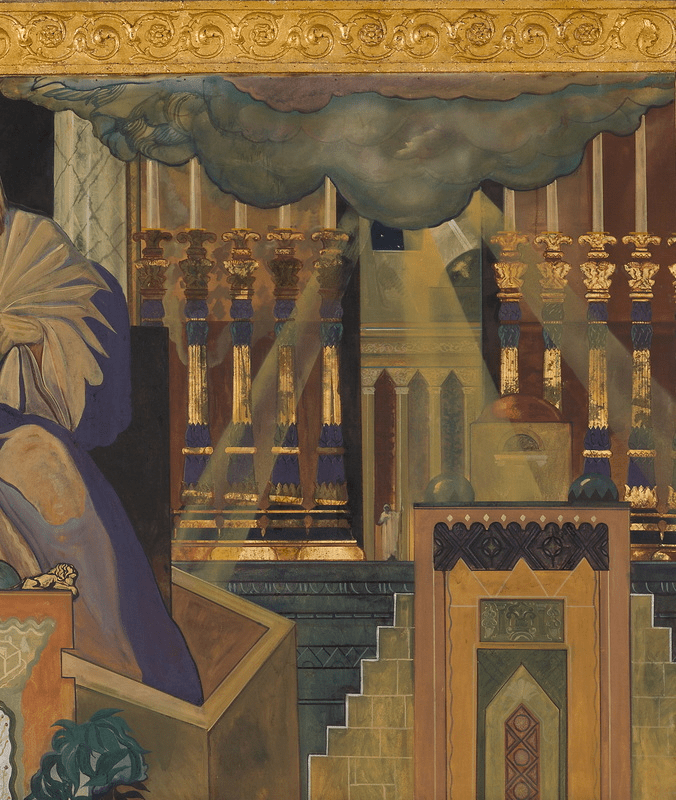
Mural of King Solomon and building the Temple, Wilshire Boulevard Temple, Los Angeles

Solomon ordered 30,000 people from all over Israel to cut logs for the temple, and he put Adoniram in charge of these workers. Solomon divided them into three groups of 10,000. Each group worked one month in Lebanon and had two months off at home.

He also had 80,000 workers to cut stone in the hill country of Israel, 70,000 workers to carry the stones, and over 3,000 assistants to keep track of the work and to supervise the workers. He ordered the workers to cut and shape large blocks of good stone for the foundation of the temple.

Solomon’s and Hiram’s men worked with men from the city of Gebal, and together they got the stones and logs ready for the temple. (Contemporary English Version)

A lot of labor went into construction of the temple in Jerusalem. King Solomon raised a massive workforce, and placed them under the command of Adoniram. The work was not voluntary, but compulsory; no tribe or citizen in Israel or Judah had a choice of whether to labor in the forest and the quarry, or not.

This treatment of the Israelite people, in being required to work in Lebanon one month out of every three months, became a significant reason for the kingdom’s split after Solomon’s death. (1 Kings 11:26-28; 12:1-16)

There was an even larger group of workers to quarry and dress the stones in the hill country. The workforce was likely made up of both Jewish and non-Jewish persons, because of the needed manpower.

King Solomon was a master administrator. All of the planning, and movement of supplies and people, was a major endeavor to pull off. And this gets to the nub of working relations, both then and now.

Cedars of Lebanon, in “The Land of the Book,” by W.M. Thomson, 1894

Oftentimes, what looks good on paper, and makes sense to those in charge, is short-sighted. The actual people who will do the work are rarely consulted. This is especially strange and unacceptable in this day and age.

If companies can put a lot of time, energy, and expenditures into marketing focus groups to determine things like what color to use on packaging in order to sell more, then it is curious that no time and energy is placed into communication and interaction with workers.

It is sad and tragic that the corporation with high levels of effective engagement between management and employees is so very rare.

At the core of it all, I believe, is our anthropological view. Show me a workplace with sour relations and strained negotiations, and I will show you a management and executive team who use workers as replaceable parts in a machine.

But show me a company that discerns people as inherently worthy of respect and kindness, and I will show you a place where effective communication flows freely, and worker satisfaction is high.

Furthermore, our anthropology determines how we treat safety on the job. Rather than putting some safe policies in place because of government oversight and pressure, a view of people as important above all else will ensure that both the physical and psychological environment are secure – and they will take a zero tolerance approach to any and all unsafe practices, in order to preserve human dignity and life.

Therefore, why we do what we do is just as important as what we do.

And the only effective way to answer the why is through a broad and involved connection with a diversity of people within an organization. There is absolutely no substitute for this. Taking shortcuts only leads to ineffectiveness, and more importantly, to human duress and harm.

In order to achieve such an ambitious goal of constructing a temple – along with a palace and administrative buildings – a large corporate government was required to make it all happen.

Essentially, King Solomon enacted a massive administration akin to ancient Egypt and their construction of pyramids. With such a government came classes and ranks and opportunities. Frankly, it was a lot like a totalitarian regime, in which the major function was to bless what was happening.

This resulted in a humungous structure and system that became intolerant of any alternative thinking. Thus, the kingdom (the government) was prepared to crush anything or anyone that threatened the established status quo of how to operate. This is why the Old Testament prophets were not viewed well by the state, and many of them were killed.

So, if you have been following me through these reflections on King Solomon over the past several days, you may wonder if I like him, or loathe him. The fact of the matter is that Solomon, like us, is a complicated person. He tends to get hailed as the wisest person who ever lived, to the neglect of some of his unwise choices. For many, Solomon too easily gets off the hook.

Along with all of Solomon’s grandeur and sagacity, he also had a slave labor force that toiled in quarries, forests, and mines. He was given to excess in most things, and didn’t seem to have a stop button. And, later in life, he honored forbidden gods with sinister sacrifices at shrines on the outskirts of Jerusalem.

The truly wise person in the room will view Solomon in his totality; will have a broader and more contextual view of work and labor; and will discern people as majestic creatures in God’s image, who also have a tragically twisted heart which can easily be prone to foolishness and harming others.

So, as we remember the temple Solomon built, we can keep in mind its beauty and architectural wonder, and the skill needed to make it happen, as well as the thousands of people who endured harsh and sometimes inhumane treatment.

Looking at history from only one angle is really not seeing history at all. We need a full-orbed understanding of people, their situations, the context of events, and the challenges they faced. Otherwise, we’ll get a sanitized version which only ends up demeaning everyone.

Lord God Almighty, who has made all the peoples of the earth for your glory, to serve you in freedom and in peace: Give to the people of this world a zeal for justice and the strength of forbearance, so that we may use our liberty in accordance with your gracious will; through Jesus Christ our Lord, who lives and reigns with you and the Holy Spirit, one God, now and forever. Amen.

Skilled Work (1 Kings 5:1-12)

King Solomon and King Hiram, by Unknown artist

Because King Hiram of Tyre was loyal to David throughout his rule, Hiram sent his servants to Solomon when he heard that Solomon had become king after his father. Solomon sent the following message to Hiram: 

“You know that my father David wasn’t able to build a temple for the name of the Lord my God. This was because of the enemies that fought him on all sides until the Lord put them under the soles of his feet. Now the Lord my God has given me peace on every side, without enemies or misfortune. So I’m planning to build a temple for the name of the Lord my God, just as the Lord indicated to my father David, ‘I will give you a son to follow you on your throne. He will build the temple for my name.’ Now give the order and have the cedars of Lebanon cut down for me. My servants will work with your servants. I’ll pay your servants whatever price you set, because you know we have no one here who is skilled in cutting wood like the Sidonians.”

Hiram was thrilled when he heard Solomon’s message. He said, “Today the Lord is blessed because he has given David a wise son who is in charge of this great people.” Hiram sent word back to Solomon:

“I have heard your message to me. I will do as you wish with the cedar and pinewood. My servants will bring the wood down the Lebanon Mountains to the sea. I’ll make rafts out of them and float them on the sea to the place you specify. There I’ll dismantle them, and you can carry them away. Now, as for what you must do for me in return, I ask you to provide for my royal house.”

So Hiram gave Solomon all the cedar and pinewood that he wanted. In return, Solomon gave an annual gift to Hiram of twenty thousand kors [2,000 tons] of wheat to eat, and twenty thousand kors [4,000 liters] of pure oil for his palace use. Now the Lord made Solomon wise, just as he had promised. Solomon and Hiram made a covenant and had peace. (Common English Bible)

King Solomon was granted by God all the wisdom necessary to rule over Israel and Judah (1 Kings 3:1-15). Early in his reign, he began the construction of a permanent Temple in Jerusalem – a task that was originally in the heart of his father King David.

Today’s Old Testament lesson is the beginning of the account of Solomon’s grand building project. It focuses on the assistance offered by King Hiram of Tyre.

Skilled Leaders

The city of Tyre was a major port in Lebanon. The cedar trees of Lebanon were renowned in the ancient world as being large and strong. Solomon – always the savvy one in knowing where to find the best of the best – looked to King Hiram for the cedar logs needed for building the Temple.

What’s more, Solomon asked Hiram for the builders to help in construction of God’s Temple. King Solomon not only had a broad knowledge of just about everything in creation, but he also understood human nature. He named the reality that the Sidonians were the best at handling their exceptional lumber.

Furthermore, Solomon was clear about the reason for the ambitious building project of the Temple. He believed that the task of erecting the Temple was divinely given to him. Solomon therefore trusted God to help him complete the job.

As a result, the two kings negotiated a treaty in which Hiram provided the lumber and the lumbermen, with Solomon providing grain and olive oil for Hiram’s court. In recounting this, the editor of Kings emphasized Solomon’s wisdom, and the peaceful relations that Jerusalem and Tyre enjoyed.

Perhaps all of this rehashing of an old agreement between a couple of ancient kings seems irrelevant to the modern and post-modern person. Yet, it is a classic example of the realities concerning communication and theology.

Skilled Communication

Hiram had the resources for building, and the skilled builders; Solomon had the money, goods, and administrative knowledge to make their relationship a mutually beneficial one.

Each king negotiated successfully, namely because there was no disadvantage in their treaty relationship. The two nations balanced one another by offering it’s advantages to the other.

Solomon and Hiram came to a genuine win-win agreement. Each of them stated exactly what they wanted and what they would provide, without apology. Both kings promoted their own interests while showing concern for the other’s interests, as well.

The success of their deal was based on mutual trust, which began years earlier with King David.

Skilled Theology

Today’s narrative is more than an example of how to negotiate a deal. It fits into a larger narrative of what God was doing with the nation of Israel. Central to every biblical story is God, who is both object and subject of Holy Scripture.

The Lord revealed a slow and unfolding drama of redemption for people. The construction of the Temple was a prominent way of God revealing divine mercy to the people. It’s central place at the highest point in Jerusalem communicated that the Lord is in the middle of everything, and high above it all.

And the way in which Solomon went about constructing the Jewish Temple included non-Jewish builders. God, through divine sovereignty and grace, led Gentiles to hob-nob with Jews who worship Yahweh, and to thus experience a glimpse of the Lord through the people and the place.

Indeed, all things work together for good to those who love God. (Romans 8:28)

Gracious God, I ask that your love and goodness will have its way for all those who seek to live according to justice and righteousness. You are full of steadfast in love and abounding in mercy. Help me accept your love and mercy. May it flow powerfully in me, and through me, to your glory and honor. Amen.