Be Careful about Your Decisions (2 Samuel 11:14-21)

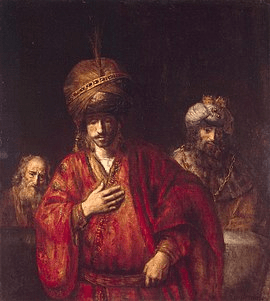
David and Uriah, by Rembrandt, c.1665

In the morning David wrote a letter to Joab and sent it with Uriah. In it he wrote, “Put Uriah out in front where the fighting is fiercest. Then withdraw from him so he will be struck down and die.”

So while Joab had the city under siege, he put Uriah at a place where he knew the strongest defenders were. When the men of the city came out and fought against Joab, some of the men in David’s army fell; moreover, Uriah the Hittite died.

Joab sent David a full account of the battle. He instructed the messenger: “When you have finished giving the king this account of the battle, the king’s anger may flare up, and he may ask you, ‘Why did you get so close to the city to fight? Didn’t you know they would shoot arrows from the wall? Who killed Abimelek son of Jerub-Besheth? Didn’t a woman drop an upper millstone on him from the wall, so that he died in Thebez? Why did you get so close to the wall?’ If he asks you this, then say to him, ‘Moreover, your servant Uriah the Hittite is dead.’” (New International Version)

Today we have a lesson in the middle of a story about King David’s greatest error in judgment and cover up of that decision. Indeed, bad decisions can often beget even more bad decisions.

It would be an understatement to say that David blew it. Our Old Testament books of 1 and 2 Samuel are arranged by the original editor in such a way that the chapter of 2 Samuel 11 is a hinge upon which the life of David moves.

All of the material before 2 Samuel 11 is generally positive, describing a man devoted to God in every way. But everything after this chapter is mostly tragic. The editor wanted readers and listeners to understand that God cares about morality and ethics by showing the consequences of both a life well-lived, as well as a life that is self-centered.

Before our verses for today, the story begins with David choosing adultery and taking another man’s wife. King David should have been doing the work of a king – protecting and serving Israel. But instead, he hung out in Jerusalem and avoided all the needed military stuff. (2 Samuel 11:1)

The editor wants us to see that King David was shirking his responsibility, which then brought a set up for moral failure. It appears David was resting on his laurels, content with his victories and successes. For the most part, at the time, the nation was happy and prosperous.

The king was walking around on the roof of his palace, instead of being in the trenches with his men, leading them in the defense of Israel.

Rather than giving proper orders as a king ought to do, David was sending people to do his personal bidding in satisfying his earthly wants. This is a significant reversal of what we see from earlier chapters in the story of David.

Up to this point we have observed David as a merciful king, seeking to use power for benevolent purposes in the common good of the nation. But in today’s chapter, David turns into the typical earthly king, ordering others around and using his authority to get what he wants.

The editor wants us to learn some lessons from David’s life. One of those lessons is that if the right and just King David can fall, then none of us are immune from falling into bad decisions which alter people’s lives forever.

The moment we think we are above falling, look out, because an arrogant nose dive into depravity is probably not far behind.

The stories of people who fall into immorality are mostly the same. Having some power or authority to wield, they use it to assert control over another person or group in order to get what they want – without being concerned for the needs and wants of others, and usually unconcerned for the negative consequences it brings upon other people.

It’s important that we call such behavior what it is: Evil. Awful. Selfish. Ungodly. A violation of ethics and morality. An offense against God.

David committed adultery, then lied, manipulated others, and covered up his actions. He murdered an innocent man, and was okay with an entire regiment of soldiers getting killed to ensure that an innocent man would be dead.

None of that icky nasty stuff was a mistake, or a lapse in judgment. It was pre-meditated sin.

And the way to deal with such sin is not to say something like “I did it, but it wasn’t really me; I’m not really like that!” Well, apparently, you are. Maybe David thought he was above it all, and believed it wasn’t really something he could ever do. But he did.
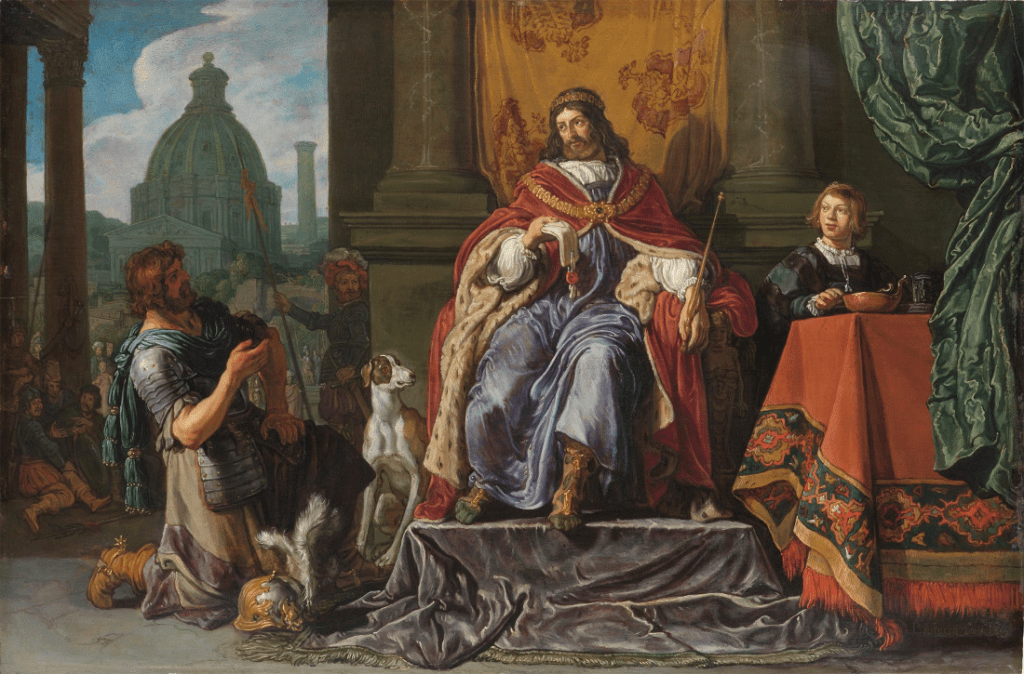
David gives Uriah a letter for Joab, by Pieter Lastman, 1619

Once we make an immoral and ungodly decision, it often causes us to start selling-out our principles and convictions. Sin only begets more sin, until we deal with it squarely.

Truth is a celebration of openness and honesty. Shame keeps to the shadows and prizes secrecy and remaining quiet. If one chooses not to go down the path of truth, then they will be continually encrusting their lives with lies so that no one ever knows.

In fact, much of religious legalism is nothing more than a person piling on the rules in order for others to not see the guilt and shame that hides deep within. Only through confession, repentance, and faith, will forgiveness, wholeness, and happiness ever occur.

Yet another lesson we can learn from this story of David is that the results which may satisfy our wants may not necessarily satisfy our needs, or God.

David accomplished what he wanted. He was successful in covering up his sin, and he got the woman he wanted. But God saw the whole thing, and was not okay with any of it. 

We must not assume that because we do something, and there was no immediate lightning strike, that it was okay. 

To only selfishly satisfy ourselves is to be a spiritual cannibal who eats other people alive.

So, how might we avoid falling into the same sorts of bad decisions which befell David?

  • Make prayers of confession a regular staple of your daily spiritual regimen. Had David engaged in prayer on the roof instead of being bored, we would likely have a very different story.
  • Maintain an active and engaged mind. An idle mind is the devil’s workshop. David was wandering around the palace instead of actively engaged in the government of his kingdom.
  • Keep the Sabbath. A day of rest helps the body to be in healthy rhythms of care, as well as enabling the spirit to connect meaningfully with God. Without adequate rest, we are like the little kid in a grocery store at 9pm throwing a fit and having a meltdown. David got out of a healthy rhythm as king, and it led to a fall.
  • Strengthen your family relationships. If you are married, live from the place of your marriage. Marriage is more than living with someone and having occasional fun; it is a one-flesh relationship that is meant to be a priority. Only from this relational place can a spouse effectively take on the world with all its needs and brokenness. 
  • Submit to accountable relationships. There are far too many lonely people with few friends in this world, even among people who are constantly around others. Everyone needs a small coterie of confidants with whom to share anything and everything with.  David’s close friends were all out with the army, and he was alone. Not a good thing.
  • Avoid stuffing all desire down as selfish and bad. Jettisoning desire only sets us up for a fall. But identifying godly desire enables us to make better decisions which engage the whole person.

Almighty God, you are the fountain of all wisdom and grace. You know our needs before we even ask, and our ignorance in not asking for the things we really need. Have compassion on our weakness, and mercifully give us those things that in our blindness we don’t know to ask for. 

Gracious Lord, we acknowledge and confess our sinful nature, prone to evil and slow to good.  You know our secret sins, and how often we have offended you and damaged others through wandering from your ways, wasting your gifts, and forgetting your love. Cleanse us from our hidden sins and forgive our faults for the sake of your Son, our Savior, Jesus Christ who loved us and gave himself for us. Amen.

Learn a Lesson from Conflict (2 Samuel 10:13-19)

David Attacks the Ammonites, by Gustave Doré, 1866

Then Joab and the troops with him advanced to fight the Arameans, and they fled before him. When the Ammonites realized that the Arameans were fleeing, they fled before Abishai and went inside the city. So Joab returned from fighting the Ammonites and came to Jerusalem.

After the Arameans saw that they had been routed by Israel, they regrouped. Hadadezer had Arameans brought from beyond the Euphrates River; they went to Helam, with Shobak the commander of Hadadezer’s army leading them.

When David was told of this, he gathered all Israel, crossed the Jordan and went to Helam. The Arameans formed their battle lines to meet David and fought against him. But they fled before Israel, and David killed seven hundred of their charioteers and forty thousand of their foot soldiers. He also struck down Shobak the commander of their army, and he died there. When all the kings who were vassals of Hadadezer saw that they had been routed by Israel, they made peace with the Israelites and became subject to them.

So the Arameans were afraid to help the Ammonites anymore. (New International Version)

Outward Conflict with Ammon

You would think that showing basic human kindness to another would always end well… Yet, not always. And King David found that out, the hard way.

David, having become king of Judah and Israel, demonstrated that his reign would be characterized by extending the sort of mercy and kindness that is characteristic of God.

Whereas David’s kindness was most often accepted, when it came to King Hanun and the Ammonites, it was misunderstood and rejected. The Ammonites humiliated King David’s sent ambassadors.

The delegation wanted to express David’s condolences to Hanun in the event of his father’s death. Then, after the Ammonites saw that King David was upset about how his ambassadors were treated, they mobilized a mercenary force of Arameans with Hadadezer leading the charge.

Both the Ammonites and the Arameans underestimated the experience and skill of the Israelite army under their commander Joab. Even though Joab was outnumbered, he conceived of a strategy that evened the odds.

All of this conflict, with preparations for battle and an escalating war, came about because a king wanted to show kindness to another. Indeed, this can be a very messed-up world that we inhabit!

The result of it all is that the Ammonites and the Arameans were soundly defeated by a smaller, yet much stronger, army with King David at the head. The Arameans became subject to Israel, and the Ammonites were left slack-jawed, not knowing what hit them.

Inner Conflict with Oneself

So, here we have David, who like all of us, is a bundle of contradictions. On the one hand, King David had his heart set on showing kindness and reflecting the heart of God in his rule and reign. And on the other hand, David is a soldier and a man of blood, who does an awful lot of killing people in his lifetime.

King David is both a paragon of moral behavior, and an example of immoral living.

He did not lift a finger against his former king who was trying to kill him; and evidenced a tender spirit through musical skill and an ability to write the psalms and songs of Israel.

Statue of King David, Copenhagen, Denmark

Yet also, King David demonstrated for us some of the worst immorality, of which is clearly seen in the next few chapters of his story in the book of 2 Samuel. Throughout David’s adult life, he took thousands of human lives in battle.

He came to fame by beheading Goliath; made his mark in Israel by killing Philistines for King Saul; survived in the wilderness while Saul was trying to kill him by killing Amalekites; and secured Israel’s borders through an enormous amount of killing.

I won’t do to simply say that the people David killed had it coming to them, or that he did all the things he did for the sake of the nation. That sort of reductionism smacks of mental laziness and purposeful ignorance.

Coming to Grips with Conflict

At the least, it seems to me that we must accept the biblical narratives as they are, and not as we want them to be, whenever there is difficulty in understanding a story.

We have the human condition in front of us every time we read a scriptural story. Either making it all good, or all bad, just won’t do – because all of us, like David, are a bundle of contradictions and paradoxes that often don’t make sense.

It turns out that, throughout Holy Scripture, we find stories of people who are no better and no worse than we ourselves. The ancient persons, like David, are those for whom a gracious God chose to use and work through – despite either their sinning or their saintliness.

We get a glimpse of how things were and how the Lord operated through the people of the time in their own political, social, economic, and religious contexts.

God comes to us, not merely from the outside by simply mandating commands and imposing control, but enters our lives on the inside, taking us as we are and graciously working with and within us to accomplish good and just purposes on this earth.

And, as it turns out, God uses whomever God wants to use, without doing some sort of divine screening interviews to find out who the most moral candidate is available for the job.

If you are looking for a bottom line in all of this mayhem, then I believe it is this: God loves us. God is with us. And God holds us – all of us, with our maddening combinations of kindness and kookiness – to establish a truly right and benevolent world characterized by humility, gentleness, mercy, purity, and peace.

It’s a rather long and messy process of bringing in such a way of life, but God is patient and will take the centuries and even the millennia needed to accomplish it.

It’s Not All About Human Conflict

Although we are a flawed and fallible people, we are nevertheless God’s people. At the end of it all, we discover that none of this was really a story about Ammonites or Israelites or David or Joab or anyone else; it is actually a story about God – because God is both the object and subject of every biblical narrative.

And what we discover about God is that there are divine initiatives happening all the time which are meant to help us and save us from ourselves. The Lord is sovereign over all creation, and brings salvation despite what we do or don’t do.

God’s kindness – shown and expressed through our own human kindness – will eventually and always win the day.

Almighty and everlasting God, whose will it is to restore all things in your well beloved Son, the King of kings and Lord of lords: Mercifully grant that the peoples of the earth, divided and enslaved by sin, may be freed and brought together under his most gracious rule; who lives and reigns with you and the Holy Spirit, one God, now and forever. Amen.

Be Careful How You Judge (2 Samuel 10:6-12)

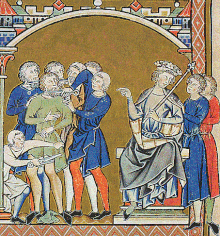
Hanun humiliates David’s ambassadors, c.1240 C.E.

When the Ammonites realized that they had become obnoxious to David, they hired twenty thousand Aramean foot soldiers from Beth Rehob and Zobah, as well as the king of Maakah with a thousand men, and also twelve thousand men from Tob.

On hearing this, David sent Joab out with the entire army of fighting men. The Ammonites came out and drew up in battle formation at the entrance of their city gate, while the Arameans of Zobah and Rehob and the men of Tob and Maakah were by themselves in the open country.

Joab saw that there were battle lines in front of him and behind him; so he selected some of the best troops in Israel and deployed them against the Arameans. He put the rest of the men under the command of Abishai his brother and deployed them against the Ammonites. 

Joab said, “If the Arameans are too strong for me, then you are to come to my rescue; but if the Ammonites are too strong for you, then I will come to rescue you. Be strong, and let us fight bravely for our people and the cities of our God. The Lord will do what is good in his sight.” (New International Version)

Cockiness can get you into a lot of trouble. It’s one thing to exude confidence; and it’s another thing to act like a puffed up peacock and do stupid stuff because of arrogance. The Israelite general Joab had the former; the Ammonites the latter.

King David had sent envoys to Ammon in the event of a new Ammonite king taking the throne after his father’s death. David was in the groove of extending kindness and establishing himself as the sort of ruler who has a heart, as well as a head.

However, Hanun the Ammonite king, viewed the Israelite delegation of people in a negative light, believing they had malevolent motives for coming. So, the king’s officials “seized David’s envoys, shaved off half of each man’s beard, cut off their garments at the buttocks, and sent them away.” (2 Samuel 10:4)

Not the smartest move on the planet. Humiliating a group of Israelites sent by David was a bad idea. The Ammonites, understandably, were put immediately on King David’s naughty list. And they then responded by recruiting mercenaries to their side, getting the clue that David wasn’t about to stand for the offense against Israel.

So, the Ammonites hired the Arameans to help fight Israel. But they were no match for the shrewd and seasoned Jewish general Joab. The mercenaries were soundly defeated, really because of God’s sovereign intervention over the much larger force put together by the Ammonites.

This ancient animosity and relational haggling tends to reflect the human condition, even to this day. It’s easy to fall into misinterpretations and misunderstandings that lead to conflict.

A lot of biblical interpreters read between the lines of the story, and see less than altruistic motives on David’s part. That may or may not be true. The story simply has David sending a delegation to Ammon in the event of the Ammonite king’s death – with the reason stated that David wanted to show kindness, just as the previous king had done with him.

It’s characteristic of judgmental spirits to look for people who agree with them – whether those people are Ammonite royalty or Bible interpreters. We tend to see what we are familiar with and know – which is why the interpretive process can and does vary widely amongst scholars and readers alike.

The Ammonite court bought into a perception of King David. And based upon that view, they believed a course of action which included humiliating others and finding mercenaries was the proper way to proceed.

But those sorts of methods themselves ought to raise a red flag with us, and cause us to question the perceptions and judgments behind them.

The king of Ammon believed he was acting in the right, and the Ammonites sought to justify themselves as legitimately acting with violence because of an Israelite threat.

By taking a Christian perspective, I believe we can be encouraged, rather than react with questionable tactics toward others who humiliate us and spout verbal violence upon us. A theological worldview discerns that righteousness will prevail. Justice and righteousness may not happen soon, and maybe not even in our lifetime; yet, it will eventually overcome any and all evil.

Jesus was unjustly judged by others who believed he was in league with the devil and was opposed to the law of Moses. Righteousness did prevail, but not after a great deal of suffering, which included a cross and a death.

King David himself did not withdraw from the situation, nor did he ignore it. David faced his accusers and entrusted himself and his nation to the God who is right and just.

We need not withdraw or ignore others in the face of judgmentalism. And we also need not resort to the same methods and tactics of judgmental people.

Showing kindness is important, and it must not be dependent upon whether one will respond favorably to us, or not. Sometimes you will experience judgmental spirits, no matter what.

Furthermore, be careful of the way you interpret another’s words and actions, and also how you respond to others. Jesus said:

“Do not judge, or you too will be judged. For in the same way you judge others, you will be judged, and with the measure you use, it will be measured to you.” (Matthew 7:1-2, NIV)

Those who love truth will tend to avoid snap judgments. God always makes a right judgment, and is the ultimate Judge of the universe. It is the Lord we need to please, and not any group of people.

A prayer of Thomas à Kempis (1380-1471):

Grant me, O Lord, to know what I ought to know,
To love what I ought to love,
To praise what delights You most,
To value what is precious in Your sight,
To hate what is offensive to You.
Do not suffer me to judge according to the sight of my eyes,
Nor to pass sentence according to the hearing of the ears of ignorant persons;
But to discern with a true judgment between things visible and spiritual,
And above all, always to inquire what is the good pleasure of Your will. Amen.

Showing God’s Kindness (2 Samuel 9:1-13)

King David reaching out and receiving Mephibosheth, 13th century Bible illustration

David asked, “Is there anyone from Saul’s family still alive that I could show faithful love for Jonathan’s sake?” There was a servant from Saul’s household named Ziba, and he was summoned before David.

“Are you Ziba?” the king asked him.

“At your service!” he answered.

The king asked, “Is there anyone left from Saul’s family that I could show God’s kindness to?”

“Yes,” Ziba said to the king, “one of Jonathan’s sons, whose feet are crippled.”

“Where is he?” the king asked.

“He is at the house of Ammiel’s son Machir at Lo-debar,” Ziba told the king.

So King David had him brought from the house of Ammiel’s son Machir at Lo-debar. Mephibosheth, Jonathan’s son and Saul’s grandson, came to David, and he fell to the ground, bowing low out of respect.

“Mephibosheth?” David said.

“Yes,” he replied. “I am at your service!”

“Don’t be afraid,” David told him, “because I will certainly show you faithful love for the sake of your father Jonathan. I will restore to you all the fields of your grandfather Saul, and you will eat at my table always.”

Mephibosheth bowed low out of respect and said, “Who am I, your servant, that you should care about a dead dog like me?”

Then David summoned Saul’s servant Ziba and said to him, “I have given your master’s grandson everything belonging to Saul and his family. You will work the land for him—you, your sons, and your servants—and you will bring food into your master’s house for them to eat. But Mephibosheth, your master’s grandson, will always be at my table.” (Now Ziba had fifteen sons and twenty servants.)

Then Ziba said to the king, “Your servant will do whatever my master the king commands.”

So Mephibosheth ate at David’s table, like one of the king’s own sons. Mephibosheth had a young son named Mica. All who lived in Ziba’s household became Mephibosheth’s servants. Mephibosheth lived in Jerusalem, because he always ate at the king’s table. He was crippled in both feet. (Common English Bible)

This is actually one of my favorite stories in all of Holy Scripture. It clearly demonstrates why David is a king and a person who reflects God’s own heart. I believe that King David is at his best here, ruling and living exactly as the Lord wanted him to.

In much of the ancient world, whenever a king came to power and replaced the previous king of whom he was not related, it was a common practice to either exile or outright kill the sons and grandsons who would have become heirs to the throne. It was a literal cutthroat way of securing the new throne, by wiping out any potential rivals.

It’s quite possible that no one would have faulted David or batted an eye if he had made sure there was nobody around related to King Saul – who died in a battle with the Philistines. Not only did David avoid that practice, but he did just the opposite of it.

Finally on the throne of both Israel and Judah, one of the first acts of King David was to wield his power and authority by finding out if there were any relatives of Saul that he could show faithful love toward.

I can just imagine the servant of Saul, Ziba, being brought into David’s presence, thinking for sure that this is the end. Instead, David wanted to know if there’s anyone in Saul’s family to which he could show kindness.

The word King David used to communicate his benevolent intentions was “chesed” (חסד – pronounced “KES-ed”). This is rich Hebrew word which refers to God’s steadfast covenant loyalty and love toward Israel.

Because of its richness, chesed is translated various ways in the English translations, including: “mercy,” “kindness,” “loving-kindness,” “steadfast love,” “compassion,” and even “goodness.”

The big idea in today’s story is that David had the power to destroy, but instead used his authority in order to extend loving loyalty and mercy to Mephibosheth, son of Jonathan, and grandson of Saul – David’s old enemy and nemesis.

What’s more, David could have found out about Mephibosheth, learned that the man was crippled, in no position to ever do anything for or against him, and simply left him alone. And again, nobody likely would have thought anything about ignoring the man.

But not David. He was determined to embody chesed in the life of Mephibosheth. So, he brought him to Jerusalem and provided for him by having him sit at the king’s table for the rest of his life.

David didn’t have to do that. Yet, God’s steadfast love compelled him. You know grace has a hold of someone’s life, whenever they go out of their way to extend human kindness to another person who has absolutely no means of paying them back or reciprocating at all.

Jesus, the Son of David, clearly understood the idea of chesed and lifted it, taught it, and embodied it for his own followers:

“If you love those who love you, why should you be commended? Even sinners love those who love them. If you do good to those who do good to you, why should you be commended? Even sinners do that. If you lend to those from whom you expect repayment, why should you be commended? Even sinners lend to sinners expecting to be paid back in full. 

“Instead, love your enemies, do good, and lend expecting nothing in return. If you do, you will have a great reward. You will be acting the way children of the Most High act, for he is kind to ungrateful and wicked people. Be compassionate just as your Father is compassionate. (Luke 6:32-36, CEB)

I wonder who it is that God wants you to show grace, mercy, and love toward?

Lord Jesus, as you commanded us to love one another, just as you love us, help us to demonstrate that love toward others. We acknowledge that it is impossible on our own, so we ask for the enabling of your Holy Spirit to produce that love in us.

We believe that you love and care for those who are suffering from illness, violence and persecution. We pray for protection, comfort and healing for those in need or who are forgotten.

Enliven us with your Holy Spirit, so that we may be instruments of your peace and love in a troubled world. Use us and all believers as your ambassadors to our families, colleagues and neighbors.

Holy God, you demonstrated your love for us through the Resurrection of your Son and our Savior Jesus Christ. We commit to making decisions as who trust in your ever-present love and grace. Guide us in becoming a people who welcomes all, and values mutuality and partnerships.

Provide us courage and insight as we seek to be a community who provides respite, and a place to sooth souls. Grant us all the things necessary for our common life, and bring us to be of one heart and mind within your Church; through Jesus Christ our Lord. Amen.