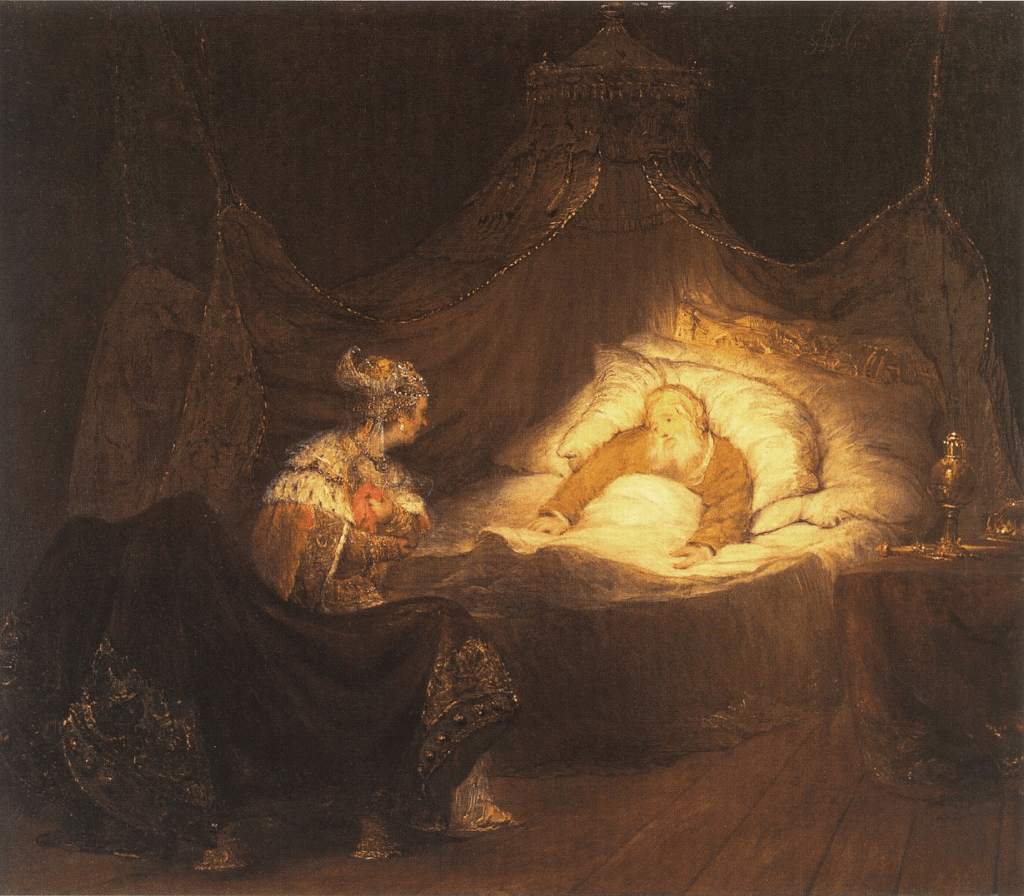
Dealing with Injustice (1 Kings 1:28-48)

Bathsheba appeals to David, by Arent de Gelder, c.1685

Then King David said, “Call in Bathsheba.” So she came into the king’s presence and stood before him.

The king then took an oath: “As surely as the Lord lives, who has delivered me out of every trouble, I will surely carry out this very day what I swore to you by the Lord, the God of Israel: Solomon your son shall be king after me, and he will sit on my throne in my place.”

Then Bathsheba bowed down with her face to the ground, prostrating herself before the king, and said, “May my lord King David live forever!”

King David said, “Call in Zadok the priest, Nathan the prophet and Benaiah son of Jehoiada.” When they came before the king, he said to them: “Take your lord’s servants with you and have Solomon my son mount my own mule and take him down to Gihon. There have Zadok the priest and Nathan the prophet anoint him king over Israel. Blow the trumpet and shout, ‘Long live King Solomon!’ Then you are to go up with him, and he is to come and sit on my throne and reign in my place. I have appointed him ruler over Israel and Judah.”

Benaiah son of Jehoiada answered the king, “Amen! May the Lord, the God of my lord the king, so declare it. As the Lord was with my lord the king, so may he be with Solomon to make his throne even greater than the throne of my lord King David!”

So Zadok the priest, Nathan the prophet, Benaiah son of Jehoiada, the Kerethites and the Pelethites went down and had Solomon mount King David’s mule, and they escorted him to Gihon. Zadok the priest took the horn of oil from the sacred tent and anointed Solomon. Then they sounded the trumpet and all the people shouted, “Long live King Solomon!” And all the people went up after him, playing pipes and rejoicing greatly, so that the ground shook with the sound.

Adonijah and all the guests who were with him heard it as they were finishing their feast. On hearing the sound of the trumpet, Joab asked, “What’s the meaning of all the noise in the city?”

Even as he was speaking, Jonathan son of Abiathar the priest arrived. Adonijah said, “Come in. A worthy man like you must be bringing good news.”

“Not at all!” Jonathan answered. “Our lord King David has made Solomon king. The king has sent with him Zadok the priest, Nathan the prophet, Benaiah son of Jehoiada, the Kerethites and the Pelethites, and they have put him on the king’s mule, and Zadok the priest and Nathan the prophet have anointed him king at Gihon. From there they have gone up cheering, and the city resounds with it. That’s the noise you hear. Moreover, Solomon has taken his seat on the royal throne. Also, the royal officials have come to congratulate our lord King David, saying, ‘May your God make Solomon’s name more famous than yours and his throne greater than yours!’ And the king bowed in worship on his bed and said, ‘Praise be to the Lord, the God of Israel, who has allowed my eyes to see a successor on my throne today.’” (New International Version)

Solomon at the deathbed of King David, by Giulio Romano (1499-1546)

One of King David’s sons, Adonijah, was a stinker. He tried to pull a fast one on his aging father, in order to try and take the throne. But some of the people caught wind of what was afoot.

Even Nathan the prophet got involved and gave some sage instructions to Bathsheba, Solomon’s mother, so that the king’s wishes could come to fruition – namely, that Solomon would succeed David.

As a result, despite King David’s struggles toward the end of life, he had enough wherewithal to attempt some decisive leadership. He confirmed Solomon as his royal successor.

Despite Adonijah’s attempt to take advantage of his father’s failing capacity and execute a coup d’état, the king immediately took action by anointing and enthroning Solomon without any delay.

The installation of Solomon as king was accomplished so quickly that it caught the conniving Adonijah and his cohorts off guard. King David may have lost several steps in his old age, but he was still someone to be reckoned with. That underestimation would cost the connivers dearly.

To be honest, I don’t like Adonijah. And that’s what the storyteller wants us to feel. We are meant to read the narrative and walk away saying to ourselves that we don’t want to be like Adonijah; we don’t want injustice to have the day; instead, we want King David’s wishes honored, and to see a just and right Ruler ensconced as king.

The Lord is a just God. And since we are people created in God’s image and likeness, we have an inherent sense of justice down deep inside us. So, it drives people nuts whenever there are things happening which are not right nor good.

Everyone faces injustice, and things that are not right, in this life. The trick is to deal with it, without becoming unjust ourselves. It’s not an easy thing to do. It’s tough. So, how do we maintain being just while handling injustice?

The feeling of helplessness is rather uncomfortable, even painful. It doesn’t feel good to think that your efforts at doing right and being just don’t accomplish much of anything, and are only a drop in the bucket of what’s needed. It also doesn’t feel right whenever we see others going through injustice, and we have little to no way in helping the situation.

The first step in dealing with the world’s injustice is to acknowledge it. Don’t purposely ignore it, avoid it, or pretend that it isn’t there. Everything in life must be acknowledged before anything can be done about it – whether it’s dealing with an event, or your own emotions.

So, it is imperative that your care for yourself. And it’s the most important thing in being of service and help to others. Attend to the whole self – body, mind, emotions, and spirit – because it is necessary in order to move through unjust circumstances with health, confidence, and sobriety.

When facing injustice and dealing with it, no matter whether it concerns yourself or another, it’s good to keep in mind that our brains tend to gravitate toward the negative, to the detriment of seeing good and positive things.

Therefore, we must work at keeping our “compassion quotient” high, and not let our compassion turn to fatigue, then burn-out.

It seems that King David continually worked on maintaining a robust spirit and healthy self, so that, even when he was old, his compassionate and wise instincts kicked in – the ones he had spent a lifetime developing.

In contrast, Adonijah appears to have nurtured a self-centered and bitter spirit. He did not attend well to his spiritual and emotional health. His mind turned to the dark thoughts of intrigue and rebellion. Arrogance clouded his right mind. This would not end well for him.

Dealing with injustice is never easy. And it very much requires us to be healthy and just ourselves, so that when we are faced with issues of justice, we can deal with them in a good and right manner.

Almighty God, you have given all peoples one common origin.
It is your will that they be gathered together
as one family in yourself.
Fill the hearts of humanity with the fire of your love
and with the desire to ensure justice for all.
By sharing the good things you give us,
may we secure an equality for all
our brothers and sisters throughout the world.
May there be an end to division, strife and war.
May there be a dawning of a truly human society
built on love and peace. Amen.

Facing Death (1 Kings 1:1-30)

Mural of King David, in the Wilshire Boulevard Temple, Los Angeles

King David was now a very old man, and although his servants covered him with blankets, he could not keep warm. So his officials said to him, “Your Majesty, let us find a young woman to stay with you and take care of you. She will lie close to you and keep you warm.” 

A search was made all over Israel for a beautiful young woman, and in Shunem they found such a woman named Abishag, and brought her to the king. She was very beautiful, and waited on the king and took care of him, but he did not have intercourse with her.

Now that Absalom was dead, Adonijah, the son of David and Haggith, was the oldest surviving son. He was a very handsome man. David had never reprimanded him about anything, and he was ambitious to be king.

He provided for himself chariots, horses, and an escort of fifty men. He talked with Joab (whose mother was Zeruiah) and with Abiathar the priest, and they agreed to support his cause. But Zadok the priest, Benaiah son of Jehoiada, Nathan the prophet, Shimei, Rei, and David’s bodyguards were not on Adonijah’s side.

One day Adonijah offered a sacrifice of sheep, bulls, and fattened calves at Snake Rock, near the spring of Enrogel. He invited the other sons of King David and the king’s officials who were from Judah to come to this sacrificial feast, but he did not invite his half-brother Solomon or Nathan the prophet or Benaiah or the king’s bodyguards.

Then Nathan went to Bathsheba, Solomon’s mother, and asked her, “Haven’t you heard that Haggith’s son Adonijah has made himself king? And King David doesn’t know anything about it! If you want to save your life and the life of your son Solomon, I would advise you to go at once to King David and ask him, ‘Your Majesty, didn’t you solemnly promise me that my son Solomon would succeed you as king? How is it, then, that Adonijah has become king?’” And Nathan added, “Then, while you are still talking with King David, I will come in and confirm your story.”

So Bathsheba went to see the king in his bedroom. He was very old, and Abishag, the young woman from Shunem, was taking care of him. Bathsheba bowed low before the king, and he asked, “What do you want?”

She answered, “Your Majesty, you made me a solemn promise in the name of the Lord your God that my son Solomon would be king after you. But Adonijah has already become king, and you don’t know anything about it. He has offered a sacrifice of many bulls, sheep, and fattened calves, and he invited your sons, and Abiathar the priest, and Joab the commander of your army to the feast, but he did not invite your son Solomon. Your Majesty, all the people of Israel are looking to you to tell them who is to succeed you as king. If you don’t, as soon as you are dead, my son Solomon and I will be treated as traitors.”

She was still speaking, when Nathan arrived at the palace. The king was told that the prophet was there, and Nathan went in and bowed low before the king. Then he said, “Your Majesty, have you announced that Adonijah would succeed you as king? This very day he has gone and offered a sacrifice of many bulls, sheep, and fattened calves. He invited all your sons, Joab the commander of your army, and Abiathar the priest, and right now they are feasting with him and shouting, ‘Long live King Adonijah!’ But he did not invite me, sir, or Zadok the priest or Benaiah or Solomon. Did Your Majesty approve all this and not even tell your officials who is to succeed you as king?”

King David said, “Ask Bathsheba to come back in”—and she came and stood before him. Then he said to her, “I promise you by the living Lord, who has rescued me from all my troubles, that today I will keep the promise I made to you in the name of the Lord, the God of Israel, that your son Solomon would succeed me as king.” (Good News Translation)

King David, by Sefira Lightstone

Death isn’t exactly a popular subject. You might think, since all of us will eventually experience it personally, and most of us have seen it up close through dying loved ones, we would talk it up as something to face and deal with squarely. And yet, we don’t.

Ideally, death ought to teach us how to live, how to face our limitations, and how to accept hardship and the inevitable.

If we will let today’s Old Testament lesson speak to us concerning the subject of death, we can observe four differing responses to the impending death of King David…

King David’s servants: death as a problem to solve

The servants of David treated his downward health as a problem to be solved. They essentially sidestepped the issue of death. Perhaps they believed it to be too negative a subject, or were simply too uncomfortable with the prospect of losing their king.

King David’s servants remembered well the vigorous David who took on enemies and problems. They wanted him to act like a king, so they looked for the miracle cure of a virgin who would be some sort of fix for David.

In the ancient world, a king’s vitality was always linked to his sexual vigor. The servants thought if they could arouse David, he would be back to his old kingly self. In other words, the servants were trying to avoid death. And, of course, it didn’t work.

King David’s son Adonijah: death as an opportunity to seize

Whereas the servants were scheming a way to get the old David back in the saddle, Adonijah was impatient to see his father David in the grave. He sought to use death for his own advantage.

Adonijah wanted his dad, the king, out of the way, so that he could pursue his own kingship. So, he simply proclaimed himself king, hoping to hasten David’s death.

The guy was looking for an opportunity; and, I might add, Adonijah ended up losing his own life for it. He never understood the true dynamics of life and death – that life is complicated, death should be honored, and not used for personal gain.

King David’s wife Bathsheba: death as a difficulty to navigate

Honestly, I have a lot of compassion for Bathsheba, because she got a raw deal earlier in her life with David. Bathsheba was married to Uriah, and was used by David, ending up in her husband’s death.

But then King David took her in and made Bathsheba one of his many wives. After their first child together died, they had Solomon. And this was the person Bathsheba really cared about. She wanted to make sure her son Solomon became king.

Reading today’s narrative, you may wonder why King David needed a virgin – where was his wife? Bathsheba showed up to see David, not because she wanted to keep him warm and comfort him, but because she was concerned for her son.

For Bathsheba, David became a means to an end – someone who could help her negotiate a difficult situation. She sought to navigate the complicated politics around death.

King David’s caregiver Abishag: death as a reality to witness

Throughout the story, we have no recorded words from Abishag. Everyone else had plenty to say. In contrast to all of the other people, Abishag was simply a witness to David’s deteriorating health, and eventual death.

She seems to me like a hospice worker, who exists to ease the person’s pain at end of life. In this, we can perhaps learn more from Abishag than from anyone else – to be present, listen, and serve.

Unfortunately, death brings out the worst in some people. But if we will face death, and not view it as a problem to be solved, an opportunity to be seized, or a difficulty to be negotiated, I believe we will find the grace of God when we become sacred witnesses to death.

Jesus faced death. He did not try and avoid death; was not impatient to get death over with; and did not stoically endure death as a difficulty. Christ’s death is life – bringing meaning to both life and death.

Into your hands, O merciful Savior, we commend all your servants staring death in the face today. We humbly ask that you acknowledge these sheep of your own fold, these lambs of your own flock, and these sinners of your own redeeming. Receive them into the arms of your mercy, into the blessed rest of everlasting peace, and into the glorious company of the saints in light. Amen.

Holding Both Victory and Defeat (2 Samuel 19:1-18)

David mourns the death of Absalom, by Gustave Doré (1832-1883)

Joab was told, “The king is weeping and mourning for Absalom.” And for the whole army the victory that day was turned into mourning, because on that day the troops heard it said, “The king is grieving for his son.” The men stole into the city that day as men steal in who are ashamed when they flee from battle. The king covered his face and cried aloud, “O my son Absalom! O Absalom, my son, my son!”

Then Joab went into the house to the king and said, “Today you have humiliated all your men, who have just saved your life and the lives of your sons and daughters and the lives of your wives and concubines. You love those who hate you and hate those who love you. You have made it clear today that the commanders and their men mean nothing to you. I see that you would be pleased if Absalom were alive today and all of us were dead. Now go out and encourage your men. I swear by the Lord that if you don’t go out, not a man will be left with you by nightfall. This will be worse for you than all the calamities that have come on you from your youth till now.”

So the king got up and took his seat in the gateway. When the men were told, “The king is sitting in the gateway,” they all came before him.

Meanwhile, the Israelites had fled to their homes.

Throughout the tribes of Israel, all the people were arguing among themselves, saying, “The king delivered us from the hand of our enemies; he is the one who rescued us from the hand of the Philistines. But now he has fled the country to escape from Absalom; and Absalom, whom we anointed to rule over us, has died in battle. So why do you say nothing about bringing the king back?”

King David sent this message to Zadok and Abiathar, the priests: “Ask the elders of Judah, ‘Why should you be the last to bring the king back to his palace, since what is being said throughout Israel has reached the king at his quarters? You are my relatives, my own flesh and blood. So why should you be the last to bring back the king?’ And say to Amasa, ‘Are you not my own flesh and blood? May God deal with me, be it ever so severely, if you are not the commander of my army for life in place of Joab.’”

He won over the hearts of the men of Judah so that they were all of one mind. They sent word to the king, “Return, you and all your men.” Then the king returned and went as far as the Jordan.

Now the men of Judah had come to Gilgal to go out and meet the king and bring him across the Jordan. Shimei son of Gera, the Benjamite from Bahurim, hurried down with the men of Judah to meet King David. With him were a thousand Benjamites, along with Ziba, the steward of Saul’s household, and his fifteen sons and twenty servants. They rushed to the Jordan, where the king was. They crossed at the ford to take the king’s household over and to do whatever he wished. (New International Version)

King David learns of Absalom’s death, by Unknown artist, c.1590

King David’s son, Absalom had become a bitter and angry man, especially toward his father. He took his time to build a conspiracy against David, in order to replace him as king. Absalom succeeded in taking Jerusalem.

However, King David escaped with those loyal to him. Although Absalom had the upper hand and could have followed through with overtaking David, a monkey wrench in counsel led to David gaining a fighting chance. It all eventually led to the death of Absalom in battle.

And this is where King David showed yet again the sort of incongruence that, it seems, only a parent can do. His loyal men won the battle, yet Absalom was slain because of Joab, the commander. David’s grief over his son’s loss was palpable; he wept and lamented, despite the great victory that had been achieved against the odds.

Indeed, David experienced the dilemma of being both a father and a king – and it ripped his heart.

Throughout the narratives of David, Joab is presented as a no-nonsense business-like guy. He didn’t have much tolerance for the touchy-feely stuff, and let the king know it. Joab often had a right assessment of things, but conversely, he often spoke and acted in a wrong manner.

Joab essentially picked up a strange parental role of scolding David into facing his present circumstance. The troops needed assurance; and it could only come from the king, whom they were fighting for in the first place.

So, David acquiesced to Joab, and took his public seat, receiving the army as victors. Yet, King David had enough of Joab’s unfeeling shenanigans, and summarily replaced him as commander of the military.

With Absalom dead, and David acting more like a king again, it isn’t long before Israel and Judah receive him back as their king, and take him to Jerusalem to once again rule over the land. David had to discover, yet again, in a new situation what it means to hold both victory and defeat, joy and sorrow, together.

It’s typical for us as biblical readers to ask, “What’s the point of the story?” We tend to like our bottom lines and neat summaries of things. After all, we’re busy people with things to do and people to see. Just give it to me straight, and I’ll go on my merry way.

But Scripture reading doesn’t work like that. It’s not fast food. Scriptural narratives require us to slowly chew on them, to sit with them for a while, and to take the time for reflection, prayer, and listening.

In doing this, we will likely discover that we could read the same story at different times and at various seasons of our lives, and come away with a different “bottom line” in each fresh reading of the text.

This is why I am a committed Bible reader (and thinker!). In some cases, I’ve read the same story hundreds of times. Nearly always, I walk away from the encounter seeing something new or discovering an insight of the text (or myself!) that I had never seen before.

So, these daily Bible reflections are my thoughts of Scripture that I had at a particular time and place. Having said that, I wonder what stirs within you as you read and encounter the story of King David after the death of his son Absalom…

Feel free to share your thoughts.

O Lord, we call upon You in times of both sorrow and joy. Give us the strength and the will to bear our heavy burdens, as well as to wisely carry our manageable ones. In all things, help us feel the warmth and love of Your divine compassion. Amen.

Be Merciful to Me (Psalm 57)

“For thy mercy is great unto the heavens, and thy truth unto the clouds.” (Psalm 57:10, KJV) by Bible Art

Be merciful to me, O God; be merciful to me,
    for in you my soul takes refuge;
in the shadow of your wings I will take refuge,
    until the destroying storms pass by.
I cry to God Most High,
    to God who fulfills his purpose for me.
He will send from heaven and save me;
    he will put to shame those who trample on me.
God will send forth his steadfast love and his faithfulness.

I lie down among lions
    that greedily devour human prey;
their teeth are spears and arrows,
    their tongues sharp swords.

Be exalted, O God, above the heavens.
    Let your glory be over all the earth.

They set a net for my steps;
    my soul was bowed down.
They dug a pit in my path,
    but they have fallen into it themselves.
My heart is steadfast, O God;
    my heart is steadfast.
I will sing and make melody.
    Awake, my soul!
Awake, O harp and lyre!
    I will awake the dawn.
I will give thanks to you, O Lord, among the peoples;
    I will sing praises to you among the nations.
For your steadfast love is as high as the heavens;
    your faithfulness extends to the clouds.

Be exalted, O God, above the heavens.
    Let your glory be over all the earth. (New Revised Standard Version)

The Human Condition

Maybe it’s just me, yet it seems, over the past several years, that our world has become increasingly depressed, jaded, and unkind. Things like appreciation and encouragement of others are found less and less as time goes on. It’s as if we are all in some sort of collective funk, in which everyone has an underlying sullenness and frustration about them.

Humanity has suffered a great deal of change and loss, without a healthy means of grieving and lamenting for what has happened to them. In other words, we simply don’t know what to do with our hurt, so we end up projecting our hurt onto others. *Sigh*

There is something that we all share together about the human experience: Sooner or later, someone or a group of people will let us down. They will hurt us in some way. And that hurt will change us – either for good or for ill.

What’s worse, many have experienced, or will experience, some sort of abuse and victimization from another person or group – leaving them scarred by trauma. And, what’s more, there are those who have had their very lives at risk, because someone intentionally sought to kill them. 

King David’s Condition

That is the company David found himself in when King Saul, and the later when his son Absalom, sought to do away with his life.

To David’s credit, he never retaliated and did not try and turn the tables by putting a hit out on either Saul or Absalom. Instead, David cried out to God. And we get to listen in on the prayer. Today’s psalm is David’s prayerful reliance upon the God in whom he put all his trust and praise. 

The entire basis of prayer is to let God be God. So, how do we exactly do that?

Our Condition

Whenever the storms of life assail us, calloused persons trample on us with impunity, devious individuals set traps for us, and greedy organizations prey upon us, we must refuse to respond in kind.

Instead, let us deliberately praise the Lord, rely on divine protection, and pray to God, so that we might steadfastly hold on to our confidence. Because if God is for us, nothing nor no one, can be against us.

That advice may seem like a sort of pie-in-the-sky rot of ginning up positive thoughts when there is nothing positive to be seen in the experience. Yet, please keep in mind that we must never, and I repeat, never invalidate another’s experience, nor our own, when those experiences are hellish.

There is always hope. There are two unshakable truths which are constant, and are never diminished by any adverse circumstance:

  1. God is present with us
  2. God loves us

If we know nothing else, and everything seems to be descending into the abyss of tragedy, the twin towers of divine presence and divine mercy stand guard as the strongest sentinels over our dilapidated situation, and struggling faith.

Letting God be God means not to try and control things we have no control over. Rather, it means to affirm that the Lord is willing and capable of handling our worst stuff.

It could be that we are stuck in the belly of a whale because, without our knowing it, there are sharks surrounding us, who cannot get to us because of divine attention and protection.

Our perspective of life-circumstances is, at best, severely limited. It is much better to place faith in the God who sees it all, with an expansive eye which misses nothing.

One of the best things, to me, about the psalms is that they are a wonderful collection of prayers we can adopt for our own. Not only can we use them for ourselves, but we are also obliged to do so. 

If anyone has been in an adverse situation, so deep that it feels like having ambled into a pride of lions, it’s quite likely that the experience leaves one with no adequate words to say. There we are – paralyzed with fear, and unable to move. 

So, let the psalm say for you what you cannot even begin to utter yourself. The Word of God is not meant to sit on a coffee table,  or to rest on a shelf; it is meant to be opened and used for prayer. Allow it to do its intended purpose.

Who knows? Perhaps your faith in the mercy of God, and your praises lifted to God, will give rise to a newfound confidence and peace, so that you can rest secure, even when all around you is going to hell.

Be merciful to me, O God, for in you my soul takes refuge. Even though I feel the slash of people with tongues as swords, my heart is steadfast, and I will exalt your name above the heavens. Let your glory be over all the earth! Amen.