1 Samuel 16:14-23 – The Work of God

Now the Lord’s spirit had departed from Saul, and an evil spirit from the Lord tormented him. Saul’s servants said to him, “Look, an evil spirit from God is tormenting you. If our master just says the word, your servants will search for someone who knows how to play the lyre. The musician can play whenever the evil spirit from God is affecting you, and then you’ll feel better.”

Saul said to his servants, “Find me a good musician and bring him to me.”

One of the servants responded, “I know that one of Jesse’s sons from Bethlehem is a good musician. He’s a strong man and heroic, a warrior who speaks well and is good-looking too. The Lord is with him.”

So, Saul sent messengers to Jesse to say, “Send me your son David, the one who keeps the sheep.”

Jesse then took a donkey and loaded it with a homer of bread, a jar of wine, and a young goat, and he sent it along with his son David to Saul. That is how David came to Saul and entered his service. Saul liked David very much, and David became his armor-bearer. Saul sent a message to Jesse: “Please allow David to remain in my service because I am pleased with him.” Whenever the evil spirit from God affected Saul, David would take the lyre and play it. Then Saul would relax and feel better, and the evil spirit would leave him alone. (Common English Bible)

In the realm of God, everything seems upside-down. Those who are first are last, and the last are first. The rich are really poor, and the poor are actually rich. People of low position are the highest in God’s realm, while those at the top are really at the bottom. The religious insiders, appearing close to God, are on the outside; and the outsiders, seemingly far from God, are really the insiders and close to the Lord.

If we judge circumstances according to human standards of fair-play and what seems right to us, God’s ethics might not make much sense. There are two extreme responses to this reality of God’s odd working in the world. 

One response is to try and nail down everything we don’t understand, to create a black and white world where every question has an answer, and all things are certain so that we know exactly how God works, all the time. 

The opposite response is to never try answering anything about the mysterious working of God, saying, “whatever will be, will be.” Somewhere in the middle of the extremes is probably a good place to be – working to know God better and how divinity operates in the world, while being comfortable with mystery and discerning we will never completely understand everything in this life.

There are times we feel confident of what God is doing. Other times, maybe most of the time, we are clueless as to how God is working. We do not have all the answers to God’s activity. Yet, there is still a lot we know about God. The Lord worked in quite different ways with Saul than with David.  

The difference in the two characters, Saul and David, hinges upon the presence and absence of God. God withdrew divine presence from Saul. King Saul’s deliberate and consistent disobedience of God’s direct commands led to the divine absence. Not only did God leave Saul, but an evil or bad spirit from the Lord tormented him. That reality might be something way off your understanding of how God works with people.  God departed from Saul and put him in a situation of inflicting pain.

Bear in mind, in a biblical worldview, there are not two equally opposing forces of God and Satan. Rather, Lucifer is a created being who aspired to be like God and fell from heaven. God stands alone as the one sovereign Being who controls all things in heaven and earth. 

Saul is not an isolated occurrence of experiencing a bad spirit. For example, God hardened the heart of Pharaoh so that he acted harshly against the people of Israel (Exodus 9:12; 10:20, 27; 11:10). From a strictly human perspective, it seemed God was kicking the can down the road, pushing off the people’s deliverance. Yet, the Lord was orchestrating deliverance from bondage, and a redemption far beyond what the Israelites could have ever imagined. 

Sometimes, we are privy to God’s working. For example, in the days of the Judges:

Abimelech ruled over Israel three years. But God sent an evil spirit between Abimelech and the lords of Shechem; and the lords of Shechem dealt treacherously with Abimelech. This happened so that the violence done to the seventy sons of Jerubbaal might be avenged and their blood be laid on their brother Abimelech, who killed them, and on the lords of Shechem, who strengthened his hands to kill his brothers. (Judges 9:22-24, NRSV)

In whatever way we understand an evil spirit from God in the life of Saul, the point to grasp is that God is aware and in control – whereas Saul is a disturbed man due to his own bad choices. Some ancient interpreters of the story view this as an act of mercy on God’s part, by not just eradicating Saul altogether, but, instead, giving Saul an opportunity to turn his life around and again experience the presence of God.

Keep in mind, just because someone experiences mental or emotional pain in the form of depression or anxiety or other disorder, does not necessarily mean there is a bad decision behind it. To go down that route is to take the extreme position of living in the black and white world of trying to be certain of everything. We only need consider the life of Job to know that pain, even extreme pain and horrible circumstances, does not necessarily mean sin is at the root of it all. (Job 2:7-10)

“People with absolute certainty are usually the misguided souls who confidently tell other people in terrible circumstances how God is either punishing them or that this will all work out in some fairy tale ending of the miraculous (which it rarely does).” 

Mit Tdrahrhe

On the other extreme, those embracing only mystery simply say to people in pain to trust God and accept your situation because God has a plan (not helpful, even hurtful). So, what is helpful?

The servants of Saul knew what was helpful. They asked the king to put out an ad for a music therapist. And the best one they could find was David. The problem of Saul’s anguish needed the answer of a good harpist. 

Saul got some relief from pain, got a chance to perhaps come back to God, and David (already the next anointed king) got to learn the job of leading first-hand from the bottom-up by being in Saul’s service.

David needed to learn lowly service before becoming an exalted king. God could have simply knocked Saul off the throne and did away with him (which would make sense to a lot of people). Instead, God graciously gave young David time to observe the duties of a king.

God isn’t off his rocker. God knows what he is doing. God knew both Saul and David, inside and out. And, the Lord intimately knows each person, family, faith community, nation, and people group. If anyone claims to know precisely what God is doing and should do, they are a spiritual huckster speaking from ignorant pride. Conversely, if anyone throws up their arms in exasperation, mumbling how nobody can know God’s working, they are spiritually immature and irresponsible.

How we act or not act, what we say and do not say, is all a function of our theology – our real view of God. So, what might we take away from this story?

  1. The mystery of God and the certainty of people do not mix well. Claiming to always know what God is doing is delusional and just doesn’t help anyone.
  2. The clarity of God through divine commands, and the apathy of people to them, is a bad situation.  Claiming to never know what God is doing is a cop-out (because God has spoken clearly about a lot of things, like the Ten Commandments).
  3. Unlike Saul, do the best you can in the circumstances before you. Many situations we cannot avoid. However, in every situation we can control our response.
  4. Like David, be an agent of comfort, healing, and blessing to others. Most of the psalms were written in times of doubt, distress, and disturbance. We can take those psalms and pray them directly to God in the midst of our own discomfort.

We are in God’s hands, all of time. There is never a time when we are outside of God’s sight or ability to work.  The Lord’s arm is not too short to accomplish good purposes. God is our strong tower and mighty fortress for every life circumstance.

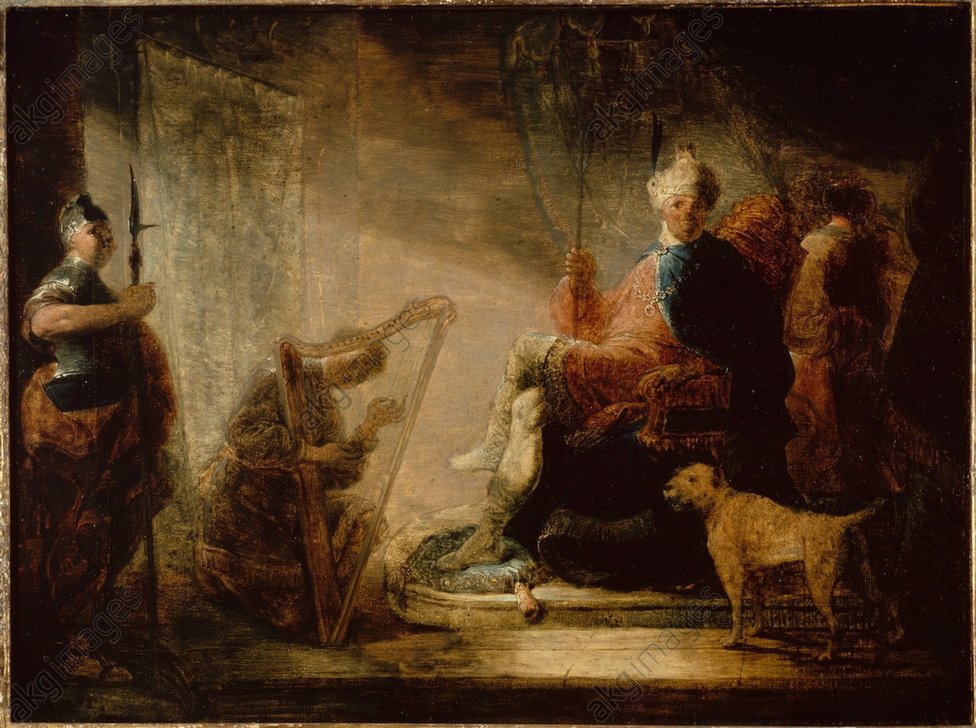
**Above painting: David playing the harp for King Saul, by German painter, Januarius Zick, 1750

Psalm 86 – Theology Proper

Psalm 86 by Ann Williams

Incline your ear, O Lord, and answer me,
    for I am poor and needy.
Preserve my life, for I am devoted to you;
    save your servant who trusts in you.
You are my God; be gracious to me, O Lord,
    for to you do I cry all day long.
Gladden the soul of your servant,
    for to you, O Lord, I lift up my soul.
For you, O Lord, are good and forgiving,
    abounding in steadfast love to all who call on you.
Give ear, O Lord, to my prayer;
    listen to my cry of supplication.
In the day of my trouble I call on you,
    for you will answer me.

There is none like you among the gods, O Lord,
    nor are there any works like yours.
All the nations you have made shall come
    and bow down before you, O Lord,
    and shall glorify your name.
For you are great and do wondrous things;
    you alone are God.
Teach me your way, O Lord,
    that I may walk in your truth;
    give me an undivided heart to revere your name.
I give thanks to you, O Lord my God, with my whole heart,
    and I will glorify your name forever.
For great is your steadfast love toward me;
    you have delivered my soul from the depths of Sheol.

O God, the insolent rise up against me;
    a band of ruffians seeks my life,
    and they do not set you before them.
But you, O Lord, are a God merciful and gracious,
    slow to anger and abounding in steadfast love and faithfulness.
Turn to me and be gracious to me;
    give your strength to your servant;
    save the child of your serving girl.
Show me a sign of your favor,
    so that those who hate me may see it and be put to shame,
    because you, Lord, have helped me and comforted me. (NRSV)

Today’s psalm is a prayer of David, asking God for help against enemies. David was a guy who knew what it was like to have evil men hate him and pursue taking his life through no fault of his own. I am not sure about your experiences with such people. Although I have never faced adversity to such a degree as David, I do know something about people who, to put it bluntly, just flat-out hate my guts. It feels awful, and it can be terribly draining emotionally and spiritually. Having disrespectful and rude people talk behind your back (and sometimes even to your face) is in direct contrast to who God is.

God is described by David as merciful and gracious, slow to anger, abounding in steadfast love, and faithful. Whereas insolent people objectify others and seek their own selfish agendas, God always acts in accord with a basic character of love and grace. Based upon the nature of God, we can choose to cry out, just like David did, to show us a sign of God’s favor. We can pray for God to provide us with some tangible communication of divine love in ways we can understand so that we can be helped and receive the kind of comfort we need through our adversity.

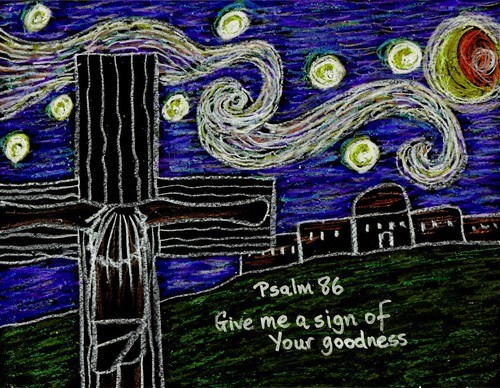
Psalm 86, chalk art by Scottish pastor and artist John Stuart, 2009

Be assured that with such a God, our pleas, cries, and tears will be noticed, affirmed, and answered. We can trust the sovereign Lord of all creation to address the insolence and injustice that exists around us and toward us.

All of this gets down to our view of God, our theological understanding of the basic Divine nature and purpose.  For some people, God is up there, somewhere, like some white-bearded old guy who is aloof to what is going on down here – there is neither anything personal nor personable about him, at all. For others, God is a force which binds all things together. In this theology, God exists, but you are never quite sure how to connect – it is like a crapshoot trying to get in touch with him.  For yet others, God is perpetually perturbed about something; he has a bee in his bonnet, and it is apparently our job to figure out what he is so sullen and upset about all the time so that we can appease him in some way.

However, the psalmist, David, sees God in wholly other ways than this. For David, God is personal, knowable, and reachable. David thought about God in ways which transcend either gendered or personality-type categories. Note the descriptions David provided: a willingness to forgive; an abiding, consistent, and steadfast presence of divine love; always having the time and desire to listen; possessing the power and ability to provide help and protection; being kind and merciful; not being easily angered; and extending needed comfort and consolation.

Now this is a God you can sink your teeth into – attentive, engaged, and anything but upset all the time. This is the reason why David has confidence to ask for deliverance, direction, and delight. Such a God is like a caring grandmother who seeks to always love and serve, and not a crotchety old curmudgeon who always seems bothered by everyone and everything.

If your theology, your view of God, cannot support and bear the weight of life’s hardest circumstances, then you need a different view of God! I invite you to see the God of David. Theology proper discerns the being, attributes, and works of God as fundamentally faithful and loving. This God has both the ability and the will to meet and satisfy your life’s greatest needs.

Great God of David, you are above all things and beside all things and with all things. You are uniquely positioned and powerful to walk with me through all the situations of my life. Thank you for sending the Son of David to make real your promises to me.  Amen.

1 Samuel 16:1-13 – Solitude of the Heart

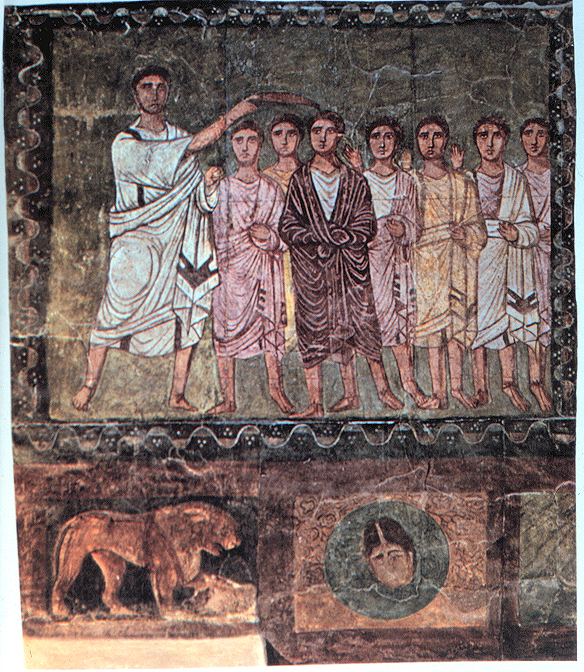
Samuel Anoints David as King, Syrian Orthodox Church, 3rd Century C.E.

The Lord said to Samuel, “How long will you mourn for Saul, since I have rejected him as king over Israel? Fill your horn with oil and be on your way; I am sending you to Jesse of Bethlehem. I have chosen one of his sons to be king.”

But Samuel said, “How can I go? If Saul hears about it, he will kill me.”

The Lord said, “Take a heifer with you and say, ‘I have come to sacrifice to the Lord.’ Invite Jesse to the sacrifice, and I will show you what to do. You are to anoint for me the one I indicate.”

Samuel did what the Lord said. When he arrived at Bethlehem, the elders of the town trembled when they met him. They asked, “Do you come in peace?”

Samuel replied, “Yes, in peace; I have come to sacrifice to the Lord. Consecrate yourselves and come to the sacrifice with me.” Then he consecrated Jesse and his sons and invited them to the sacrifice.

When they arrived, Samuel saw Eliab and thought, “Surely the Lord’s anointed stands here before the Lord.”

But the Lord said to Samuel, “Do not consider his appearance or his height, for I have rejected him. The Lord does not look at the things people look at. People look at the outward appearance, but the Lord looks at the heart.”

Then Jesse called Abinadab and had him pass in front of Samuel. But Samuel said, “The Lord has not chosen this one either.” Jesse then had Shammah pass by, but Samuel said, “Nor has the Lord chosen this one.” Jesse had seven of his sons pass before Samuel, but Samuel said to him, “The Lord has not chosen these.” So, he asked Jesse, “Are these all the sons you have?”

“There is still the youngest,” Jesse answered. “He is tending the sheep.”

Samuel said, “Send for him; we will not sit down until he arrives.”

So, he sent for him and had him brought in. He was glowing with health and had a fine appearance and handsome features.

Then the Lord said, “Rise and anoint him; this is the one.”

So, Samuel took the horn of oil and anointed him in the presence of his brothers, and from that day on the Spirit of the Lord came powerfully upon David. Samuel then went to Ramah. (NIV)

Solitude by Polish artist Piotr Dura

Appearances can be deceiving. One of the best ways to see beyond mere physical sight is to engage in the spiritual practice of solitude. Solitude is not loneliness but a deliberate retreat from normal routines to be alone with the Lord. The faith of both Samuel and David were strengthened through solitude. It prepared them for public service and made them godly. Because they had established patterns of being alone with God, they had an inward solitude even when in a crowd. That is why Samuel could have an interaction with the Lord, even when among lots of people.

Solitude is important because it is the true path to listening well.  A person whose faith has been shaped through solitude has an ability to carry on a dialogue with God while, at the same time, having a conversation with others.

Christ’s relationship with the Father was formed through solitude. Jesus was able to have simultaneous conversations with God and people since he practiced solitude on a regular basis. Jesus began his ministry with solitude (Matthew 4:1-11); made major decisions through solitude (Luke 6:12); and taught his disciples to practice solitude (Matthew 17:1-9; 26:36-46).

Solitude is necessary because engaging the world is important. Effective interaction with others requires times of retreat for solitude with God. Solitude as a spiritual discipline:

  • Gives us freedom from the need for constant noise and activity.
  • Allows God to shape our faith rather than conform to the world.
  • Liberates us from other people’s expectations for us.
  • Helps quiet internal noise and racing thoughts so we can better listen to God.
  • Provides the opportunity for reflection upon and preparation for future events.
  • Creates encouraging speech for the benefit of others.
  • Fuels a desire to keep practicing solitude because of its benefit.

Solitude taught Samuel obedience.

Samuel learned obedience through years of solitude with old Eli the priest. “Speak Lord, for I am listening” became a way of life for Samuel, as he was trained in how to listen well. 

Samuel’s greatness as the Judge of Israel did not lie in his original ideas or the initiatives he took, but in simple obedience to the commands of God. Years of obscurity and solitude as a child created the ability to hear and carry-out what the Lord told him to do.

Even Samuel, as godly as he was, could not rely on personal observations about choosing the next king of Israel. Because he had long years of practicing solitude with the Lord, Samuel was able to clearly hear divine speech and anointed the right person as king. Samuel did not trust his own judgment but relied on God’s direction.

Solitude characterizes God.

Christians serve a triune God of Father, Son, and Spirit. God has complete and perfect solitude along with focused engagement with humanity. Through spending time with God, people can simultaneously interact with divinity and humanity. It is a bit like my wife who began her broadcasting career in radio by simulcasting the AM station in one ear of her headphones, and the FM station in the other ear. She could que a record for the FM station while, at the same time, forecasting the weather for the AM station. Her ability was born of practice and commitment to her craft.  In the same way, we have been given a vocation to engage the church and world, and the ability to have a solitude of heart while interacting with others.

God, unlike us, sees us completely, inside-and-out – which is why we are dependent upon solitude of heart so that we can make proper judgments. God urged Samuel to not look at the outward appearance because this is how wrong judgments happen.

Solitude formed David into a king.

David was on nobody’s short list to become king. He was so far out there as a candidate for the position that his own family did not even think it necessary to have him present for the sacrificial feast. It is just like God to have a way of choosing the people we think would be the least likely to do anything.

Being in the pasture day after day and night after night by himself was just the right curriculum that trained the next king. Shepherding was not a lonely affair for David. It was a rich experience of solitude which developed a solid relationship with God. Out in the field, away from all the wrong judgments of the world, David learned to discern God’s voice – a skill he carried with him the rest of his life.

Solitude might seem unrealistic for extroverts, and only something for introverts. Yet, solitude is essential to creating a robust faith in God. The following are some steps toward the practice of solitude and allowing it to bring you into a closer walk with the Lord.

  1. Practice “little solitudes” in the day. The early morning cup of coffee or shower, the drive-time to work, the lunch break, the quiet at night when all is dark and everyone in bed are opportunities for solitude with God to reorient and redirect our lives.
  2. Find or create a quiet place designed specifically for solitude. It might be a room, a closet, or a chair. It might be outdoors. It can be anywhere that helps you be free from distraction and invites you to connect deeply with Jesus.
  3. Begin the day by spending at least 10 minutes alone with God in silence. Over time, work your way to even more minutes, even hours. I am a believer in an hour a day keeping the devil away. Eventually, take an entire day away, every few months. Consider taking a weekend or even a week away once a year.
  4. Read Holy Scripture slowly and meditatively. Listen to what the Spirit may be saying in your reading.  Keep a journal handy and write down your observations. Allow prayers to arise from what you hear from the Lord.

This might seem optional only for those with discretionary time – but it is no more optional than planting in the Spring to get a harvest in the Fall. Such fruit results in the slaying of giants….

Psalm 89:1-4, 19-26 – Being Confident

Our Lord, I will sing
    of your love forever.
Everyone yet to be born
    will hear me praise
    your faithfulness.
I will tell them,
“God’s love
    can always be trusted,
    and his faithfulness lasts
    as long as the heavens.”

You said, “David, my servant,
    is my chosen one,
    and this is the agreement
    I made with him:
David, one of your descendants
    will always be king….”

In a vision, you once said
    to your faithful followers:
“I have helped a mighty hero.
    I chose him from my people
    and made him famous.
David, my servant, is the one
    I chose to be king,
    and I will always be there
    to help and strengthen him.

No enemy will outsmart David,
    and he won’t be defeated
    by any hateful people.
I will strike down and crush
    his troublesome enemies.
He will always be able
    to depend on my love,
    and I will make him strong
    with my own power.
I will let him rule the lands
    across the rivers and seas.
He will say to me,
‘You are my Father
    and my God,
    as well as the mighty rock
    where I am safe.’” (CEV)

I wonder where the world places its confidence. I also sometimes wonder where the church places her confidence. Poverty, injustice, starvation, human rights violations, and war have existed throughout time. We all recognize these and the awful problems they are for so many people. It is, however, quite another thing when it comes to our confidence in addressing them and how they will ever be eradicated.

If we view these great humanitarian issues as a matter of ignorance, we will pursue education as the means of tackling them. If we discern them as political issues, we will seek to elect officials who will take them on, and we will lobby to make things different. If we understand them as moral issues, we will agitate for change and speak prophetically into what we believe to be the sources of the problems. In truth, each of these approaches have merit and are necessary components to a full orbed attention of their multifaceted and complicated nature.

For the pious and devout, the ultimate confidence comes in basic faith and trust of the Divine. God’s faithfulness and steadfast love are the solid foundation from which the believer constructs her hope and confidence.

The psalmist is not one bit bashful in reminding God of divine promises. God swore to King David that his descendants would rule forever. At the time the psalmist crafted these words, it was not looking much like those promises were having any attention from the Lord.

The David spoken of in the psalm is interpreted in the Christian tradition as Jesus. King David of old was certainly no perfect man, and the psalmist presents an idealized version, looking ahead to messianic qualities of a coming Ruler. Those qualities include a concern for the common good of all persons without striving for personal power or being aloof; and an ability to be victorious over foes.

Advent, much like today’s Psalm, calls on people to rely upon and have confidence in divine promises – even when those promises seem far from being realized. It is the trust and hope of the faithful which perseveres in prayer for a coming redemption and a day when wars shall cease, the rights of people are thoroughly met, starvation eradicated, injustice turned to justice, and poverty done away with once for all. In other words, a sinless world free from the machinations of evil.

It is no small thing holding on to our confidence as believers when circumstances all around us are askew and askance. The author of the New Testament book of Hebrews had this to say to a struggling church who had a hard time seeing future promises fulfilled:

Remember those earlier days after you had received the light, when you endured in a great conflict full of suffering. Sometimes you were publicly exposed to insult and persecution; at other times you stood side by side with those who were so treated. You suffered along with those in prison and joyfully accepted the confiscation of your property, because you knew that you yourselves had better and lasting possessions. So do not throw away your confidence; it will be richly rewarded.

You need to persevere so that when you have done the will of God, you will receive what he has promised. For,

“In just a little while,
    he who is coming will come
    and will not delay.”

And,

“But my righteous one will live by faith.
    And I take no pleasure
    in the one who shrinks back.”

But we do not belong to those who shrink back and are destroyed, but to those who have faith and are saved. (Hebrews 10:32-39, NIV)

We keep going by remembering God’s faithfulness and steadfast love, and our past joy of committed faith. Then, like psalmist, we allow a song to bubble up and be sung about divine goodness. Never underestimate the power of memory and music to keep us on track toward living each day in faith and confidence.

May you be able to sing of God’s love forever.

May you give voice to God’s faithfulness.

May you express daily affirmations of faith in God.

May you bank on the promises of God.

May your faith be strengthened for the rigors of this life.

May your hope overflow.

May the love of God work in and through you to the glory of Jesus Christ. Amen.

I Could Sing of Your Love Forever by Encounter Worship Band.