Psalm 101… Again

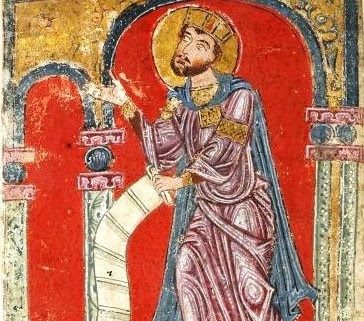
King David, by Unknown artist, c.14th century B.C.E.

I will sing of loyalty and of justice;
    to you, O Lord, I will sing.
I will study the way that is blameless.
    When shall I attain it?

I will walk with integrity of heart
    within my house;
I will not set before my eyes
    anything that is base.

I hate the work of those who fall away;
    it shall not cling to me.
Perverseness of heart shall be far from me;
    I will know nothing of evil.

One who secretly slanders a neighbor
    I will destroy.
A haughty look and an arrogant heart
    I will not tolerate.

I will look with favor on the faithful in the land,
    so that they may live with me;
whoever walks in the way that is blameless
    shall minister to me.

No one who practices deceit
    shall remain in my house;
no one who utters lies
    shall continue in my presence.

Morning by morning I will destroy
    all the wicked in the land,
cutting off all evildoers
    from the city of the Lord. (New Revised Standard Version)

Routine and repetition might seem tedious and boring. However, they are indispensable. People are designed for doing, saying, and thinking the same things over and over again. Habits help to press what is most important into our minds, our speech, and our behavior.

Transformation and change aren’t accomplished through sheer willpower. It happens through the small daily decisions of life. A mere ten minutes, dedicated specifically to a particular task each day, has the power to completely alter our lives.

The biblical psalms, read every day, out loud, through singing and praying, can bring an inside-out metamorphosis which can serve us for a lifetime. To help remind us of this, I sometimes include the psalm readings in my blog reflections two, even three, days in a row.

The Revised Common Lectionary is a method of reading through the Bible in a three-year cycle (Year A, B, C). Rather than reading the Bible from cover to cover, the Lectionary follows the seasons of the Christian Year (Advent, Christmas, Epiphany, Lent, Easter, Pentecost and Ordinary Time).

The advantage to reading the Bible with daily assigned texts from the Old Testament, Psalms, and the New Testament is that the reader has an opportunity to follow the life of Jesus through the course of a year. For a Christian who wants to grow in discipleship, the Lectionary is a helpful way of getting to know Christ better.

Another benefit of following the Lectionary readings is that they can be read slowly in about ten to fifteen minutes. This affords the opportunity to spend time reflecting and thinking about how the Bible applies to our life today. Since the daily readings relate to one another from various places in the Bible, it is a helpful way of keeping in mind the whole of Scripture.

The daily readings of the Lectionary revolve around the Sunday readings. Monday, Tuesday, and Wednesday readings reflect on the Sunday texts. Thursday, Friday, and Saturday prepare for Sunday. This has the obvious advantage for making Christian worship a special experience.

The purpose of the Lectionary is to encourage Bible reading, a well-rounded understanding of the Bible’s contents, as well as provide a good foundation for prayer. The Lectionary is meant to be a devotional reading of the Bible which draws people closer to God.

A consistent feature of the Revised Common Lectionary is that the same Psalm is read three days in a row. There is a reason for that. Psalms are meant for more than reading. They are also designed for prayer, singing, and worship.

Since I spiritually dwell a lot within the psalter, I have written out my own translation of many of them. I encourage you to read the following version out loud as a prayer to God….


God almighty, I will sing about your committed love and the exercise of your justice;
    and I will make music to and for you.
I have committed myself to wise discernment so I can walk in the way of integrity;
    so when will you come and help me?
    I will, with your assistance, establish integrity in my own home.
I refuse to set goals on worthless things which add no value to my life.
    I despise the actions of deviant and deceitful people,
    and I will not let their crud stick to me.
My mind and heart won’t go down that crooked path,
    for I will have nothing to do with the deeds of darkness.
The person who slanders another behind their back –
    well, just know, I will not put up with it!
The person who is full of themselves and looks down on others –
    believe you me, I will not tolerate it!

My eyes are fixated on pursuing trustworthy persons,

    and I will surround myself with them.

The person who walks in the way of integrity –

    for sure, will be my friend and confidant.
There is absolutely no room for deceitful hypocrites within my household,
    nor for any two-faced liar; they won’t be around me for long!
Every morning, without fail, I will practice justice,
    I will make it so evil persons cannot survive around me,
    effectively cutting-off troublemakers from your holy place.
Amen.

Psalm 101 – The Ethics of King David

I will sing to you, Lord!
    I will celebrate your kindness
    and your justice.
Please help me learn
    to do the right thing,
    and I will be honest and fair
    in my own kingdom.

I refuse to be corrupt
or to take part
    in anything crooked,
    and I won’t be dishonest
    or deceitful.

Anyone who spreads gossip
    will be silenced,
    and no one who is conceited
    will be my friend.

I will find trustworthy people
    to serve as my advisors,
    and only an honest person
    will serve as an official.

No one who cheats or lies
    will have a position
    in my royal court.
Each morning I will silence
    any lawbreakers I find
    in the countryside
    or in the city of the Lord. (Contemporary English Version)

King David was one serious dude when it came to dealing with wickedness and injustice. He had a zero tolerance policy toward people who were deceitful and proud. David was determined to deal with slanderous and arrogant people. He sought to establish a rule and reign based in his own personal integrity and practice of being a king who seeks after what is right and just.

And so, David refused to take a second look at corrupt people and things which degraded and debased others. He gathered around himself officials who genuinely care about kindness and justice.

David was not about to put up with anyone in his court who had personal agendas of power and privilege at the expense of the powerless.

For David, a diligent and conscientious application of God’s just and right law was absolutely necessary to a benevolent reign in which everyone felt secure and were able to enjoy the Promised Land. Corrupt officials had no place in the kingdom and would be summarily dealt with.

Unfortunately, there are far too many leaders in our world today who create cultures of fear, insecurity, and walking on eggshells. They are crafty and deceitful, actually using organizational codes of morality and ethics to hide their damaging and destructive effect on people.

We may not be kings like David, yet we can share his stance of not avoiding the evil in front of us and dealing with corruption, dishonesty, and disingenuous behavior from others, especially those in positions of power and authority. Toxic authority figures actively isolate us, making us feel stupid and incompetent and afraid to share our struggles with others, so that they can maintain all of the power. 

How, pray tell, might us lowly persons take on those with leverage and power over us, whether they be job bosses, church pastors, local politicians, or family members?

  • Do everything from a place of integrity. Seek the Lord in doing the right thing. Ultimate power belongs to God, not some puny person who is master of a small world.

Whoever walks in integrity walks securely, but whoever takes crooked paths will be found out. (Proverbs 10:9, NIV)

  • Refuse to play their game. Don’t resort to gossip, backbiting, or displays of your own supposed power. Be just, kind, wise, and, most of all, humble. Virtue will serve you well. Vice will not.

Gossip is spread by wicked people; they stir up trouble and break up friendships. (Proverbs 16:28, GNT)

  • Keep in mind that niceness is often used by corrupt leaders to keep others under their thumb. Dishonest and deceitful people are not necessarily bullying. They’ll use whatever means they can to get their way.

Flattery is nothing less than setting a trap. (Proverbs 29:5, CEV)

  • It is always our place to love, not judge. King Jesus is the Judge, not me, not you. Loving an unlovable person can only happen if we have a love for God which is able to see God’s image in every person we encounter, including that difficult leader. In the end, they will be held accountable – whether in this life, or in the one to come. Jesus said:

“You have heard that it was said, You must love your neighbor and hate your enemy. But I say to you, love your enemies and pray for those who harass you.” (Matthew 5:43-44, CEB)

  • Watch your back. Yes, we are to trust in the Lord. That doesn’t mean we implicitly trust everyone and/or every organization. Jesus said:

“Listen! I am sending you, and you will be like sheep among wolves. So be smart like snakes. But also, be like doves and don’t hurt anyone. Be careful!” (Matthew 10:16-17a, ERV)

We all, like King David of old, need an unequivocal commitment to a zero tolerance policy toward evil. It is simply unacceptable to flirt with it. Whatever we must do to remind ourselves of righteousness, and whatever boundaries we need to set, is most necessary, because no one who practices deceit will dwell in the Lord’s house.

Holy God of justice, I will make a covenant with my eyes to set before them no vile thing. Help me to be strong in your mighty power so that my daily walk of faith in Jesus is righteous, free of guilt, and enjoyable.  Amen.

1 Kings 1:1-30 – Facing Death

King David was now an old man, and he always felt cold, even under a lot of blankets. His officials said, “Your Majesty, we will look for a young woman to take care of you. She can lie down beside you and keep you warm.” They looked everywhere in Israel until they found a beautiful young woman named Abishag, who lived in the town of Shunem. They brought her to David, and she took care of him. But David did not have sex with her.

Adonijah was the son of David and Haggith. He was Absalom’s younger brother and was very handsome. One day, Adonijah started bragging, “I’m going to make myself king!” So, he got some chariots and horses, and he hired fifty men as bodyguards. David did not want to hurt his feelings, so he never asked Adonijah why he was doing these things.

Adonijah met with Joab the son of Zeruiah and Abiathar the priest and asked them if they would help him become king. Both of them agreed to help. But Zadok the priest, Benaiah the son of Jehoiada, Nathan the prophet, Shimei, Rei, and David’s bodyguards all refused.

Adonijah invited his brothers and David’s officials from Judah to go with him to Crawling Rock near Rogel Spring, where he sacrificed some sheep, cattle, and fat calves. But he did not invite Nathan, Benaiah, David’s bodyguards, or his own brother Solomon.

When Nathan heard what had happened, he asked Bathsheba, Solomon’s mother:

Have you heard that Adonijah the son of Haggith has made himself king? But David doesn’t know a thing about it. You and your son Solomon will be killed, unless you do what I tell you. Go say to David, “You promised me that Solomon would be the next king. So why is Adonijah now king?”

While you are still talking to David, I’ll come in and tell him that everything you said is true.

Meanwhile, David was in his bedroom where Abishag was taking care of him because he was so old. Bathsheba went in and bowed down.

“What can I do for you?” David asked.

Bathsheba answered:

Your Majesty, you promised me in the name of the Lord your God that my son Solomon would be the next king.But Adonijah has already been made king, and you didn’t know anything about it.He sacrificed a lot of cattle, calves, and sheep. And he invited Abiathar the priest, Joab your army commander, and all your sons to be there, except Solomon, your loyal servant.

Your Majesty, everyone in Israel is waiting for you to announce who will be the next king. If you don’t, they will say that Solomon and I have rebelled. They will treat us like criminals and kill us as soon as you die.

Just then, Nathan the prophet arrived. Someone told David that he was there, and Nathan came in. He bowed with his face to the ground and said:

Your Majesty, did you say that Adonijah would be king? Earlier today, he sacrificed a lot of cattle, calves, and sheep. He invited the army commanders, Abiathar, and all your sons to be there. Right now, they are eating and drinking and shouting, “Long live King Adonijah!” But he didn’t invite me or Zadok the priest or Benaiah or Solomon. Did you say they could do this without telling the rest of us who would be the next king?

David said, “Tell Bathsheba to come here.” She came and stood in front of him. Then he said, “The living Lord God of Israel has kept me safe. And so today, I will keep the promise I made to you in his name: Solomon will be the next king!” (Contemporary English Version)

Death isn’t exactly a popular subject. You might think, since all of us will eventually experience it personally, and most of us have seen it up close through dying loved ones, we would talk it up as something to face and deal with squarely…. Yet, we don’t.

Death ought to teach us how to live, how to face our limitations, and how to accept hardship and the inevitable.  Through today’s Old Testament lesson, I want us to observe four differing responses to the impending death of King David:

King David’s Servants

The servants of David treated his downward health as a problem to be solved. They were essentially sidestepping the whole death situation. The servants knew the David who was vigorous and took on enemies and problems. They wanted him to act like a king, so they looked for the miracle cure of a virgin who would be some sort of fix for David. In the ancient world, a king’s vitality was always linked to his sexual vigor. The servants thought if they could arouse David, he would be back to his old kingly self. In other words, the servants were trying to avoid death. And, of course, it didn’t work.

King David’s Son, Adonijah

Whereas the servants were scheming a way to get the old David back in the saddle, Adonijah was impatient to see his father David in the grave. He wanted his dad, the king, out of the way so he could pursue his own kingship. So, Adonijah simply proclaimed himself king, maybe hoping to hasten David’s death. Adonijah was just looking for his own opportunity and ended up losing his own life for it. Adonijah never understood the true dynamics of life and death – that life is complicated, and death should be honored, not used for personal gain.

King David’s Wife, Bathsheba

Bathsheba wanted to make sure her son Solomon became king. Reading today’s narrative, you might wonder why King David needed a virgin – where in the world was his wife!?  Bathsheba shows up to see David, not because she wanted to keep him warm and comfort him, but because she was concerned for her son. For Bathsheba, David simply became a means to an end – someone who could help her negotiate a difficult situation.

King David’s Caregiver, Abishag

Throughout this story, we have no recorded words from Abishag. Everyone else had plenty to say. In contrast to all of the other people, Abishag is simply a witness to David’s deteriorating health, and eventual death. She is like a hospice worker, who exists to ease the person’s pain in the end of life. In this, we can perhaps learn more from Abishag than from anyone else – to be present, to listen, to serve.

Unfortunately, death brings out the worst in some people. But if we will face death and not view it as a problem to be solved, an opportunity to be seized, or a difficulty to be negotiated, I believe we will find the grace of God when we become sacred witnesses to death.

The Lord Jesus faced death. Christ didn’t try to avoid death. He wasn’t impatient to get it over with. And it was not a difficulty to stoically endure. Our Lord’s death is our life – and it has brought meaning to both our lives and to our own eventual deaths.

Into your hands, O merciful Savior, we commend all your servants staring death in the face today. We, your people, humbly ask that you acknowledge these sheep of your own fold, these lambs of your own flock, and these sinners of your own redeeming. Receive them into the arms of your mercy, into the blessed rest of everlasting peace, and into the glorious company of the saints in light. Amen.

2 Samuel 15:13-31 – Unflagging Trust

Stained glass of King David, Fringford, England church

A messenger came and told David, “The hearts of the people of Israel are with Absalom.”

Then David said to all his officials who were with him in Jerusalem, “Come! We must flee, or none of us will escape from Absalom. We must leave immediately, or he will move quickly to overtake us and bring ruin on us and put the city to the sword.”

The king’s officials answered him, “Your servants are ready to do whatever our lord the king chooses.”

The king set out, with his entire household following him; but he left ten concubines to take care of the palace. So, the king set out, with all the people following him, and they halted at the edge of the city. All his men marched past him, along with all the Kerethites and Pelethites; and all the six hundred Gittites who had accompanied him from Gath marched before the king.

The king said to Ittai the Gittite, “Why should you come along with us? Go back and stay with King Absalom. You are a foreigner, an exile from your homeland. You came only yesterday. And today shall I make you wander about with us when I do not know where I am going? Go back and take your people with you. May the Lord show you kindness and faithfulness.”

But Ittai replied to the king, “As surely as the Lord lives, and as my lord the king lives, wherever my lord the king may be, whether it means life or death, there will your servant be.”

David said to Ittai, “Go ahead, march on.” So Ittai the Gittite marched on with all his men and the families that were with him.

The whole countryside wept aloud as all the people passed by. The king also crossed the Kidron Valley, and all the people moved on toward the wilderness.

Zadok was there, too, and all the Levites who were with him were carrying the ark of the covenant of God. They set down the ark of God, and Abiathar offered sacrifices until all the people had finished leaving the city.

Then the king said to Zadok, “Take the ark of God back into the city. If I find favor in the Lord’s eyes, he will bring me back and let me see it and his dwelling place again. But if he says, ‘I am not pleased with you,’ then I am ready; let him do to me whatever seems good to him.”

The king also said to Zadok the priest, “Do you understand? Go back to the city with my blessing. Take your son Ahimaaz with you, and also Abiathar’s son Jonathan. You and Abiathar return with your two sons. I will wait at the fords in the wilderness until word comes from you to inform me.” So Zadok and Abiathar took the ark of God back to Jerusalem and stayed there.

But David continued up the Mount of Olives, weeping as he went; his head was covered, and he was barefoot. All the people with him covered their heads too and were weeping as they went up. Now David had been told, “Ahithophel is among the conspirators with Absalom.” So, David prayed, “Lord, turn Ahithophel’s counsel into foolishness.” (New International Version)

“Faith is taking the first step even when you don’t see the whole staircase.”

Martin Luther King, Jr.

It’s an understatement to say that King David had family drama.

Maybe that’s because he had a lot of wives and even more kids. Or it could be that being a king didn’t transfer well to being a father. And it just might be that his experience was mostly about simply living in a fallen world, full of icky relational dynamics and human conflict.

David seemed to be at his best when at his lowest. His son, Absalom, carefully designed a conspiracy to take over the kingdom. And it was looking as though he might just do it. David, and those loyal to him, fled Jerusalem to avoid being overthrown and killed. They were between a rock and a hard place, to put it mildly. David was literally running for his life.

If we put ourselves in David’s sandals, how would we respond? 

I suppose, at the least, we would likely complain. Who is Absalom that he should dishonor his father in such a way as this? Then, we may try and find ways to maintain power, and get back at Absalom for being a rebellious and destructive son. 

I am humbled by David’s unflagging trust in God. Like the suffering Job centuries before him, David was willing to receive anything from the hand of God, whether for good or evil. He wholesale accepted whatever seemed good to God, without attempting to force anything on the Lord. “Let God do to me what seems good to him,” was the faith affirmation of David.

Yet, at the same time, David was aware and in touch with his emotions as he left the city and ascended the Mount of Olives. He wept and lamented over the situation he and all those with him had to experience. 

A thousand years later, Jesus took the same trek out of the city in great sorrow because of people who conspired against him. Christ faced the agony of the cross through the machinations of sinful humanity who did not want him as Lord over their lives.

Our confidence must rest in the God who is never caught unaware of our situations and always knows how to respond. We must rely on our prayers to the Lord as we navigate the difficulties of this life. 

Humility goes a long way toward letting the will of God rule the day.

O Lord, please turn the plans and the counsel of evil persons into foolishness. Do not let the sinfulness of people have its way and run roughshod over my life.  I trust in you to bend a bad situation toward your own good purpose through Jesus Christ my Lord.  Amen.