Luke 10:25-37 – How Do We Start Our Ministry?

The Good Samaritan by He Qi

On one occasion an expert in the law stood up to test Jesus. “Teacher,” he asked, “what must I do to inherit eternal life?”

“What is written in the Law?” he replied. “How do you read it?”

He answered, “‘Love the Lord your God with all your heart and with all your soul and with all your strength and with all your mind’; and ‘Love your neighbor as yourself.”

“You have answered correctly,” Jesus replied. “Do this and you will live.”

But he wanted to justify himself, so he asked Jesus, “And who is my neighbor?”

In reply Jesus said: “A man was going down from Jerusalem to Jericho, when he was attacked by robbers. They stripped him of his clothes, beat him and went away, leaving him half dead. A priest happened to be going down the same road, and when he saw the man, he passed by on the other side. So too, a Levite, when he came to the place and saw him, passed by on the other side. But a Samaritan, as he traveled, came where the man was; and when he saw him, he took pity on him. He went to him and bandaged his wounds, pouring on oil and wine. Then he put the man on his own donkey, brought him to an inn and took care of him. The next day he took out two denarii and gave them to the innkeeper. ‘Look after him,’ he said, ‘and when I return, I will reimburse you for any extra expense you may have.’

“Which of these three do you think was a neighbor to the man who fell into the hands of robbers?”

The expert in the law replied, “The one who had mercy on him.”

Jesus told him, “Go and do likewise.” (New International Version)

Mosaic of the Good Samaritan in the Cathedral of St. Mary, Madrid, Spain

Start with Love and Mercy

The short answer to the question of how to begin any ministry is love, by providing relief through showing mercy. Compassion, mercy, and love are always behind every true Christian ministry.

Being available and approachable, crossing paths with people in need, noticing and caring about others is a merciful response. Following the example of Jesus, the Christian community ought not to pass by on the other side of the road. Instead, we are to stop and get involved smack in the middle of human need.

That isn’t what always happens, though. It can be far too easy to respond to the vast sea of human need by being judgmental and critical. We might observe people’s predicaments and write those persons off as being lazy, foolish, or of bad character. Just as bad, our prejudice or bias might see a person’s clothes, habits, race, ethnicity, or gender and immediately make sweeping negative assumptions about them – without having even engaged them.

Frankly, from a Christian perspective, it just doesn’t matter. Whether we believe someone deserves our help or not, all Christian ministry is to be driven by a spirit of love, compassion, and mercy – rather than a spirit of condemnation. We need to see all people, without exception, as image bearers of God who possess inherent worth and dignity as human beings.

The Good Samaritan by Vincent Van Gogh, 1890

Start with Relationships

It is good to give money, food, and resources to those in need. It’s even better to develop relationships and get to know the people for whom we are helping. Both handouts and hugs are good and necessary. In this COVID-19 world we are currently living in, I am using “hug” as both a metaphor and an acronym….

Hold eye contact. One of the things we all have discovered about masking is that the eyes communicate a lot. Looking someone in the eye is important. Far too many people in our world don’t feel seen by others. They wonder, if they fell off the face of the earth, whether anyone would even notice. Seeing people is a necessary ministry, in and of itself.

Understand another’s life and point of view. Be curious about their lives, their history, their faith background, and their experiences. Put yourself in their shoes. See things from their perspective. Empathy (communicating to someone that they are not alone) goes a long way. What’s more, we don’t have to agree with another to extend mercy.

Go to others, rather than waiting for others to come to you. Go where they are. Get close enough to show empathy and compassion, even if it’s an air hug. Half of any relationship, before any talking or doing happens, is simply showing up. The good Samaritan showed up and stopped. He was willing to go wherever the mercy of God sent him.

Start with Building Trust

Most needy people have been, at the least, ignored or dismissed by others; and, at worst, like the man attacked by robbers, beat down and berated by others and left for dead. Anyone who has endured past abuse or trauma is understandably guarded in trusting others. The last thing they want to do is be open and vulnerable to a stranger who might take advantage of them and hurt them.

It takes time to build trust. A person’s issues, a neighborhood’s concerns, and a city’s anxiety won’t be solved overnight. Those problems took a great deal of time in their development, and so, it will take just as much, or more, time to address and resolve all that is wrong.

As we lovingly and mercifully tackle those problems, we must always keep in mind that we fix problems and heal people – and never the other way around. Trying to fix people is a fool’s errand because people are not their problems. Nobody is a cancer, a disease, a schizophrenic, or a lunatic. People have physical, mental, emotional, and spiritual illnesses but they are not inherently those problems. Anything we won’t possess in heaven is something we are not, as people.

Human organizations, systems, institutions, and culture can be a problem – but not people themselves. Whenever someone begins labeling people as “problem” people, or as “those” people, or even worse, as “monsters” or some other label, the judgment of God is not far behind. (Matthew 5:22)

Trust cannot be developed with putting adjectives in front of people’s names or replace those names with pejorative terms. Christian ministry can only thrive in an atmosphere of love, mercy, and compassion.

Trust is developed when we give people the dignity of choices and ask whether they would like help, or not. We don’t save anyone. God does. We are all responsible for our own choices and our own openness to accepting and owning our own problems.

The Good Samaritan by Paulus Hoffman

Start with Meeting a Need

The man alongside the road had a clear need for immediate assistance. The Samaritan stepped in and met that pressing need. The man would have died without it. Yet, some people’s needs aren’t quite so obvious. If we have worked at building trust, some of those needs become known. And there are always existing organizations who are diligently addressing many of those needs with whom we can partner.

Another way of meeting needs is to connect people with one another. Through consulting and collaborating with others, we can foster relational connections in which someone’s or a group’s needs can be met. Since no one person or community can meet everyone’s needs, many times the best approach is to help people meet one another.

When we get neighbors working together to care for one another and improve their neighborhood, they are empowered to make a difference. This is especially viable when a church commits itself to the place or parish in which it exists. By being involved, partnering with community organizations or neighborhood associations, the church joins others as a community connector and a place where the community comfortably gathers.

Conclusion

All Christian ministry begins with a loving attitude, a compassionate heart, and a merciful spirit. Then, it looks for opportunities to be available and show up with a compassionate presence. From there, we are able to discover and discern the real needs of people so that we are providing what is truly needed instead of what we believe someone else needs.

In one of the communities I once pastored, I noticed the town had a significant number of single parents trying to raise their kids. So, I did a bit of demographic work and presented it to the elders, pointing out the opportunity we have to make a difference in many of these family’s lives. The elders became excited about the chance for outreach, that is, until I proposed that we recruit two or three of those single parents to come, sit around the table, and help us understand their needs and how we might help…. The elders became eerily silent…. Finally, one of them spoke up and said, “We can’t do that. They got themselves into this single parent situation. They don’t know what’s best. We do….”

That response is just the opposite of what God is looking for in us. If we believe we know better to the point of not even asking others how we might help, then our arrogance and prejudice has blinded us to true Christian ministry in the way of Jesus. Now for a better story….

The Good Samaritan by Corinne Vonaesch

A woman and her husband were not from the area they were living, and so, every Thanksgiving they spent it only with each other, since both their families lived far away. So, when one Thanksgiving came around, they wondered if there were others like them, spending the holiday apart from family.

They found a few and spent that Thanksgiving together. Those folks had such a good time together that, next year, the woman and her husband asked if they could use the church fellowship hall where I was pastoring at Thanksgiving because they found more people who had no family to celebrate with.

To make a long story short, these two people now serve about two-hundred people in the community every Thanksgiving who gather together, and another two hundred shut-ins are delivered a Thanksgiving meal, along with some needed human connection. Many positive friendships and relationships are formed.

“It’s not how much we give but how much love we put into giving.”

Mother Teresa

Small acts of kindness done with big love result in the kind of Christian ministry which pleases God.

Lord, help us believe we are all ordinary people made extraordinary through your vision and power. Take our insecurities and feelings of inadequacy and give us the courage to see ourselves and others as you see us, with gifts and potential to transform your world and build your Kingdom, through Jesus Christ our Lord. Amen.


Micah 6:1-8 – What Does the Lord Require of Us?

Jesus the Good Shepherd by Solomon Raj

Listen to what the Lord says:

“Stand up, plead my case before the mountains;
    let the hills hear what you have to say.

“Hear, you mountains, the Lord’s accusation;
    listen, you everlasting foundations of the earth.
For the Lord has a case against his people;
    he is lodging a charge against Israel.

“My people, what have I done to you?
    How have I burdened you? Answer me.
I brought you up out of Egypt
    and redeemed you from the land of slavery.
I sent Moses to lead you,
    also Aaron and Miriam.
My people, remember
    what Balak king of Moab plotted
    and what Balaam son of Beor answered.
Remember your journey from Shittim to Gilgal,
    that you may know the righteous acts of the Lord.”

With what shall I come before the Lord
    and bow down before the exalted God?
Shall I come before him with burnt offerings,
    with calves a year old?
Will the Lord be pleased with thousands of rams,
    with ten thousand rivers of olive oil?
Shall I offer my firstborn for my transgression,
    the fruit of my body for the sin of my soul?
He has shown you, O mortal, what is good.
    And what does the Lord require of you?
To act justly and to love mercy
    and to walk humbly with your God. (New International Version)

We are the people of God, the Church, the Body of Christ, the army of God, a holy temple. Those biblical labels are a picture of who we are and what we are to do. These metaphors all describe a people set apart for service, working in concert together toward a shared purpose.

In the prophet Micah’s day, the Israelites lost sight of the purpose and meaning of being God’s people. They needed to remember that the Lord acts in and through them for the redemption of the world. The kind of sacrifice and service which God wants is not so much a largess of tangible offerings we give. Rather, it is neatly summarized this way: Act justly. Love mercy. Walk humbly with your God.

This Old Testament passage has the feel of a courtroom scene. The defense lawyer is Micah, representing God. The people of Israel are the plaintiffs. The world is the judge. All of creation is the jury.

Israel was complaining about God. It’s an age old complaint from many people through the millennia: Blame God for anything that goes sideways in my life. The reasoning goes something like this: After all, God is powerful and in control. God should fix everything.

In their small-minded and short-sighted ways, the people seem unable to discern that easy fixes rarely help anyone. Like yanking up a big weed next to a small plant, it destroys both of them.

The defendant, Micah, speaks on behalf of God. What have I done to you? How have I burdened you? In fact, God has done just the opposite of failing to act or wronging the people in some way. The Lord actively delivered the Israelites:

  • When the people groaned and grumbled under Egyptian slavery, God delivered them with a series of miraculous deeds.
  • When the Israelites were heading to the Promised Land and vulnerable to their enemies, God protected them from the Moabites. The Lord even used a talking donkey to work on their behalf. God miraculously turned the efforts of Balak to curse the people into a blessing.
  • When the people entered the land, they did so by the powerful act of God to stop the Jordan River from flowing so the Israelites could cross over.

These saving acts of God are the motivation for living a life pleasing to God. Micah sarcastically pressed his argument, essentially asking if there’s anything that can be done to keep the people happy? What extremes need to happen to meet such excessive demands? The response by God is this: Do justice. Love mercy. Walk humbly with God.

Walk Humbly with God

Faith and action are meant to work seamlessly together. Doing justice and loving mercy are possible as we walk with God. Walking everyday with Jesus gives us the power and passion to invest in the healing of the world. God desires that we journey with Jesus and follow his words and ways. Throughout the New Testament, the Christian life is described as a road or a way we walk. In fact, the earliest believers were known as “The Way.” (Acts 9:1-19)

Jesus is the way (John 14:6). Jesus is the way to deal with our current concerns and anticipated anxieties. He himself is the way. The way is not through a program of self-improvement. The way is not through a fake-it-till-you-make-it approach. The way is not through an ability to articulate well-crafted words or through being able to answer with certainty every question of faith. The way is not through finding just the right plan or system.

Jesus is our way – he is the way of rescue, the road to a life of harmonious peace and settled rest even when the world is going to hell around us. Jesus is the way for the church everywhere – fellowship, encouragement, acts of loving service, teaching, and strengthening of faith all center around Jesus because he is love incarnate.

Jesus is the way for the world – serving neighbors and nations, advocating for those who are mistreated and facing injustice, tackling the dozens of world problems which oppress humanity – come through the continuing presence of Jesus here on this earth, that is, through the Holy Spirit and God’s people.

Love Mercy

This phrase (in the NIV) is translated various ways in other Bible versions:

  • “Embrace faithful love” (CEB)
  • “Let mercy be your first concern” (CEV)
  • “Show constant love” (GNT)
  • “Be compassionate and loyal in your love” (MSG)
  • “Love being kind to others” (NCV)
  • “Love kindness” (NRSV).

The reason for the variations is that the phrase in Hebrew carries a lot of meaning – and it’s difficult to capture that meaning in just one or two English words. It has to do with God’s steadfast loyalty to people based in a committed love and determination to do what is good and kind on their behalf – no matter whether they deserve such a grace, or not.

To love mercy comes from a large heart. The Grinch had a small heart. It caused him to be a nasty green curmudgeon who could steal gifts from a sweet little Who-girl. Only when his heart was enlarged did he mercifully return the gifts and then participate with the Whoville folks in their grand celebration.

God was merciful! We were dead because of our sins, but God loved us so much that he made us alive with Christ, and God’s wonderful kindness is what saves you. (Ephesians 2:4-5, CEV)

Love one another as if your lives depended on it.

1 Peter 1:22, MSG

Act Justly

Because many people define justice as a punitive act toward a wrongdoer, they struggle with this admonition to “do justice.” Giving people what they deserve doesn’t primarily mean someone is supposed to go to prison. Some people deserve that. Most don’t.

Instead, to act justly means to create a world in which everyone has what they need to live, thrive, and develop the gifts God has placed within them. Everyone deserves their basic human needs met – to have an equal opportunity in realizing the meeting of their needs. And that is what the heart of biblical justice is. Therefore, justice includes practical things like:

  • Providing tutors so that kids in urban schools have the same opportunities to read and as suburban kids.
  • Supporting an overwhelmed single parent who is struggling to find the time and resources to give adequate time to his or her children.
  • Taking in a foster child who needs the environment of a loving family.
  • Employing a person coming out of prison so that the terrible rates of recidivism don’t keep going.
  • Advocating for an underprivileged person who needs adequate healthcare or good housing.

Doing justice is more than giving away money or resources. It’s helping people to help themselves. It’s providing others the dignity and respect of putting them in a position so that they can take pride in their own efforts, just like we do. It’s not only giving someone a fish but taking the time and effort in teaching them how to fish.

Speak up for people who cannot speak for themselves. Help people who are in trouble. Stand up for what you know is right and judge all people fairly. Protect the rights of the poor and those who need help. (Proverbs 31:8-9, ERV)

Conclusion

What does the Lord require or desire of you?

What gifts and abilities has God given to you to act justly, love mercy, and walk humbly?

How can you and I step outside our comfort zones to other areas the Lord might be desiring for us?

The answers to those questions will determine whether we sink or swim as the people of God.

Father God, you have made all people in your image. It’s your desire and requirement that they be gathered together as one family in yourself. Fill the hearts of humanity with the fire of your love and the desire to ensure justice for all. By sharing the good things, you give us, may we secure equality for all our brothers and sisters throughout the world. May there be a truly human society built on love and peace, through Jesus Christ our Lord. Amen.

Romans 2:1-11 – Connection, not Criticism

Those people are on a dark spiral downward. But if you think that leaves you on the high ground where you can point your finger at others, think again. Every time you criticize someone, you condemn yourself. It takes one to know one. Judgmental criticism of others is a well-known way of escaping detection in your own crimes and misdemeanors. But God isn’t so easily diverted. He sees right through all such smoke screens and holds you to what you’ve done.

You didn’t think, did you, that just by pointing your finger at others you would distract God from seeing all your misdoings and from coming down on you hard? Or did you think that because he’s such a nice God, he’d let you off the hook? Better think this one through from the beginning. God is kind, but he’s not soft. In kindness he takes us firmly by the hand and leads us into a radical life-change.

You’re not getting by with anything. Every refusal and avoidance of God adds fuel to the fire. The day is coming when it’s going to blaze hot and high, God’s fiery and righteous judgment. Make no mistake: In the end you get what’s coming to you—Real Life for those who work on God’s side, but to those who insist on getting their own way and take the path of least resistance, Fire!

If you go against the grain, you get splinters, regardless of which neighborhood you’re from, what your parents taught you, what schools you attended. But if you embrace the way God does things, there are wonderful payoffs, again without regard to where you are from or how you were brought up. Being a Jew won’t give you an automatic stamp of approval. God pays no attention to what others say (or what you think) about you. He makes up his own mind. (The Message)

Claiming the moniker of self-appointed Judge will only get you, well, judged! There is only one true Judge. And Judge Jesus renders decisions which are always right, just, and fair, with no favoritism, cronyism, or malice.

A critical spirit is an evil spirit. It vaults oneself over and above others who are viewed as inferior, unworthy of love and belonging. It is the very antithesis of Christ’s way of being in the world with others.

The Apostle Paul, writing to the Church at Rome, merely upheld the teaching of his Lord Jesus, who said:

“Do not judge, so that you may not be judged. For with the judgment you make, you will be judged, and the measure you give will be the measure you get.” (Matthew 7:1-2, NRSV)

Although most people would affirm that showing favoritism is a bad thing, in practice we have a difficult time avoiding it – especially in polarizing times such as ours. Political mudslinging is (unfortunately) a time-honored American tradition. And so is religious judgmentalism.

Some of the most emotionally laden vitriol comes from folks who are so heavily entrenched in their religious convictions that they believe any deviation from their way of belief is worthy of scathing criticism.

People, however, do not change because someone criticizes or judges them. They experience transformation through basic divine and human kindness.

As a hospital chaplain in a behavioral health unit, I wholeheartedly affirm this to be true. Many patients have been told repeatedly by family or friends to stop their destructive behavior or thinking, get their lives together, move on, wake up, etc. – all with the condescending edge of criticizing judgment.

Yet, when someone takes notice, is curious about them, treats them like a fellow person, offers helpful encouragement, and a listening ear without trying to fix, souls become open to receiving the healing grace of love and truth.

God shows no partiality, and neither should we, period.

God is right, just, and fair in all dealings with everyone. The Lord judges according to divine standards of righteousness and mercy – no matter one’s race, ethnicity, gender, economic status, or social standing. And it is all laced with the love and compassion of Christ.

Christians are not exempt or given a pass on being judgmental, as if owning multiple Bibles or giving lots of money exempts one from a wagging tongue and an insensitive spirit.

Our own unhealthy practices, bad habits, and angry outbursts will be treated just like any non-Christian by God. In a time when decrying the moral condition of our world is nearly a spectator sport, the New Testament lesson for today reminds us that we must first be concerned for the condition of our own hearts before we can point the finger at another.

We all equally stand in need of God’s grace in Jesus.  There is a symbiotic relationship between our actions and the state of our hearts.  A soft and tender heart toward God leads to obedience; disobedience hardens the heart and leads to God’s wrath, no matter the individual.

So, it will help if we all faithfully engage in daily spiritual practices which keep our hearts attentive and alert to God’s will and way. 

No matter how busy we are, or how we feel, to forego or ignore the Word of God and prayer on a regular basis will slowly calcify our hearts and render them unable to respond rightly to grace. Instead, we can drink deeply of the gospel throughout every day so that we may experience peace.

A critical spirit begins to melt away when the tools of empathy, compassion, understanding, and acceptance are used to forge connections and provide support.

It takes little to no practice to bludgeon someone with condemning criticism. However, it takes repeated practice to speak and act with grace, mercy, and peace, especially when we are stressed and/or anxious about our surrounding circumstances.

Instead of judgment, observe and be curious. Seek more information. Ask clarifying questions. Expand the gap between observation and conclusion.

The ability to have an awareness of one’s own emotions, to be mindful of self and surroundings, and to do it all with neither criticism nor judgment is perhaps the highest form of intelligence and spirituality.

It is kindness which leads others to repentance, not condemnation. Grace has the final word, not judgment. So, let us be blessed through a gentle spirit which spreads the goodness of God throughout the world.

O God, thank you for the gift of prayer and the grace of your Word.  May it seep deep down into my heart so that I am compassionate and kind, just like Jesus.  Amen.

John 4:7-26 – Living Water

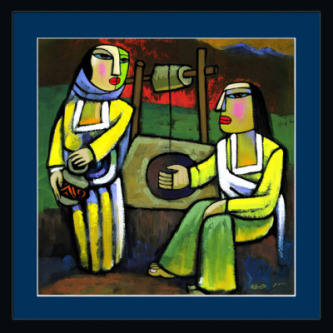
Samaritan Woman at the Well by He Qi

When a Samaritan woman came to draw water, Jesus said to her, “Will you give me a drink?” (His disciples had gone into the town to buy food.)

The Samaritan woman said to him, “You are a Jew, and I am a Samaritan woman. How can you ask me for a drink?” (For Jews do not associate with Samaritans.)

Jesus answered her, “If you knew the gift of God and who it is that asks you for a drink, you would have asked him, and he would have given you living water.”

“Sir,” the woman said, “you have nothing to draw with and the well is deep. Where can you get this living water? Are you greater than our father Jacob, who gave us the well and drank from it himself, as did also his sons and his livestock?”

Jesus answered, “Everyone who drinks this water will be thirsty again, but whoever drinks the water I give them will never thirst. Indeed, the water I give them will become in them a spring of water welling up to eternal life.”

The woman said to him, “Sir, give me this water so that I won’t get thirsty and have to keep coming here to draw water.”

He told her, “Go, call your husband and come back.”

“I have no husband,” she replied.

Jesus said to her, “You are right when you say you have no husband. The fact is, you have had five husbands, and the man you now have is not your husband. What you have just said is quite true.”

“Sir,” the woman said, “I can see that you are a prophet. Our ancestors worshiped on this mountain, but you Jews claim that the place where we must worship is in Jerusalem.”

“Woman,” Jesus replied, “believe me, a time is coming when you will worship the Father neither on this mountain nor in Jerusalem. You Samaritans worship what you do not know; we worship what we do know, for salvation is from the Jews. Yet a time is coming and has now come when the true worshipers will worship the Father in the Spirit and in truth, for they are the kind of worshipers the Father seeks. God is spirit, and his worshipers must worship in the Spirit and in truth.”

The woman said, “I know that Messiah” (called Christ) “is coming. When he comes, he will explain everything to us.”

Then Jesus declared, “I, the one speaking to you—I am he.” (New International Version)

Jesus and the Samaritan Woman by He Qi

Many years ago, I was the pastor of a small congregation north of Detroit, Michigan. Many of the people in the community viewed the big city as a place of disrepute. So, they avoided going into the heart of the great city as much as possible.

The locale of Samaria was viewed much the same way by many Jews back in Christ’s day. Samaritans were seen as untrustworthy, a mongrel people with a mix of Jewish and ancient Assyrian blood. And their religion was most suspect of all – an amalgam of Jewish and Gentile practices.

Jesus, however, didn’t avoid the territory. He confidently walked through Samaria and had no problem stopping to rest on his journey in a foreign area. That’s because Jesus didn’t class people into groups, nor did he attach adjectives to people, such as “those” Samaritans.

Jesus had no obstacles between himself and others.

Which is why an organic conversation happened between Jesus and a Samaritan woman. Christ simply saw a human being who happened to be a woman and a Samaritan. He acknowledged both her gender and her ethnicity without those being a problem. Not even Christ’s knowledge of her string of husbands was a problem in conversing with her.

Every time I read this narrative of Jesus interacting with the Samaritan woman, I wonder and use my imagination about all the non-verbal communication. I am sure the conversation was as much about Christ’s affect, gestures, and tone of voice, as it was his well placed words. I fully believe his verbal and non-verbal communication was perfectly congruent with each other, giving the woman a compelling sense that her ultimate needs could be met with the living well of a person in front of her.

Water gives life. And Jesus, as living water, gives new life. A bunch of failed relationships testified to the woman’s dissatisfaction. Even though we hear no more about her after this story in the Bible, we as readers get the overwhelming sense that the woman finally found satisfaction. The love which kept slipping through her fingers now had staying power.

I am sure the Samaritan woman discovered true worship, in spirit and in truth.

I still remember my first encounter, at least my first aware experience, with the living Christ. I am quite sure Jesus was near me for a long time, without me knowing his presence. Words will never truly capture the overwhelming sense of love, acceptance, mercy, kindness, and deep satisfaction – a contentment and gratification which has stuck with me now for decades.

Messiah, “Savior,” is an apt term for Jesus. He certainly saved me from myself. And Christ has never left me nor forsaken me – always there, always available, always loving with both tender love and tough love.

I’m glad that Jesus didn’t consider this earth like the city of Detroit – a place to avoid – but willingly came to encounter people like the Samaritan woman, and me. And this is the basis of true worship.

“Have faith in me, and you will have life-giving water flowing from deep inside you, just as the Scriptures say.” (John 7:38, CEV)

Lord Jesus, Son of God, Savior of humanity, there is a river flowing straight from your heart into mine — replenishing, renewing, sustaining. May you, as Living Water, be persistent in me, breaking through every barrier in its path. Send this hydro-power through the dark crevices of my heart like a mighty flood overcoming and pushing everything out of the way that blocks its path. I want my heart to be washed clean of any debris cluttering and blocking your life-giving flow. May your love overflow onto your people — your grace, your mercy — into the lives of those we encounter, to your glory and honor, in spirit, and in truth. Amen.