Living Without Answers (Job 41:12-34)

“I will not keep silent concerning its limbs
    or its mighty strength or its splendid frame.
Who can strip off its outer garment?
    Who can penetrate its double coat of mail?
Who can open the doors of its face?
    There is terror all around its teeth.
Its back is made of shields in rows,
    shut up closely as with a seal.
One is so near to another
    that no air can come between them.
They are joined one to another;
    they clasp each other and cannot be separated.
Its sneezes flash forth light,
    and its eyes are like the eyelids of the dawn.
From its mouth go flaming torches;
    sparks of fire leap out.
Out of its nostrils comes smoke,
    as from a boiling pot and burning rushes.
Its breath kindles coals,
    and a flame comes out of its mouth.
In its neck abides strength,
    and terror dances before it.
The folds of its flesh cling together;
    it is firmly cast and immovable.
Its heart is as hard as stone,
    as hard as the lower millstone.
When it raises itself up the gods are afraid;
    at the crashing they are beside themselves.
Though the sword reaches it, it does not avail,
    nor does the spear, the dart, or the javelin.
It counts iron as straw
    and bronze as rotten wood.
The arrow cannot make it flee;
    slingstones, for it, are turned to chaff.
Clubs are counted as chaff;
    it laughs at the rattle of javelins.
Its underparts are like sharp potsherds;
    it spreads itself like a threshing sledge on the mire.
It makes the deep boil like a pot;
    it makes the sea like a pot of ointment.
It leaves a shining wake behind it;
    one would think the deep to be white-haired.
On earth it has no equal,
    a creature without fear.
It surveys everything that is lofty;
    it is king over all that are proud.” (New Revised Standard Version)

In a long anticipated response, God finally spoke to Job with his companions present. And it was nothing like anyone expected.

Today’s Old Testament lesson continues God’s questioning of Job, and talking of the great Leviathan – a large and uncontrollable creature.

Trying to figure out exactly what Leviathan is or was (e.g. a dragon, a dinosaur, or some dang demon) is not the point of having this chapter in Holy Scripture.

We can become obsessed with having our questions answered, everything neatly categorized and understood, every problem and mystery solved to our satisfaction.

If the Book of Job teaches us anything, it is that there are questions for which there are no answers this side of heaven. There are problems which we humans cannot logically and scientifically solve.

Ironically, we discover the presence of God through God’s absence; and hear the voice of God through God’s silence.

Any encounter we may have with God will typically shatter any preconceived notions about divinity. Any experience with God shall prevent us from packaging up an answer with some nice pretty paper and bows, as if we were enjoying a delightful Christmas at home.

Facing God is much more like coming face to face with who you really are, and what motivations and intentions are really in your heart. It’s more like Halloween than Christmas. It’s staring at a scary monstrous Leviathan, and not a bright jolly Santa Claus.

Coming to grips with our fears and anxieties, struggles and weaknesses, mortality and vulnerability, is the real sort of encounter people have with God. It’s not so much that God is scary; it’s we who are scary.

It’s scary what people will sometimes do in order to try and get answers to their questions. And it is equally scary what we will do to avoid the questions asked of us.

We don’t like hearing there are some things which are unanswerable. Yet, the mystery of God is real, which means that we are never going to know about everything we want to understand.

And we also don’t like being questioned. But what can you do, whenever you cannot move, and God begins peppering you with his own questions?

We would like to justify and vindicate ourselves – even rationalize our words and actions, if that’s what it takes. Yet, it is God alone who has the power to absolve and exonerate, to bring justice while in the teeth of injustice.

Furthermore, such justification comes in God’s own timing, not ours. Again, this is one of those realities which is far above us, for which we have only a very limited perspective on.

As we move ever closer to the end of the Book of Job, Job’s quest for answers and vindication hasn’t come, at least yet. We, along with Job, must handover the entire affair thoroughly to God in complete trust – without insisting that God say or do what I want God to say or do.

Living by faith is the only real option we have. All other options leave us in an existential angst, sliding toward nihilism.

Anyone who believes they can govern the world better than God, better brace themselves for some serious questioning.

There is not a person on this earth, including myself, that I would trust to run it for ten minutes. Because within ten seconds the world would be burning.

I don’t want that world.

I want a world with God – because I wholeheartedly believe that grace is the real and true operative force on this earth.

The grace of God allows us to see the divine without having to have our puny questions answered. Grace reassures us that we are not lost, that God sees and knows what is happening, and will do something about it.

So therefore, I can rest assured that everything is held in the sinewy strong arms of God. And no person, no monster, no Leviathan, is outside of God’s ability to effect justice and righteousness in the world.

It may take some time to realize complete and total justice, but God has given me enough faith to rest in mystery, and to live with uncertainty.

May it be so, to the glory of God.

Creator of the world, we pray

That you, with steadfast love, would keep

Your watch around us while we sleep.

From evil dreams defend our sight,

From fears and terrors of the night;

Tread underfoot our deadly foe

That we no sinful thought may know.

O Father, we ask your will to be done

Through Jesus Christ, your only Son;

And Holy Spirit, by whose breath

Our souls are raised to life from death. Amen.

Mercy and Judgment (Revelation 8:1-5)

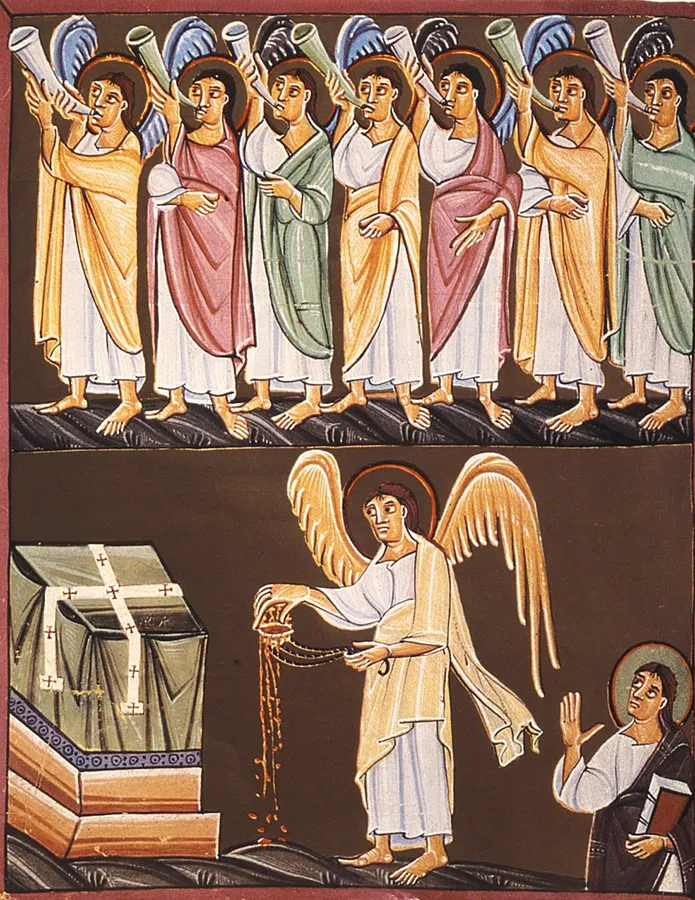
Seven angels with seven trumpets, and the angel with a censer, from the Bamberg Apocalypse, c.1020 C.E.

Then, when the Lamb opened the seventh seal, there was silence in heaven for about half an hour.

Then I saw the seven angels who stand before God, and seven trumpets were given to them. Another angel came and stood at the altar, and he held a gold bowl for burning incense. He was given a large amount of incense, in order to offer it on behalf of the prayers of all the saints on the gold altar in front of the throne. 

The smoke of the incense offered for the prayers of the saints rose up before God from the angel’s hand. Then the angel took the incense container and filled it with fire from the altar. He threw it down to the earth, and there were thunder, voices, lightning, and an earthquake. (Common English Bible)

When I was kid, growing up on a Midwest American farm, I remember times when severe weather was coming. I knew it was going to be bad whenever everything became still and there was complete silence: No wind, no birds singing, no insects chirping, nothing moving whatsoever. It was the eerie silence which precedes something big coming.

That is the way it will be in heaven when the seventh seal is opened. The silence is so quiet that you know a lot of noise and movement are about to happen. It’s not serene silence; it’s scary silent.

With the opening of the seventh seal, a climactic moment is reached. The silence is not only an anticipation of the coming drama, but is also a sign of reverence and awe.

The seventh seal initiates a series of woes: The seven trumpets. But before the trumpets begin, an angel appears. Standing before a heavenly altar, the angel mixes incense along with prayers from the people, then offers them on the altar.

These prayers of the people are for justice, and a longing for the kingdom to come, and God’s will to be done, on earth, as it is always done in heaven.

The imagery relates to us that God hears the prayers, and will act, according to the divine character and will.

The angel takes fire from the altar and hurls it down to earth, causing thunder and lightning, and an earthquake. In other words, the prayers are being answered; they are having an effect. Judgment on the earth begins with the blowing of the seven trumpets.

As we may expect, the incredible silence gives way to an equally incredible noise of weather and the earth moving. And the angel, serving as a quiet and contemplative high priest, now moves to becoming a judge upon the earth.

It turns out that mercy and judgment are not two contrasting concepts and actions; they are two sides of the very same coin. The altar of mercy becomes the source of judgment.

Whenever there is an injustice, we want (and expect) to have that act acknowledged and taken care of by a proper authority. To have a judge simply say that he/she is merciful and will acquit the guilty, does not work in every situation. Mercy only exists because of the presence of guilt and judgment.

God takes care of sin because God loves. An unloving deity would be unconcerned, random, and capricious in handling injustice. But not the God of the Bible. God shows mercy to the righteous, and will judge the wicked.

God’s mercy extends to the point of acquitting the guilty, if God so desires to do so. And everyone needs mercy, because we all have committed injustices in our lives.

Yet, by means of humble contrition and faith, we can mercifully discover gracious amnesty. This is why Jesus came, to take care of the sin issue once for all through the Cross.

We have been made holy by God’s will through the offering of Jesus Christ’s body once for all. (Hebrews 10:10, CEB)

In the time of the Apostle John’s vision, which is the Book of Revelation, Christians were facing persecution and martyrdom. The prayers of the suffering believers rose to heaven:

They cried out with a loud voice, “Holy and true Master, how long will you wait before you pass judgment? How long before you require justice for our blood, which was shed by those who live on earth?” (Revelation 6:10, CEB)

God’s response to the prayers of the saints is to send judgmental fire against the earth by the hand of the angel. In John’s apocalyptic vision, not only are the believers in Christ facing trials and tribulations for their faith, but the unbelieving persecutors who victimize the saints will be punished, as well.

If the persecutors use fiery elements against the believers, God can (and will) turn that fire back on the them. This is similar to the Book of Exodus, in which the plagues that struck and judged the Egyptians were, at the same time, a means of protecting and preserving the Israelites.

The Book of Revelation included in the Christian canon of scripture, not for the purpose of predicting the time or the season in which Jesus Christ will come back to judge the living and the dead. Rather, John’s Apocalypse is meant to encourage the followers of Christ that their suffering will not last forever; and neither will the arrogance of the wicked.

We don’t know when all of this end-of-the-age stuff is going to shake out. Which is why it is so important we learn to persevere through suffering. Because we might have to wait awhile.

Prayer for us then becomes not simply something we do if we have a bit of discretionary time; it becomes vital for us. We discern that we must speak with God. We are compelled to offer our prayers. We feel the great need to cry out and petition God for justice and righteousness.

It seems, if I don’t pray, I won’t make it. Therefore, I must pray. I will pray with all of my heart and soul, till I cannot pray anymore. And then I will pray some more, because I need God.

There is nothing easy about moving through suffering. It’s hard to persevere. It hurts to be the brunt of another’s violent tongue and/or hand. Yet, we do not experience this alone. The divine presence is with us. And that makes all the difference.

Oh God:
Give me strength to live another day;
Let me not turn coward before its difficulties, or fail in its duties;
Let me not lose faith in other people;
Keep me sweet and sound of heart, in spite of ingratitude, treachery, or meanness;
Preserve me from minding little stings, or giving them;
Help me to keep my heart clean, and to live so honestly and fearlessly that no outward failure can dishearten me, or take away the joy of conscious integrity;
Open wide the eyes of my soul that I may see good in all things;
Grant me this day some new vision of your truth;
Inspire me with the spirit of joy and gladness and make me the cup of strength to suffering souls; in the name of the strong Deliverer, our only Lord and Savior, Jesus Christ. Amen.

What Is It You Are Trying To Do? (Mark 10:2-16)

Jesus blesses the children

Some, testing him, asked, “Is it lawful for a man to divorce his wife?” He answered them, “What did Moses command you?” They said, “Moses allowed a man to write a certificate of dismissal and to divorce her.” But Jesus said to them, “Because of your hardness of heart he wrote this commandment for you. But from the beginning of creation, ‘God made them male and female.’ ‘For this reason a man shall leave his father and mother and be joined to his wife, and the two shall become one flesh.’ So they are no longer two but one flesh. Therefore what God has joined together, let no one separate.”

Then in the house the disciples asked him again about this matter. He said to them, “Whoever divorces his wife and marries another commits adultery against her, and if she divorces her husband and marries another, she commits adultery.”

People were bringing children to him in order that he might touch them, and the disciples spoke sternly to them. But when Jesus saw this, he was indignant and said to them, “Let the children come to me; do not stop them, for it is to such as these that the kingdom of God belongs. Truly I tell you, whoever does not receive the kingdom of God as a little child will never enter it.” And he took them up in his arms, laid his hands on them, and blessed them. (New Revised Standard Version)

Trying To Parse the Law?

The topic of divorce has always been a hot button issue throughout human history. And there have continually been diverse views and opinions about it. This is also true of Holy Scripture. A variety of interpretations are offered by many about the Bible’s view of divorce, and Christ’s words concerning it.

Much like today, divorce in the first century was accepted as part of what happens in society, even among Jews, although it was more proliferate in other cultures. Most of the discussions about divorce centered in legal details, with some speaking against it as bad for society.

Among the Jewish religious leaders and experts in the law, it was generally recognized that divorce occurs, with Mosaic legislation proscribing how to carry out divorce (Deuteronomy 24:1-4). Yet, other scripture texts frame the existence of divorce as questionable for God’s people. (e.g. Genesis 2:24; Malachi 2:13-16)

Trying to Test Jesus?

Anyone who doesn’t like another, will often confront them on a hot button issue that has plenty of diverse opinion to it. This is why the Pharisees sought to get Christ’s take on the topic of divorce.

Essentially, Jesus reframed divorce so that it was no longer simply a legal topic, but involves real people. Christ talked about divorce in a way that upheld the dignity of persons, especially women; and lifted up the true sanctity of marriage.

In turning the discussion from a legalities to God’s design for humanity and marriage, Jesus cut to the heart of the matter, to God’s intent, and to human frailty. He focused on relationships, because they were inherent from the beginning.

Yes, divorce is a reality, and it is has its place in society. But no, it’s not supposed to be this way. The very word “divorce” means there is a separation, a breech, a disconnection of relationship. This is why Christ went to another topic: adultery.

Trying To Divorce Women?

Jesus said that a person initiating a divorce in order to marry another person commits adultery. In saying this, he was not offering a legal conversation of details. Rather, Christ was focusing on people; he was concerned for wives and women.

The conversation between Jesus and the Pharisees was a discussion between men, and presupposed a man’s point of view on divorce. Women did not have the ability to initiate divorce in the ancient society.

And Christ seems to have had no stomach for being drawn into abstract legal debates between a bunch of men. Instead, he cared about the people involved in an actual divorce, especially the women.

For all intents and purposes, women (and their sexuality) were the property of men – the father, and then later, the husband. In this social milieu, whenever a husband initiated a break in the relationship, it was important for a woman to have a certified document of divorce. Without that certification, a woman divorcee would be landlocked, unable to do much of anything, as well as be the brunt of societal gossip, slander, or worse.

Since Jesus was talking to the men, the Pharisees, he pointedly looked at them and let them know that, although they might initiate a divorce, it in no way justified their sneaking and creeping around. It didn’t cover their adulterous relationship(s) nor their adulterous hearts.

All this is to say that Christ very much opposed divorce on the grounds of putting a wife away out of a desire for a different spouse. He intended on empowering women. In a divorce situation, because a man was in control of the process, it was then the man who commits adultery against the woman.

Both logically and legally, a woman could never commit adultery because of divorce – only the man. What’s more, adultery is not primarily a violation of the law, but of the woman. Jesus believed it was high time for some accountability with the men.

Even though contemporary Western society is much different than the ancient social structure, Christ’s teaching is still relevant. The need to uphold not just the law, but the rights of women is a must for today, as well.

Unless we can observe Christ’s concern for women’s justice and rights, there will be men who continue to leverage their own gender over and against females and wives. And there will continue to be both husbands and wives who initiate divorce for their own adulterous motives, thus putting their spouse in moral, legal, emotional, and spiritual jeopardy.

Trying To Keep Children Away?

The overarching ethics of Jesus, and the law of God, is to provide justice and righteousness for the most vulnerable among us. And this is why the teaching about divorce is coupled with instruction about children.

In our contemporary society, children have rights and are accorded significant status. That was not true in the ancient world. Children were mostly viewed as potential adults. Until then, kids were to stay quiet unless spoken to, and to obey their parents with absolutely no talk-back.

Christ’s disciples did what any student following their teacher would do; they kept the kids at bay so that Jesus could do his important ministry work. But what the disciples discovered is that the kids were actually part of that important ministry work. As children, they were vulnerable, at the low end of the social scale, and had no personal rights other than being part of a family.

To become like a little child in order to enter the kingdom of God did not mean becoming innocent; it meant becoming humble and dependent, and embracing meekness, gentleness, and lowliness. It meant to become the last and the least among us. Because the last will be first, and the least will become great.

Trying To Get It Right?

It’s important for us to uphold the sanctity of human life, and the spirit of the law. The law is intended to preserve and protect life – and is not to be used to find loopholes or ways to get what you want.

Meeting the needs of all people – whether they be men, women, children, and whether they be rich or poor – is to be everyone’s concern. Why? Because justice and righteousness are at the heart of God’s concern for humanity.

Merciful God, who discerns each heart: We confess our family is most often like strangers to us. So, give to all parents and children the grace to see one another as they truly are, and as you have called them to be. In the name of Jesus Christ, our mediator and advocate, we pray. Amen.

Live with Integrity (Psalm 26)

Vindicate me, O Lord,
    for I have walked in my integrity,
    and I have trusted in the Lord without wavering.
Prove me, O Lord, and try me;
    test my heart and mind.
For your steadfast love is before my eyes,
    and I walk in faithfulness to you.

I do not sit with the worthless,
    nor do I consort with hypocrites;
I hate the company of evildoers
    and will not sit with the wicked.

I wash my hands in innocence
    and go around your altar, O Lord,
singing aloud a song of thanksgiving
    and telling all your wondrous deeds.

O Lord, I love the house in which you dwell
    and the place where your glory abides.
Do not sweep me away with sinners
    nor my life with the bloodthirsty,
those in whose hands are evil devices
    and whose right hands are full of bribes.

But as for me, I walk in my integrity;
    redeem me and be gracious to me.
My foot stands on level ground;
    in the great congregation I will bless the Lord. (New Revised Standard Version)

Those with integrity long for, and pray for, justice and righteousness. They despise evil and desire the community of faith to be full of love.

Today’s psalm, as well as all of the psalms, are solid prayers which are meant to be prayed by any individual person, at any time, in any era. Those desiring the right, the just, and the good, will especially gravitate toward the psalter and prayer.

The faithful seek to live a morally upright life of integrity, peace, and wholeness. Yet, the psalm is also for those who find themselves unfaithful. They can pray and ask God to search their hearts and bring them to innocence. So, no matter who you are, this psalm is for anyone who wants to connect with the Lord

We have the ability to come before God because God encourages it, and makes it possible for us to approach. The Lord isn’t looking for perfection; God wants some honesty and vulnerability, and for us to realize how utterly dependent creatures we are.

The steadfast love of God is everywhere, and the psalmist recognized this. No matter the situation or circumstance, no matter the place or time, God’s love is present. The reason why we can wrap our faith and commitment around God is that God is consistently and constantly loving in everything.

And whenever we discern and know that this world spins on the axis of love, then we have no desire whatsoever to hang out with those who practice wickedness; we want nothing to do with worthless conversations and actions.

When one has been touched by divine love, not only is there a desire to avoid all evil, but there is also a longing to remain in that love, and to have love be the dominant operative force in all things on this earth.

Once we receive love, we want to give love. And having given love, we desire for the entire world to know this love, which is the true ballast and support of the world.

Without love, there is nothing. With love, all things are possible.

The one who loves does not consort with liars or hypocrites, because such persons indulge deception and selfishness, not openness and respect for others. The lover of God and of righteousness is not found in the company of evildoers.

The lovers amongst us are much too busy providing justice and goodness. The haters amongst us just sit around and curmudgeon on about everything that is messed up in this world, and make fun of all the do-gooders who are so enamored with love.

Which group of people would you rather be around? The lovers or the curmudgeons? Would you like to be in the group who acts like they have everything together? Or would you instead like to be in the group who knows how much they are dependent on the force of love, and of the originator of love, the one who is Love incarnate?

I, personally, would rather be in the community of the redeemed, who know they have been rescued by grace and could fall into wickedness if not for God’s sustaining grace. I have no desire to be in community with people who talk one way and live another.

I would like to be in the place characterized by integrity and love, the sort of place described by the Apostle Paul in his letter to the Romans:

Therefore, I urge you, brothers and sisters, in view of God’s mercy, to offer your bodies as a living sacrifice, holy and pleasing to God—this is your true and proper worship. Do not conform to the pattern of this world, but be transformed by the renewing of your mind. Then you will be able to test and approve what God’s will is—his good, pleasing and perfect will.

For by the grace given me I say to every one of you: Do not think of yourself more highly than you ought, but rather think of yourself with sober judgment, in accordance with the faith God has distributed to each of you….

Love must be sincere. Hate what is evil; cling to what is good. Be devoted to one another in love. Honor one another above yourselves. Never be lacking in zeal, but keep your spiritual fervor, serving the Lord. Be joyful in hope, patient in affliction, faithful in prayer. Share with the Lord’s people who are in need. Practice hospitality.

Bless those who persecute you; bless and do not curse. Rejoice with those who rejoice; mourn with those who mourn. Live in harmony with one another. Do not be proud, but be willing to associate with people of low position. Do not be conceited.

Do not repay anyone evil for evil. Be careful to do what is right in the eyes of everyone. If it is possible, as far as it depends on you, live at peace with everyone. (Romans 12:1-3, 9-18, NIV)

The only thing better than blessing the Lord, is blessing the Lord with an entire congregation of redeemed people who possess integrity, righteousness, and sincere love.

The psalmist, along with the Apostle Paul, lets us know that each of us is responsible for our moral and spiritual integrity. We bear the responsibility to give and receive love. Prayer then becomes much easier and desirable whenever we can pray with a longing for God and God’s righteousness. We really can follow God’s ways and serve the common good of all people with some solid integrity.

Our Father in heaven,
Hallowed be Your name.
Your kingdom come.
Your will be done
On earth as it is in heaven.
Give us this day our daily bread.
And forgive us our debts,
As we forgive our debtors.
And do not lead us into temptation,
But deliver us from the evil one.
For Yours is the kingdom and the power and the glory forever. Amen. (Matthew 6:9-13, NKJV)