

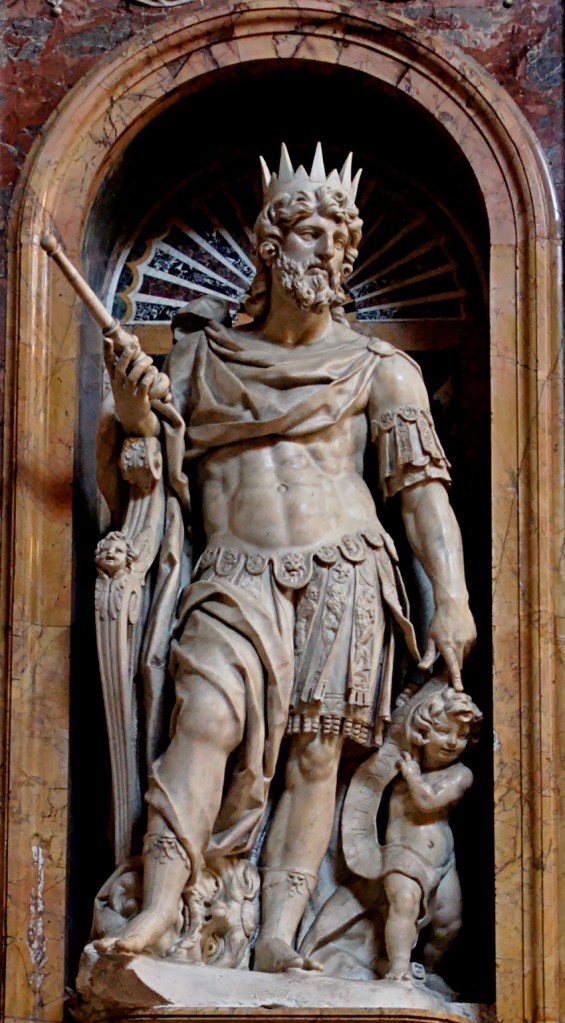
2 Samuel 3:1-12 – Which One Would You Follow?

The war between the house of Saul and the house of David lasted a long time. David grew stronger and stronger, while the house of Saul grew weaker and weaker.

Sons were born to David in Hebron: His firstborn was Amnon the son of Ahinoam of Jezreel; his second, Kileab the son of Abigail the widow of Nabal of Carmel; the third, Absalom the son of Maakah daughter of Talmai king of Geshur; the fourth, Adonijah the son of Haggith; the fifth, Shephatiah the son of Abital; and the sixth, Ithream the son of David’s wife Eglah. These were born to David in Hebron.

During the war between the house of Saul and the house of David, Abner had been strengthening his own position in the house of Saul. Now Saul had had a concubine named Rizpah daughter of Aiah. And Ish-Bosheth said to Abner, “Why did you sleep with my father’s concubine?”

Abner was incredibly angry because of what Ish-Bosheth said. So, he answered, “Am I a dog’s head—on Judah’s side? This very day I am loyal to the house of your father Saul and to his family and friends. I haven’t handed you over to David. Yet now you accuse me of an offense involving this woman! May God deal with Abner, be it ever so severely, if I do not do for David what the Lord promised him on oathand transfer the kingdom from the house of Saul and establish David’s throne over Israel and Judah from Dan to Beersheba.” Ish-Bosheth did not dare to say another word to Abner, because he was afraid of him.

Then Abner sent messengers on his behalf to say to David, “Whose land, is it? Make an agreement with me, and I will help you bring all Israel over to you.” (New International Version)

“Leadership is the capacity and will to rally men and women to a common purpose and the character which inspires confidence.”

World War II British Field Marshall Bernard Montgomery (1887-1976)

Our inner character is a combination of what we do, why we do it, and how we go about it. Personal character is seen in the reactions and responses of life events and situations. And Holy Scripture is concerned and attentive to all our attitudes and actions in the world.

Stories in the Old Testament are largely designed to help us, as readers and listeners, to compare and contrast the mindsets, motivations, and morals of the principal actors in those narratives. We are meant to understand the difference between godly and ungodly people through how the story shakes out.

Three leaders are paraded before us in today’s Old Testament lesson. The story is arranged so that we will take a look at their manner of life. The lesson begs us to implicitly ask: Which of the three characters would you follow?

David

King David was a true leader, having G-d’s calling, inquiring to G-d continually, and using his ruling authority to extend kindness, like G-d does. Because of David’s character, his reign became stronger and stronger. David neither planned to annihilate all of Saul’s heirs as rivals to this throne, nor did he set out to make their lives miserable – despite the fact that most people of the time would actually expect him to do that.

Ish-Bosheth

Whereas David was initially ruling only Judah, Ish-Bosheth was a son of Saul and king of Israel. He was a mere figurehead. Abner, the army’s general, was really calling the political shots in Israel. Ish-Bosheth was too fearful to challenge Abner, and so, never exerted a significant influence. Instructive for us as readers is the absence of this king’s prayers or efforts to do anything helpful or constructive for his people.

Ish-Bosheth’s name essentially means “Master,” a dignified word which is meant to communicate respect. The incongruence between Ish-Bosheth’s ascribed name, and his actual attitudes and lack of action, betrays a double-minded person, divided in decision-making, not knowing quite what to do, so doing nothing of substance which helps anyone.

Contrasting Ish-Bosheth with David, we clearly see that David is no figurehead but the leader of his people. Unlike Ish-Bosheth, David is no washrag and is no one’s puppet but takes charge of situations by inquiring of G-d, then acting.

Confidence comes from knowing the Lord and stepping out in faith, which is precisely what David’s pattern of kingship was like.

“God grant that men of principle shall be our principal men.”

Thomas Jefferson, 3rd President of the United States of America (1743-1826)

Abner

Israel’s general, Abner, was neither like David nor Ish-Bosheth. Although Abner had the qualities of confidence and taking charge, unlike David, he was a self-serving leader.

Abner used his position to gain for himself power and prestige. He was willing to quickly switch his loyalties when it was no longer helpful for him, personally. Although Abner did right by working toward uniting the kingdoms of Israel and Judah (a good thing) he did it for all the wrong reasons (a bad thing).

Compared to David, Abner has only self-interest, not the common interest of all citizens. He acts for what he can personally get out of it – which is just the opposite of David, who has an eye which scans the horizon to do what is best for the common good of all the kingdom’s subjects.

Conclusion

When we read today’s story, the guided narrative wants us to arrive at the conclusion of saying, “I don’t want to become or follow somebody like Ish-Bosheth or Abner. I want to become and follow someone like King David.”

David listened to G-d, prayed to G-d, and acted with justice and kindness because of G-d. There’s likely no better approach to the spiritual life than that.

Grant us, Lord G-d, a vision of our world as your love would make it: a world where the weak are protected, and none go hungry or poor; a world where the benefits of abundant life are shared, and everyone can enjoy them; a world where different races and cultures live in tolerance and mutual respect; a world where peace is built with justice, and justice is guided by love. And give us the inspiration and courage to build it, through Jesus Christ our Lord. Amen.

*Above statue of King David by French artist Nicolas Cordier, c.1610

Psalm 9:9-20 – Assertive Anger and Confident Trust

The poor can run to you
    because you are a fortress
    in times of trouble.
Everyone who honors your name
    can trust you,
    because you are faithful
    to all who depend on you.

You rule from Zion, Lord,
    and we sing about you
    to let the nations know
    everything you have done.
You did not forget
    to punish the guilty
    or listen to the cries
    of those in need.

Please have mercy, Lord!
    My enemies mistreat me.
Keep me from the gates
    that lead to death,
    and I will sing about you
    at the gate to Zion.
I will be happy there
    because you rescued me.

Our Lord, the nations fell
    into their own pits,
    and their feet were caught
    in their own traps.
You showed what you are like,
and you made certain
    that justice is done,
    but evil people are trapped
    by their own evil deeds.
The wicked will go down
    to the world of the dead
    to be with those nations
    that forgot about you.

The poor and the homeless
won’t always be forgotten
    and without hope.

Do something, Lord!
    Don’t let the nations win.
    Make them stand trial
    in your court of law.
Make the nations afraid
and let them all discover
    just how weak they are.
(Contemporary English Version)

Everyone gets angry. Every single person on planet earth knows what anger feels like. And, to me, it makes sense that people get angry. After all, God gets angry. As people created in God’s image, we share God’s sense of justice and injustice.

That’s really what anger is: an emotional response to injustice. Whenever we are wronged or treated unfairly – or observe another person or group of people experiencing injustice – it stirs up our anger.

So, anger, in and of itself, is neither good nor bad. It just is. It’s what we do with our anger that gets dicey. A lot of human anger gets expressed in unhealthy ways by either passively stuffing it down into the soul and ignoring it; aggressively lashing out with verbal or physical violence; or passive-aggressively doing indirect jabs at the object of our anger.

The psalmist, however, takes another way of expressing anger. He is assertive, straightforward, and addressed God with his observations and feelings, as well as affirming that the Lord is the One who administers justice with fairness and equity.

When the poor are overlooked or oppressed by the rich, it is unjust. It creates anger, both human and divine. In their misery and hardship, they can flee to God, who is faithful to care for them and treat them with respect and dignity, as people carrying the divine image, like everyone else.

The nations of the earth are not all attentive to the needy. They don’t all serve their citizens and try to do right by them. Unfortunately, many people throughout the world groan under national leadership which is enamored with power and privilege – and forget those who are powerless, unable to lift themselves by their bootstraps.

Because of this reality, the psalmist petitions God. He asks, even insists, that God step in and act as judge and jury. It is an assertive use of anger that goes to the source of true help, to the Lord, who possesses both the will and the ability to overturn injustice and establish a right use of power.

Holy Scripture is consistent in its insistence on paying attention to those outside the halls of power. The prophets directed their message to issues of justice:

Learn to live right. See that justice is done. Defend widows and orphans and help those in need. (Isaiah 1:17, CEV)

Just look at those lawmakers who write evil laws and make life hard for the people. They are not fair to the poor. They take away the rights of the poor and allow people to steal from widows and orphans. (Isaiah 10:1-2, ERV)

He has told you, human one, what is good and what the Lord requires from you: to do justice, embrace faithful love, and walk humbly with your God. (Micah 6:8, CEB)

Do you know what I want? I want justice—oceans of it. I want fairness—rivers of it. That’s what I want. That’s all I want. (Amos 5:24, MSG)

Doing justice is taking up the cause of the powerless, the oppressed, and the needy among us in society. Because God cares, we care. To ignore the poor is to ignore God. To treat them unfairly is to flip the middle finger at God.

The Lord, thankfully, is a strong fortress for the oppressed and a protective force in times of trouble.

God remembers the prayers of the down-and-out.

Sooner, or later, those who are wicked in their dealings through exploitation of the powerless, will know firsthand, they are puny humans, and that God is immensely big.

Today’s psalm is both an angry petition, as well as an affirmation of faith. May it serve as a model for using our anger assertively, ordering our love rightly, and trusting our God confidently.

God almighty, you have given all peoples one common origin. It is your will they be gathered together as one family in yourself. Fill the hearts of humanity with the fire of your love and with the desire to ensure justice for all. By sharing the good you give us, may we ensure equity for all our brothers and sisters throughout the world. May there be an end to division, strife and war. May there be a dawning of a truly human society built on love and peace, through Jesus Christ, our Lord. Amen.

**Above image: The Kveshi Fortress in the nation of Georgia.

Psalm 53 – Is God Gone?

Bilious and bloated, they gas,
   “God is gone.”
It’s poison gas—
    they foul themselves, they poison
Rivers and skies;
    thistles are their cash crop.
God sticks his head out of heaven.
    He looks around.
He’s looking for someone not stupid—
    one man, even, God-expectant,
    just one God-ready woman.

He comes up empty. A string
    of zeros. Useless, un-shepherded
Sheep, taking turns pretending
    to be Shepherd.
The ninety and nine
    follow the one.

Don’t they know anything,
    all these predators?
Don’t they know
    they can’t get away with this,
Treating people like a fast-food meal
    over which they’re too busy to pray?

Night is coming for them, and nightmare—
    a nightmare they’ll never wake up from.
God will make hash of these squatters,
    send them packing for good.

Is there anyone around to save Israel?
    God turns life around.
Turned-around Jacob skips rope,
    turned-around Israel sings laughter.
(The Message)

In 1888, the German philosopher Friedrich Nietzsche published his book, “The Antichrist.” Nietzsche used the phrase, “God is dead,” to express his idea that the Enlightenment, with its thorough rejection of all things subjective and intuitive, and the embrace of everything objective and observable, had eliminated the possibility of the existence of God.

Nietzsche simply named what a modern progressive society had become: drained of divine mystery. He wrote:

“God is dead. God remains dead. And we have killed him. How shall we comfort ourselves, the murderers of all murderers? What was holiest and mightiest of all that the world has yet owned has bled to death under our knives: Who will wipe this blood off us? What water is there for us to clean ourselves? What festivals of atonement, what sacred games shall we have to invent? Is not the greatness of this deed too great for us? Must we ourselves not become gods simply to appear worthy of it?”

Friedrich Nietzsche

This was the nineteenth century equivalent of making the psalmist’s observation that there is a philosophy extant which states, “There is no God.” He’s gone. And humanity has replaced him with themselves.

Unlike Nietzsche, however, the psalmist takes the perspective not of the human but of God. The Lord looks about for someone wise, someone who truly takes notice to see with spiritual eyes, hear with spiritual ears, discern a spiritual touch, smell the aroma of God, and taste that the Lord is good – rather than relying solely on the five senses.

So, where is God? In the grave? No, he is risen, just as he said.

Just because there seems to be an absence of good in the world, doesn’t mean it isn’t there – or that God is gone.

Any fool can make bold proclamations when they are an epistemology all to themselves.

From God’s perspective, anyone can use their five physical senses. To only use them, and completely ignore other ways of knowing, is, well, plain stupid.

Where is God? Not hanging out with fools, drinking cheap dandelion wine and smoking nasty inexpensive cigars. Rather, the Lord is in the company of the righteous with wise persons who discern God’s presence.

Things are not always what they seem. Violence and oppression in the world are not signaling God is on vacation, doesn’t care, or simply doesn’t exist, at all. We must see beyond or through the world’s crud to a Divine Being who is there, reachable, and very much, cares about the state of humanity.

All our posturing and preening to appear we have it all together is nothing more than a poorly produced television reality show to God. So, if the Lord chooses to change the channel, it doesn’t translate that he isn’t viewing the screen. Only a fool believes no one is watching.

If we ignore God, perhaps we shouldn’t be surprised or upset when divine Skittles don’t come raining down from heaven for us to enjoy.

Instead, we are to attend to the spiritual life. There are divine resources available if we will use them. Though they are abundant and free, we still have to ask and receive them with the humility which comes from realizing we aren’t the center of the universe.

Nietzsche is not exactly a person that many Christians would typically acknowledge, let alone refer to, and, for good reason. And yet, he understood that when God is removed from societal norms, it leaves us with a nihilist worldview (the belief that nothing has any inherent importance, and that life lacks purpose).

Christianity and/or a focus on the spiritual life can be, and is, I believe, an antidote to the despair of meaninglessness. If God is truly the ground of moral reality and gives real shape to human purpose, then we have a way to center ourselves. Yet, if God is ignored to the point of being “dead” then there is nothing substantial for humanity to orient their lives around.

Try as we might to create, as Nietzsche did, an Übermensch (superman) in the form of the radically independent and strong person to fill the enormous spiritual void of God’s death, it is merely a façade covering our weakness and foolishness as creatures.

I suggest we consider the psalmist as a reliable source of knowledge – that God is a force for justice and for good in the world – and that we explore what this means for us in our respective lives, families, communities, as well as in our public discourse and personal philosophy.

Is God gone? Not really. We humans just tend to give him the stiff arm.

Almighty God, you called your church to be one, holy, universal and missional people. By your grace you have given us new life in Jesus Christ, and by your Spirit you have called us to proclaim his name throughout the nations. Awaken in us such a love for you and your world that we may boldly proclaim Jesus Christ by word and deed. May all people everywhere come to know you and Christ’s power to save. Amen.

Psalm 138 – The Lord Will Defend the Humble

I give thanks to you with all my heart, Lord.
    I sing your praise before all other gods.
I bow toward your holy temple
    and thank your name
    for your loyal love and faithfulness
        because you have made your name and word
        greater than everything else.
On the day I cried out, you answered me.
    You encouraged me with inner strength.

Let all the earth’s rulers give thanks to you, Lord,
    when they hear what you say.
Let them sing about the Lord’s ways
    because the Lord’s glory is so great!
Even though the Lord is high,
    he can still see the lowly,
    but God keeps his distance from the arrogant.

Whenever I am in deep trouble,
    you make me live again;
    you send your power against my enemies’ wrath;
    you save me with your strong hand.
The Lord will do all this for my sake.

Your faithful love lasts forever, Lord!
    Don’t let go of what your hands
    have made.
(Common English Bible)

“God opposes everyone
   who is proud,
but is kind to everyone
    who is humble.”

James 4:6, CEV

God Cares

God consistently cares for lowly and humble folk. The Lord continually draws near to them. God bends down to meet them at their level. Conversely, the Lord hangs out on the margins of proud and arrogant people. God stands straight up and looks down from afar on such persons. They will experience divine distance, mostly because their attitudes and actions put the stiff arm toward God.

One of the most frustrating experiences in life is to have someone in power arrogantly misjudge you. Rather than carefully listening and offering gracious attention, the proud already assume they know what’s going on and what is best. So, like a bull about to enter a china shop, or a timebomb ready to explode, human hubris of the heart violates and blows up another’s life based upon misinformation and faulty egotistic assumptions.

God Sees

Yet, God sees. From a lofty place, clearly observing all creaturely activity, the Lord knows what is truly happening. And God is not okay with injustice perpetrated by cocky and pretentious autocrats. Everyone will experience God’s power. It’s just a matter of what type of power one receives.

Saving and encouraging power will sustain and uphold the humble of heart. However, the power of God’s wrath is the lot of puffed up peacocks who only care about getting their way. Their own puny power will be eventually stripped away and given to those who will wield it with grace.

The difference between the proud and the lowly is evidenced by their prayers. Megalomaniacs are concerned for material acquisitions, high positions, and fame. And their prayers reflect those ambitions. The meek, however, pray for increased spiritual strength to withstand trouble; enlarged hearts to hold more of God; and acceptance of whatever the Lord wants, whether it is for personal good or ill.

God Knows

The haughty might do many things which are good. It’s possible for them to achieve greatness through outstanding work and incredible feats. Yet, God knows the real score. Jesus said:

“Not everyone who calls me Lord will enter God’s kingdom. The only people who will enter are those who do what my Father in heaven wants. On that last Day many will call me Lord. They will say, ‘Lord, Lord, by the power of your name we spoke for God. And by your name we forced out demons and did many miracles.’ Then I will tell those people clearly, ‘Get away from me, you people who do wrong. I never knew you.’” (Matthew 7:21-23, ERV)

Self-absorbed people enjoy their own presence and narcissistically believe everyone else should, too. Yet, ordinary people, being attentive to the common good of all persons, rely on the presence and protection of God for everyone and everything.

God Helps

Whereas the vainglorious person trusts in their own ability to achieve accomplishments and hold power so that they can smugly boast about their superiority, on the contrary, the meek are content to labor for the Lord in relative obscurity, to try and use their skills and aptitude for the benefit of their fellow humanity. God holds them tightly and securely, but not so with the egotistical. They will fall because they were never in God’s hand to begin with.

If the humble are weak, that’s okay. Because God is strong. If they are in trouble, no problem. The Lord has their back. They can let go, knowing there is a God who doesn’t. And that is the irony to the spiritual life – that in releasing and relinquishing we gain and acquire. We shall be vindicated by God from the wicked. For the Lord’s steadfast love will have the day.

Most merciful God, we confess that we have sinned against you in thought, word, and deed, by what we have done, and by what we have left undone. We have not loved you with our whole heart; we have not loved our neighbors as ourselves. We are terribly sorry, and we humbly repent. For the sake of your Son, Jesus Christ, have mercy on us and forgive us so that we may delight in your will, and walk in your ways, to the glory of your Name. Amen.