Romans 12:17-21, 13:8-10 – Let Love Be Your Only Debt

Don’t mistreat someone who has mistreated you. But try to earn the respect of others and do your best to live at peace with everyone.

Dear friends, don’t try to get even. Let God take revenge. In the Scriptures the Lord says,

“I am the one to take revenge
    and pay them back.”

The Scriptures also say,

“If your enemies are hungry,
    give them something to eat.
And if they are thirsty,
give them something
    to drink.
This will be the same
as piling burning coals
    on their heads.”

Don’t let evil defeat you but defeat evil with good….

Let love be your only debt! If you love others, you have done all that the Law demands. In the Law there are many commands, such as, “Be faithful in marriage. Do not murder. Do not steal. Do not want what belongs to others.” But all of these are summed up in the command that says, “Love others as much as you love yourself.” No one who loves others will harm them. So, love is all that the Law demands. (Contemporary English Version)

Not everybody is likable. We all have others that drive us crazy on the inside with their annoying habits or ungodly ways of life. 

Sometimes we might experience much more than being irritated. Raging vitriol that results in verbal persecution; becoming the targets of evil intent; and, in some cases, finding ourselves victims of violence done to us or a loved one can stretch our Christian sensibilities to their maximum. It is understandable that in such cases we would be upset, angry, in grief, and desire justice.

As we reflect back on Reformation Day and the great truth that we are justified apart from any work of our own but by grace alone through faith, this helps to give understanding as to why we do not take vengeance into our own hands. 

We are clearly exhorted in today’s New Testament lesson to repay no one evil for evil because vengeance belongs to God alone, not us. 

If justification is a work of God to rescue and redeem sinners from their plight, then wrath is also a work of God. Just as justification is initiated and made possible through Christ by faith, so vengeance belongs to God, as well. Our part in the whole affair is to trust God to take care of judging the world. Judgment is way above our pay grade.

Our responsibility is showing love, even to those whom we consider enemies. If we are to love our neighbors as ourselves, then we will leave plenty of room for God to do what God does best: either show mercy to sinners or execute judgment upon them. It’s all God’s business what happens with humanity. Our business is coming under the lordship of Christ and allowing God’s new creation to work itself out through us. 

We are to work for the kind of justice that provides others with what they need, not what they deserve. The world cannot become a better place if we keep insisting on playing judge, jury, and executioner. Sometimes the best way to show love is to sincerely pray for the person for whom we have such difficulty loving. 

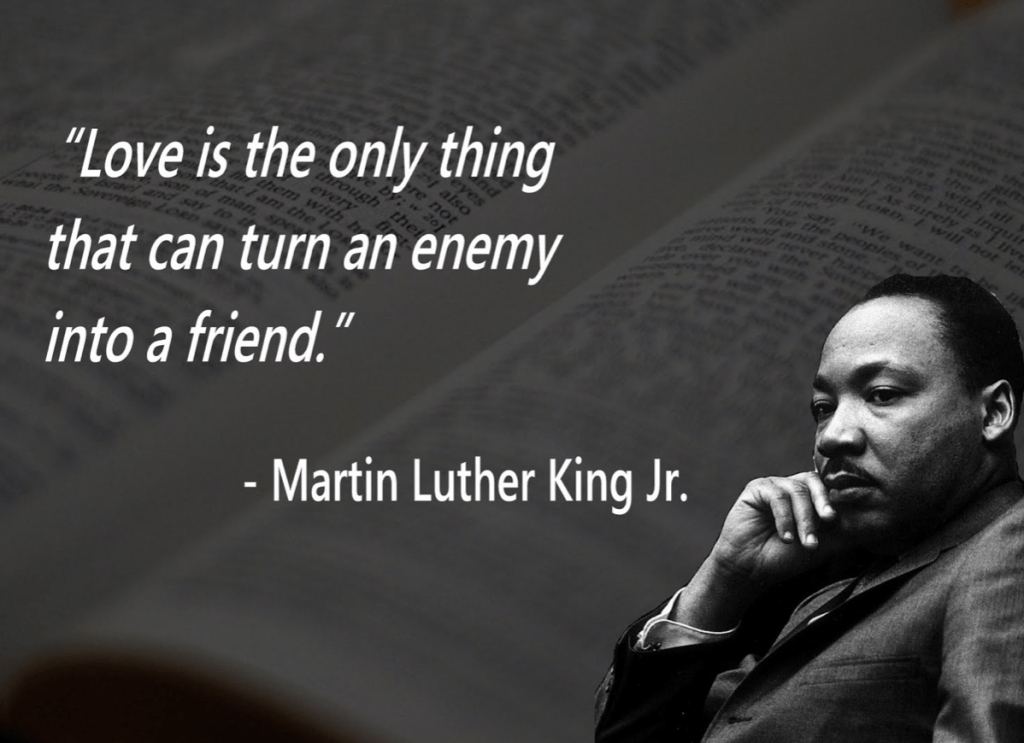
Who do you need to love today? Here is an excerpt from a sermon by Dr. Martin Luther King Jr., delivered at the Dexter Avenue Baptist Church, Montgomery, Alabama, on November 17, 1957:

“Love has within it a redemptive power. And there is a power there that eventually transforms individuals. That’s why Jesus says, ‘Love your enemies.’ Because if you hate your enemies, you have no way to redeem and to transform your enemies. But if you love your enemies, you will discover that at the very root of love is the power of redemption. You just keep loving people and keep loving them, even though they’re mistreating you.

Here’s the person who is a neighbor, and this person is doing something wrong to you and all of that. Just keep being friendly to that person. Keep loving them. Don’t do anything to embarrass them. Just keep loving them, and they can’t stand it too long. Oh, they react in many ways in the beginning. They react with bitterness because they’re mad because you love them like that. They react with guilt feelings, and sometimes they’ll hate you a little more at that transition period, but just keep loving them.

And by the power of your love, they will break down under the load. That’s love, you see. It is redemptive, and this is why Jesus says love. There’s something about love that builds up and is creative. There is something about hate that tears down and is destructive. So, love your enemies.”

Just and merciful God, you are the rightful Judge of all the earth. Help me to trust in you so that I can give room for you to do whatever you want to do in others’ lives. I pray you will grace many people with the repentance that leads to new life in Jesus. Amen.

Luke 10:25-37 – The Parable of the Good Samaritan

Good Samaritan by He Qi

A legal expert stood up to test Jesus. “Teacher,” he said, “what must I do to gain eternal life?”

Jesus replied, “What is written in the Law? How do you interpret it?”

He responded, “You must love the Lord your God with all your heart, with all your being, with all your strength, and with all your mind, and love your neighbor as yourself.”

Jesus said to him, “You have answered correctly. Do this and you will live.”

But the legal expert wanted to prove that he was right, so he said to Jesus, “And who is my neighbor?”

Jesus replied, “A man went down from Jerusalem to Jericho. He encountered thieves, who stripped him naked, beat him up, and left him near death. Now it just so happened that a priest was also going down the same road. When he saw the injured man, he crossed over to the other side of the road and went on his way. Likewise, a Levite came by that spot, saw the injured man, and crossed over to the other side of the road and went on his way. A Samaritan, who was on a journey, came to where the man was. But when he saw him, he was moved with compassion. The Samaritan went to him and bandaged his wounds, tending them with oil and wine. Then he placed the wounded man on his own donkey, took him to an inn, and took care of him. The next day, he took two full days’ worth of wages and gave them to the innkeeper. He said, ‘Take care of him, and when I return, I will pay you back for any additional costs.’ What do you think? Which one of these three was a neighbor to the man who encountered thieves?”

Then the legal expert said, “The one who demonstrated mercy toward him.”

Jesus told him, “Go and do likewise.” (Common English Bible)

In Christianity, no one justifies themselves. The kingdom of God turns on grace, and not with us working more or harder. As we anticipate Reformation Day, Christians remember the famous posting of the 95 Theses by Martin Luther on the Castle Church door in Wittenberg, Germany in 1517. 

Justification by grace through faith, apart from human effort, is the great theological emphasis and legacy of the Reformers. I suppose one would expect to look at the New Testament books of Romans and Galatians when it comes to dealing with justification. However, there might just be a better place to go….

Christ’s parable of the Good Samaritan is a famous and familiar story to many people, even for those outside of the Christian faith tradition. The parable is likely not the place one thinks to go when considering the Reformation. Yet, this parable is just the right place for considering the grand Reformation doctrine of justification.

“Every week I preach justification by faith to my people, because every week they forget it.”

Martin Luther (1483-1546)

The Gospel writer, Luke, gives us insight into the thought process of the person for whom Jesus told the parable to. That man sought to justify himself. 

When we view the parable from the angle of justification, we see the perspective of the wounded and hapless man, the victim of robbers. He was left for dead, and, indeed, in the story we know that he would die apart from help – the kind of help the man could not do for himself. He was completely dependent on someone to rescue him from his plight.

The Samaritan, the Christ figure in the story, comes and shows the man mercy. This grace was free, lacked any sort of favoritism, and was full of sheer kindness. Without the Samaritan’s actions of binding up the man’s wounds and getting him to a safe place, the victim would have died.  

Reformation Day, and every day, is a good day to celebrate the wonderful and glorious reality that Jesus Christ saves people from their terrible plight. 

Christ’s mercy is not dependent on what kind of people we are but is simply based on need. God graciously gives us the gift of faith and the mercy of deliverance. By Christ’s wounds we are healed. 

Take some time today to reflect on this most gracious of biblical truths: We do not need to justify ourselves. As Christians, we already possess justification by grace alone apart from human effort. 

Read the parable of the Good Samaritan carefully and slowly, absorbing it from this angle of the inability to justify ourselves and the incredible mercy of Christ. Let this wonderful truth sink deep in your soul to bring increased awareness, emotional wholeness, and spiritual healing.

Lord God, heavenly Father, you did not spare your only Son, but gave him up for us all to be our Savior, and along with him you have graciously given us all things. We thank you for your precious, saving gospel, and we pray that you would help us to believe in the name of our Savior faithfully and steadfastly, for he alone is our righteousness and wisdom, our comfort and peace, so that we may stand on the day of his appearing, through Jesus Christ, your dear Son, our Lord. Amen. – A Lutheran Collect of Thanksgiving

Psalm 146 – Underdog

Praise the Lord!

Let all that I am praise the Lord.
    I will praise the Lord as long as I live.
    I will sing praises to my God with my dying breath.

Don’t put your confidence in powerful people;
    there is no help for you there.
When they breathe their last, they return to the earth,
    and all their plans die with them.
But joyful are those who have the God of Israelas their helper,
    whose hope is in the Lord their God.
He made heaven and earth,
    the sea, and everything in them.
    He keeps every promise forever.
He gives justice to the oppressed
    and food to the hungry.
The Lord frees the prisoners.
    The Lord opens the eyes of the blind.
The Lord lifts up those who are weighed down.
    The Lord loves the godly.
The Lord protects the foreigners among us.
    He cares for the orphans and widows,
    but he frustrates the plans of the wicked.

The Lord will reign forever.
    He will be your God, O Jerusalem, throughout the generations.

Praise the Lord! (New Living Translation)

I confess to being a classic cartoon connoisseur. Adults told me when I was a kid that I would outgrow watching them. Well, I’m still waiting for that day. 

One of the cartoons I enjoyed (and still do!) watching is “Underdog” (1964-1973). There is something deep within the human psyche that cheers for the underdog. Wally Cox was the perfect voice for the mild-mannered shoe-shine boy to take his underdog super energy pill and fly through the sky to rescue Sweet Polly Purebread.

That “something” inside us which identifies with the underdog is the justice of G-d. 

It’s important to understand that when the term “justice” is used, it isn’t meant primarily in punitive terms, as we might typically think of it. Rather, justice is providing people with what they need to survive, thrive, and flourish in life. Conversely, withholding needs from individuals or groups of people in this world is “injustice.” 

Today’s Psalm lets us know G-d cares about the underdog – the one who lacks basic material and spiritual provisions for living. 

G-d is deeply concerned for those who are powerless, defenseless, and on the margins of society. The psalmist identifies such persons: the hungry; prisoners; the blind; those bowed down; the orphan; and the widow. All these people represent individuals without ability to be movers and shakers in society. In short, they need G-d and deserve justice.

The Lord delights to use divine power in championing the underdog and lifting them up. What’s more, truth be told, it turns out that all of us are underdogs. Everyone needs G-d. 

We are meant to both receive and provide justice without prejudice or discrimination. Every action and decision we make is really G-d’s grace and enablement to do it. Thus, the logical and reasonable response to such a G-d is praise – to declare our hallelujahs to the One who reigns forever and will always see humanity’s great need. 

So, how will you acknowledge and praise G-d today for divine attributes and actions? Let such praise shape your soul and lift your spirit as you intentionally connect with the gracious G-d who gives us what we need so that we can say, “There’s no need to fear. Underdog is here!”

Almighty God, Father of all mercies, we your unworthy servants give you humble thanks for all your goodness and loving-kindness to us and to all whom you have made. We bless you for our creation, preservation, and all the blessings of this life; but above all for your immeasurable love in the redemption of the world by our Lord Jesus Christ; for the means of grace, and for the hope of glory. Amen.

Isaiah 59:9-19 – (Un)Truth in the Public Square

Because of all this, justice is far from us,
    and righteousness beyond our reach.
We expect light, and there is darkness;
    we await a gleam of light, but walk about in gloom.
We grope along the wall like the blind;
    like those without eyes we grope.
We stumble at noonday as if it were twilight,
    and among the strong as if we were dying.
All of us growl like bears,
    and like doves we moan.
We expect justice, but there is none;
    we await salvation, but it is far from us.
Our rebellions are numerous in your presence;
    our sins testify against us.
Our rebellions are with us;
    we’re aware of our guilt:
    defying and denying the Lord,
    turning away from our God,
    planning oppression and revolt,
    muttering lying words conceived in our minds.
Justice is pushed aside;
    righteousness stands far off,
    because truth has stumbled in the public square,
    and honesty can’t enter.
Truth is missing;
    anyone turning from evil is plundered.

The Lord looked and was upset at the absence of justice.
Seeing that there was no one,
    and astonished that no one would intervene,
    God’s arm brought victory,
    upheld by righteousness,
    putting on righteousness as armor
    and a helmet of salvation on his head,
    putting on garments of vengeance,
    and wrapping himself in a cloak of zeal.
God will repay according to their actions:
    wrath to his foes, retribution to enemies,
    retribution to the coastlands,
    so those in the west will fear the Lord’s name,
    and those in the east will fear God’s glory.
It will come like a rushing river
    that the Lord’s wind drives on. (Common English Bible)

It is telling that when the word “politics” is used today, we immediately think of other words like, “polarized” “rancorous” and “corrupt.” The word “statecraft,” that is, the positive use of politics as a vocation in serving the common good of all persons, seems now like some anachronistic concept of the past.

Isaiah the prophet may have spoken over two millennia ago, yet his words are eerily relevant today, when he said, “Truth has stumbled in the public square.”

Politics, today as in Isaiah’s day, has become less about unselfish public servants promoting the welfare of citizens, and more about winning elections and possessing power. 

A party spirit rules the day, where, in the Unites States, Republicans and Democrats are more divided than ever with less and less ability to truly listen to one another in order to advance genuine justice, ethical righteousness, and social peace within both the nation and the world.

We, as citizens of both our local regions and of the world, must avoid getting sucked into the vortex of acrimonious speech and hate-filled rhetoric. 

Christians, especially those who desire to live and love like Jesus, need to be at the forefront of forsaking the hypocrisy of saying one thing and doing another; of envying power in order to satisfy personal agendas; and, of believing that malicious talk is justified if it accomplishes my wants and needs. 

We are not to keep looking for politicians, and everyone else whom we disagree with, to change. Rather, we ourselves are to practice repentance and allow the grace of God to transform and renew us. 

If what we speak in the public square is selfish and deceitful, we have no further to look than within, when it comes to turning from evil. A slow, careful, and serious reading of the prophet Isaiah is quite necessary. If it does not lead to repentance, we only have God’s displeasure to anticipate.

So, instead of continually insisting that others change or move over, let’s focus on us and seek the following:

  • Seek our better angels of humility, tolerance, and patience to guide our public discourse.
  • Open our eyes to see the image of God in others who are different from us and who see the world differently than we do.
  • Embrace civility and basic human respect for all persons, no matter who they are, as our presuppositions to all conversations.
  • Develop good listening skills so that we aren’t misinterpreting and misrepresenting another’s viewpoint.
  • Be willing, within our own communities of faith, to participate and worship together as the one people of God, without assigning other identities to each other which are not helpful.
  • Enlarge our hearts so that we are big enough people to hold the differing perspectives and politics of others without demonizing them.
  • Default to grace when we aren’t sure what to do say or do.

The Lord will not contend forever with injustice and unrighteousness in the world’s politics, including the extremely local politics of church, family, and neighborhood. Divine intervention cuts both ways, bringing deliverance and freedom, as well as judgment and retribution.

Let us, then, be found to be truthful and honest in all our words and ways; encouraging and helpful in all our public service; and seeking the peace of everyone in our own relational orbits.

Great God of truth and justice, you have every right to judge the world. Yet, instead of destroying the earth, you sent your Son to redeem lost humanity to yourself. May I, along with every creature you have made, come to our senses and speak truth with grace and act with integrity so that there is again righteousness throughout the land. Amen.