Seeking God in Hard Times (Psalm 9:9-20)

By Bible Art

The Lord is a safe place for the oppressed—
    a safe place in difficult times.
Those who know your name trust you
    because you have not abandoned
    any who seek you, Lord.

Sing praises to the Lord, who lives in Zion!
    Proclaim his mighty acts among all people!
Because the one who avenges bloodshed
    remembers those who suffer;
    the Lord hasn’t forgotten their cries for help.

Have mercy on me, Lord!
    Just look how I suffer
    because of those who hate me.
But you are the one who brings me back
    from the very gates of death
        so I can declare all your praises,
        so I can rejoice in your salvation
        in the gates of Daughter Zion.

The nations have fallen
    into the hole they themselves made!
    Their feet are caught
        in the very net they themselves hid!
The Lord is famous for the justice he has done;
    it’s his own doing that the wicked are trapped.

Let the wicked go straight to the grave,
    the same for every nation that forgets God.

Because the poor won’t be forgotten forever,
    the hope of those who suffer won’t be lost for all time.

Get up, Lord! Don’t let people prevail!
    Let the nations be judged before you.
Strike them with fear, Lord.
    Let the nations know they are only human. (Common English Bible)

I firmly believe that there is hopeful comfort in the Lord – that when people go through awful things, God is there to be a safe place for them.

I also believe that, in the end, good triumphs and evil perishes. That’s because I am convinced that the Lord is an equitable judge; God hears the cries of defenseless righteous victims and acts on behalf of the oppressed without prejudice or favoritism.

Yet, that does not mean God’s people will always be inoculated from trouble, hardship, and adversity. What it does mean is that the Lord is with us, and that God loves us.

Everyone goes through difficult times. Some folks endure horrible trauma. And those experiences can dog us and torment us, even long after the event. Even in good times, we might sometimes become anxious or frantic without any real threat in front of us.

We may want to praise God with genuineness and sincerity. However, we might not yet feel vindicated or released. And there still may be some unjust suffering going on. We long to declare the goodness of God, but we also want to do so with a testimony of deliverance and healing.

That is precisely how the psalmist felt. He knows the wicked won’t endure, but he also wants to give praise to the Lord for seeing them sink in the sinister pit they’ve dug for others.

God is a righteous judge. And there are times when the Lord brings judgment upon evil by letting the wicked self-destruct with their own words and behavior. In other words, God at times engages in direct judgment, and other times lets the moral gravity of the earth crush them in their duplicitous crimes.

Whenever circumstances are hard, it’s easy to feel forgotten, as if no one sees or hears our suffering; they don’t realize the depth of our hurt by a wicked person. It’s appropriate, as the psalmist did, to cry out and plead with God to rise up on behalf of the weak and powerless; and to call for an end of the mindless and godless insanity of arrogant people.

It is equally hard to observe others we care about experience oppression. We cry out to the Lord on their behalf, that they will no longer have to endure such injustice. We want our loved ones to thrive and enjoy life and thrive – not to be crushed under an unjust burden from selfish people who only care about themselves.

We boldly ask God to knock them off the evil hill they’ve built for themselves – to blot them out because of their continual oppression of the righteous. The wicked think no one can touch them atop their proud strong perch. They believe they’re above accountability and can get away with anything. That makes us angry!

Whenever we are wronged or treated unfairly – or observe another person or group of people experiencing injustice – it stirs up our anger.

Anger, in and of itself, is neither good nor bad. It just is. It’s what we do with our anger that gets dicey. A lot of human anger gets expressed in unhealthy ways by either passively stuffing it and ignoring it; aggressively lashing out with verbal and/or physical violence; or passive-aggressively doing indirect jabs at the object of our anger.

The psalmist, however, is assertive with his anger. He offered straightforward observations with definite feelings to God. He also affirmed that the Lord is the One who administers justice with fairness and equity.

There are times when only God can bring an evil system, institution, organization, government, nation, group of people, or individual to heel.

When the poor are overlooked or oppressed by the rich, it’s unjust. It creates anger, both human and divine. In their misery and hardship, the needy can flee to God, who is faithful to care for them and treat them with respect and dignity, as people carrying the divine image.

The nations of the earth are not all attentive to the needy. They don’t all serve their citizens and try to do right by them. Unfortunately, many people throughout the world groan under national leadership which is enamored with power and privilege – and forget those who are powerless, unable to lift themselves by their bootstraps.

In the teeth of such a reality, the psalmist petitioned God. He asked, even insisted, that God step in and act as judge and jury. It was an assertive use of anger that went to the source of true help, to the Lord, who possesses both the will and the ability to overturn injustice and establish a right use of power.

Do you know what I want? I want justice—oceans of it. I want fairness—rivers of it. That’s what I want. That’s all I want.

Amos 5:24, MSG

The Lord, thankfully, is a strong fortress for the oppressed and a protective force in times of trouble.

God remembers the prayers of the down-and-out.

Sooner, or later, those who are wicked in their dealings through exploitation of the powerless, will know firsthand that they are puny humans, and that God is immensely big.

God almighty, you have given all peoples one common origin. It is your will they be gathered together as one family in yourself. Fill the hearts of humanity with the fire of your love and with the desire to ensure justice for all.

By sharing the good you give us, may we ensure equity for all our brothers and sisters throughout the world. May there be an end to division, strife and war. May there be a dawning of a truly human society built on love and peace, through Jesus Christ, our Lord. Amen.

A Time of Woe (Isaiah 5:15-24)

The Prophet Isaiah, by Raphael, 1512

So people will be brought low
    and everyone humbled,
    the eyes of the arrogant humbled.
But the Lord Almighty will be exalted by his justice,
    and the holy God will be proved holy by his righteous acts.
Then sheep will graze as in their own pasture;
    lambs will feed among the ruins of the rich.

Woe to those who draw sin along with cords of deceit,
    and wickedness as with cart ropes,
to those who say, “Let God hurry;
    let him hasten his work
    so we may see it.
The plan of the Holy One of Israel—
    let it approach, let it come into view,
    so we may know it.”

Woe to those who call evil good
    and good evil,
who put darkness for light
    and light for darkness,
who put bitter for sweet
    and sweet for bitter.

Woe to those who are wise in their own eyes
    and clever in their own sight.

Woe to those who are heroes at drinking wine
    and champions at mixing drinks,
who acquit the guilty for a bribe,
    but deny justice to the innocent.
Therefore, as tongues of fire lick up straw
    and as dry grass sinks down in the flames,
so their roots will decay
    and their flowers blow away like dust;
for they have rejected the law of the Lord Almighty
    and spurned the word of the Holy One of Israel. (New International Version)

I’m willing to bet that you, like me, have had to contend with some rather annoying and obnoxious people from time to time in your life.

It’s the person whose head is so big, they can barely walk in and out of a room. And when they talk, it’s usually about themselves, the great things they’ve done, and what they think – not framed as opinions but as the truth.

Since this sort of person rarely listens to anyone, they have no clue about the real needs of people in front of them. Their self-inflated importance is to the degree that they don’t ask and are not curious; yet they demand of others. They see no problem with double-standards. It’s okay for them to bribe, even steal from another. But if you cross the self-important person, look out, because they’ll hunt you down like an animal.

Yes, such people exist. And there are typically some deep psychological reasons why they are so arrogant and difficult to be around. Yet the best thing to know about them is that the true Sovereign of the universe, God, is the rightful judge who will handle them.

If you see a path of destruction on the ground, you know a tornado has touched down and done its damage. And if you observe a bunch of people devastated and demoralized, you know that the haughty and self-important person has been through and laid waste to people’s lives.

The Lord almighty is not okay with such people moving about and hurting others with impunity; the wicked will have to contend with the One who knows what’s going on.

God looks and sees – and pronounces appropriate woes (curses) upon those who feign righteousness and holiness, yet in reality do anything but.

You can easily tell what God abhors by what sorts of behavior receives a disapproving woe upon it. God condemns self-indulgence and self-absorption. This shows itself in how one drinks and does business. The sheer accumulation of land, resources, and strong drink – without any sort of regard to one’s neighbor – is a foolish use of wealth.

The self-absorbed and self-important person becomes desensitized to the needs of others. They also become insensitive to God’s concerns and workings in the world. To disregard the poor and needy is to disregard God. Such injustice, resulting from only caring about oneself, is why the Lord levels divine woes upon them.

Actions and inactions both have consequences. Acting selfishly through wanton accumulation is an equal inaction against the community. As a result of so much economic disparity and carelessness in society, God displaces and deports the ones who arrogantly and smugly believed they are secure.

There is accountability in this world, even though it may not sometimes seem like it. There are ethical requirements and moral imperatives. The social laws contained in the covenant code between God and Israel were expected to be honored. So, when they were continually and habitually ignored, the Lord held the people accountable.

The selfishly proud and arrogant, who acquire all they can and become masters of small worlds, will eventually face ruin by means of divine judgment. It’s as if persons had so loaded their backpacks with sin, that it became heavy to the point of self-crushing.

Divine intervention is either a very good thing, or a very bad thing, depending upon who you are. People are expected to be self-aware enough to know the difference between right and wrong, bad and good, just and unjust. To not know this is to be self-addicted and unable to make proper discernments and decisions.

If you are reading or listening to this, you are likely a person who is concerned enough to care for others and is not lost in yourself. Yet, you likely have to contend with a few persons who are only in this life for themselves. So, watch out and do your best to avoid people who do the following:

  • Manipulate through deceptive language. There are some people in positions of authority or power who intentionally obscure, cover up, and confuse things. If you never know how things stand and are doing, then beware.
  • Independent without accountability. There is no interdependent relationships, and only obedience when it suits them. The constant caginess, and lack of vulnerability, is a warning. If you feel like you’re being micro-managed without much ability to ask specific questions and get straight answers, then look out.
  • Distort how things really are. I’m talking about gaslighting. Gaslighting is the attempt by another to accept the gaslighter’s view of reality as your own. And in the gaslighter’s quest, it seems to you as if there is continually chaos and you are off kilter. If you question it to them, then you will most likely be accused of having a problem. It’s not you. So, skedaddle the first chance you get.

The bottom line of it all is that God is rejected and there are people reneging on their commitments to the Lord. You need not be such a person, and you don’t need to live in such a way that another is in complete control of your life – other than God.

Take note of what the Lord dislikes and despises, and keep away from persons who set up themselves as being akin to God.

Grant us, Lord God, a vision of your world as your love would have it:
a world where the weak are protected, and none go hungry or poor;
a world where the riches of creation are shared, and everyone can enjoy them;
a world where different races and cultures live in harmony and mutual respect;
a world where peace is built with justice, and justice is guided by love.
Give us the inspiration and courage to build it, through Jesus Christ our Lord. Amen.

Learn To Do Right (Isaiah 1:1-4, 16-20)

Statue of Isaiah the Prophet, by Salvatore Revelli (1816-1859), Rome, Italy

The vision concerning Judah and Jerusalem that Isaiah son of Amoz saw during the reigns of Uzziah, Jotham, Ahaz and Hezekiah, kings of Judah.

Hear me, you heavens! Listen, earth!
    For the Lord has spoken:
“I reared children and brought them up,
    but they have rebelled against me.
The ox knows its master,
    the donkey its owner’s manger,
but Israel does not know,
    my people do not understand.”

Woe to the sinful nation,
    a people whose guilt is great,
a brood of evildoers,
    children given to corruption!
They have forsaken the Lord;
    they have spurned the Holy One of Israel
    and turned their backs on him…

Wash and make yourselves clean.
    Take your evil deeds out of my sight;
    stop doing wrong.
Learn to do right; seek justice.
    Defend the oppressed.
Take up the cause of the fatherless;
    plead the case of the widow.

“Come now, let us settle the matter,”
    says the Lord.
“Though your sins are like scarlet,
    they shall be as white as snow;
though they are red as crimson,
    they shall be like wool.
If you are willing and obedient,
    you will eat the good things of the land;
but if you resist and rebel,
    you will be devoured by the sword.”
For the mouth of the Lord has spoken. (New International Version)

Whenever the prophet has a vision, everyone better perk up and take notice.

After the northern Jewish kingdom of Israel fell to the Assyrians in 722 B.C.E., they lost their national identity. The southern Jewish kingdom of Judah, and its capitol Jerusalem, continued to exist for nearly a century and a half – even though they were vassals of either the Assyrians or the Babylonians.

Yet, Judah still functioned as its own nation in a semi-independent state. It was during this time that the prophet Isaiah had his vision, under the kingship of those descended from King David.

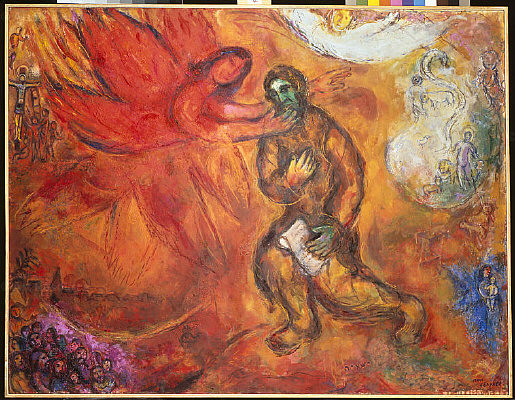
The Prophet Isaiah, by Marc Chagall,1968

The initial section of Isaiah’s prophecy is a series of oracles that establish the relationship between God and the nation of Judah, especially Jerusalem. The gist of God’s message is that the people are guilty of lots of sins.

However, the Lord left a gracious opening for them; their fate was not yet sealed. The nation could repent of their sins and experience a future restoration. God wanted to bring a resolution, and not have the people keep going in their unhealthy ways.

Throughout Isaiah’s vision, God is presented as a Father, with the children being Israel (both northern and southern kingdoms). And Father God has a complaint against them. The people’s principal sins were rebellion and ignorance. They spurned God’s authority, and did not accept their family intimacy with God.

Thus, the Lord is quite disappointed with the people. Heavenly witnesses are called to hear the charges of wrongdoing. The troubles of the nation were to be interpreted as warnings and disciplines, meant to lead them to stop and do right. Yet it seems that the warnings go unheeded by the people. It appears that God’s efforts to woo the people back are in vain.

Although the people’s continued sacrificial worship is merely done as a mere perfunctory act, and without true hearts of devotion for what is just and right, God offered them a chance to make things right, so that they could do justice and embrace righteousness.

God made it clear what it would take to repent: learn to do good; seek justice; recuse the oppressed; defend the orphan; plead for the widow. God even issued an invitation for a divine/human dialogue to happen.

Grace and cleansing from sin are possible, that is, if the people are willing and obedient, instead of remaining rebellious and refusing to do what is right, just, and good.

The nation was at a crossroads and had to make a decision. Would they choose wisely or foolishly?

Decision-making is critical. Some choices are harder than others. Yet the ability to decide is a God-given gift and ability.

Making decisions is fraught with consequences; we may try to anticipate or ignore what might happen with a particular choice. And how we go about decision-making is important. Who do we listen to? What information do we need? How will this choice shake out in the end?

Intentions are not choices, but are simply a mental resolve to do or not do something, at some point. And to not make a decision is to have already made a decision to either procrastinate or not do anything at all.

There are also decisions of duty. This may or may not be admirable. There is also the choice of attitude and energy given to the decision – because a choice of doing one’s duty can be done with joy or grumpiness, excitement or bitterness, with a bright disposition or a flat sullen affect.

It’s not really hard to guess or assess the choices of the people in Judah and Jerusalem in Isaiah’s day. They were doing an outward duty of temple worship, but without any heart to it.

Many of the people looked upon their duty as a sort of magical talisman that would ward off any trouble or army invasion. With that kind of approach, the people looked upon the rest of their time as their own, as discretionary, as the choice to do whatever they wanted to do.

If their business practices were dubious and not quite right, then big deal. After all, they give their money at the temple.

If the leaders played favorites and overlooked the needy person among them, then so what? The poor and oppressed can work harder, right?

And if orphans and widows – who were the most vulnerable persons in society – were not completely cared for, then that’s sad, but too bad for them.

I can picture an ancient city council saying something like, “We have a lot on our plate, dealing with foreign powers, the economy, and political issues. Those needy persons need to get a clue. It’s their own fault for hanging around and not leaving the city for greener pastures. Not our problem.”

Oh, but it very much was their problem. It was everyone’s problem, and each person’s responsibility, to ensure that God’s justice, goodness, and righteousness was infused throughout the entire city and nation.

Hence, the reason for the book of Isaiah. Tackle the moral and ethical problems head on before it’s too late and the gravity of judgment presses everyone out of the land.

What’s needed is a willing heart inclined to walk into divine obedience, without any talkback, and without any negotiations or deals.

God is merciful, and is willing to talk it out. But justice must be done. Needs must be met. People must be cared for. The Lord’s will must be done, here on earth, as it is always done in heaven. Is this what you are about, or not? Will you learn to do right?

Most merciful God, shine the light of your gracious love upon my cold hard heart. Enlighten my mind and dispel the darkness; speak the truth and help me obey; and have pity upon me. Forgive me yet again of my offenses, transgressions, and guilty acts. Grant me the grace to serve you with faithfulness and care for your people with love and purity, today and always. Amen.

The Issue of Holy War (Deuteronomy 7:1-11)

Joshua’s military campaign against the five Amorite kings, by Gilliam van der Gouwen, 1728

When the Lord your God brings you into the land you are entering to possess and drives out before you many nations—the Hittites, Girgashites, Amorites, Canaanites, Perizzites, Hivites and Jebusites, seven nations larger and stronger than you—and when the Lord your God has delivered them over to you and you have defeated them, then you must destroy them totally. 

Make no treaty with them, and show them no mercy. Do not intermarry with them. Do not give your daughters to their sons or take their daughters for your sons, for they will turn your children away from following me to serve other gods, and the Lord’s anger will burn against you and will quickly destroy you. 

This is what you are to do to them: Break down their altars, smash their sacred stones, cut down their Asherah poles and burn their idols in the fire. For you are a people holy to the Lord your God. The Lord your God has chosen you out of all the peoples on the face of the earth to be his people, his treasured possession.

The Lord did not set his affection on you and choose you because you were more numerous than other peoples, for you were the fewest of all peoples. But it was because the Lord loved you and kept the oath he swore to your ancestors that he brought you out with a mighty hand and redeemed you from the land of slavery, from the power of Pharaoh king of Egypt. 

Know therefore that the Lord your God is God; he is the faithful God, keeping his covenant of love to a thousand generations of those who love him and keep his commandments. But

those who hate him he will repay to their face by destruction;
    he will not be slow to repay to their face those who hate him.

Therefore, take care to follow the commands, decrees and laws I give you today. (New International  Version)

You may likely identify today’s Scripture as a difficult passage in the Bible. And rightly so. It doesn’t quite square with many people’s concept of a gracious and loving God. Yet, here it is. So, what do we do with this supposed loving God, commanding the new nation of Israel to completely wipe out the Canaanites?

Here are a couple of approaches I believe are completely unhelpful as we consider the text in front of us: 1) Ignore this text and relegate it as some antiquated piece of ancient literature which has nothing to do with us today; or 2) Reinterpret the text so that the killing doesn’t seem so bad, e.g. it’s not murder but a just war that was necessary to do.

However we choose to approach this text of Scripture, there’s no getting around the reality that it is talking about God commanding the Israelites to engage in a holy war of killing Canaanites – even though it was God who commanded, “Thou shalt not kill.” (Exodus 20:13, KJV)

Indeed, let’s face the reality that this is a moral and ethical conundrum for us. Let’s neither ignore it, nor do some interpretive gymnastics to make it say something it isn’t saying. In practical and objective terms, this is about God giving the Promised Land to the Israelites, of occupying and settling the land without any sort of residual contamination from the Canaanite way of life.

The taking of the land involved the exclusive worship of Yahweh. In order for that to effectively happen, the elimination of Canaanite gods needed to occur, according to God. And it was taken to the extreme limit of also eliminating those who worship the other gods.

An explanation is given for the method of holy war: To leave anything Canaanite in the land would end up being a snare to the Israelites because they would be led astray to serve those other gods.

For Israel to make it as a nation, they were to be holy and set apart exclusively for the worship of Yahweh. To have the Canaanites alongside them would be something like leaving a box of donuts on the desk next to you when you’re trying to work and attempting to lose weight.

Gathering, by Yoram Raanan, 2015

Covenant loyalty was highly important to both God and the Israelites. If the people would faithfully follow God’s will, as revealed in God’s Law, they could confidently go into battle against their enemies. Then, the Israelites will know that the Lord is going before them to give them success and victory.

However we try to understand holy war in the Old Testament, this was not really an issue for ancient cultures. Such an approach to taking land and occupying it was almost taken for granted. And in light of the Israelites having just lost an entire generation of people because of disobedience and complaining, they wanted nothing to do with that again – or with being under the slavery of an empire like Egypt.

Yet, here we are, trying to still make sense of the text of Scripture for today. And, it seems to me, every generation of Bible readers will continually grapple with this. There is something, however, that is important to consider: The nature of the ancient pagan worship.

There was a huge difference between the worship of Yahweh and the worship of the seven distinct gods in Canaan such as Molech and Chemosh. The abuse of both women and men in cult prostitution, as well as the practice of child sacrifice, were characteristics of that pagan worship.

Canaanite worship was so offensive to the Lord, that God as the rightful and just Judge, made the judgment to do away with them – not because Israel was so holy, but because Canaan was that immoral. In those circumstances of immoral and unethical ways of worship and life, the danger of Israel becoming morally and religiously corrupt was particularly acute.

So, this is why the Lord demanded that the Canaanite implements of worship be completely destroyed. And this situation was deemed of such high risk, that God commanded everything of the Canaanites – including the Canaanites themselves – be done away with. It was a war not just against people, but against their gods.

None of this necessarily makes a holy war justifiable from a contemporary perspective; but it does bring a needed context and understanding as to the extreme nature of ensuring the Canaanites were snuffed out altogether.

All of us are influenced by others. Bad relationships corrupt good character. No individual, group of people, or even an entire nation, can keep itself on a right, just, and good path if they are continually around others who harm people either verbally and/or physically.

It behooves us to be vigilant as to our relationships and to who we choose to listen to. One of the most significant issues for people today, in my opinion, is how we hear, and who we listen to. The poor choices that so many persons make as to the sort of people and ideas they hear every day significantly impacts our culture and society.

It is my ardent desire to be an agent of healthy religion, sound ethics, personal morality, cultural good, and societal justice. I neither need to be an obnoxious jerk in doing so, nor need to go on a holy war – namely because only God can call for such a thing. And if any person (especially a politician or a pastor) tries to tell you or me that it’s okay to destroy others and harm them, then that person is not speaking from a place of understanding or rationality.

In the end, we can choose to listen or not listen to whomever; yet we will eventually have to listen to the greatest force which exists in the universe.

Almighty God, the Sovereign of the universe who dispenses both judgment and grace: Deliver us from any sort of coldness and hardness of heart, or any kind of unhealthy and deluded thinking, so that we may have thoughts of steadfast love and affections of that which is just and true. Amen.