
Learn To Do Right (Isaiah 1:1-4, 16-20)

Statue of Isaiah the Prophet, by Salvatore Revelli (1816-1859), Rome, Italy

The vision concerning Judah and Jerusalem that Isaiah son of Amoz saw during the reigns of Uzziah, Jotham, Ahaz and Hezekiah, kings of Judah.

Hear me, you heavens! Listen, earth!
    For the Lord has spoken:
“I reared children and brought them up,
    but they have rebelled against me.
The ox knows its master,
    the donkey its owner’s manger,
but Israel does not know,
    my people do not understand.”

Woe to the sinful nation,
    a people whose guilt is great,
a brood of evildoers,
    children given to corruption!
They have forsaken the Lord;
    they have spurned the Holy One of Israel
    and turned their backs on him…

Wash and make yourselves clean.
    Take your evil deeds out of my sight;
    stop doing wrong.
Learn to do right; seek justice.
    Defend the oppressed.
Take up the cause of the fatherless;
    plead the case of the widow.

“Come now, let us settle the matter,”
    says the Lord.
“Though your sins are like scarlet,
    they shall be as white as snow;
though they are red as crimson,
    they shall be like wool.
If you are willing and obedient,
    you will eat the good things of the land;
but if you resist and rebel,
    you will be devoured by the sword.”
For the mouth of the Lord has spoken. (New International Version)

Whenever the prophet has a vision, everyone better perk up and take notice.

After the northern Jewish kingdom of Israel fell to the Assyrians in 722 B.C.E., they lost their national identity. The southern Jewish kingdom of Judah, and its capitol Jerusalem, continued to exist for nearly a century and a half – even though they were vassals of either the Assyrians or the Babylonians.

Yet, Judah still functioned as its own nation in a semi-independent state. It was during this time that the prophet Isaiah had his vision, under the kingship of those descended from King David.
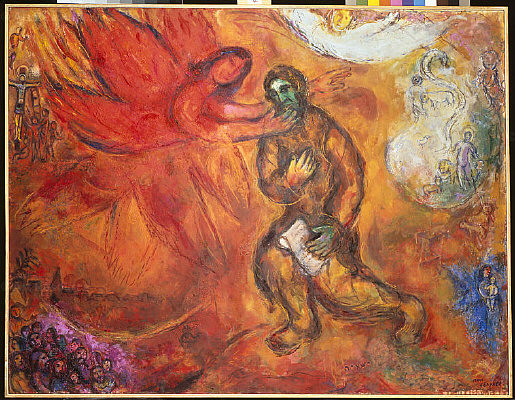
The Prophet Isaiah, by Marc Chagall,1968

The initial section of Isaiah’s prophecy is a series of oracles that establish the relationship between God and the nation of Judah, especially Jerusalem. The gist of God’s message is that the people are guilty of lots of sins.

However, the Lord left a gracious opening for them; their fate was not yet sealed. The nation could repent of their sins and experience a future restoration. God wanted to bring a resolution, and not have the people keep going in their unhealthy ways.

Throughout Isaiah’s vision, God is presented as a Father, with the children being Israel (both northern and southern kingdoms). And Father God has a complaint against them. The people’s principal sins were rebellion and ignorance. They spurned God’s authority, and did not accept their family intimacy with God.

Thus, the Lord is quite disappointed with the people. Heavenly witnesses are called to hear the charges of wrongdoing. The troubles of the nation were to be interpreted as warnings and disciplines, meant to lead them to stop and do right. Yet it seems that the warnings go unheeded by the people. It appears that God’s efforts to woo the people back are in vain.

Although the people’s continued sacrificial worship is merely done as a mere perfunctory act, and without true hearts of devotion for what is just and right, God offered them a chance to make things right, so that they could do justice and embrace righteousness.

God made it clear what it would take to repent: learn to do good; seek justice; recuse the oppressed; defend the orphan; plead for the widow. God even issued an invitation for a divine/human dialogue to happen.

Grace and cleansing from sin are possible, that is, if the people are willing and obedient, instead of remaining rebellious and refusing to do what is right, just, and good.

The nation was at a crossroads and had to make a decision. Would they choose wisely or foolishly?

Decision-making is critical. Some choices are harder than others. Yet the ability to decide is a God-given gift and ability.

Making decisions is fraught with consequences; we may try to anticipate or ignore what might happen with a particular choice. And how we go about decision-making is important. Who do we listen to? What information do we need? How will this choice shake out in the end?

Intentions are not choices, but are simply a mental resolve to do or not do something, at some point. And to not make a decision is to have already made a decision to either procrastinate or not do anything at all.

There are also decisions of duty. This may or may not be admirable. There is also the choice of attitude and energy given to the decision – because a choice of doing one’s duty can be done with joy or grumpiness, excitement or bitterness, with a bright disposition or a flat sullen affect.

It’s not really hard to guess or assess the choices of the people in Judah and Jerusalem in Isaiah’s day. They were doing an outward duty of temple worship, but without any heart to it.

Many of the people looked upon their duty as a sort of magical talisman that would ward off any trouble or army invasion. With that kind of approach, the people looked upon the rest of their time as their own, as discretionary, as the choice to do whatever they wanted to do.

If their business practices were dubious and not quite right, then big deal. After all, they give their money at the temple.

If the leaders played favorites and overlooked the needy person among them, then so what? The poor and oppressed can work harder, right?

And if orphans and widows – who were the most vulnerable persons in society – were not completely cared for, then that’s sad, but too bad for them.

I can picture an ancient city council saying something like, “We have a lot on our plate, dealing with foreign powers, the economy, and political issues. Those needy persons need to get a clue. It’s their own fault for hanging around and not leaving the city for greener pastures. Not our problem.”

Oh, but it very much was their problem. It was everyone’s problem, and each person’s responsibility, to ensure that God’s justice, goodness, and righteousness was infused throughout the entire city and nation.

Hence, the reason for the book of Isaiah. Tackle the moral and ethical problems head on before it’s too late and the gravity of judgment presses everyone out of the land.

What’s needed is a willing heart inclined to walk into divine obedience, without any talkback, and without any negotiations or deals.

God is merciful, and is willing to talk it out. But justice must be done. Needs must be met. People must be cared for. The Lord’s will must be done, here on earth, as it is always done in heaven. Is this what you are about, or not? Will you learn to do right?

Most merciful God, shine the light of your gracious love upon my cold hard heart. Enlighten my mind and dispel the darkness; speak the truth and help me obey; and have pity upon me. Forgive me yet again of my offenses, transgressions, and guilty acts. Grant me the grace to serve you with faithfulness and care for your people with love and purity, today and always. Amen.

How To Be Honest, Just, and Fair (Proverbs 1:1-7)

Solomon writing Proverbs by Gustave Doré (1832-1883)

The proverbs of Solomon, son of David and king of Israel.

Here are proverbs that will help you recognize wisdom and good advice, and understand sayings with deep meaning. 

They can teach you how to live intelligently and how to be honest, just, and fair. They can make an inexperienced person clever and teach young people how to be resourceful. 

These proverbs can even add to the knowledge of the wise and give guidance to the educated, so that they can understand the hidden meanings of proverbs and the problems that the wise raise.

To have knowledge, you must first have reverence for the Lord. Stupid people have no respect for wisdom and refuse to learn. (Good News Translation)

At the beginning of this year, if you like making new year’s resolutions, or are looking for a good practice to adopt, I have a suggestion: Consider committing yourself to the reading, reflection, and study of the biblical proverbs. At the least, read a chapter of Proverbs every day throughout this month. Since there are 31 chapters, and 31 days in the month of January, you have a guide in what to read every day.

The pursuit of wisdom is a noble aspiration for the New Year. One of the best places to go in that pursuit is the biblical book of Proverbs because it is all about living wisely and not foolishly. To acquire and live by wisdom means learning how to grow in being right, just, and fair in all our interactions and dealings with others.

Honest

“Honest” is “right” or “righteous.” For King Solomon of old, this is a relational term – to be righteous, to have honest and right relationships with God and other people. Righteousness involves experiencing peaceful, harmonious, and fruitful relations. 

For the Christian, right living is to know the wonderful freedom and joy of an unhindered relationship through Jesus Christ in dependence upon the Holy Spirit. When it comes to fellow human relations, a person characterized by righteousness does not, for example, let the sun go down on their anger. It is to know personal peace as well as to be a peacemaker, so that relationships do not remain strained, but enjoy harmony.

Just

“Just” is closely related to “right.” We might tend toward primarily understanding justice as a punitive act – and that is certainly a part of the term. God punishes the wicked with appropriate timing and wisdom; and deals with those who withhold righteousness and love through their uncaring, inattentive, or evil acts. 

Solomon understood justice as mostly concerned with providing a person with the necessities of life. So, for example, if someone is hungry and needs food, or does not have clean water to drink, it is a “just” act for us to provide those critical needs. God is deeply concerned for justice, and expects people to act in this same manner.

Fair

“Fair” is to be egalitarian. Fairness and equity binds righteousness and peace together by avoiding prejudice toward others and their needs. It means to not show favoritism because there is an unshakable belief in the equality of all people, no matter where they are from, what they do, or who they are.

Therefore, if we exercise righteousness and justice exclusively with individuals and groups we like, but ignore others in need, there is no fairness. To give our love and service to all persons without strings attached, or without being concerned to get paid back, is the practice of being fair in everything we do and say.

To live in the way of being honest, just, and fair in all our interactions is to be wise. Conversely, the classic fool is one who judges others, creates discord, and ranks persons according to their own personal standard of who deserves help, and who does not. Trying to have a useful and gracious conversation with a fool is like trying to reason with a toddler – you will get nowhere. 

A good way of pursuing the wise and biblical virtues of honest righteousness, restorative justice, and egalitarian fairness is to ask God to open our eyes to those within our sphere of influence who need both physical and relational needs met. Then, follow through by loving those persons for whom God brings into our lives.

Almighty God, the essence and source of wisdom, you are always right, just, and fair in all things. I praise you for your infinite and abundant wisdom.

Whereas you abound in wisdom, I am lacking. Please help me to grow in wisdom, as I increase in my knowledge and respect of your divine presence.

By means of your Spirit, please increase my depth of insight as I study your Holy Word. Hold me back from leaning on my own understanding and enable me to wholeheartedly embrace the wisdom from above.

Since you are a just God who shows no favoritism, lead me into being like you in my dealings with others through the example of Jesus Christ, in the strength of the Holy Spirit. Amen.

Proverbs 1:1-7 – Right, Just, and Fair

“Passing Wisdom, Planting Seeds,” building art in Brooklyn, New York City by artists Danielle McDonald and Jazmine Hayes

These are the proverbs of Solomon, David’s son, king of Israel.

Their purpose is to teach people wisdom and discipline,
    to help them understand the insights of the wise.
Their purpose is to teach people to live disciplined and successful lives,
    to help them do what is right, just, and fair.
These proverbs will give insight to the simple,
    knowledge and discernment to the young.

Let the wise listen to these proverbs and become even wiser.
    Let those with understanding receive guidance
by exploring the meaning in these proverbs and parables,
    the words of the wise and their riddles.

Fear of the Lord is the foundation of true knowledge,
    but fools despise wisdom and discipline. (NLT)

The pursuit of wisdom is a noble aspiration for the New Year. One of the best places to go in that pursuit is the biblical book of Proverbs because it is all about living wisely and not foolishly.

To acquire and live by wisdom means learning to become right, just, and fair in all our interactions and dealings with others.

“Right” for the ancient King Solomon is a relational term – to be righteous, to have right relationships with God and other people. Righteousness involves experiencing peaceful, harmonious, and fruitful relations. For the Christian, right living is to know the wonderful freedom and joy of an unhindered relationship through Jesus Christ in dependence upon the Holy Spirit. 

When it comes to fellow human relations, a person characterized by righteousness does not, for example, let the sun go down on their anger. It is to know personal peace as well as to be a peacemaker so that relationships do not remain strained but enjoy harmony.

“Just” is closely related to “right.” We might tend toward primarily understanding justice as a punitive act – and that is certainly a part of the term. God punishes the wicked (not us!) with appropriate timing and wisdom; and deals with those who withhold righteousness and love through their uncaring, inattentive, or evil acts. 

Solomon understood justice as mostly concerned with providing a person with the necessities of life. So, for example, if someone is hungry and needs food, or does not have clean water to drink, it is a “just” act for us to provide those critical needs. God is deeply concerned for justice and expects people to act in this same manner.

“Fair” is to be egalitarian. Fairness and equity binds righteousness and peace together by avoiding prejudice toward others and their needs. It means to not show favoritism because there is an unshakable belief in the equality of all people, no matter where they are from, what they do, or who they are.

Therefore, if we exercise righteousness and justice exclusively with individuals and groups we like, but ignore others in need, there is no fairness. To give our love and service to all persons without strings attached, or without being concerned to get paid back, is the practice of being fair in all our affairs.

To live in the way of being right, just, and fair in all things is to be wise. Conversely, the classic fool is one who judges others, creates discord, and ranks persons according to their own personal standard of who deserves help, and who does not. Trying to have a useful and gracious conversation with a fool is like trying to reason with a toddler – you will get nowhere. 

A good place to start in pursuing the wise and biblical virtues of righteousness, justice, and fairness is to ask God to open our eyes to those within our sphere of influence who need both physical and relational needs met. Then, follow through with loving those persons for whom God brings into our lives.

Almighty God, the essence and source of wisdom, you are always right, just, and fair in all things, I praise you for your infinite and abundant wisdom. Whereas you abound in wisdom, I am lacking. Please help me to grow in wisdom as I increase in my knowledge and respect of your divine presence. By means of your Spirit, please increase my depth of insight as I study your Holy Word. Hold me back from leaning on my own understanding and enable me to wholeheartedly embrace the wisdom from above. Righteous God help me to grow in wisdom continually and consistently. Teach me your ways. Since you are a just God who shows no favoritism, lead me into being like you in my dealings with others through the example of Jesus Christ, in the strength of the Holy Spirit. Amen.