Against Arrogance and Injustice (Isaiah 47:1-9)

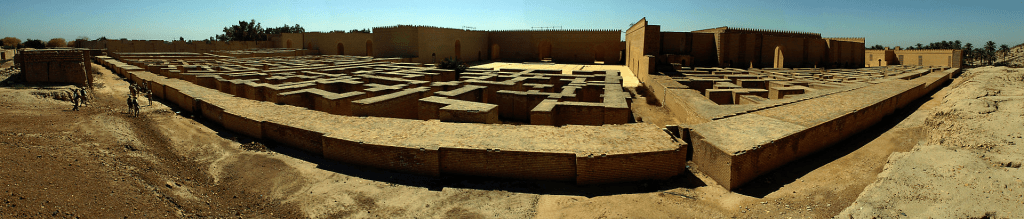
Ancient ruins of Babylon in present day Iraq

City of Babylon,
You are delicate
    and untouched,
    but that will change.
Surrender your royal power
    and sit in the dirt.
Start grinding grain!
    Take off your veil.
Strip off your fancy clothes
    and wade across rivers.
You will suffer the shame
    of going naked,
because I will take revenge,
    and no one can escape.
I am the Lord All-Powerful,
the holy God of Israel.
    I am their Savior.

Babylon, be silent!
    Sit in the dark.
No longer will nations
    accept you as their queen.
I was angry with my people.
So I let you take their land
    and bring disgrace on them.
You showed them no mercy,
but were especially cruel
    to those who were old.
You thought that you
    would be queen forever.
You didn’t care what you did;
it never entered your mind
    that you might get caught.

You think that you alone
    are all-powerful,
that you won’t be a widow
    or lose your children.
All you care about is pleasure,
    but listen to what I say.
Your magic powers and charms
    will suddenly fail,
then you will be a widow
    and lose your children. (Contemporary English Version)

The God of the Bible is not merely a local deity that the ancient Hebrews worshiped way back in history. From the biblical standpoint, God is the Lord of the universe, and the Creator of heaven and earth. Therefore, every nation on earth is accountable to the Divine Sovereign of all, the right and just Judge of the world.

Divine judgment extended to ancient Babylon. Just because they may not have worshiped and served the God of the Israelites, doesn’t mean they were off the hook for their violence and injustice.

For every nation and each person on this earth will have to give an account of their life and existence before God.

The prophet Isaiah likened Babylon to a princess who becomes a slave girl. It’s as if God is taunting her, putting her in her place; showing her who is really in charge.

Babylon had trusted in her own cleverly devised ways of manipulating reality to get what she wanted in this world. But she became helpless, stripped of her power and authority by the One who holds ultimate authority; and holds everyone accountable.

The mocking, taunting, and sarcastic nature of the Lord toward Babylon in Isaiah’s prophecy may seem out of sync with how we understand God. Yet, I invite you to remember how some great injustice of the past was done to you, or someone you care about, from someone with power and authority over you.

Allow me the liberty of reframing and retranslating today’s Old Testament lesson from the vantage of one person’s unjust victimization from another’s position of power and authority, with God exacting divine attention to such an injustice:

“Get off your high horse and sit in the dirt,
    Miss High and Mighty Babylon.
No more doing whatever the hell you want—No! Sit on the ground,
    daughter of Pride and Arrogance.
Nobody will be calling you anymore in order to get things done;
    you won’t be batting your big eyelashes and getting your way with me! So, get used to it.
Get a real job, a job where you have to do what you’ve made others do:
    Dig ditches, scrub toilets, stand at the factory line for hours on end.
You might as well get rid of your fancy clothes,
    and put on some real working gear—because the gig is up, sister.
Your true vulnerability will be on public display,
    and you will feel the criticism and manipulation that you did to others.
Now you have to contend with me. I’m intervening. And I’m taking vengeance.
    No one gets away with treating people like dirt. And if dirt is what you like, dirt is what I’m going to give you.”

Our Redeemer speaks,
    whose name is Yahweh of Armies, The Sacred One:
“Shut up and sit down in the dirt,
    Miss High and Mighty.
Because no one is ever again going to call you
    ‘Boss Lady in charge,’ or ‘Queen of the Empire.’
Believe me, I was angry with my own people,
    and was disgusted with my own children.
Which is why I let them be under your authority;
    but you didn’t show any compassion to them whatsoever.
You treated long-standing reliable people like cogs in a machine,
    and expected them to work at hard labor like they’re young men.
You arrogantly said, ‘I’m Miss High and Mighty!
    I’m here forever, and you will always serve me.’
You took no one seriously, took nothing to heart,
    never thought a wit about the consequences of your actions.
Well, Miss High and Mighty, you better start thinking!
    You’re acting as if you are the center of the universe,
saying to yourself, ‘I’m in charge. There’s nobody but me.
    I will always be in charge, I’ll never lose my authority.’
But two things are going to hit you between the eyes,
    suddenly, on the same day:
Your high position, and your company suck-ups, will be gone, a total loss,
    and your manipulative and gaslighting ways won’t help you, at all.”

Let it be known that the God of Holy Scripture hates injustice, and wants all people everywhere to extend basic human kindness and goodness to one another without prejudice or favoritism.

Individuals and even nations who selfishly grab power and control for themselves, shall have to contend with the ultimate authority in the universe. And that, my friend, is a very good thing for the righteous; and very bad thing for the selfish and arrogant.

Injustice, unfairness, and selfishness will not exist forever. Therefore, it is best for everyone to put their efforts into what lasts, what is permanent and enduring. In the end, peace and righteousness will have an unending rule and reign. Loving relationships will last. God’s justice shall endure.

So, be encouraged, in your own difficult experience and hardship. If you are the victim of another’s positional power used against you, know that the Lord sees, cares, and will do something about it.

Almighty God, who created us in your image: Grant us grace fearlessly to contend against evil and to make no peace with oppression; and, that we may reverently use our freedom, help us to employ it in the maintenance of justice in our communities and among the nations, to the glory of your holy Name; through Jesus Christ our Lord, who lives and reigns with you and the Holy Spirit, one God, now and forever. Amen.

Mercy and Judgment (Revelation 8:1-5)

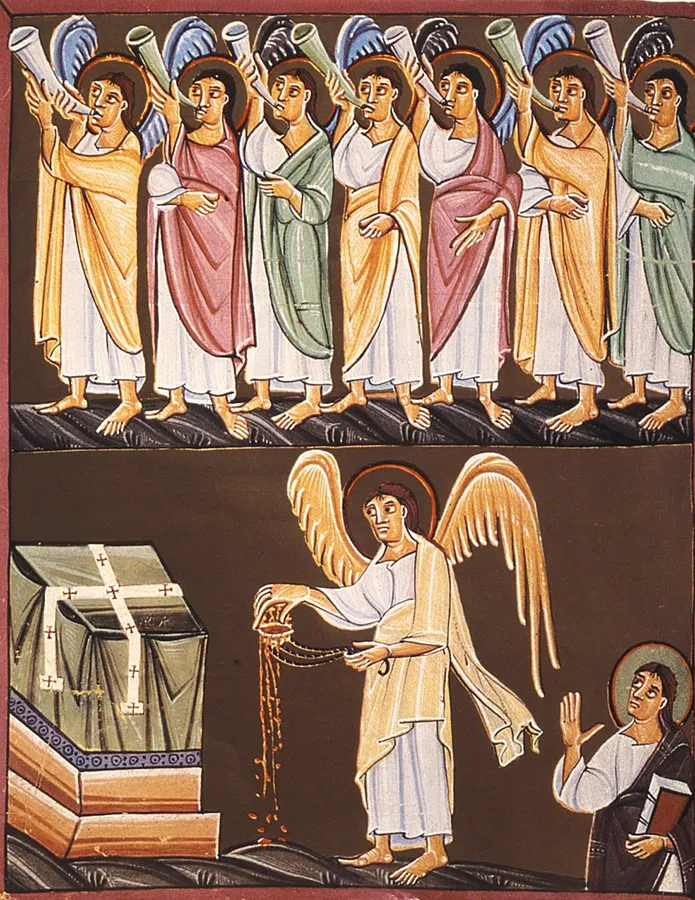
Seven angels with seven trumpets, and the angel with a censer, from the Bamberg Apocalypse, c.1020 C.E.

Then, when the Lamb opened the seventh seal, there was silence in heaven for about half an hour.

Then I saw the seven angels who stand before God, and seven trumpets were given to them. Another angel came and stood at the altar, and he held a gold bowl for burning incense. He was given a large amount of incense, in order to offer it on behalf of the prayers of all the saints on the gold altar in front of the throne. 

The smoke of the incense offered for the prayers of the saints rose up before God from the angel’s hand. Then the angel took the incense container and filled it with fire from the altar. He threw it down to the earth, and there were thunder, voices, lightning, and an earthquake. (Common English Bible)

When I was kid, growing up on a Midwest American farm, I remember times when severe weather was coming. I knew it was going to be bad whenever everything became still and there was complete silence: No wind, no birds singing, no insects chirping, nothing moving whatsoever. It was the eerie silence which precedes something big coming.

That is the way it will be in heaven when the seventh seal is opened. The silence is so quiet that you know a lot of noise and movement are about to happen. It’s not serene silence; it’s scary silent.

With the opening of the seventh seal, a climactic moment is reached. The silence is not only an anticipation of the coming drama, but is also a sign of reverence and awe.

The seventh seal initiates a series of woes: The seven trumpets. But before the trumpets begin, an angel appears. Standing before a heavenly altar, the angel mixes incense along with prayers from the people, then offers them on the altar.

These prayers of the people are for justice, and a longing for the kingdom to come, and God’s will to be done, on earth, as it is always done in heaven.

The imagery relates to us that God hears the prayers, and will act, according to the divine character and will.

The angel takes fire from the altar and hurls it down to earth, causing thunder and lightning, and an earthquake. In other words, the prayers are being answered; they are having an effect. Judgment on the earth begins with the blowing of the seven trumpets.

As we may expect, the incredible silence gives way to an equally incredible noise of weather and the earth moving. And the angel, serving as a quiet and contemplative high priest, now moves to becoming a judge upon the earth.

It turns out that mercy and judgment are not two contrasting concepts and actions; they are two sides of the very same coin. The altar of mercy becomes the source of judgment.

Whenever there is an injustice, we want (and expect) to have that act acknowledged and taken care of by a proper authority. To have a judge simply say that he/she is merciful and will acquit the guilty, does not work in every situation. Mercy only exists because of the presence of guilt and judgment.

God takes care of sin because God loves. An unloving deity would be unconcerned, random, and capricious in handling injustice. But not the God of the Bible. God shows mercy to the righteous, and will judge the wicked.

God’s mercy extends to the point of acquitting the guilty, if God so desires to do so. And everyone needs mercy, because we all have committed injustices in our lives.

Yet, by means of humble contrition and faith, we can mercifully discover gracious amnesty. This is why Jesus came, to take care of the sin issue once for all through the Cross.

We have been made holy by God’s will through the offering of Jesus Christ’s body once for all. (Hebrews 10:10, CEB)

In the time of the Apostle John’s vision, which is the Book of Revelation, Christians were facing persecution and martyrdom. The prayers of the suffering believers rose to heaven:

They cried out with a loud voice, “Holy and true Master, how long will you wait before you pass judgment? How long before you require justice for our blood, which was shed by those who live on earth?” (Revelation 6:10, CEB)

God’s response to the prayers of the saints is to send judgmental fire against the earth by the hand of the angel. In John’s apocalyptic vision, not only are the believers in Christ facing trials and tribulations for their faith, but the unbelieving persecutors who victimize the saints will be punished, as well.

If the persecutors use fiery elements against the believers, God can (and will) turn that fire back on the them. This is similar to the Book of Exodus, in which the plagues that struck and judged the Egyptians were, at the same time, a means of protecting and preserving the Israelites.

The Book of Revelation included in the Christian canon of scripture, not for the purpose of predicting the time or the season in which Jesus Christ will come back to judge the living and the dead. Rather, John’s Apocalypse is meant to encourage the followers of Christ that their suffering will not last forever; and neither will the arrogance of the wicked.

We don’t know when all of this end-of-the-age stuff is going to shake out. Which is why it is so important we learn to persevere through suffering. Because we might have to wait awhile.

Prayer for us then becomes not simply something we do if we have a bit of discretionary time; it becomes vital for us. We discern that we must speak with God. We are compelled to offer our prayers. We feel the great need to cry out and petition God for justice and righteousness.

It seems, if I don’t pray, I won’t make it. Therefore, I must pray. I will pray with all of my heart and soul, till I cannot pray anymore. And then I will pray some more, because I need God.

There is nothing easy about moving through suffering. It’s hard to persevere. It hurts to be the brunt of another’s violent tongue and/or hand. Yet, we do not experience this alone. The divine presence is with us. And that makes all the difference.

Oh God:
Give me strength to live another day;
Let me not turn coward before its difficulties, or fail in its duties;
Let me not lose faith in other people;
Keep me sweet and sound of heart, in spite of ingratitude, treachery, or meanness;
Preserve me from minding little stings, or giving them;
Help me to keep my heart clean, and to live so honestly and fearlessly that no outward failure can dishearten me, or take away the joy of conscious integrity;
Open wide the eyes of my soul that I may see good in all things;
Grant me this day some new vision of your truth;
Inspire me with the spirit of joy and gladness and make me the cup of strength to suffering souls; in the name of the strong Deliverer, our only Lord and Savior, Jesus Christ. Amen.

Fight, Flight, Freeze, or Faith (Psalm 11)

I have taken refuge in the Lord.
    So how can you say to me,
    “Flee to the hills like a bird
        because the wicked
        have already bent their bows;
        they’ve already strung their arrows;
        they are ready to secretly shoot
        those whose heart is right”?
When the very bottom of things falls out,
    what can a righteous person possibly accomplish?

But the Lord is in his holy temple.
    The Lord! His throne is in heaven.
His eyes see—
    his vision examines all of humanity.
The Lord examines
    both the righteous and the wicked;
    his very being hates anyone who loves violence.
God will rain fiery coals and sulfur on the wicked;
    their cups will be filled
    with nothing but a scorching hot wind
    because the Lord is righteous!
    He loves righteous deeds.
    Those whose heart is right will see God’s face. (Common English Bible)

We all know what it feels like to take the brunt of someone’s poison verbal darts. It’s scary and stressful. What do you do? In a state of fear, shock, or panic, we will likely either fight, flight, freeze, or faith.

Fight

If you have ever received a nasty email based on half-truths and accusations; stood dumbfounded as someone hurled misinformation and criticism at you; and/or experienced the victimization that comes from slanderous and gossiping tongues, then the psalmist knows exactly how you feel. 

Cobbling together a hasty email response, full of anger and vitriol, only sucks us into the person’s evil ways. Metaphorically punching someone in the face for their slap to your face is how the demonic realm handles offenses. Fighting back with an equal or greater force is diametrically opposed to the way of Jesus in loving our enemies and praying for those who persecute us.

Flight

Then, there is the response of taking flight from the nastiness. Indeed, it sometimes seems as if good people are always getting swallowed whole by unjust words and behaviors directed squarely at them. 

And it doesn’t help when the downers among us stroll along and give us their unhelpful fatalism about how there is nothing we can do and how nothing will ever change.

Freeze

Some folks are just plain dumbfounded that another person can be so mean or controlling, so they freeze, unable to speak or do anything. They end up suffering in silence, without their victimization having a voice.

Faith

To be the target of evil speech or malevolent actions is, at the least, unsettling, and, at worst, can bring years of struggle, depression, and inability to serve. Yet, there is someone who sees it all, and that someone will address the wrong. 

We have an option beyond fighting back in anger, fleeing altogether in fear, or freezing in our tracks. We can trust God. We can have faith.

God Sees

The Lord sits aloft, overseeing all, and knows everything humanity does and says. God always does right and wants justice done. Everyone who shares a divine sense of what is right and just will see God’s face. God will act because the Lord abhors and despises those who are cruel and enjoy violence.

It’s not a good idea to get on God’s bad side. The way to flare God’s anger is by possessing an acerbic tongue; relishing in verbal violence; and, having no remorse about any of it. Because God loves people, God hates evil. 

The righteous can take solace in the truth that God really does see the harm done and is in a position to do something about it. Like the psalmist, we seek the Lord. The Lord fights our battles.

Not Okay

Whenever we are harassed and the ungodly give us a hard time, the psalmist isn’t offering some nice religious platitudes such as, “Just let go and let God,” “Everything works for the good of those who love God,” or “It’s okay, you’ll be in heaven someday.”

In another context, maybe those statements are helpful. But being in the teeth of the wicked, all is not okay. As much as some folks try to sanitize an evil situation with rainbows and butterflies, the evil is real, and it’s there.

The truth is that everything is not okay. And it’s okay to not feel okay. The earth is filled with violence, malevolence, oppression, injustice, and systemic evil. The psalmist knows this, all too well.

Humble yourselves under God’s power so that he may raise you up in the last day. Throw all your anxiety onto him because he cares about you.

1 Peter 5:6-7, CEB

God Acts

Today’s psalm is reminding and reassuring us that the Lord is aware of what’s going on and will most certainly do something about it. God will act to punish the wicked and deliver the Lord’s people.

There may not be peace this present moment, yet it will not always be this way. We shall behold the face of the Lord.

The Lord is a righteous judge. Justice is the foundation of God’s throne. God sees the entire spectrum of humanity and can make a right assessment of people’s thoughts, intents, words, and actions.

We, however, cannot. Therefore, it is most necessary for us to put our trust in a Divine Being who cares about right and wrong and has the power to act with justice.

Whenever we are hemmed-in through the schemes of diabolical persons and are powerless, there is always the choice to trust in the Lord. The outcome of every life on earth rests in the hands of God. And it will be a just and right rendering.

Trust in the Lord and do good. Seek peace and pursue it. We might struggle mightily on both the inside and outside – our hard circumstance might not change immediately – yet God is the One who will vindicate the just person when the time is right.

You are not alone. The Lord is with you always.

God of justice, look at the state of your servant and act on my behalf. Do not let evil prevail. Thwart the ungodly so that they can no longer do any harm. Amen.

Absalom’s Conspiracy (2 Samuel 15:1-13)

Absalom propitiating friends, painted 1595, in the National Museum, Warsaw, Poland

In the course of time, Absalom provided himself with a chariot and horses and with fifty men to run ahead of him. He would get up early and stand by the side of the road leading to the city gate. Whenever anyone came with a complaint to be placed before the king for a decision, Absalom would call out to him, “What town are you from?” He would answer, “Your servant is from one of the tribes of Israel.” Then Absalom would say to him, “Look, your claims are valid and proper, but there is no representative of the king to hear you.” And Absalom would add, “If only I were appointed judge in the land! Then everyone who has a complaint or case could come to me and I would see that they receive justice.”

Also, whenever anyone approached him to bow down before him, Absalom would reach out his hand, take hold of him and kiss him. Absalom behaved in this way toward all the Israelites who came to the king asking for justice, and so he stole the hearts of the people of Israel.

At the end of four years, Absalom said to the king, “Let me go to Hebron and fulfill a vow I made to the Lord. While your servant was living at Geshur in Aram, I made this vow: ‘If the Lord takes me back to Jerusalem, I will worship the Lord in Hebron.’”

The king said to him, “Go in peace.” So he went to Hebron.

Then Absalom sent secret messengers throughout the tribes of Israel to say, “As soon as you hear the sound of the trumpets, then say, ‘Absalom is king in Hebron.’” Two hundred men from Jerusalem had accompanied Absalom. They had been invited as guests and went quite innocently, knowing nothing about the matter. While Absalom was offering sacrifices, he also sent for Ahithophel the Gilonite, David’s counselor, to come from Giloh, his hometown. And so the conspiracy gained strength, and Absalom’s following kept on increasing.

A messenger came and told David, “The hearts of the people of Israel are with Absalom.” (New International Version)

Although Absalom, a son of David, began to despise his father, he learned some things from him, namely, the ability to wait and plan. He spent two years preparing to kill his half-brother Amnon, and four years getting ready to kill his father and take his throne.

I’m sure Absalom did not feel like a murderer. He likely looked at the situations and felt justified in doing away with Amnon, then going after David. To be sure, Amnon had committed a heinous crime – one in which Tamar, Absalom’s sister, was left bereft, only to be cared for by her brother. Absalom seems to have believed he was merely dispensing justice, not murder.

David, typically astute and proactive, was anything but that when it came to his family; he did not initiate very much of anything. The king’s inaction was so profound that Absalom began plotting a takeover. As in the case of Amnon, it’s likely that Absalom saw forming a conspiracy as bringing some needed justice.

After all, it appears that King David had become lax in his royal responsibilities. Seemingly, David was no longer himself – deciding cases in favor of the weak, needy, and vulnerable. Absalom was more than happy to fill the void.

Absalom evidenced an oversized ego in believing that if he were the judge in the land, everything would be okay. Whenever a person who feels the smack of injustice begins interacting with others who have not been receiving justice, rarely does that person rely upon the Divine Judge for righteousness. Absalom took matters into his own hands.

Whenever we hear the cry “It’s not fair!” there is often, not far behind, an angry person seeking to become judge, jury, and executioner.

So, Absalom worked the crowd. He spent years refining his image, and presenting the sort of reputation he sought from the people. Absalom was handsome and charming. The country became putty in his hands.

What nobody knew was that Absalom had an axe to grind, that underneath the silver tongue and the careful marketing opportunities was a person who was downright hurt, and mad enough to destroy and kill.

Finally, he began implementing his plot for taking over the kingdom. And he would need all the appearances of royal approval from some people in high positions. A religious banquet with a few hundred people, including David’s trusted counselor, would do the trick. The plan was to gain enough endorsements to gain momentum for others to join the conspiracy.

And it worked. The hearts of the people were with Absalom. They loved the guy.

Yet, the thing about it is, it wasn’t so much that Absalom loved the people, near as much as he hated his father, King David.

For the truly right, just, and good people of the land, they could observe the distinction. They knew better. The good people of the kingdom could discern that Absalom may look good, but something didn’t smell right about him.

No matter how flawed David was, or how much he had slipped in his duties, he was still nevertheless the king, the anointed one whom God had chosen. And the wise people could keep their wits about them, and begin to see what was really going on.

Anyone who comes along and tells us that they can make everything better, and do it quickly, is probably a hack preacher who, like Absalom, has a grievance against someone.

We can do better than leaders like that. And we can do better than to incessantly criticize existing leadership – no matter where it’s found – until we have done our due diligence in spending years in prayer for our leaders, and done what we could do to help them be successful in their positions.

Nurturing bitterness and hate is a one way trip to the grave. The evidence is seen in the constant vitriol we hear on a daily basis. But cultivating wisdom and discernment, along with a healthy spiritual and religious life, brings sanity and compassion where it needs to be.

Which way do you want to go?

Blessed heavenly Father: Forgive me for the things in my life which continue to keep me from the path you have chosen for me. Remove the sins from my life that block me from becoming the person you want me to be. Fill my life with your Holy Spirit that I may be a light unto others, so that they may come to know you. Amen.